



HCPCS code E0198: Water pressure pad billing guide
HCPCS code E0198 is a water pad for a standard mattress HCPCS code E0198 is the ...

Last Updated: Oct 13, 2026

CPT Code 43659 is the unlisted laparoscopic procedure code for the stomach, used when no specific CPT code covers the performed gastric procedure.
Revisional bariatric surgery is the primary clinical driver of 43659 claims, accounting for a growing share of submissions as novel techniques outpace dedicated code availability.
Medicare determines reimbursement for CPT 43659 case-by-case. Most payers require an operative report, a cover letter comparing the procedure to the most similar listed code, and prior authorization.
Pabau’s claims management software helps surgical practices track prior authorization status and attach operative documentation directly to 43659 claims without switching systems.
CPT Code 43659 is the unlisted laparoscopic procedure code for the stomach. Coders use it when a laparoscopic gastric procedure has no dedicated code within the 43644-43659 range, most often for revisional bariatric surgery and novel gastric techniques.
It carries no pre-assigned RVU. Medicare and commercial payers set payment case by case after reviewing the operative report and a cover-letter crosswalk to the most similar listed code.
The official American Medical Association descriptor for CPT Code 43659 is “Unlisted laparoscopic procedure, stomach.” It sits at the end of the Laparoscopic Procedures on the Stomach range (43644 through 43659), serving as a catch-all for any laparoscopic gastric procedure that does not have a dedicated code within that range.
The code is informational rather than descriptive: it tells the payer that a laparoscopic stomach procedure occurred, but says nothing about what that procedure was. This is exactly why documentation carries more weight here than with any listed code.
The unlisted laparoscopic procedure code for the stomach exists because bariatric and upper GI surgery keeps evolving faster than the CPT code set. A peer-reviewed study published in Surgery for Obesity and Related Diseases, known as SOARD, examined 43659 use in a bariatric cohort.
The study found that revisional bariatric procedures account for a substantial and growing share of submissions. Dedicated codes simply do not exist for many revision scenarios.
Practices serving bariatric and weight loss patients should confirm their coding team knows the listed-code alternatives before defaulting to 43659. A well-run weight loss clinic software workflow surfaces the right code candidates automatically, but the final call always rests with the coder.
Common clinical scenarios driving CPT 43659 use:
The critical test before submitting 43659: can the procedure be accurately described by any listed code in the 43644-43659 range? If yes, use the listed code. Using 43659 when a specific code applies is a coding error, not a gray area.
The AMA’s instruction for all unlisted codes is explicit: report a listed code when one accurately describes the service. For laparoscopic gastric procedures, the decision tree below covers the codes coders most frequently evaluate before reaching 43659.
Note the distinction between 43659 and 49329: 43659 is specifically for laparoscopic procedures on the stomach. 49329 covers unlisted laparoscopic procedures on the broader abdomen. Choosing the wrong unlisted code is a common denial trigger.
Modifier selection for 43659 follows the same logic as any other surgical procedure code, with one additional consideration: because the procedure is already unlisted and requires manual review, attaching an incorrect modifier compounds the payer’s uncertainty and typically results in a denial.
Modifiers that alter a procedure’s defined scope, such as 22 (increased procedural services), 52 (reduced services), and 53 (discontinued procedure), do not apply to unlisted codes like 43659. There is no fixed descriptor to increase, reduce, or discontinue, since the code itself does not describe a specific procedure.
Any change in work intensity belongs in the cover-letter crosswalk and operative documentation, not in a modifier.
Modifier applicability rules vary by payer. Never treat the table above as a universal approval. Confirm modifier requirements in the payer’s specific policy before submitting. An unplanned reoperation for a complication such as septic arterial embolism.
A functional medicine platform keeps GI codes, food diaries, and supplement protocols in one patient record.
Medicare does not assign a pre-set payment rate to CPT 43659. Because the code is unlisted, the CMS Physician Fee Schedule determines payment by comparing the submitted claim to the most similar listed procedure. The MAC (Medicare Administrative Contractor) for the provider’s jurisdiction reviews the documentation and sets a payment amount accordingly.
This case-by-case review has practical consequences. Payment timelines are longer than standard codes. Denial rates are higher. And appeals are more documentation-intensive. Practices that submit 43659 claims regularly need claims management software capable of tracking each claim individually through the manual review process. Payment posting from a remittance file is faster than manual entry and keeps the adjustment reasons attached.
The anesthesia component of a 43659 procedure is billed and paid separately from the surgical code.
Always identify the most similar listed CPT code before submitting a 43659 claim. State this comparison code explicitly in your cover letter. MACs use your stated crosswalk as the starting point for payment determination — a vague or missing crosswalk almost guarantees a delay or reduced payment.
Pairing the correct ICD-10-CM diagnosis code with CPT 43659 is part of the medical necessity argument. For bariatric claims, the diagnosis codes most commonly submitted with 43659 fall within the E66 (obesity) chapter, supported by comorbidity codes where applicable.
Many practices standardize BMI and comorbidity capture with a dedicated bariatric intake form completed before the surgical consult, so the diagnosis codes are ready when the claim is built.
Code selection must reflect the patient’s documented diagnosis. E66.01 is appropriate only when the medical record supports morbid obesity due to excess calories. Never assign a diagnosis code to strengthen a claim if the documentation does not support it. Doing so is a compliance violation under HIPAA and CMS guidelines.
Documentation is the most frequent failure point for 43659 claims. Payers cannot evaluate medical necessity from the code descriptor alone. The absence of a complete documentation package is the leading cause of initial denial for unlisted procedure codes. Most claim errors on unlisted codes are structural rather than clinical, so scrubbing rules catch them before submission.
Complications requiring extra supplies, such as a collagen wound filler for a complicated closure.
Most payers, including Medicare under CMS A56422 guidance, require all of the following when a 43659 claim is submitted. Using digital clinical documentation tools that centralize operative notes, consent forms, and prior auth records reduces the manual effort of assembling this package for each claim.
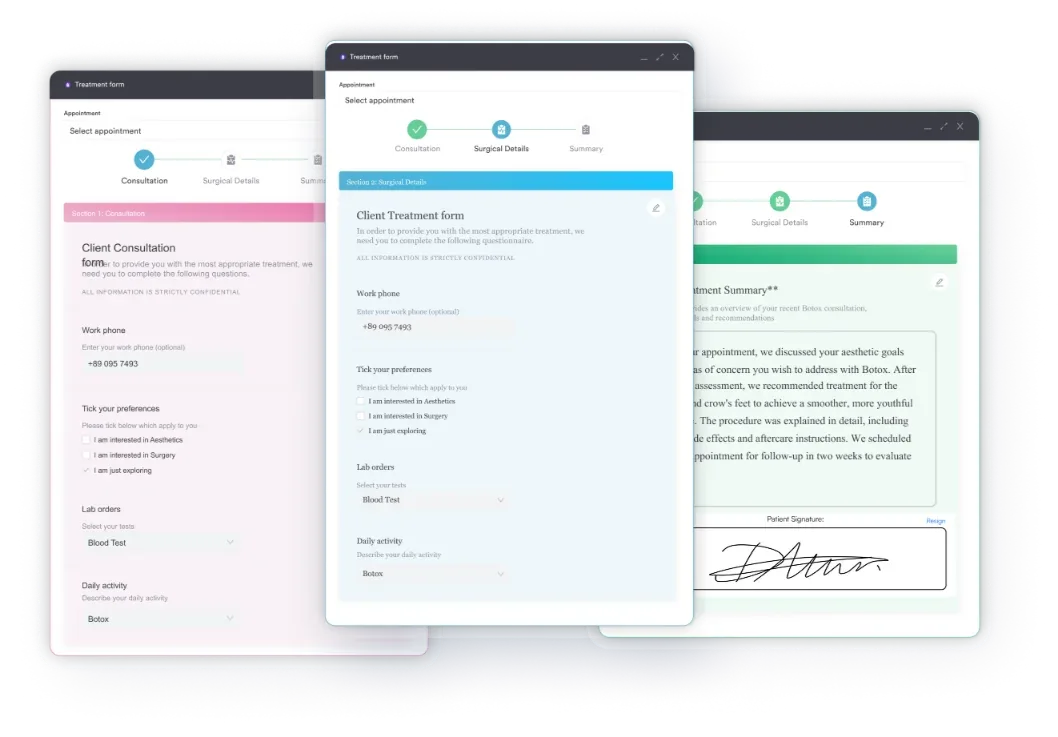
Build a 43659 documentation template that your surgical team completes before the claim is submitted, not after a denial. Include a checklist: operative report, crosswalk letter, medical necessity attestation, and prior auth reference. Claims that arrive complete get processed faster and denied less.
Billing 43659 correctly is a multi-step process. Each step is a potential denial point. The workflow below reflects standard industry practice consistent with CMS Medicare Claims Processing Manual Chapter 12 guidance for unlisted procedure codes.
For HIPAA-compliant claim submission practices, all patient-specific documentation attached to claims must be transmitted through secure channels and handled according to your practice’s minimum-necessary policies.

Pabau’s practice management platform helps surgical practices attach operative documentation to claims, track prior authorization status, and monitor denial patterns for unlisted procedure codes like 43659.

CMS coverage article A56422 (Bariatric Surgical Management of Morbid Obesity) governs Medicare coverage for bariatric procedures, including 43659 use cases. Per CMS, Medicare covers bariatric surgery for beneficiaries with a BMI of 35 or greater and at least one obesity-related comorbidity.
Verify the current BMI threshold and comorbidity criteria against the live CMS A56422 article before submitting, since coverage policies update periodically.
Coverage under A56422 applies to specific listed bariatric codes. When 43659 is submitted, the MAC must determine whether the performed procedure falls within the covered clinical indication. Non-covered indications under A56422 include procedures performed solely for weight loss without documented comorbidities meeting the criteria.
Unlisted codes like CPT 43659 create an operational problem that goes beyond the code itself. The documentation, authorization tracking, and denial management happen across multiple systems with no unified view. Surgical practices billing 43659 regularly face the same bottleneck:
Pabau’s claims management software centralizes this workflow. Operative notes and consent records live in the same system as the claim, so assembling the documentation package takes minutes rather than hours.
Prior authorization status is tracked per claim, and denial patterns surface in reporting without manual log maintenance. Practices can also configure clinical record management templates to capture the specific data fields required for unlisted code justification letters at the point of care, before the billing team ever sees the file.
CPT Code 43659 will continue to be used as revisional bariatric surgery and emerging laparoscopic techniques outpace dedicated code availability. The code itself is straightforward. The billing process is not. Every 43659 claim requires a complete documentation package, a clearly stated crosswalk to the most similar listed code, and active claim tracking through manual payer review.
Pabau’s claims management tools are built for exactly this kind of complex billing workflow. If your practice handles unlisted procedure codes regularly, book a demo to see how Pabau centralizes documentation and prior auth tracking in one place.

Billing an orthopedic tendon repair instead? CCSD code T6810 guide covers billing the secondary repair of an Achilles tendon for foot and ankle specialists.
Billing a reconstructive surgery procedure? CCSD code T7602 guide covers billing microvascular free tissue transfer correctly as an add-on rather than a standalone code.
Billing a shoulder procedure instead? CCSD code T7915 guide covers billing arthroscopic rotator cuff repairs larger than 2cm under the MAJOR+ complexity rules.
CPT Code 43659 is an unlisted laparoscopic procedure code for the stomach, used when a performed laparoscopic gastric procedure has no specific CPT code within the 43644-43659 range. Because it is unlisted, it carries no pre-assigned RVU and requires full documentation including an operative report and a crosswalk to the most similar listed code.
It means a laparoscopic procedure was performed on the stomach for which no dedicated CPT code exists. The code does not describe the procedure. It signals to the payer that manual review is required. Common examples include revisional bariatric procedures, novel gastric techniques, and combination cases where the gastric component lacks a standalone code.
Yes, prior authorization is required by Medicare and most commercial payers for unlisted procedure codes including 43659. The authorization process typically involves submitting the planned procedure description, the comparable listed code, and documentation of medical necessity before the procedure date. Submitting without prior auth is the most common cause of initial denial.
Payers typically require five documents: a complete operative report, a cover letter naming the most similar listed CPT code and explaining the crosswalk, a medical necessity letter with diagnosis codes and clinical rationale, prior authorization documentation, and supporting diagnostic reports. Submitting the claim without this package attached is the primary reason 43659 claims are denied on first submission.
E66.01 (morbid obesity due to excess calories) is the most common primary diagnosis paired with 43659 for bariatric claims. Z98.84 (bariatric surgery status) supports revisional procedure claims. Comorbidity codes such as E11.9 (type 2 diabetes), I10 (hypertension), and G47.33 (obstructive sleep apnea) are added where documented and relevant to medical necessity.
CPT 43659 typically carries a 90-day global surgery period, consistent with major laparoscopic surgery. Verify the current global days assignment against the CMS Physician Fee Schedule for the active fiscal year, as global period designations can be updated annually. Services furnished during the 90-day window must be billed with modifier 78 or 79 where appropriate.



