CCSD code F5010: Parotid duct transposition billing guide
CCSD code F5010 covers parotid duct transposition, one side or both CCSD code F5...

Last Updated: Oct 9, 2026

CPT Code 43644 describes a laparoscopic gastric restrictive procedure with gastric bypass and Roux-en-Y gastroenterostomy, with a roux limb of 150 cm or less.
Documentation must confirm both gastric pouch creation and Roux-en-Y reconstruction; missing either element is a leading cause of claim denial.
ICD-10-CM codes E66.01 (morbid obesity) and Z68.41-Z68.45 (BMI 40 or above) are the primary medical necessity anchors, per CMS Article A56422.
Pabau’s claims management software and digital forms help bariatric practices streamline pre-authorization tracking, operative note capture, and denial follow-up.
CPT code 43644 is the billing code for a laparoscopic gastric restrictive procedure with gastric bypass and Roux-en-Y gastroenterostomy, performed with a roux limb of 150 cm or less. It reports minimally invasive Roux-en-Y gastric bypass for the surgical treatment of morbid obesity.
This guide covers the official code descriptor, the 43644 vs 43645 distinction, required documentation, ICD-10 medical necessity codes, modifier rules, Medicare reimbursement, and bundling considerations.
The American Medical Association (AMA) defines CPT Code 43644 as:
Laparoscopy, surgical, gastric restrictive procedure; with gastric bypass and Roux-en-Y gastroenterostomy (roux limb 150 cm or less).
That roux limb length threshold is the defining clinical and billing distinction. The procedure creates a small gastric pouch (typically 15-30 mL), then connects it to a loop of small intestine (the Roux limb) no longer than 150 cm. The result is both restrictive and malabsorptive weight loss. CPT 43644 captures the laparoscopic approach to this anatomy; the open equivalent is CPT 43846.
Bariatric programs at weight loss practices that perform this procedure regularly should have a dedicated coding protocol for 43644. The two-component nature of the operation (pouch creation plus gastrojejunostomy) means documentation failures are common, and payers verify both components before processing payment.
The difference between these two codes is the type of reconstruction: 43644 covers the standard roux limb of 150 cm or less, while 43645 adds small intestine reconstruction to limit absorption (the malabsorptive, long-limb variant).
Coding the wrong code between 43644 and 43645 is one of the most common bariatric billing errors. The operative note must document the measured roux limb length. If the note states “approximately 150 cm” without a specific measurement, payers may default to the lower-complexity code or deny on specificity grounds.
Payers require operative notes that confirm every component of the procedure. A note that describes gastric pouch formation but does not confirm the Roux-en-Y reconstruction will fail payer review. Both elements must be explicit.
Payer review of 43644 claims requires documentation that verifies both gastric pouch creation and Roux-en-Y reconstruction. The following checklist reflects standard CMS operative note requirements.
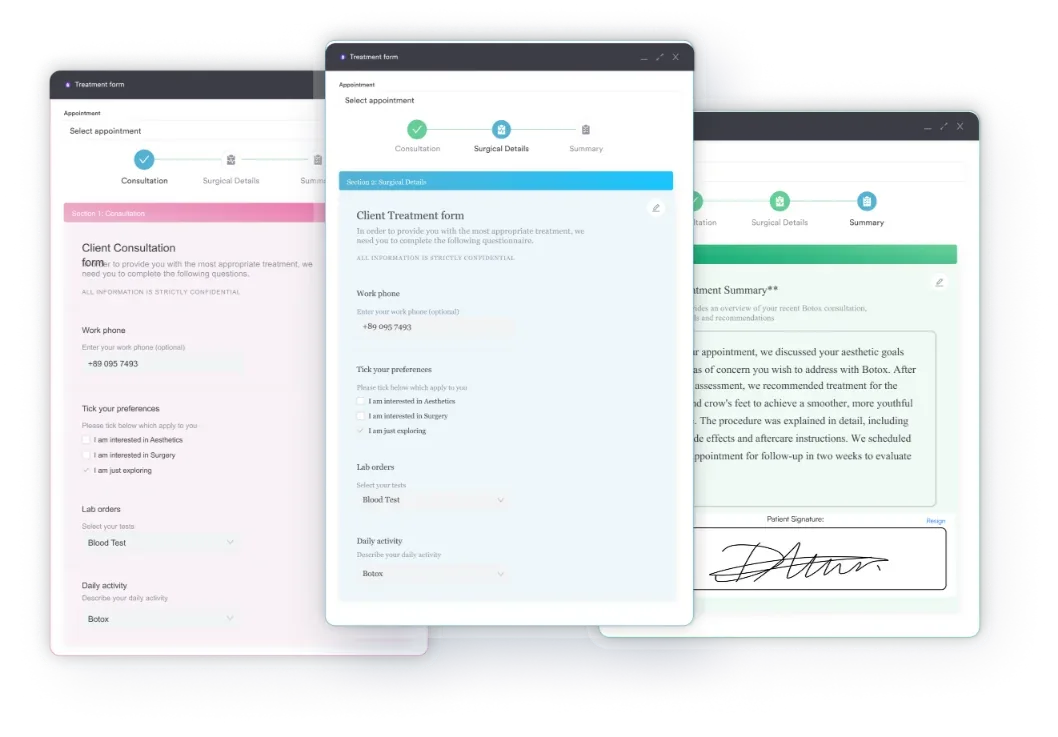
Practices using digital intake forms for pre-operative consent and history capture can pre-populate key fields (BMI, comorbidities, prior bariatric procedures) that support the operative note and medical necessity documentation. Keeping that data structured from the first patient contact reduces rework at claim submission. Maintaining HIPAA-compliant documentation practices throughout this workflow is equally critical for bariatric programs.
Flag operative notes for secondary review before claim submission whenever the roux limb measurement is absent or approximated. Payers treating ‘approximately 150 cm’ as insufficient specificity are common among commercial plans, and a corrected note submitted post-denial costs far more time than a pre-submission review.
Per CMS Article A56422 (Billing and Coding: Bariatric Surgical Management of Morbid Obesity), the following ICD-10-CM codes support medical necessity for CPT 43644. This article is the anchor reference for Medicare and many commercial payers.
Assign E66.01 as the primary diagnosis for virtually all 43644 claims. BMI codes (Z68.41 through Z68.45) are secondary codes that quantify severity. Do not use Z68.4x as a standalone primary diagnosis. Many payers also require documentation of failed conservative weight loss attempts (typically 6 months of medically supervised diet), so include relevant history codes where applicable.
Reviewing the full LCD (Local Coverage Determination) for bariatric surgery specific to your Medicare Administrative Contractor (MAC) is essential. Medical necessity criteria vary between MACs and may differ from CMS Article A56422. Consider how your practice management software features handle ICD-10 code tracking across the care episode, from initial consultation through post-operative follow-up.
Medicare reimbursement for CPT 43644 varies by geographic location and setting. The CMS Physician Fee Schedule (MPFS) lookup tool is the authoritative source for current-year rates by locality, applying the geographic practice cost indices (GPCIs) for your area.
CPT 43644 carries substantial relative value units (RVUs) reflecting the technical complexity of laparoscopic bariatric surgery. The procedure falls under a 90-day global surgical package, meaning post-operative visits within 90 days are bundled into the payment unless a separate significant service is provided and documented with an appropriate modifier.
Kaiser Permanente includes CPT 43644 in its Roux-en-Y Laparoscopic authorization code range alongside 43846 and 43847. Verifying payer-specific authorization requirements before scheduling surgery is a non-negotiable step for bariatric programs. Tracking authorization status through structured pre-authorization workflows prevents claims from being submitted before coverage is confirmed.

Pabau helps surgical practices manage prior authorization tracking, digital operative documentation, and claims follow-up in one platform. See how it handles high-complexity procedure billing.

Modifier selection for CPT 43644 claims depends on the clinical scenario. Applying the wrong modifier, or omitting a required one, is a frequent denial trigger. Each modifier requires supporting documentation in the operative or clinical record.
Modifier 22 requires particular care. The operative note must contain a specific narrative explaining why the procedure was substantially more complex than usual. A generic statement that “the procedure was difficult” will not support the modifier. Quantify the added complexity, such as duration beyond standard benchmarks or anatomical challenges encountered.
Document Modifier 22 justification as a separate paragraph at the end of the operative note. Payers reviewing Modifier 22 claims often look specifically for this section. Including it separately from the standard procedure narrative makes the increased complexity immediately visible to the reviewer without requiring them to search through the full note.
Understanding National Correct Coding Initiative (NCCI) edits is essential before billing any secondary code alongside 43644. Several related bariatric codes have bundling restrictions that vary depending on approach (laparoscopic vs open), while the anesthesia component is reported separately by the anesthesia provider on its own base-unit scale.
CPT 43774 (laparoscopic removal of an adjustable gastric restrictive device and subcutaneous port components) is separately billable with the laparoscopic Roux-en-Y (43644) but not with the open procedure (43846) under current NCCI edits. This distinction matters for practices that remove a gastric band and perform a bypass in the same session. Verify current NCCI edits before submitting any combination claim, as edits are updated quarterly.
Revision surgery coding (such as converting a laparoscopic sleeve gastrectomy to a gastric bypass) is a complex scenario. While 43644 may be appropriate in some conversions, the specifics depend on what was performed and what the prior procedure was. Coders unfamiliar with revision bariatric surgery should consult a specialist coder before submitting. A complete procedure history across a patient’s bariatric care episode helps build the documentation trail needed for these complex revision claims.

Prior authorization requirements for CPT 43644 vary significantly by payer and plan. Medicare coverage is governed by NCD 100-3, 100.1, which sets national criteria, but commercial payers often apply their own criteria that can be stricter or more expansive.
Common prior authorization requirements across major payers include documented BMI at or above 40 (or 35 with obesity-related comorbidities), completion of a medically supervised weight loss program (typically 3-6 months, though this varies), psychiatric clearance, nutritional evaluation, and documented failure of conservative treatments.
These criteria must be reflected in the pre-operative record. Missing any element during authorization review will result in non-authorization, meaning the claim will not be covered regardless of the surgery’s clinical appropriateness.
Managing authorization workflows for high-complexity procedures requires careful tracking. Surgical teams that rely on manual tracking through spreadsheets frequently miss follow-up deadlines or submit claims before authorization is confirmed.
Understanding how documentation burden affects surgical teams is part of building more sustainable authorization workflows. Consider how going paperless in clinical practice can reduce the administrative overhead of managing multi-step authorization processes.
Most 43644 denials fall into a small number of repeating categories. Addressing these proactively reduces denial rates and shortens the revenue cycle for bariatric programs. Batch submissions group many claims into one claim file, and one malformed record can hold up the batch.
Using a structured pre-submission review aligned with automated billing workflows can catch most of these issues before the claim leaves the practice. A denial on a high-complexity bariatric claim typically takes 30-60 days to resolve and requires significant coder and physician time to appeal successfully. A clean claim rate below the practice benchmark usually points at one recurring coding or eligibility error.
CPT Code 43644 billing requires precise operative documentation, correct ICD-10 medical necessity coding, and payer-specific prior authorization management. The roux limb measurement, the two-component documentation requirement, and the 90-day global package are the three areas where most bariatric billing errors originate.
Pabau’s claims management software gives bariatric practices a structured environment for tracking authorization status, managing operative documentation, and following up on denials before they age. To see how Pabau handles surgical billing workflows, book a demo with the team.

Running a weight loss program alongside bariatric surgery? Weight loss clinic software covers how Pabau supports multi-service bariatric and metabolic health programs.
Billing a hernia repair procedure instead? CCSD code T2002 guide covers billing laparoscopic inguinal hernia repair with mesh placement.
Billing an incisional hernia repair? CCSD code T2502 guide covers billing the minimally invasive repair of a hernia that develops through a prior incision.
CPT Code 43644 is the billing code for a laparoscopic gastric restrictive procedure with gastric bypass and Roux-en-Y gastroenterostomy, performed with a roux limb of 150 cm or less. It is maintained by the American Medical Association and used to report minimally invasive Roux-en-Y gastric bypass surgery for the treatment of morbid obesity.
CPT 43644 applies to a standard Roux-en-Y gastric bypass with a roux limb of 150 cm or less. CPT 43645 applies when the procedure includes small intestine reconstruction to limit absorption (the malabsorptive, long-limb variant). The operative note’s documentation of the reconstruction and measured limb length determines which code is correct.
Per CMS Article A56422, the primary code is E66.01 (morbid obesity due to excess calories). Supplementary codes include Z68.41-Z68.45 (BMI 40 or greater) and comorbidity codes such as E11.9 (type 2 diabetes) and K21.0 (GERD with esophagitis). Verify payer-specific LCD requirements, as criteria vary by Medicare Administrative Contractor.
CPT 43774 (removal of an adjustable gastric restrictive device and subcutaneous port components) is separately billable alongside laparoscopic 43644, but not with the open equivalent 43846. This applies when a gastric band is removed and a bypass is performed in the same session. Verify current NCCI edits before submitting, as coding edit tables are updated quarterly.
Coding depends on the exact procedures performed. CPT 43644 may be appropriate for the bypass component, but the sleeve revision element requires separate consideration; CPT 43774 covers laparoscopic removal of an adjustable gastric band and its port components (not sleeve revision). Complex revisions that do not fit a specific code descriptor should use CPT 43659 (unlisted laparoscopic stomach procedure) with detailed operative documentation. A specialist bariatric coder review is strongly recommended for revision surgery claims.
Most payers require documented BMI at or above 40 (or 35 with comorbidities), completion of a medically supervised weight loss program, psychiatric and nutritional clearance, and evidence of failed conservative weight loss attempts. Requirements vary by payer, so obtain the current LCD or commercial payer policy before initiating the authorization process.