CCSD code H4430: Examination of rectum under anaesthetic
CCSD code H4430 pays for the examination alone CCSD code H4430 is the UK private...

Last Updated: Oct 20, 2026
36902 is the CPT code for dialysis circuit access with diagnostic angiography and transluminal balloon angioplasty of the peripheral dialysis segment. It covers the needle or catheter access, the full fistulogram from the arterial anastomosis through the venous outflow, and every angioplasty in that segment.
The code sits in the 36901-36909 dialysis circuit family introduced in 2017. It is reported once per session, however many peripheral lesions are treated. A stent in the same segment moves the claim to 36903, and a thrombectomy with angioplasty moves it to 36905.
Let Pabau's smart automation suggest the right codes, reduce claim denials, and keep your practice compliant—effortlessly.
Automate repetitive tasks and focus on what matters most—your patients.
Reduce coding errors and ensure compliance with the latest regulations.
Clean claims, fewer denials, and faster reimbursements.
Powerful insights and reporting to help your practice thrive.
HIPAA compliant SOC 2 certified GDPR-compliant Trusted by 4,000+ clinics worldwide

CPT 36902 covers balloon angioplasty of the peripheral dialysis segment of an AV fistula or graft, with all access and imaging bundled in.
It sits in the 36901-36909 dialysis circuit family, where 36901 is the imaging-only base code and 36902 adds angioplasty.
36902 is reported once per session, however many peripheral lesions are treated, and central-segment angioplasty takes add-on 36907.
Medicare LCD L34062 requires documented stenosis of 50% or greater and clinical access dysfunction before the claim is payable.
Pabau’s claims management software pre-fills and validates each claim before submission, then tracks it through to payment.
CPT Code 36902 is the code for dialysis circuit angiography plus transluminal balloon angioplasty of the peripheral dialysis segment. The American Medical Association maintains the CPT code set and updated this family effective January 1, 2017. The official descriptor is long, so the table below quotes it verbatim, clause by clause.
In practice, the code covers needle insertion into the dialysis access and the diagnostic imaging that guides the intervention. It also covers balloon angioplasty of each stenosis in the peripheral segment and the completion imaging that confirms the result.
The dialysis circuit runs from the arterial anastomosis of an arteriovenous fistula (AVF) or graft (AVG) through the venous outflow to the vena cava. CPT splits it into two segments. The peripheral segment runs from the anastomosis through the axillary vein, including the cephalic arch, and 36902 covers angioplasty anywhere in it.
The central segment covers the subclavian and brachiocephalic veins and the vena cava, where angioplasty is reported with add-on 36907.
The fistula itself is created in an earlier open operation, reported with 36821 when the surgeon joins artery to vein directly. CPT Code 36902 applies to that access later, once a stenosis needs angioplasty. An open repair of that stenosis, with no clot removed, is billed under CPT Code 36832 instead.
Before 2017, practices reported imaging and intervention as separate line items. The bundled family collapsed those charges, so each code up the ladder includes the work of the codes beneath it.
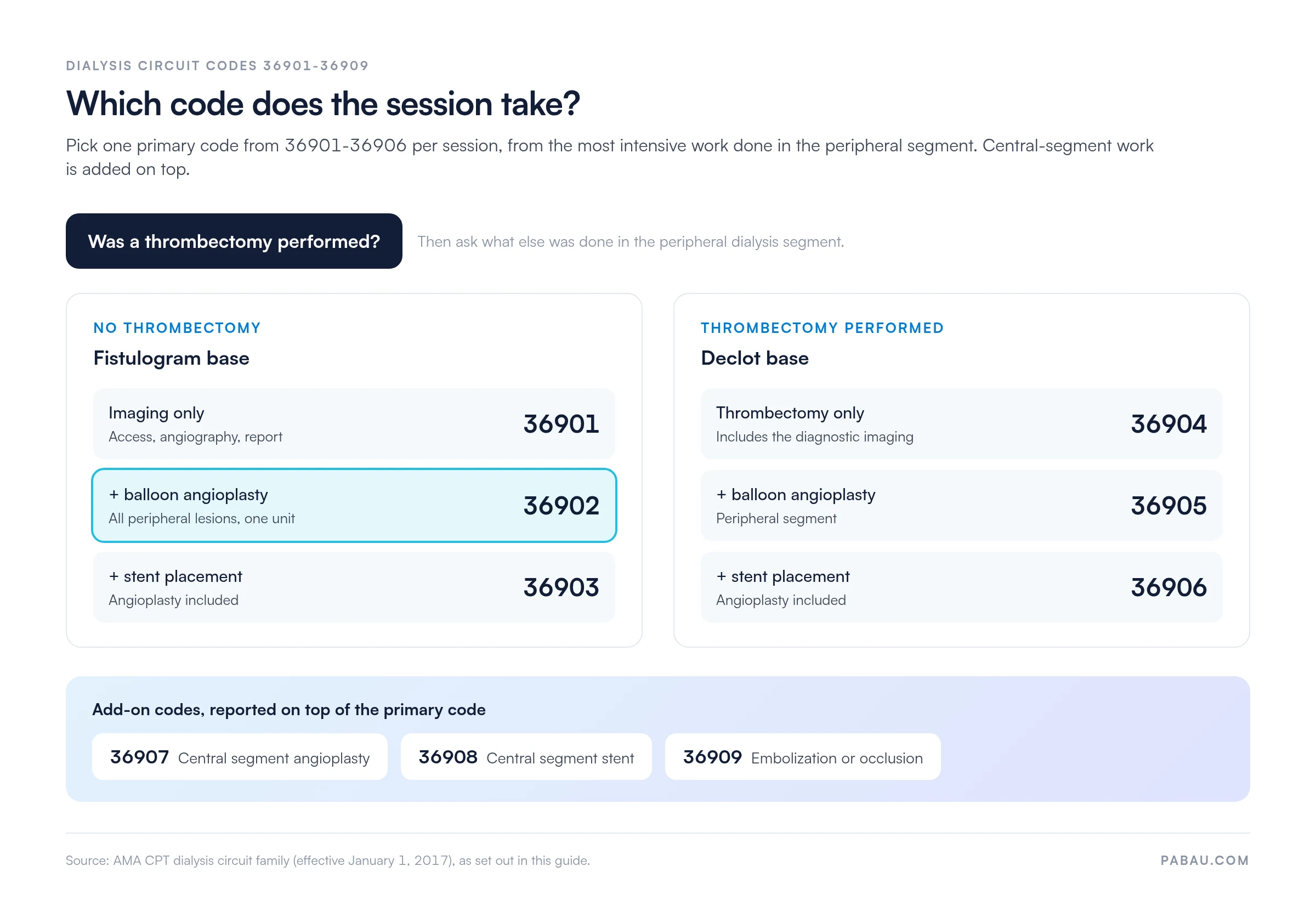
Only one code from 36901-36906 is reported per session, chosen by the most intensive work done in the peripheral segment. Add-ons 36907 (central angioplasty), 36908 (central stent) and 36909 (embolization or occlusion) sit on top of it. The chart below walks through the choice.
Knowing what is bundled into 36902 prevents the unbundling errors that NCCI edits catch. Every service in the left column below is already paid through the 36902 allowance, and billing one separately triggers an NCCI bundling denial.
The critical distinction for CPT 36902 vs. 36903: if the procedure concludes with angioplasty only (no stent deployed), 36902 is correct. If a stent is placed in the peripheral segment, 36903 is the right code, whether or not angioplasty was also performed. Billing 36902 and 36903 together in one session triggers an NCCI edit, because only one code from 36901-36906 is reportable per session.
Coders reviewing the operative report for 36902 need to confirm that it explicitly supports each component bundled into the code. Payers audit these elements most closely on dialysis access patients, who return for interventions often.
The operative report must address, in order:
An operative report that covers each of these elements is the starting point for a clean claim submission.
CMS LCD L34062 requires the stenosis to be documented as a percentage reduction in luminal diameter. Simply writing “stenosis present” does not satisfy the requirement. The operative note must state something like “50% or greater reduction in luminal diameter confirmed on fluoroscopic imaging.” Coders should flag any report that describes only qualitative findings (“significant narrowing,” “flow reduction”) without a quantified percentage.
Modifier selection for CPT Code 36902 follows specific rules that differ between Medicare and commercial payers. Using the wrong modifier, or omitting a required one, is a common denial cause for this code family.
Take a patient with a left-arm AV fistula who has a cephalic vein stenosis and a separate anastomotic stenosis. Both are treated with balloon angioplasty in the same session. Both lesions sit in the peripheral dialysis segment, so the session is reported with a single unit of 36902. Modifier 59 or XS has no role here. It applies only when a genuinely separate procedure is billed in the same session, such as add-on 36907 for central segment angioplasty.
Check each payer’s modifier policy annually. Several Medicare Advantage plans apply commercial modifier rules rather than traditional Medicare rules. Applying modifier XS when the plan only recognizes modifier 59 causes automatic denials that take weeks to appeal.
Medicare reimbursement for CPT Code 36902 is set by the Centers for Medicare and Medicaid Services (CMS) Physician Fee Schedule. It is adjusted by Geographic Practice Cost Index (GPCI) values that vary by MAC jurisdiction, so your payment depends on locality.
Use the CMS Physician Fee Schedule search tool or the FastRVU 2026 RVU lookup to confirm the current locality-adjusted rate before submitting claims. Submitting electronically through a clearinghouse runs each claim through payer edits first, and the ERA remittance confirms the exact paid amount.
The global period for CPT 36902 is 0 days, based on CMS policy for interventional vascular procedures in this family. A 0-day global means no post-operative period is bundled into the payment, so a visit on a later date of service is separately reportable. That matters for dialysis access patients, who return often for access evaluation after an intervention.
Medicare coverage for CPT Code 36902 is governed by Local Coverage Determination L34062. It defines the clinical indications a claim must document before it is payable. Meeting its billing compliance requirements takes evidence of access dysfunction plus imaging that confirms stenosis severity.
Required coverage criteria under LCD L34062 include:
MAC contractors vary in their interpretation of LCD L34062. Some require pre-procedure duplex ultrasound to establish baseline flow before the claim is approvable. Others accept post-dialysis pressure measurements as sufficient clinical documentation. Coders should get their own MAC’s billing article, the implementation document paired with the LCD, rather than relying on the national LCD text alone.
Prior authorization requirements for CPT Code 36902 vary significantly by payer type and regional plan. Traditional Medicare (Parts A and B) does not require prior authorization for 36902 as a standalone procedure. MAC contractors may still request records after payment during probe audits. Tracking payer-specific PA rules is part of revenue cycle management for any dialysis practice, so build it into the billing process from the start.
Commercial payer and Medicare Advantage considerations include:
A PA verification step at booking belongs in the medical billing workflows for dialysis access. It surfaces the requirement when the procedure is scheduled rather than after it is performed.
Denials for CPT Code 36902 cluster around four root causes: wrong code selection within the family, missing stenosis measurements, unbundling errors, and modifier misuse. Strong denial management workflows handle each category separately rather than treating every rejection as the same appeals job.
Practices that review medical billing denial codes systematically after each remittance cycle catch the wrong-code-family error before it becomes a recurring pattern. A single coder audit of the month’s 36901 vs. 36902 selections against the operative reports usually finds the source of the problem in one sitting.
Drug-eluting balloon (DEB) technology uses a paclitaxel-coated balloon catheter that delivers antirestenotic medication to the vessel wall during angioplasty. HCPCS code C2623 describes the device itself and may be separately reportable alongside CPT 36902 with some payers. Treat C2623 as payer-conditional rather than universally billable, because acceptance varies and the evidence for DEB in dialysis access is still evolving.
Key billing rules for C2623 alongside CPT Code 36902:
Request the payer’s current HCPCS C2623 policy in writing before the procedure date when the use of a drug-eluting balloon is anticipated. A verbal authorization from a provider relations representative is not binding, and written policy documentation is your strongest evidence in a denial appeal.
Many dialysis access billing teams still check each 36902 claim by hand. A coder reads the operative note, picks the code from the family, and keys the charge into a separate billing tool. Errors surface weeks later as denials.
In Pabau, the practice management and billing platform we build, the claim is pre-filled from the patient record, the treatment, and the insurer details. Validation checks run in the background, so a missing authorization code or membership number is caught before submission. US claims go out through Claim.MD, with real-time eligibility checks before the procedure date.
Each claim then sits in one live view, from pending through submitted to paid or error. ERA remittances post back against the right invoice, so your team sees what each 36902 claim paid without chasing the payer.

Pabau’s claims management software pre-fills each claim from the patient record, checks required details before submission, and tracks it through to payment.

The safest way to code a dialysis circuit session is to code the session, not the lesion. Pick one code from 36901-36906 for the most intensive peripheral work. Then add 36907, 36908 or 36909 only for the work those add-ons describe.
The trade-off is documentation. A quantified stenosis percentage and a clear segment location cost the physician a minute in the operative note. Leaving them out costs a denial and an appeal.
Book a demo to see how Pabau pre-fills, validates, and tracks dialysis circuit claims from charge entry to remittance.

Need to understand how clearinghouse routing works for dialysis access claims? Medical claims clearinghouse guide explains how electronic claim routing reduces submission errors.
Want to see how remittance data feeds denial tracking? Electronic remittance advice (ERA) processing covers how ERA data integrates with denial tracking.
Looking for guidance on 837P file submission for interventional radiology? 837 electronic claim file guide walks through professional claim format requirements.
CPT code 36902 is a bundled code covering access to the dialysis circuit and all diagnostic imaging (fistulogram) needed for the intervention. It also includes balloon angioplasty of every lesion in the peripheral dialysis segment and the completion imaging. Separately billing any of these alongside 36902 triggers an NCCI bundling denial.
CPT 36901 covers diagnostic imaging of the dialysis circuit (fistulogram with access) only, with no therapeutic intervention. CPT 36902 includes the same access and imaging plus balloon angioplasty of the peripheral dialysis segment. When the session ends with imaging and no angioplasty, 36901 is correct. When angioplasty is performed in the peripheral segment, 36902 is the appropriate code.
Modifier 59 or XS applies only when a genuinely separate procedure is billed in the same session, such as add-on 36907 for the central segment. It never supports a second 36902 unit, because every peripheral-segment lesion is bundled into one unit. Modifier 52 applies when the procedure is reduced in scope before completion. Modifier 50 applies for bilateral procedures on separate access sites. Laterality modifiers LT and RT are required by some commercial payers but generally not by traditional Medicare for this code family.
The operative report must document the clinical indication, such as elevated venous pressures or decreased flow rates, and the percutaneous approach. It must quantify the stenosis on imaging as a luminal reduction of 50% or greater. It also records balloon size, inflation pressure and duration, post-treatment imaging, and closure technique. Qualitative stenosis descriptions without numeric percentages are the most common documentation failure.
HCPCS C2623 may be separately reportable alongside CPT 36902 with some payers, but not universally. In hospital outpatient (OPPS) settings, its payment status is set in CMS’s quarterly OPPS addenda. Many commercial payers and Medicare Advantage plans bundle the device into the 36902 allowance. Verify each payer’s C2623 policy in writing before the procedure to avoid a post-service denial.
CPT 36902 carries a 0-day global period under the Medicare Physician Fee Schedule. No post-operative period is bundled into the payment, so evaluation and management visits on later dates of service are separately reportable. Verify the global period each year with the CMS Physician Fee Schedule Look-Up Tool, since values can change with annual PFS updates.