CCSD code H4430: Examination of rectum under anaesthetic
CCSD code H4430 pays for the examination alone CCSD code H4430 is the UK private...

Last Updated: Oct 20, 2026
58262 is the CPT code for vaginal hysterectomy, for uterus 250 g or less; with removal of tube(s) and/or ovary(ies).
It applies when the surgeon removes the uterus through the vagina without laparoscopic assistance. The specimen must weigh 250 g or less, and at least one tube or ovary must come out in the same session. A laparoscopic approach, a heavier uterus, or no adnexal removal moves the case to a neighboring hysterectomy code.
Let Pabau's smart automation suggest the right codes, reduce claim denials, and keep your practice compliant—effortlessly.
Automate repetitive tasks and focus on what matters most—your patients.
Reduce coding errors and ensure compliance with the latest regulations.
Clean claims, fewer denials, and faster reimbursements.
Powerful insights and reporting to help your practice thrive.
HIPAA compliant SOC 2 certified GDPR-compliant Trusted by 4,000+ clinics worldwide

CPT code 58262 covers vaginal hysterectomy with tube or ovary removal when the uterus weighs 250 g or less. The operative report must record that weight.
Laparoscopic cases never use 58262. Total laparoscopic hysterectomy is CPT 58570 without adnexa or CPT 58571 with adnexa.
NCCI edits bundle lysis of adhesions and routine surgical steps into 58262. A separately reportable procedure, such as a sling (57288), needs modifier 51 or 59 and supporting documentation.
Robotic assistance is reported with HCPCS code S2900 on its own claim line, not as a modifier, and only where the payer accepts it.
Pabau, the practice management platform we build, checks each claim for required details like authorization codes before it goes out through Claim.MD.
CPT code 58262 is the surgical procedure code for vaginal hysterectomy with removal of tube(s) and/or ovary(ies) when the uterus weighs 250 g or less. The American Medical Association’s CPT code set places it in the female genital system subsection of the surgery chapter. It sits between 58260, the same procedure without adnexal removal, and 58263, which adds repair of enterocele.
Three elements must be documented to support this code. The operative report needs the vaginal approach, removal of at least one fallopian tube or ovary, and a uterus weight at or below 250 g. If any one is missing, the claim will be denied outright or downgraded to an adjacent code.
The AMA descriptor reads: “Vaginal hysterectomy, for uterus 250 g or less; with removal of tube(s) and/or ovary(ies).” The parent code 58260 covers the same weight class without adnexal removal. Codes 58290 through 58294 apply when the uterus exceeds 250 g. This weight-based split structures the whole vaginal hysterectomy family, and it is the first check an auditor runs.
A vaginal hysterectomy proceeds entirely through the vaginal canal, with no abdominal incision. The surgeon detaches the uterus from its supporting ligaments, divides the uterine vessels, and removes the specimen through the vagina. Under CPT code 58262, the surgeon also removes at least one fallopian tube or ovary during the same operative session.
The operative report must document each of these steps to support the code:
If the operative note says “laparoscopic assistance” or doesn’t specify the approach, the case may belong to a different code family entirely. Coders shouldn’t infer a vaginal approach from the procedure title alone.
The vaginal and laparoscopic hysterectomy code families overlap heavily in clinical appearance. The table below maps the most commonly confused codes across three decision axes: Approach, uterus weight, and adnexal removal.
Read as a decision, the same codes resolve in three questions, asked in the order shown below.
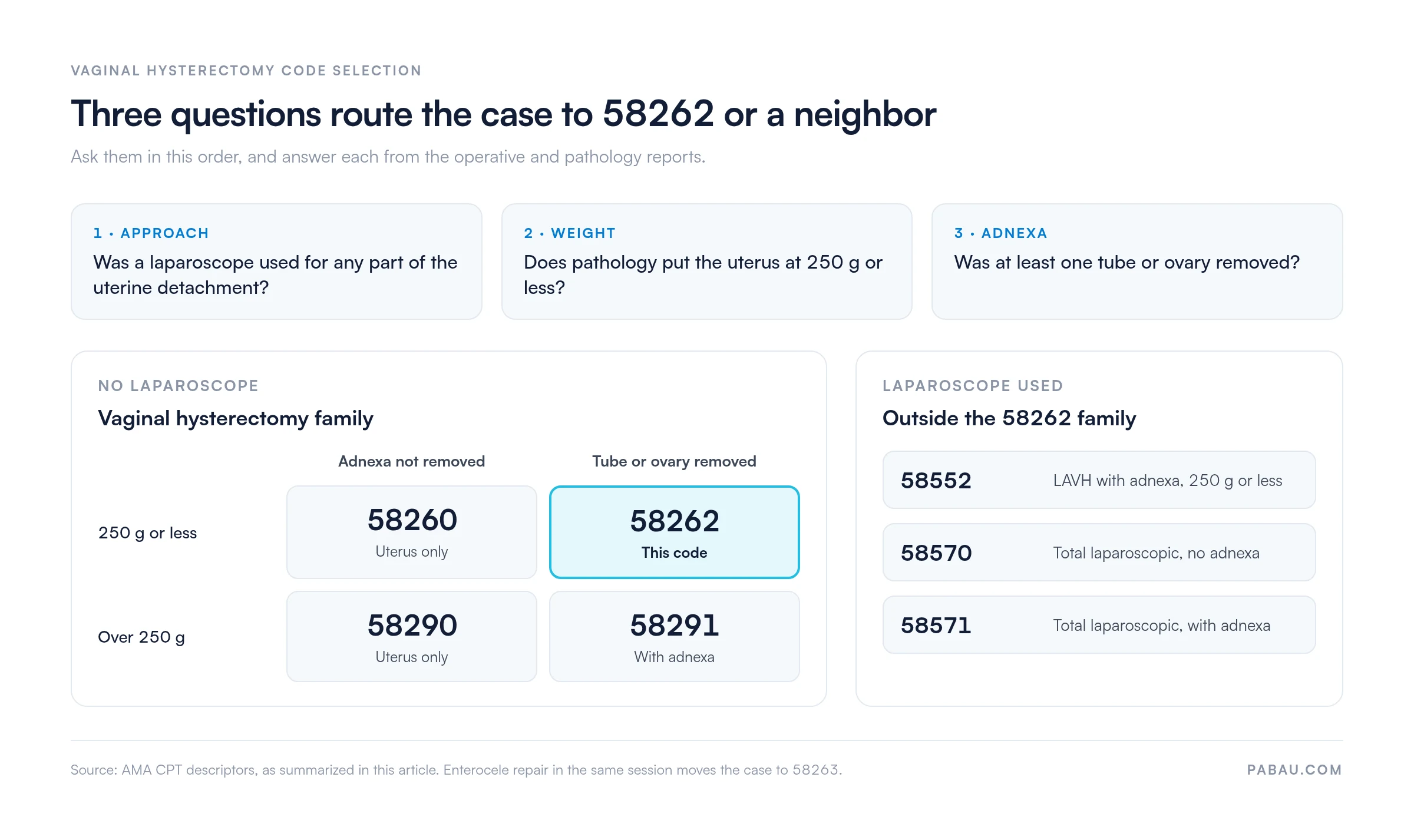
CPT 58570 and 58571 describe total laparoscopic hysterectomy, where uterine detachment and removal are both performed laparoscopically. CPT code 58262 is strictly for the vaginal approach. The uterus is detached and removed through the vaginal canal without laparoscopic assistance. If the surgeon uses a laparoscope for any portion of the detachment, the case shifts to 58552 or 58571, depending on technique.
The operative note phrases to watch for are “laparoscope was introduced” and “laparoscopic assistance was used.” Either phrase removes the case from the 58262 category, even if the specimen came out vaginally.
Robotic-assisted vaginal hysterectomy has no CPT code of its own. When a robotic system assists a vaginal approach, CPT code 58262 remains the procedure code. Some payers accept HCPCS Level II code S2900 for the robotic surgical system, reported as a separate line item alongside 58262.
S2900 is an add-on code, not a modifier, so it is never appended to the 58262 line. Other payers limit robotic billing to the facility claim and don’t recognize S2900 at the professional fee level. Check the payer’s policy before reporting it, because acceptance varies between commercial plans and Medicare Advantage plans.
Medical necessity for CPT code 58262 requires an ICD-10-CM diagnosis that justifies both the hysterectomy and the adnexal removal. The most commonly paired codes are listed below. Payer LCDs and NCDs govern which diagnoses are accepted, so check the plan’s coverage policy before submitting.
Under the CMS Medicare Physician Fee Schedule, CPT code 58262 carries 15.54 work RVUs and a 90-day global surgical period. Payment also depends on practice expense and malpractice RVUs, the annual conversion factor, and geographic adjustments. Those inputs change every year and differ by locality, so this guide doesn’t quote a national dollar figure.
For current facility and non-facility values in your locality, search 58262 in the CMS PFS Look-Up Tool. Private payer contracts often reimburse at a multiple of Medicare rates, and each contract sets its own terms.
Medicare fee-for-service does not require prior authorization for CPT code 58262 as a routine rule, but Medicare Advantage plans and most commercial insurers do. Requirements vary by plan, and clinical criteria differ between carriers. The documentation supporting an authorization request should include:
Medicaid prior authorization thresholds vary by state. Some state Medicaid programs have moved gynecologic surgery to a managed-care authorization model. There, the managed-care organization sets the criteria, not the state fee-for-service program. Always verify with the specific plan before scheduling.
Strong medical billing compliance processes cut last-minute denials, and tracking authorization status before the case is one of the simplest.
The National Correct Coding Initiative (NCCI) bundles several services into CPT code 58262 as included components. Billing them separately without a supporting modifier counts as unbundling and triggers an automatic edit denial.
These services are commonly bundled into 58262 and aren’t separately billable unless an exception applies:
These procedures may be billed alongside CPT code 58262 with the correct modifier:
CPT code 58262 carries a 90-day global surgical period under CMS MPFS rules. Routine postoperative care during the 90 days after the operative date is part of the global package. That includes wound checks, surgery-related medication management, and follow-up visits tied to the hysterectomy, and none of it can be billed separately.
Visits that are separately billable during the 90-day global period need modifiers to signal their independence:
Tracking the global period is core to revenue cycle management for surgical practices. A billing team that loses sight of the 90-day window will either hold back legitimate claims or miss the modifier on a genuinely unrelated service.
A clean claim for CPT code 58262 depends on five specific data points in the operative report. Missing any one of them is enough for a payer to request more documentation or deny the first submission.
Denial patterns for CPT code 58262 cluster around five root causes. Denial management workflows that address each cause before submission cost less than working appeals after the fact.
Tracking denials by root cause, rather than by payer alone, gives OB/GYN billing teams a clearer point to intervene. For the reason codes payers return on ERAs, see the guide to medical billing denial codes.
Before releasing a CPT 58262 claim, run a three-point check. Confirm the chart holds a pathology weight at or below 250 g. Confirm the operative note names each adnexal structure removed. Confirm the authorization number on file matches the code being billed. Those three checks head off the most common denials for this code.
Most 58262 denials start before submission. A missing authorization, a pathology weight the coder never saw, or incomplete payer details can each send the claim back. Billing teams without a checking step catch these only when the rejection arrives.
Pabau includes claims software for gynecologists and other surgical practices, and it runs validation checks each time a claim is about to go out. If a required detail such as an authorization code is missing, the Send button stays disabled until the claim is complete.
Through its Claim.MD integration, Pabau submits the claim electronically as a CMS-1500, checks patient eligibility in real time, and tracks each claim’s status. ERA remittances flow back into the same dashboard, so your team can match 58262 payments against what the practice expected.
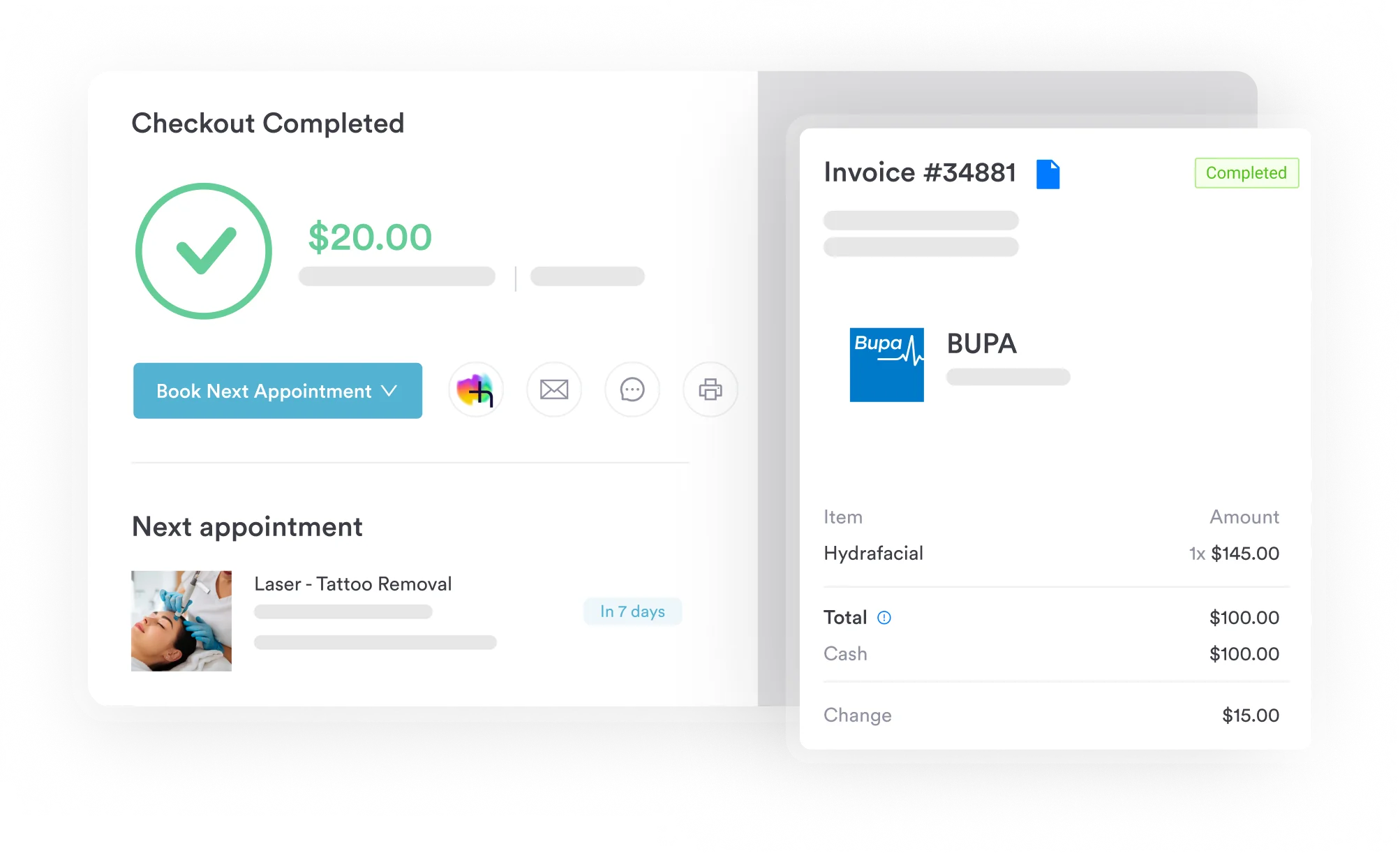

Pabau checks each claim for required details like authorization codes, then sends it through Claim.MD. OB/GYN practices spend less time reworking hysterectomy claims.

For 58262, the coding decision lives in the pathology report and the op note more than in the procedure title. Holding the claim until the weight comes back, and reading the note for any laparoscope, prevents most wrong-code denials.
The trade-off is a short billing lag on each case. That lag costs far less than reworking a denied hysterectomy claim and waiting on the appeal.
Book a demo to see how Pabau keeps authorization details, claim status, and remittances in one place for gynecologic surgery billing.

Coding a laparoscopic case instead? CPT code 58571 covers total laparoscopic hysterectomy with tube or ovary removal for a uterus 250 g or less.
Was the uterus removed through an abdominal incision? CPT code 58150 walks through total abdominal hysterectomy billing and its documentation requirements.
Billing the anesthesia side of the case? CPT code 00944 explains anesthesia coding for vaginal hysterectomy.
Removing the adnexa in a separate session? CPT code 58661 covers laparoscopic removal of adnexal structures and when it is reported on its own.
Supporting a hysterectomy for abnormal bleeding? ICD-10 code N93.9 covers unspecified abnormal uterine and vaginal bleeding and how to document it.
CPT code 58262 covers vaginal hysterectomy with removal of tube(s) and/or ovary(ies) when the uterus weighs 250 g or less. The operative report must confirm the vaginal approach, the adnexal removal, and the weight threshold.
The difference is the approach. CPT 58262 is a vaginal hysterectomy with adnexal removal and no laparoscopic instrumentation. CPT 58571 is a total laparoscopic hysterectomy with adnexal removal for a uterus 250 g or less.
CPT code 58262 carries 15.54 work RVUs and a 90-day global period. The dollar amount depends on the annual CMS conversion factor and your locality’s adjustments. Use the CMS Physician Fee Schedule Look-Up Tool for the current figure in your area.
Yes, with some payers. When a robotic system assists a vaginal hysterectomy, 58262 stays the procedure code. HCPCS Level II code S2900 goes on its own claim line alongside it, not as a modifier. Acceptance at the professional fee level varies by payer, so check the plan’s policy first.
The operative report must confirm a vaginal approach with no laparoscopic assistance. It also needs the uterus weight at or below 250 g and the name of each adnexal structure removed. A pathology order and a diagnosis matching the claim’s ICD-10-CM code complete the record.
Medicare fee-for-service does not routinely require prior authorization for CPT code 58262. Medicare Advantage plans, commercial insurers, and many state Medicaid managed-care organizations do. Criteria differ by plan, so verify with the payer before scheduling the procedure.