

HCPCS Code L0472: Hyperextension TLSO billing guide
HCPCS code L0472: Official descriptor and device definition HCPCS code L0472 des...

Last Updated: Nov 5, 2026
33880 is the CPT code for endovascular repair of the thoracic aorta by deployment of an aorto-aortic tube endograft covering the left subclavian artery. It includes pre-procedure sizing, device selection, nonselective catheterization, all radiological supervision and interpretation, and every extension placed in the same session.
The code reports thoracic endovascular aortic repair (TEVAR) when the proximal seal sits in Zone 2 or more proximally. When the left subclavian origin stays uncovered, the repair is reported with 33881 instead. The two are mutually exclusive primary codes, so the operative report must document the proximal landing zone.
Let Pabau's smart automation suggest the right codes, reduce claim denials, and keep your practice compliant—effortlessly.
Automate repetitive tasks and focus on what matters most—your patients.
Reduce coding errors and ensure compliance with the latest regulations.
Clean claims, fewer denials, and faster reimbursements.
Powerful insights and reporting to help your practice thrive.
HIPAA compliant SOC 2 certified GDPR-compliant Trusted by 4,000+ clinics worldwide

CPT Code 33880 reports TEVAR when the endograft covers the left subclavian artery origin. Same-session extensions are included in the code.
33880 and 33881 are mutually exclusive primary codes. Use 33881 only when the left subclavian origin stays uncovered, and never report both in one session.
Missing or expired prior authorization is a frequent denial reason for CPT Code 33880 claims with commercial and Medicare Advantage payers.
Pabau’s claims management software checks claims for missing details, stores each payer authorization as a case, and flags rejected claims for rework.
CPT Code 33880 describes endovascular repair of the thoracic aorta by deployment of an aorto-aortic tube endograft that covers the left subclavian artery.
It includes pre-procedure sizing, device selection, nonselective catheterization and all associated radiological supervision and interpretation.
Every extension placed in the same session is included, proximally into the aortic arch and ascending aorta and distally to the celiac artery.
The American Medical Association’s CPT code set places 33880 in the cardiovascular surgery section, among the thoracic endovascular repair codes. Coverage of the left subclavian artery is the qualifier that separates 33880 from 33881, its sibling primary code.
CPT 2026 revised this wording. For dates of service through 2025, the code covered the “initial endoprosthesis plus descending thoracic aortic extension(s), if required, to level of celiac artery origin.” Under both versions, extensions placed in the same session are part of 33880.
The procedure itself is TEVAR. The vascular surgeon deploys a fabric-covered stent graft through femoral access and advances it under fluoroscopic guidance to the target segment.
The left subclavian artery origin is covered when the graft’s proximal landing zone sits in Ishimaru Zone 2 or more proximally. A repair with a branched endograft that keeps a dedicated left subclavian branch is reported with 33882, a code new in 2026.
CPT Code 33880 bundles several services into one billable unit. Billing them separately on the same claim triggers NCCI edit rejections and potential overpayment audits.
Key bundling rule: The descriptor covers every extension placed in the same session, in both directions. Whether the surgeon deploys one extension or three, 33880 captures them all.
Reporting each extension separately is unbundling and violates National Correct Coding Initiative (NCCI) edits. Radiological supervision and interpretation is not reported separately either, as codes 75956-75959 were deleted in 2018. Check the current edit tables before billing any code pair, because NCCI edits update quarterly.
33880 applies when the endograft covers the left subclavian artery origin, and 33881 applies when it does not. They are mutually exclusive primary codes, so each TEVAR session is reported with one or the other. That single anatomical distinction drives code selection, and getting it wrong is a frequent coding error on TEVAR claims.
The confusion compounds because both codes describe the same base procedure, and both include same-session extensions. The operative report must state the proximal landing zone explicitly. Without it, a coder cannot tell which code applies, and an auditor will flag the claim whichever code was used.
Extensions follow the same session logic. Proximal or distal extensions placed during the initial repair are part of 33880 and never billed on their own. At a later session, a delayed distal extension is reported with 33886, and a delayed proximal extension that spares the left subclavian with 33883.
If a delayed proximal extension covers the left subclavian artery, CPT points back to 33880 or 33882. Before 2026, proximal extensions used 33883 for the first and +33884 for each additional one, and 33884 is now deleted. The chart below sorts each of these scenarios into its code.
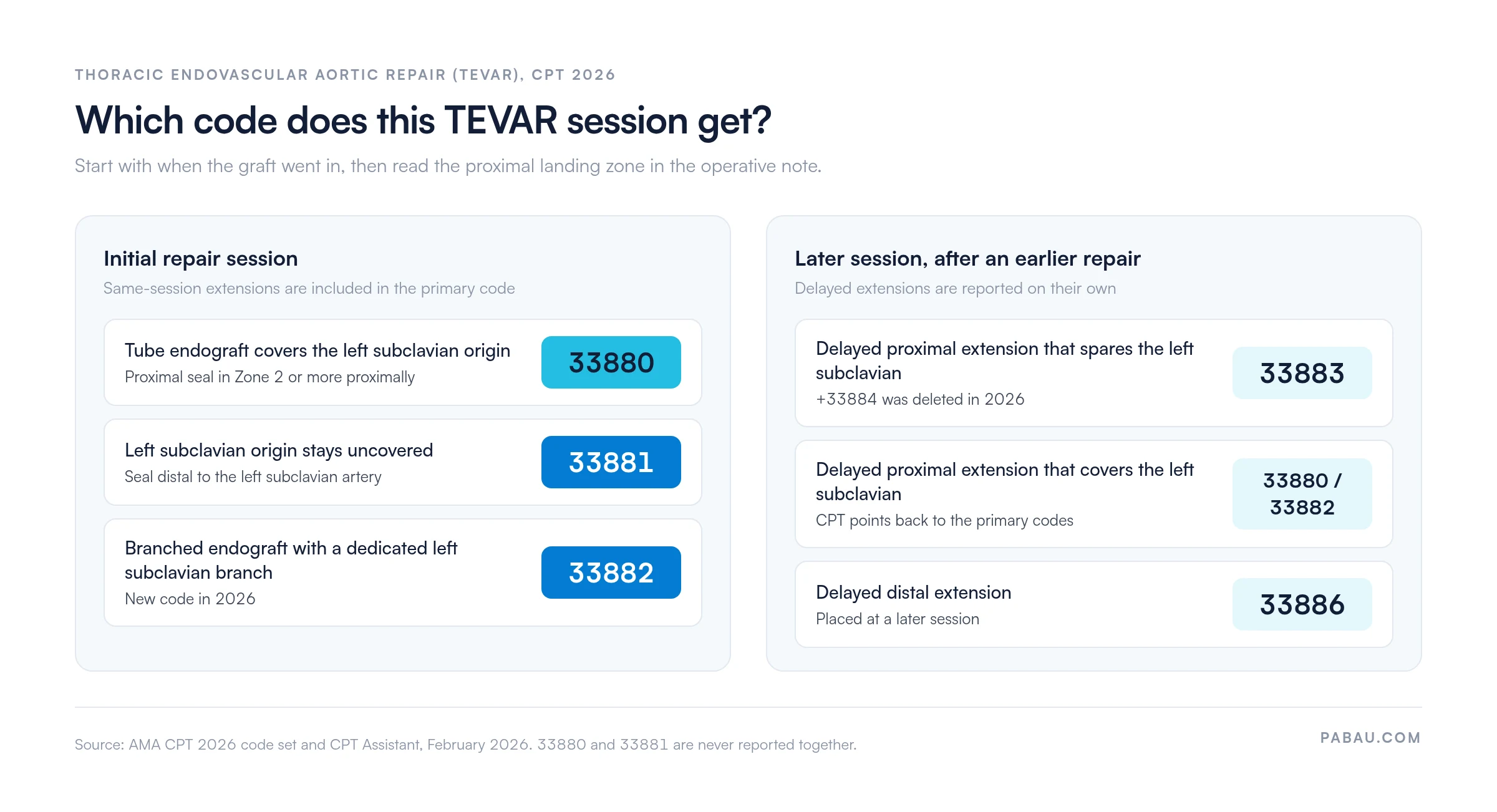
TEVAR procedures often involve ancillary interventions. Each needs its own coding analysis, and not all are separately reportable when performed at the same session as 33880.
Deleted code alert: CPT 2026 deleted 33884, 33889 and 33891. Through 2025, 33889 reported open subclavian-to-carotid transposition performed with endovascular thoracic aortic repair, and 33891 reported carotid-carotid bypass.
For 2026 dates of service, use 35694 for the transposition and 35602 for a carotid-contralateral carotid bypass. Billing templates built before 2026 may still carry the old codes, and a deleted code gets the claim rejected.
Before reporting 37236 alongside CPT Code 33880, verify the current NCCI column indicator. Edits change quarterly, and a pair that was separately reportable last year may be bundled now. Pull the current NCCI edit table from CMS before finalizing any combination that is not explicitly addressed in the AMA CPT guidelines.
TEVAR procedures carry a 90-day global surgical period. Most modifier questions for CPT Code 33880 arise from the global period, the complexity of the procedure, or two-surgeon scenarios. Each modifier requires specific documentation to survive audit.
Payers evaluate medical necessity for CPT Code 33880 based on the paired ICD-10-CM diagnosis code. The diagnosis must reflect the clinical indication that prompted TEVAR. Using a vague or nonspecific code when a specific one exists is a common audit trigger.
Since October 2022, thoracic aneurysm and dissection codes name the aortic segment, so I71.1, I71.2 and I71.01 are no longer billable. Reserve I71.9 for imaging that cannot place the aneurysm, because auditors query unspecified codes on a procedure this targeted. ICD-10-CM updates take effect on October 1 each year, so verify codes against the current tabular list before submitting.
Local Coverage Determinations (LCDs) from Medicare Administrative Contractors may set minimum aneurysm diameter thresholds, commonly 5.5 cm or greater for elective repair. The supporting imaging documentation must reflect them.
CPT Code 33880 reimbursement under Medicare is calculated from the Medicare Physician Fee Schedule (MPFS), which the CMS MPFS lookup tool publishes annually. Rates vary by geographic locality and are adjusted by the Geographic Practice Cost Index (GPCI). The figures below represent approximate national averages and should be verified against the current fee schedule year before use in billing decisions.
Use the FastRVU lookup tool or the CMS MPFS search to pull this year’s RVU values for 33880 by locality. Rates adjust each January 1, and the conversion factor changes annually. Practices billing 33880 should also check whether their Medicare Administrative Contractor (MAC) has an LCD with extra coverage criteria for TEVAR.
Commercial payers and Medicare Advantage plans commonly require prior authorization for CPT Code 33880. Traditional Medicare (Parts A and B) does not require prior authorization for TEVAR. Medicare Advantage plans set their own coverage rules, and many require pre-approval for high-cost vascular interventions. Always verify with the individual payer before the procedure is scheduled.
Run insurance eligibility verification at intake, so a missing or expired approval surfaces weeks before the surgery date rather than the day before.
Standard prior authorization documentation package:
Blue Cross Blue Shield plans, including BCBS Florida, publish medical coverage policies for endovascular stent grafts. These set coverage criteria by indication, such as aneurysm diameter and dissection classification. They also list exclusions, such as connective tissue disease without surgical consultation or inadequate landing zone anatomy.
Citing the payer’s LCD or coverage policy in the prior authorization request strengthens the case. It also leaves a documented audit trail if the claim is later challenged. Maintaining medical billing compliance records for each prior authorization decision is standard practice for vascular surgery billing teams.
Denials for CPT Code 33880 tend to fall into five groups. Each has a specific prevention step and a resubmission path. A structured denial management workflow shortens the time between an initial denial and a paid resubmission.
Knowing the common denial codes across CARC categories helps vascular surgery billing teams triage denials faster. Each denial then goes to the right resubmission workflow instead of a generic appeal.
Incomplete operative reports are a frequent audit finding for CPT Code 33880. Auditors reviewing TEVAR claims look for specific elements in the operative note. A note that confirms TEVAR was performed but omits the anatomical detail that justifies 33880 over 33881 will not survive a post-payment audit.
The operative report for CPT Code 33880 must include:
A clean claim submission process checks the operative documentation against the claim before transmission. That beats finding the problem after a denial. Vascular surgery practices that build a documentation checklist into the pre-billing workflow catch missing details before the claim reaches the payer.
Complex vascular codes like CPT Code 33880 concentrate billing risk. They pay well, often need prior authorization, face quarterly NCCI edit changes, and carry a 90-day global period that needs ongoing claim monitoring. When authorizations sit in a spreadsheet and claims in a separate billing tool, an expired approval or a deleted code slips through unnoticed.
Pabau, the practice management platform we build, includes claims management software that handles this in one place. It checks each claim for missing or invalid details before it leaves the system. It also stores each payer authorization as a case, so the team can see how many approved sessions remain.
Rejected claims are flagged for action, and remittance files settle payments against the claims they cover. For practices running both TEVAR and open surgical caseloads, that means one queue to work instead of chasing each claim separately.
Efficient revenue cycle management for surgical specialties depends on closing the loop between clinical documentation, code assignment, and claim submission. When those three steps happen in one system, the note that justifies 33880 over 33881 is captured at the point of service. Nobody has to reconstruct it after a denial.
Set a recurring calendar reminder to re-verify NCCI edit pairs for your most-used CPT codes every January 1 and July 1. Edit tables update quarterly, but the largest shifts happen at the start of each calendar year and mid-year. Catching a new bundle edit before submitting a claim avoids the denial-and-appeal cycle entirely.

Pabau’s claims management checks each claim for missing details, keeps payer authorizations on file as cases, and flags rejected claims for rework.

Correct billing for CPT Code 33880 turns on one fact in the operative report: whether the endograft covered the left subclavian origin. Ask surgeons to state the proximal landing zone in every TEVAR note, and the choice between 33880 and 33881 settles itself.
The trade-off is front-loaded work. Prior authorization, the ICD-10-CM pairing and the LCD diameter criteria all need checking before the case, not after a denial. On a code this valuable, that upstream effort costs far less than an appeal.
To see how Pabau keeps authorizations, claim checks and rejections in one queue for complex vascular codes, book a demo with the team.

Need guidance on what gets bundled vs separately billed? Common denial codes in medical billing explains CARC and RARC code categories used in EOB adjudication.
Want to reduce claim rejections before submission? Clean claim submission practices covers the pre-transmission checks that prevent the most common rejection triggers.
Looking for end-to-end billing workflow guidance? What is medical billing walks through the full revenue cycle from patient registration to payment posting.
CPT Code 33880 includes endovascular repair of the thoracic aorta with an endograft that covers the left subclavian artery origin. It bundles pre-procedure sizing, device selection, nonselective catheterization and all associated radiological supervision and interpretation. Every same-session extension is included, proximally into the arch and ascending aorta and distally to the celiac artery. Femoral access (34713 or 34812), left subclavian revascularization and stents in a separate vessel may be reported separately, subject to current NCCI edits.
33880 applies when the endograft covers the left subclavian artery origin, with a proximal seal in Zone 2 or more proximally. 33881 applies when the repair leaves that origin uncovered. Both are primary codes and mutually exclusive, so one session is reported with one of them. The operative report must state the proximal landing zone so the coder can pick the right code. Submitting 33881 when the left subclavian artery was covered is a frequent code-selection error on TEVAR claims.
The most applicable modifiers are -22 for increased procedural complexity, -62 for two primary surgeons, and -AS or -80/-81 for a surgical assistant. Modifier -22 needs a detailed operative narrative. Modifier -52 applies when a reduced service is rendered. Each modifier requires specific supporting documentation. Payer acceptance of assistant-at-surgery modifiers varies, and Medicare restricts -80 without documented medical necessity.
Often, yes. Commercial payers and Medicare Advantage plans commonly require it, while Traditional Medicare (Parts A and B) does not require prior authorization for TEVAR. Each Medicare Advantage plan sets its own rules, so verify with the specific payer before scheduling. Required documentation typically includes cross-sectional imaging confirming the indication, a surgeon attestation of medical necessity, and the operative plan.
No. CPT instructs coders not to report 33880 with 33881 in the same session, because the two codes describe alternative versions of the same repair. Choose 33880 if the endograft covers the left subclavian artery origin and 33881 if it does not. Extensions placed in that session are already included in the code you choose. Delayed extensions at a later session are reported with 33883 or 33886.
The main supporting codes are I71.23 (descending thoracic aortic aneurysm, without rupture), I71.13 (the ruptured form) and I71.012 (descending thoracic aortic dissection). I71.9 (aortic aneurysm of unspecified site) is acceptable only when the site cannot be specified. Use the most specific code the documentation supports. Payer LCDs often set minimum diameter thresholds for elective TEVAR, and the imaging report must reflect them.



