CPT Code 72193: CT Pelvis With Contrast Billing Guide
CPT code 72193: Official descriptor and procedure overview CPT code 72193 descri...

Last Updated: Nov 13, 2026
Billable Code
34705 is the CPT code for endovascular repair of the infrarenal aorta and/or iliac arteries with an aorto-bi-iliac endograft, for other than rupture. The bifurcated graft sits in the aorta, with a limb landing in each common iliac artery.
The landing zones decide the code. Aorta-only repair with a tube graft is 34701, and a graft from the aorta into one common iliac is 34703. Iliac-only repair is 34707, and a ruptured aneurysm treated with a bifurcated graft is 34706.
Let Pabau's smart automation suggest the right codes, reduce claim denials, and keep your practice compliant—effortlessly.
Automate repetitive tasks and focus on what matters most—your patients.
Reduce coding errors and ensure compliance with the latest regulations.
Clean claims, fewer denials, and faster reimbursements.
Powerful insights and reporting to help your practice thrive.
HIPAA compliant SOC 2 certified GDPR-compliant Trusted by 4,000+ clinics worldwide

CPT code 34705 covers endovascular repair with a bifurcated endograft whose limbs land in both common iliac arteries, for other than rupture.
Aorta-only repair with a tube graft is 34701, a graft from the aorta into one common iliac is 34703, and iliac-only repair is 34707.
The global period is 90 days, and fluoroscopy, nonselective catheterization and radiological supervision for the graft are bundled into the code.
Add-on 34709 is reported per vessel for an extension placed beyond the common iliac artery or above the renal arteries.
Pabau, the practice management platform we build, tracks CPT codes from the operative note to the claim and surfaces denial reasons on each remittance.
CPT code 34705 is the code for endovascular repair of the infrarenal aorta and/or iliac arteries with an aorto-bi-iliac endograft, for other than rupture. The American Medical Association descriptor opens with “Endovascular repair of infrarenal aorta and/or iliac artery(ies) by deployment of an aorto-bi-iliac endograft.”
Two anatomical facts must both appear in the operative report. The graft must span the infrarenal aorta, and a limb must land in each iliac artery. The descriptor closes with “for other than rupture (eg, for aneurysm, pseudoaneurysm, dissection, penetrating ulcer).”
The procedure starts with percutaneous or open femoral access. The surgeon delivers the bifurcated endograft under fluoroscopy and seals it in the aortic neck and both iliac landing zones. Completion angiography then confirms that the aneurysm sac is excluded.
The descriptor itself bundles the following work into 34705, so none of it is reported as an extra line item:
Several services performed in the same session may be reported separately when the documentation supports them. The table shows which add-on codes apply and where NCCI bundling edits block a separate line.
CMS updates the National Correct Coding Initiative (NCCI) edits every quarter. Check the current edit version before you treat a service as separately reportable. Billing a bundled service without the right modifier is a primary audit trigger on vascular claims.
34703 covers an aorto-uni-iliac endograft, which runs from the infrarenal aorta into one common iliac artery only. 34705 requires a bifurcated graft with a limb in each iliac artery. Aorta-only repair with a tube graft is a third code, 34701. The distal landing zones in the operative report decide which one applies, as the decision panel below shows.
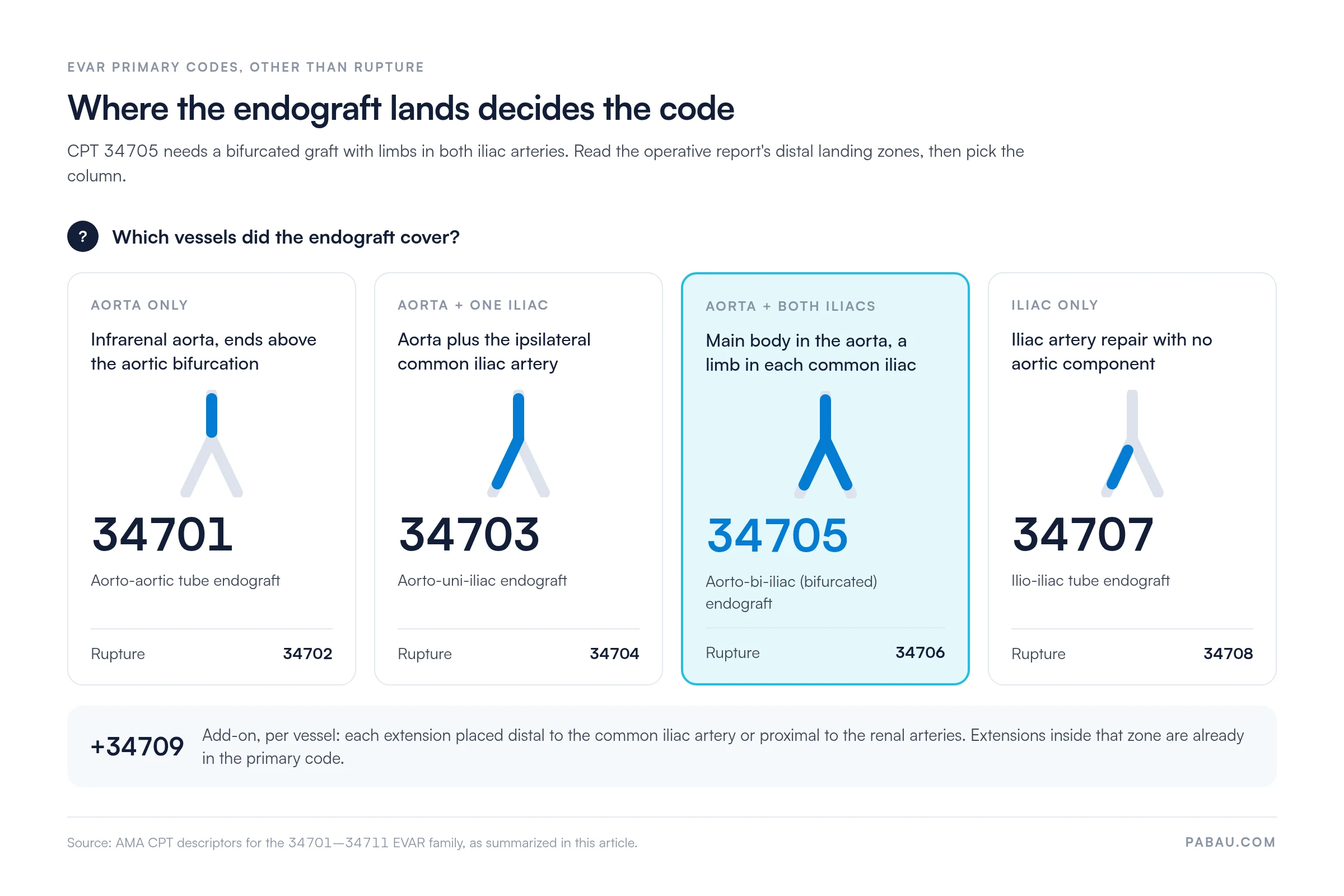
Staged cases cause the most confusion. When a single iliac limb is deployed from an aortic graft, the session matches the uni-iliac code 34703. When both limbs are placed in one session, the code is 34705. For a contralateral limb added later, code from the operative report and check the payer’s policy before you submit.
The 2018 CPT restructure replaced the 34800-series EVAR codes with a family organized by endograft type, landing zone and rupture status. The table covers the primary and add-on codes most relevant to aortoiliac repair alongside CPT code 34705.
Search the full 34701-34834 range with the AAPC Codify CPT lookup or the AMA’s own resources. Our CPT code library also covers the neighboring procedure codes one page at a time. Before 2018, codes such as 34800 and 34802 did not separate graft type or landing zone, and they were deleted with the restructure.
Confirm that your billing system flags 34709 as an add-on. Some platforms let it go out as a standalone code, which triggers an automatic denial. Report it alongside 34705, 34703, 34701 or another primary EVAR code.
Medical necessity for CPT code 34705 needs an ICD-10-CM code that states the type, location and status of the aneurysm. Payers check the diagnosis against the size documentation and imaging in the record. A mismatch between the ICD-10 code and the operative note is a leading denial trigger.
I71.4 and I71.3 became non-billable parent codes in fiscal year 2023, so a claim still carrying either one will reject. Report the six-character code for the documented site.
Size threshold documentation: Most payers, including Medicare, follow Society for Vascular Surgery (SVS) guidelines for elective repair in asymptomatic patients. Those guidelines set the threshold at an aneurysm diameter of 5.5 cm or greater. Some payers accept repair from 5.0 cm, and symptomatic aneurysms of any size typically qualify.
The CT angiography report must be in the record before the procedure date. It should state the maximum aortic diameter, neck length, neck angulation and iliac landing zone dimensions. That report supports both prior authorization and medical necessity on the claim.
Under the Medicare Physician Fee Schedule (MPFS), CPT code 34705 carries a 90-day global period. Related services in that window are part of the global package and cannot be billed separately. Unrelated E&M visits and new, unrelated procedures are the exceptions. The global period starts on the day of surgery, so postoperative visits through day 90 are included.
RVU values and national payment rates change with every annual MPFS update. Use the CMS Physician Fee Schedule lookup tool to confirm the current-year rate and total RVUs for 34705. The FastRVU lookup tool breaks out work, practice expense and malpractice RVUs with the Medicare amount for each payment locality.
EVAR is performed in a hospital operating room in the overwhelming majority of cases. The surgeon’s professional fee is paid at the facility rate under the MPFS. The hospital bills separately, under the Outpatient Prospective Payment System (OPPS) or as an inpatient claim.
Before you advise on site-of-service billing, check the current-year CMS Inpatient-Only (IPO) list and the MPFS status indicator for 34705. Both can change with each annual rule.
Hospital-based vascular practices often split facility and professional billing across two departments. Their revenue cycle management needs a clear handoff, so the op note reaches both teams with the landing zones intact.
Traditional Medicare fee-for-service does not require prior authorization for CPT code 34705. Medicare Advantage plans set their own rules, and many require authorization. Commercial payers almost always require it before an elective EVAR. A missing authorization is one of the top denial reasons on high-value vascular claims.
Medical billing compliance for high-cost vascular procedures starts with the authorization request. Payers typically ask for the following:
Medicare Advantage plans may also want the authorization to name 34705 and any planned add-on codes, such as 34709 or 34808. An authorization for one code followed by a claim for another creates a mismatch. Payers deny that mismatch separately from medical necessity.
The operative report is the primary documentation source for 34705. Building a clean claim for EVAR means the op note addresses each element below. Missing even one gives the payer grounds to downcode, deny or audit the claim.
A vascular surgery superbill should capture the prosthesis type and unilateral or bilateral iliac involvement as separate fields. Without them, the coder has to infer the code from a vague procedure description. A generic “EVAR” entry with no graft type is a persistent source of miscoding.
Audit documentation before billing. Pull five recent 34705 operative reports and check each for both iliac landing zones, the prosthesis type and the access method. If a report is ambiguous, the surgeon clarifies it before the claim goes out. A query after a denial is slower and costs more than a pre-bill review.
Denials on CPT code 34705 cluster around four root causes: Wrong code selection, prior authorization failure, bundling errors and missing medical necessity evidence. Each has its own fix.
High-value vascular claims need denial management workflows with a first-pass review within 48 hours of the remittance. Route EVAR denials to a coder with vascular experience rather than a general billing queue.
Practices with steady EVAR volume should track the 34705 denial rate by payer and reason each quarter. A pattern, such as one payer that keeps asking for modifier 22 documentation, shows up faster than it would claim by claim.
Modifiers explain a departure from the standard 34705 scenario or prevent inappropriate bundling. A wrong or missing modifier causes denials that are preventable at claim submission.
Modifier 22 needs the most supporting detail on 34705 claims. Payers expect the operative note to quantify the complexity, and vague language such as “the procedure was complex” falls short.
A stronger note reads “hostile neck with angulation greater than 60 degrees requiring adjunctive balloon molding and extended fluoroscopy time.” That gives the clinical reviewer a basis for approval. Without that detail, the claim returns to base payment.
In most vascular practices, the coder reads the op note days after the case and picks a code from a generic “EVAR” superbill line. The difference between 34703 and 34705 is one iliac limb, and that detail is easy to miss in a narrative report.
Pabau’s vascular billing claims management keeps the CPT code, add-on codes and diagnosis on the same record as the clinical note. Claims go out through our Claim.MD clearinghouse integration, which supports eligibility checks and ERA remittances. Denial and CARC reason codes then appear alongside each claim.
The result is fewer 34705 claims that need rework, and a billing team that can work appeals without switching systems.

Pabau keeps the operative note, the CPT code and the claim together. Your team submits 34705 claims through Claim.MD, checks eligibility and tracks ERA responses in one place.

Code 34705 from the landing zones, never from the word “EVAR.” If the op note does not name both iliac limbs, query the surgeon before the claim goes out. A wrong primary code costs a full resubmission cycle on one of the highest-value claims a vascular practice bills.
The fix sits upstream of the coder. Teams newer to medical billing should add graft type and iliac involvement to the superbill first. Book a demo to see how Pabau carries those details from the operative note to a clean 34705 claim.

Need to understand how clearinghouse submission works for surgical claims? Medical claims clearinghouse guide explains how payer routing, real-time edits, and 837P transmission work for high-value procedure codes.
Trying to reduce claim denials across your vascular billing team? Denial codes in medical billing covers CARC and RARC reason codes so your team can action remittance responses faster.
Looking for a primer on electronic remittance for surgical payments? Electronic remittance advice (ERA) explains 835 transaction sets and how ERA data maps to claim adjustments for EVAR reimbursement.
CPT code 34705 covers endovascular repair of the infrarenal aorta and iliac arteries with a bifurcated (aorto-bi-iliac) endograft, for other than rupture. The graft must land a limb in both iliac arteries, not just one. Bundled services include sizing, nonselective catheterization, fluoroscopy, intraoperative angiography and the introducer systems used during the procedure.
34703 covers an aorto-uni-iliac endograft that runs from the aorta into one common iliac artery, while 34705 requires a bifurcated graft in both iliac arteries. The distal landing zones in the operative report decide the code. Aorta-only repair with a tube graft is a different code again, 34701.
The primary supporting diagnosis for elective infrarenal repair is I71.43, infrarenal abdominal aortic aneurysm without rupture. I71.40 to I71.44 cover other abdominal aneurysm sites. I71.33, a ruptured infrarenal aneurysm, pairs with the rupture code 34706, not 34705. I72.3 may be added when an iliac aneurysm is also treated.
The global period for CPT code 34705 is 90 days under Medicare. Related postoperative services in that window are part of the global package, including follow-up visits and returns to the OR for related complications. Use modifier 78 for a related return to the operating room and modifier 79 for unrelated procedures.
Yes. CPT 34709 is an add-on code for each extension prosthesis placed distal to the common iliac artery(ies) or proximal to the renal artery(ies). It is reported alongside 34705 on the same claim and never on its own. Document each extended vessel in the operative report.
The most common reason is a wrong primary code, such as 34703 or 34701 billed when both iliac limbs were documented. Missing prior authorization, separately billed fluoroscopy or angiography, and an ICD-10 code that does not match the anatomy follow. Each has its own appeal path, set by the CARC code on the remittance.