

HCPCS Code Q4175: Billing, coverage, and documentation guide
HCPCS code Q4175: Code description and product identity HCPCS Code Q4175 is the ...

Last Updated: Nov 20, 2026
Billable Code
34713 is the CPT add-on code for percutaneous access and closure of femoral artery for delivery of endograft through a large sheath. The sheath is 12 French or larger. The code includes ultrasound guidance when performed, applies to one side, and is listed in addition to the primary procedure code.
It cannot be reported alone. A primary endovascular repair code must appear on the same claim. The operative report must document percutaneous access with a sheath of at least 12 French. Most denials trace back to a missing primary code, an undocumented sheath size, or the wrong modifier on bilateral access.
Let Pabau's smart automation suggest the right codes, reduce claim denials, and keep your practice compliant—effortlessly.
Automate repetitive tasks and focus on what matters most—your patients.
Reduce coding errors and ensure compliance with the latest regulations.
Clean claims, fewer denials, and faster reimbursements.
Powerful insights and reporting to help your practice thrive.
HIPAA compliant SOC 2 certified GDPR-compliant Trusted by 4,000+ clinics worldwide

CPT code 34713 covers percutaneous femoral artery access and closure through a 12 French or larger sheath during endovascular aortic repair.
It is an add-on code (+34713) and cannot be billed without a qualifying primary endovascular repair code on the same claim.
The operative report must state the sheath size in French and confirm percutaneous access, because open femoral exposure is coded 34812 or 34714.
34713 and 34812 never share one groin, but each side of a bilateral case is coded by the technique used on that side.
Pabau, a practice management platform, supports add-on pairing review through its claims management and Claim.MD electronic claims.
CPT code 34713 is an add-on code for percutaneous femoral artery access and closure when the endograft sheath is 12 French or larger. Its official long descriptor comes from the AMA’s CPT code set:
Percutaneous access and closure of femoral artery for delivery of endograft through a large sheath, 12 French or larger, including ultrasound guidance, when performed, unilateral (List separately in addition to code for primary procedure)
AMA CPT long descriptor for +34713
A 34713 line is never reported alone, and the percutaneous sheath must be 12 French or larger. Its global period is ZZZ, so the access work falls inside the primary procedure’s global. Ultrasound guidance is part of the descriptor and is not billed separately for the same access.
Because CPT code 34713 is an add-on code, it must accompany a designated primary endovascular repair code. Submitting 34713 without an eligible primary code on the same claim triggers an automatic denial.
Eligible primaries cover the infrarenal aorta, the iliac arteries and the descending thoracic aorta. Fenestrated repair of the visceral and infrarenal aorta qualifies too.
A standard bifurcated graft for a non-ruptured infrarenal aneurysm, for example, is coded 34705, with +34713 for each percutaneous groin. The pairing breaks when 34713 goes on a separate claim or carries a different date of service from the primary. Both situations trigger an automatic edit.
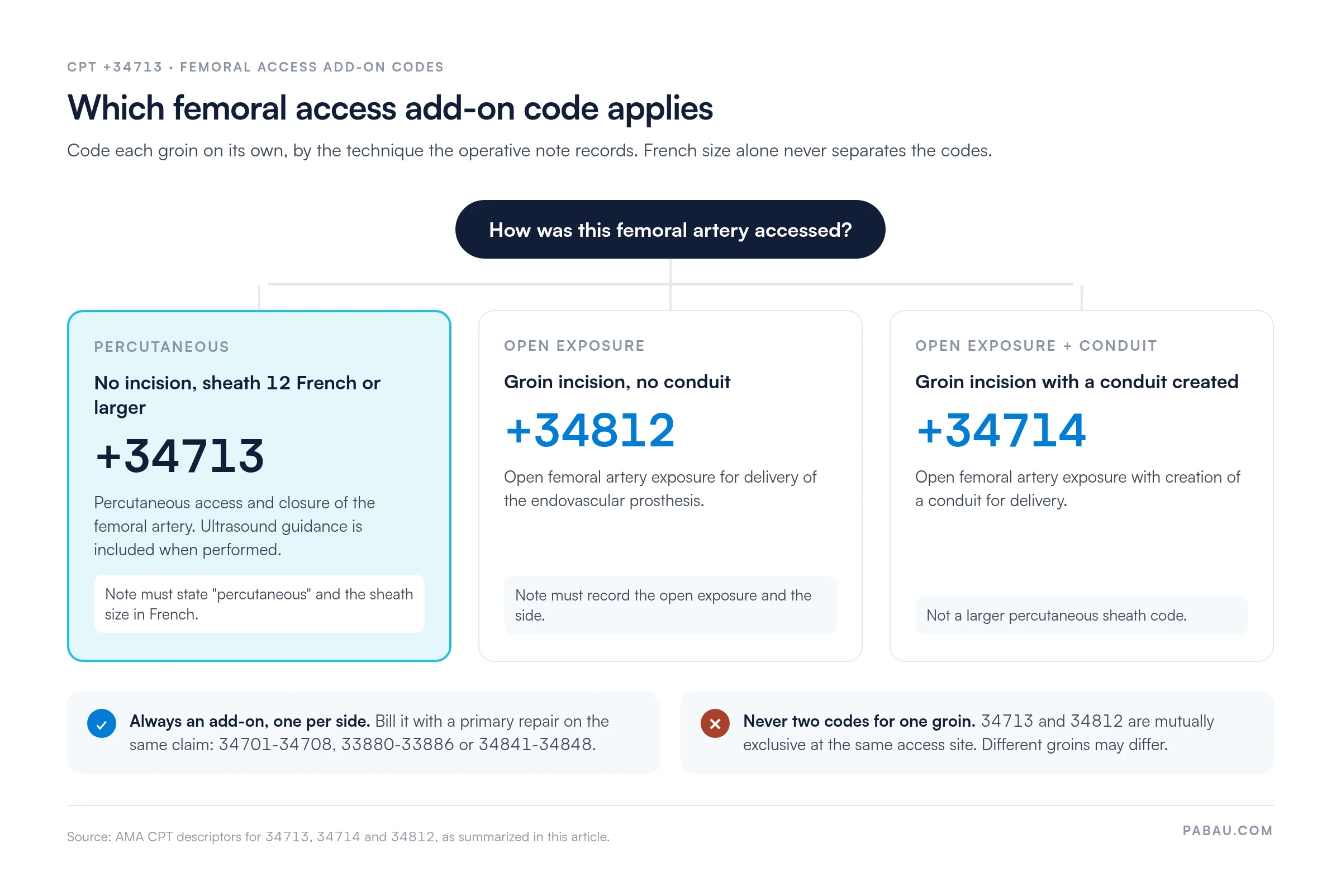
CPT 34713 and CPT 34714 describe different access techniques, so French size alone never separates them. 34713 is percutaneous femoral access and closure through a sheath of 12 French or larger. 34714 is open femoral artery exposure with creation of a conduit, by groin incision, on one side.
A conduit is a graft sewn onto the artery to give the delivery sheath a route in. The technique the surgeon records in the operative note decides the code, whatever the sheath size.
Whichever code applies, the operative report must state the introducer sheath size in French. “Large sheath” or “adequate access” will not support 34713. If no size is recorded, hold the claim until the note is corrected through the proper amendment process.
CPT 34812 covers open surgical exposure of the femoral artery for endovascular aortic repair, while CPT code 34713 covers percutaneous access at the same vessel. These two codes are mutually exclusive at the same femoral access site. Never report 34812 and 34713 for the same access site.
Society for Vascular Surgery (SVS) and AMA CPT coding guidance treat 34713 (percutaneous) and 34812 (open exposure) as alternative approaches to one objective. Billing both for a single groin on the same claim is improper unbundling and draws an edit from most payers.
Bilateral access is where coders most often confuse these codes. If one groin was accessed percutaneously and the other needed open exposure, bill 34713 for the percutaneous side and 34812 for the open side. Each line takes its laterality modifier, RT or LT. The diagram below sorts each groin by the technique the note records.
Because CPT code 34713 is unilateral, bilateral percutaneous access always needs a modifier decision. Two approaches are accepted, and your Medicare Administrative Contractor (MAC) decides which one applies.
Standard bilateral reporting rules apply to add-on codes the same way they apply to primary codes. Because modifier rules vary by MAC jurisdiction, check your payer’s local coverage determinations (LCDs) before submitting bilateral EVAR claims.
Before submitting bilateral EVAR claims, pull the operative report and confirm the French size and technique (percutaneous vs open) for each groin separately. Document them on distinct lines in your charge sheet. This two-line check prevents the most common 34713 denial scenario: a bilateral claim submitted with modifier 50 when the MAC requires separate RT/LT lines.
Medicare payment for CPT code 34713 is calculated using the Resource-Based Relative Value Scale (RBRVS). The CMS Physician Fee Schedule lookup tool provides current-year RVU values and national payment amounts by locality. Payment then varies by Geographic Practice Cost Index (GPCI) across MAC jurisdictions.
Use the FastRVU 2026 RVU lookup tool for current work and total RVU values, with GPCI-adjusted payment estimates by zip code. The AAPC Codify CPT lookup provides crosswalk data and coding notes alongside RVU values. Never quote a flat dollar amount for CPT code 34713 without noting the GPCI adjustment. Payment rates differ materially between high-cost markets and rural localities.
Medicare coverage of endovascular aortic repair is set by each MAC’s Local Coverage Determinations (LCDs). CPT code 34713 is covered as an add-on to a primary procedure that meets those criteria. The documentation must also support percutaneous access with a sheath of 12 French or larger.
Novitas, CGS, and Palmetto GBA each issue their own LCDs for EVAR procedures, and their coverage criteria can differ. Those differences affect whether 34713 is accepted without prior authorization.
The diagnosis on the claim has to support the primary repair too, so code the aneurysm site the record documents. Only an aortic aneurysm with no documented site and no rupture falls back to I71.9.
The operative report is the single document that makes or breaks a 34713 claim. Coders relying on a brief procedure note or a discharge summary to support this code will consistently produce underdocumented claims. The superbill documentation that feeds the claim must trace back to the operative note for all five required elements below.
EVAR billing denials for CPT code 34713 follow predictable patterns. Tracking them by their medical billing denial codes speeds up corrections and prevents repeats. A denial management workflow for vascular surgery codes starts with knowing which edits target add-on codes.
Clean claim submission for EVAR add-on codes depends on charge capture that flags 34713 when no qualifying primary code is present. Manual review catches some errors, but pairing rules built into the billing workflow catch them consistently.
EVAR procedures generate complex billing scenarios. Add-on code pairings, bilateral modifier decisions, and access-technique code selection all land on the same claim. When those decisions depend on a coder rereading the operative note every time, errors pile up.
Pabau’s claims management software and Claim.MD electronic claims support add-on pairing review before an EVAR claim leaves the practice. In the US, claims go out as CMS-1500/837P files through Claim.MD, with eligibility checks before the procedure.
Electronic remittance advice (ERA) comes back into the platform with its CARC denial codes. Revenue cycle teams can then spot a pattern, such as a missing primary code, a wrong modifier, or an undocumented French size. They fix it at the source rather than appealing claim by claim.
Prior authorization codes, dates and sessions are tracked on the patient’s case, with a warning when one is missing. That covers the auth denials commercial and Medicare Advantage plans issue for EVAR episodes.

Pabau’s claims management and Claim.MD electronic claims support add-on pairing review, eligibility checks and ERA tracking. See how vascular surgery practices can submit cleaner EVAR claims.

CPT code 34713 pays when the operative note answers three questions for each groin. Was the access percutaneous, does the note give a documented French size of 12F or larger, and which primary repair does it support? Once those answers are on the record, the laterality modifier follows from them.
The most reliable fix sits upstream of billing. Make access technique and sheath size required fields in the vascular operative note template, and coders stop interpreting narrative. That one change heads off the most common 34713 denials before a claim is built.
Pabau’s claims management and Claim.MD electronic claims support add-on pairing review before submission. Book a demo to see how Pabau helps vascular surgery practices send cleaner EVAR claims.

Need a step-by-step guide to denial management for surgical codes? Denial management in healthcare covers the full workflow from ERA review to appeal submission.
Trying to understand how clearinghouse submission works? Medical claims clearinghouse guide explains the 837P transaction, ERA responses, and payer enrollment steps.
Looking for a reference on 837 electronic claims files? 837 file overview covers the structure, mandatory loop segments, and common submission errors for professional claims.
CPT code 34713 is the add-on code for percutaneous access and closure of the femoral artery through a sheath of 12 French or larger. It is reported during endovascular repair of an aortic or aortoiliac aneurysm and never as a standalone code.
Yes. CPT 34713 carries the plus-sign (+) designation from the AMA, confirming it is an add-on code. It must be reported alongside an eligible primary procedure code (such as 34701-34708, 33880-33886 or 34841-34848) on the same claim date of service.
For unilateral access, modifier RT or LT may be required depending on your MAC. For bilateral percutaneous access, use modifier 50 or report 34713-RT and 34713-LT on separate claim lines. The right approach depends on MAC-specific guidance. Modifier 59 or XS distinguishes separate access sites when payer edits bundle them incorrectly.
No. CPT 34812 (open femoral artery exposure) and CPT 34713 (percutaneous femoral access) are mutually exclusive at the same access site. Billing both for a single groin is improper unbundling. They may appear on the same claim only when each describes a different groin with a different access technique.
Medicare reimbursement for CPT 34713 is calculated from the 2026 Medicare Physician Fee Schedule RVU values multiplied by the conversion factor. The result is then adjusted by the Geographic Practice Cost Index (GPCI) for each MAC locality. Use the CMS MPFS lookup tool or FastRVU for current locality-specific amounts, because no single national dollar figure applies.
Most denials trace back to four errors. The claim lacks a primary endovascular repair code, or the operative note gives no numeric French sheath size. Otherwise 34713 and 34812 were billed for one groin, or the bilateral modifier was wrong. Missed prior authorization on Medicare Advantage and commercial plans is a fifth common cause.





