HCPCS Code G0163: Skilled nursing observation and assessment
What is HCPCS Code G0163? HCPCS Code G0163 is a deleted Level II code for skille...

Last Updated: Oct 15, 2026

CPT code 28285 describes surgical correction of hammertoe deformity, including interphalangeal fusion and partial or total phalangectomy.
The 2026 national Medicare rate is roughly $548 in non-facility settings and $371 in facility settings, before geographic adjustment.
Toe modifiers TA and T1 through T9 identify the digit corrected, and every toe billed on the same day needs its own claim line.
Practice management software like Pabau scrubs claims and submits them electronically, which catches incomplete claim data before it reaches the payer.
CPT code 28285 is the surgical code for correction of a hammertoe deformity. It covers interphalangeal fusion and partial or total phalangectomy on a lesser toe. Every claim line carries a toe-specific T-modifier, a laterality-matched ICD-10 code, and a record of failed conservative care.
This guide covers the official descriptor, 2026 Medicare reimbursement rates, modifier rules, ICD-10 pairings, documentation requirements, and denial prevention. It is written for podiatrists, orthopedic coders, and billing staff working from the AMA’s CPT code set. The American Medical Association (AMA) maintains CPT. The Centers for Medicare and Medicaid Services (CMS) sets annual payment rates through the Medicare Physician Fee Schedule (MPFS).
CPT code 28285 reads: Correction, hammertoe (e.g., interphalangeal fusion, partial or total phalangectomy). It falls under the CPT section “Repair, Revision, and/or Reconstruction Procedures on the Toes.” The parenthetical examples in the descriptor are illustrative, not exhaustive. A claim is valid under 28285 when the surgeon corrects a hammertoe deformity using any combination of the included techniques.
Hammertoe deformity involves abnormal flexion at the proximal interphalangeal (PIP) joint, causing the toe to bend downward. Conservative management typically precedes surgery. When padding, orthotics, and splinting fail, surgical correction becomes medically necessary. That documented failure is a prerequisite for payer approval, not just a best practice.
The descriptor names two core techniques. Both are bundled into a single unit of 28285 per toe. Knowing what the code already includes prevents unbundling errors that trigger National Correct Coding Initiative (NCCI) edits.
NCCI treats CPT 28270, capsulotomy of the same MTP joint, as the column 2 component against 28285. It is payable alongside the correction only with modifier 59 or XS and distinct-site documentation.
Hardware removal at a later date may be separately reported using CPT 20680 (removal of implant, deep). That applies when it happens in a separate operative session outside the global period. Confirm current NCCI edit tables before billing hardware removal alongside 28285.
Total phalangectomy under 28285 removes bone but keeps the toe. If the operative note describes disarticulation at the interphalangeal joint, the procedure is an amputation and is reported with CPT 28825.
Every claim for CPT 28285 requires a supporting ICD-10-CM diagnosis code that establishes medical necessity. The M20.4 series covers acquired hammertoe deformity. Laterality specificity is required. Use unspecified codes only when the operative documentation genuinely does not indicate a side, which is rare in podiatric surgery.
Verify current ICD-10-CM FY2026 validity against the CDC/NCHS ICD-10-CM web tool before submitting. Some MAC jurisdictions publish local coverage determinations (LCDs) naming which M20.4x codes they will pay. Cross-reference the relevant MAC LCD for hammertoe procedures before the claim goes out. Our ICD-10-CM code reference covers the wider diagnosis families a podiatry practice bills against.
CMS pays CPT 28285 under the Medicare Physician Fee Schedule, and the rate depends on the site of service. Non-facility rates apply when the physician performs the procedure in an office. Facility rates apply when a hospital outpatient department or ASC bills the facility component on its own claim. Verify current figures with the CMS Physician Fee Schedule lookup, since CMS updates them each January.
Geographic payment localities move these national figures by roughly 10-20% in either direction. High-cost localities such as Manhattan and San Francisco sit above the national average, and rural jurisdictions usually sit below it. Pull your locality’s values from the CMS relative value files before quoting a patient. Checking the locality figure before submission is how a practice spots an underpayment on the remittance rather than months later.
Payment equals total RVUs multiplied by the geographic practice cost indices and the conversion factor. CMS publishes two conversion factors for 2026, and the non-qualifying-APM figure of $33.4009 applies to most podiatry practices. At that rate, 16.42 RVUs reconciles to about $548 in the office setting and 11.10 RVUs to about $371 in a facility. Confirm the current-year values in the CMS relative value file before you rely on them.
Run the expected reimbursement calculation before each claim batch, not only at contract review. Two sites in the same metro area can fall into different payment localities. A practice that submits without a locality check absorbs the difference quietly.
Modifier selection is a leading denial trigger for CPT 28285. HCPCS Level II assigns a specific T-modifier to each toe, and a claim submitted without one routes straight to denial. The map below pairs each digit with its modifier, and the table after it adds the usage note for each.
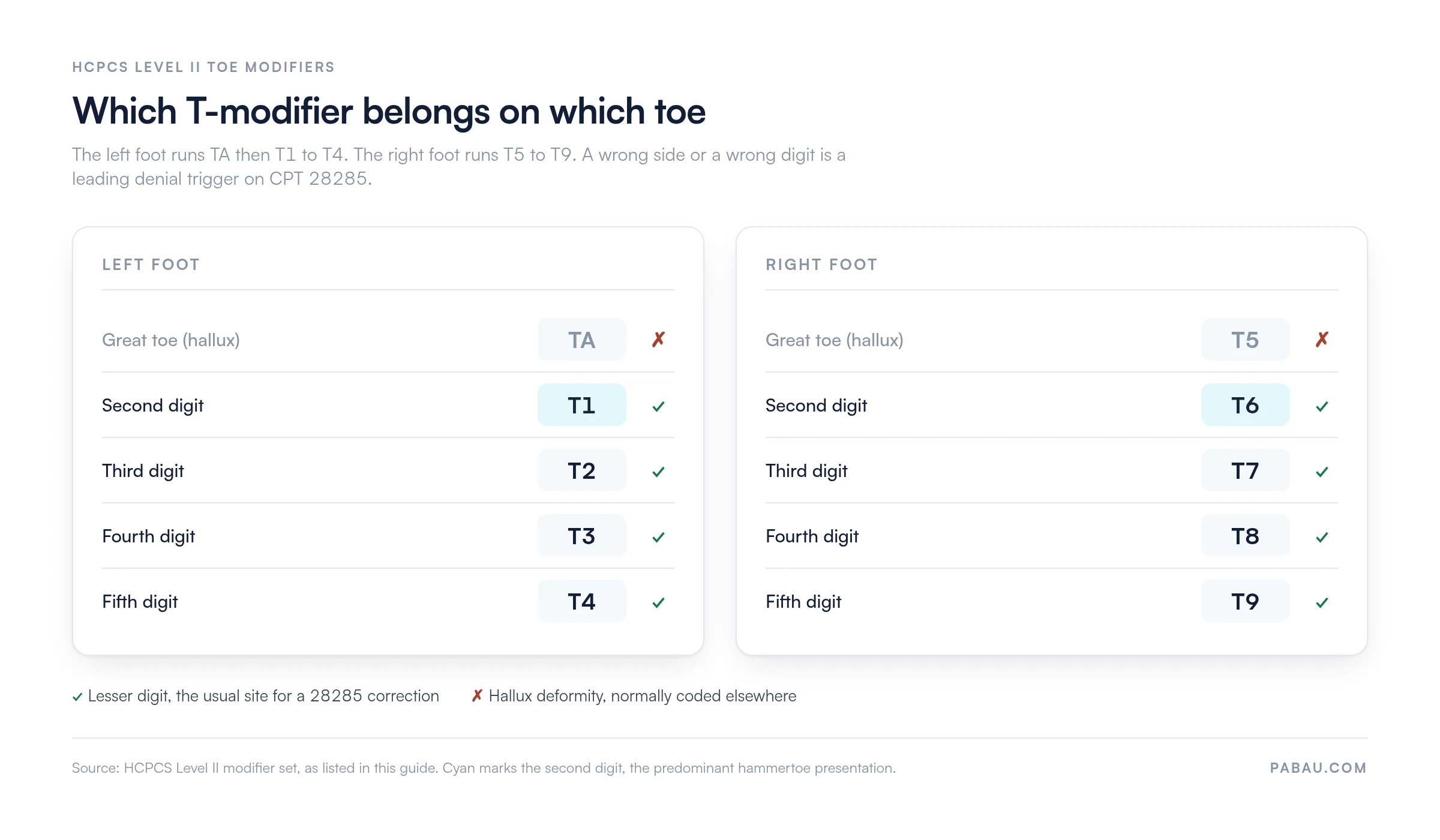
When a surgeon corrects two or more toes in the same operative session, bill a separate line for each toe with its matching T-modifier. Do not combine toes onto one line, and do not use modifier 50 for same-foot procedures. Modifier 50 covers a bilateral correction of the same digit on both feet, and its handling is payer-specific. Medicare treats bilateral toe procedures differently from many commercial payers, so confirm the policy before you apply it.
Multiple units on a single claim line for 28285 will deny. Each toe needs its own line carrying the procedure code, the toe-specific T-modifier, a unit count of 1, and the matching ICD-10 laterality code.
Audit your last 90 days of 28285 claims for T-modifier distribution. If T6 dominates the sample, spot-check whether the operative notes actually name the digit. A coder who is unsure of the digit tends to default to one modifier, and that pattern can attract payer medical review.
Incomplete documentation is another leading denial cause in hammertoe repair billing. Payers reviewing medical necessity want a clear record that surgery was the only remaining option. Gather each element below before submitting.
Capture these elements at the time of service rather than after a denial. Reconstructing a conservative-care history weeks later takes far more staff time than dictating it into the operative report on the day.
Documentation decides code selection on the supply side too. HCPCS code L0468 is physically identical to its off-the-shelf twin, so only a note describing the trimming or molding at fitting supports it.
Podiatry practices see a predictable set of denial patterns on CPT 28285 claims, and most are preventable. The table below pairs each denial with the error behind it and the check that stops it.
Practices that route every 28285 claim through an automated scrubber catch most of these errors before the claim leaves the office. Getting a clean claim out on the first pass reduces administrative rework and protects cash flow.
CPT 28285 carries a 90-day global surgery period under CMS rules. Routine post-operative care is bundled into the surgical payment for 90 days after the procedure date. Billing a standard office visit for a routine wound check inside that window will deny under Medicare.
CMS publishes global period indicators in the MPFS database, and 28285 should carry a “090” indicator confirming the 90-day package. Verify that field in the CMS file if a payer disputes the assignment. Your practice management system should flag global-period claims automatically, so nobody bills a bundled visit twice.
CPT 28285 sits within a family of foot and toe reconstruction codes. Knowing the adjacent codes prevents misbilling when the operative scope extends beyond a standard hammertoe correction.
When a bunionectomy and a hammertoe correction happen in the same session, the two codes are generally co-billable. If that bunionectomy uses a proximal phalanx osteotomy, the hallux valgus correction is reported under CPT 28298. Append modifier 51 to the secondary code, and verify the NCCI edits for that pairing first.
A proximal phalanx osteotomy on the great toe, billed with no bunionectomy on the same claim, goes to CPT 28310 instead. That descriptor carries a separate procedure designation, so the bone cut bundles into a wider correction at the same site.
Hammertoe repair billing fails at two points. The first is charge entry, where the coder sets the modifier from the operative note. The second is the scrub that runs before the claim leaves the building, and that is the point software can own outright.
Practice management software like Pabau is built for cleaner claims management. Each claim is checked for missing fields, mismatched laterality, and incomplete line data before it goes out. The coder still chooses the code and the modifier, because only the operative note supports that decision.
From there, claims leave as 837P files through the Claim.MD clearinghouse, which reaches thousands of US payers. Remittance advice comes back into the same patient record, so a denial on a 28285 line lands beside the encounter that produced it. Your billers stop reconciling two systems by hand.
For a multi-toe session, the billing workflow starts from the digits the operative record captured. The coder builds one line per toe instead of retyping the encounter from scratch. That shortens the lag between service and submission, which matters most on claims carrying an authorization deadline.

Pabau checks every claim for missing fields and mismatched laterality, then submits it electronically and posts the remittance back to the patient record. See how it handles a podiatry billing workflow.

CPT code 28285 is simple to read and exacting to bill. The descriptor is one line, but payment turns on the toe you name, the side you name, and the conservative care you can show. Get those three right and the claim is routine.
Work the checks in order. Start with the T-modifier for the digit and the laterality-specific ICD-10 code, then confirm medical necessity, the global period, and NCCI bundling. Software will not choose the code for you, but it will stop a claim with a missing field from reaching the payer. Book a demo to see how Pabau scrubs and submits podiatric claims from charge entry through remittance posting.

Need to understand how clean claims reduce podiatric denials? Clean claim best practices walks through the elements payers evaluate before processing surgical claims.
Looking to benchmark your revenue cycle against industry standards? Revenue cycle management fundamentals explains how podiatry practices can measure and optimize their billing performance.
Want to understand how clearinghouses process surgical claims? Medical claims clearinghouse guide covers how 837P submissions route from provider to payer and what happens at each validation step.
CPT Code 28285 is the surgical procedure code for correction of hammertoe deformity. The AMA defines it as: “Correction, hammertoe (e.g., interphalangeal fusion, partial or total phalangectomy).” It covers the bone-level techniques used to straighten a flexion deformity at the proximal interphalangeal joint of a lesser toe.
Yes. Bill a separate line item for each toe corrected, each with its unique T-modifier identifying the specific digit. Do not combine multiple toes on a single line or use a unit quantity greater than 1. Each line must also carry the appropriate ICD-10 laterality code.
The 2026 national Medicare rate is roughly $548 in non-facility settings and about $371 for the physician component in a facility. Those figures come from 16.42 and 11.10 total RVUs at the $33.4009 conversion factor. Geographic adjustment through your MAC locality can move them by 10-20%.
CPT 28285 carries a 90-day global surgery period under CMS policy. Routine post-operative visits, suture removal, and in-office K-wire removal within 90 days of surgery are bundled into the procedure payment. Services for unrelated conditions during the global period require modifier 24.
CPT 28285 is used for hammertoe correction. It may also apply to claw toe and mallet toe corrections when the technique involves interphalangeal fusion or phalangectomy. Coverage depends on the payer’s local coverage determination (LCD) and documentation of medical necessity, including failed conservative treatment. Verify individual payer policies before scheduling.