CPT Code 69610: Tympanic membrane patch repair (myringoplasty)
CPT code 69610: official descriptor and procedure overview CPT code 69610 descri...

Last Updated: Oct 19, 2026
28200 is the CPT code for repair, tendon, flexor, foot; primary or secondary, without free graft, each tendon. It covers direct suture of a lacerated or ruptured flexor tendon in the foot, at the time of injury or later, billed once per tendon.
The code choice turns on the graft, not the timing. When a secondary repair uses a free tendon graft, the encounter moves to 28202, which includes obtaining the graft.
Let Pabau's smart automation suggest the right codes, reduce claim denials, and keep your practice compliant—effortlessly.
Automate repetitive tasks and focus on what matters most—your patients.
Reduce coding errors and ensure compliance with the latest regulations.
Clean claims, fewer denials, and faster reimbursements.
Powerful insights and reporting to help your practice thrive.
HIPAA compliant SOC 2 certified GDPR-compliant Trusted by 4,000+ clinics worldwide

CPT code 28200 covers flexor tendon repair in the foot, primary or secondary, without a free graft, reported once per tendon repaired.
The graft decides the code, not the timing. A secondary repair with a free graft is 28202, which includes obtaining the graft.
The code carries a 90-day global period, so routine post-op visits are bundled into the surgical payment.
Add modifier -51 to additional procedures where the payer requires it (Medicare applies the multiple-procedure reduction itself), plus -LT or -RT for laterality.
Pabau’s claims management software pre-fills claims from the record, checks required claim fields, and posts ERA remittances through Claim.MD.
CPT code 28200 is defined by the American Medical Association as: Repair, tendon, flexor, foot; primary or secondary, without free graft, each tendon. The words “each tendon” matter most for billing. Two flexor tendons repaired in one foot means 28200 is reported twice, as units or separate lines depending on payer policy.
Where the payer requires it, the second repair carries modifier -51. Medicare applies the multiple-procedure reduction itself, so check each payer before you append it.
The code sits within the CPT musculoskeletal system section, subsection Foot and Toes (28001-28899). It covers the flexor tendons of the foot and toes, including flexor hallucis longus, flexor digitorum longus, and flexor digitorum brevis. “Primary or secondary” means the timing of the repair does not change the code. A repair at the time of injury and a delayed repair both report 28200.
“Without free graft” is the condition that matters. The surgeon repairs the tendon directly, without harvesting tendon tissue from another site.
The scope of 28200 is defined by two phrases in the descriptor: “primary or secondary” and “without free graft.” The first means timing does not affect code selection. The second is the documentation trigger, because a free tendon graft moves the repair to a different code.
The NCCI edit table controls what can be billed alongside 28200 in the same session. Run each code pair through the CMS NCCI edits before billing multiple procedures together.
The 28200 vs 28202 distinction comes down to one question in the operative note: did the surgeon use a free tendon graft? A direct repair without a graft maps to 28200, whether it is primary or secondary. A secondary repair with a free graft maps to 28202. The extensor pair, 28208 and 28210, follows the same split.
The diagram maps the whole foot and ankle tendon family, so you can rule out the neighboring codes in one pass.
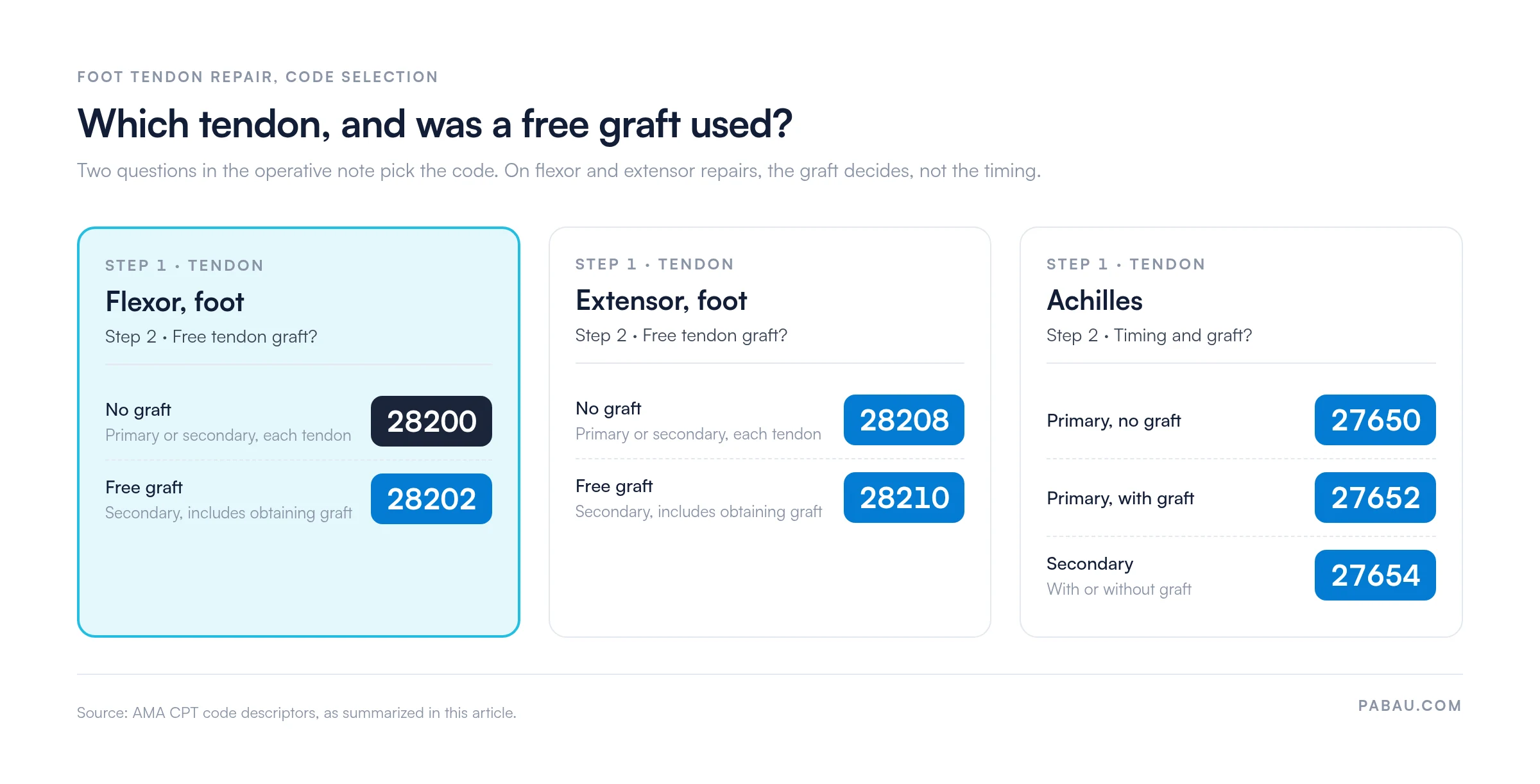
A delayed repair alone never justifies 28202. Reporting it without a documented free graft is a coding error, so check the note for graft harvest before choosing the code. Because 28202 includes obtaining the graft, no separate graft harvest code is reported with it.
Payers audit flexor tendon repair claims because the graft decision splits 28200 from 28202. The operative note should cover each item below to support medical necessity and code selection.
Pre-operative notes and imaging (ultrasound or MRI confirming tendon laceration or rupture) strengthen the medical necessity argument, particularly for commercial payers requiring prior authorization.
The diagnosis code must support the flexor tendon injury being repaired. Acute laceration and spontaneous rupture are the two main categories. Degenerative or systemic causes, such as rheumatoid arthritis, may also apply when underlying disease caused the rupture.
Laterality should come from the note. If it is missing, S96.029A covers a long flexor tendon laceration of an unspecified foot, though payers prefer a sided code.
Verify codes against the current fiscal-year ICD-10-CM tabular list. New codes are added each October. “A” (initial encounter) fits while the patient is receiving active treatment. A delayed secondary repair is still active treatment, so it also takes “A.” “D” (subsequent encounter) and “S” (sequela) are post-acute and would not support the surgical repair claim.
Document the tendon count and laterality in the operative note’s final diagnosis line, not just in the body of the report. Coders and auditors scan the final diagnosis first, and a note that buries laterality in paragraph 4 creates unnecessary review delays.
Medicare pays the sum of the work, practice expense and malpractice RVUs, each adjusted by its locality GPCI, multiplied by the conversion factor.
Facility (hospital or ASC) and non-facility (office) rates differ, because practice expense RVUs are calculated separately for each. Use the CMS Physician Fee Schedule search tool to pull exact figures for your MAC locality.
CMS updates the conversion factor every year in the physician fee schedule final rule. Pull locality-specific rates from the AAPC code lookup or the FastRVU calculator, then cross-check them against your MAC’s fee schedule. Commercial rates are set by contract and vary.
Once the code is settled, the modifiers come next. They depend on two facts: whether other procedures happened in the same session, and which foot was operated on. A missing laterality modifier is a common denial cause for this code.
Medicare applies the multiple-procedure reduction itself, without relying on -51. Many commercial payers still expect it on the lower-valued line. Check your MAC’s local policies and each payer contract where requirements differ from national guidance.
CPT code 28200 carries a 90-day global surgery period under CMS policy. This means routine post-operative services are bundled into the surgical payment from the day before surgery through the 90th post-operative day. A routine E/M visit billed in this window is denied as part of the global package.
Pabau is the practice management platform we build. Its electronic claims via Claim.MD submit clean claims and post ERA remittances, so denial patterns show up in reporting.
Before the surgery date is booked, settle the authorization. Traditional fee-for-service Medicare does not require prior authorization for most elective foot surgery.
Medicare Advantage plans set their own rules. Build the check into your medical billing workflow so it happens at scheduling, not after the denial.
For commercial payers, the medical necessity package typically includes the operative plan and imaging that confirms the rupture or laceration. It also carries a record of any conservative management and the referring physician’s notes. An incomplete authorization package is a common denial cause for 28200 claims.
Here is how a typical claim moves. A patient cuts the right forefoot on glass, and the surgeon repairs two flexor tendons the same day. The note names flexor hallucis longus and flexor digitorum longus, and states that no graft was used.
Even a clean checklist misses some claims. Four common denial causes show up on 28200 claims, and each has a predictable fix. The table pairs each one with its claim adjustment reason code (CARC). For the appeal process itself, see our guide to denial management workflows.
A CO-97 denial can follow when 28200 and 28208 (extensor tendon repair) are billed together. Check the NCCI table for the 28200/28208 pair. If an edit exists, -59/XS needs separate-site or separate-tendon documentation. Document each tendon’s repair separately in the operative note.
Other reason and remark codes can appear on the same ERA. Our reference to denial codes in billing explains each one and the usual fix.
Manual claim preparation for 28200 creates three failure points. They are missing modifiers, mismatched ICD-10 codes, and submissions that miss the payer’s timely filing window. Claims software removes the re-keying behind many of these errors, and it stops an incomplete claim before it reaches the clearinghouse.
Pabau’s claims management software pre-fills the CMS-1500 from the patient record and seeds ICD-10 codes from the problem list. ICD-10-CM and CPT lookup libraries sit inside the claim screen. Required fields are validated before the Send button unlocks. Claims then go through Claim.MD, with eligibility checks and ERA posting.
A clean claim on the first pass means less follow-up work for the billing team. Pabau also builds superbills from the appointment record. They include the procedure and diagnosis codes for manual review before electronic submission.
Add a laterality check to your pre-submission checklist. A missing -LT/-RT is the most common cause of CO-4.

Pabau’s claims management tools pre-fill claims from the record, check required fields before you send, and post ERA remittances.

For 28200, the operative note does most of the coding work. If it names the tendon, the foot and the count, and confirms no free graft, the code follows. The remaining risk sits in payer-specific rules for -51, units and authorization, so keep a short checklist for each payer.
Pabau’s claims management software pre-fills claims from the record and checks required fields before submission, which helps you send clean claims. To see it handle surgical foot codes in your workflow, book a demo.

Need to understand how clearinghouse submission works for surgical codes? Medical claims clearinghouse guide walks through how claims are validated and transmitted to payers.
Struggling with post-surgical claim denials? Denial codes in medical billing covers the full range of CARC and RARC codes with resolution guidance.
Want to see how ERA matching works across your surgical claims? Electronic remittance advice explains how 835 transaction files tie payments back to individual claim lines.
Coding other forefoot surgery? CPT code 28292 covers hallux valgus correction with resection at the base of the proximal phalanx.
The free graft. CPT 28200 covers a primary or secondary flexor tendon repair in the foot without a free graft. CPT 28202 covers a secondary repair with a free graft, including obtaining the graft.
Yes. The code covers the flexor tendons of the foot and toes, including flexor hallucis longus, flexor digitorum longus and flexor digitorum brevis. Report it once for each tendon repaired.
Use 27658 for a primary repair without graft at the leg level, and 27659 for a secondary repair. CPT 28200 applies only when the repair is at the foot level.
Orthopedic surgeons and podiatrists can report 28200 when the repair falls within their licensed scope. Podiatric scope differs by state, so confirm it before scheduling.
Four causes come up often. They are a missing laterality modifier (CO-4), an NCCI bundling conflict (CO-97), an unsupported diagnosis (CO-167), and a missing authorization (CO-197).