CCSD code H4430: Examination of rectum under anaesthetic
CCSD code H4430 pays for the examination alone CCSD code H4430 is the UK private...

Last Updated: Oct 20, 2026

CPT code 22512 covers percutaneous vertebroplasty of each additional cervicothoracic or lumbosacral vertebral body, beyond the initial level.
22512 is an add-on code, so it cannot be billed alone and must accompany primary code 22510 or 22511.
All imaging guidance is bundled into CPT 22512 and cannot be billed separately alongside it.
Modifiers 50, LT and RT do not belong on 22510 through 22515, because each descriptor already covers unilateral or bilateral injection.
No CPT code describes cervical kyphoplasty, so a cervical case is reported with unlisted code 22899.
CPT code 22512 is the add-on code for percutaneous vertebroplasty of each additional cervicothoracic or lumbosacral vertebral body. It applies to every level treated beyond the initial one in the same session. Because it is an add-on code, it never bills alone.
The AMA descriptor comes in two parts, and 22512 shares the first with 22510. The common portion reads: Percutaneous vertebroplasty (bone biopsy included when performed), 1 vertebral body, unilateral or bilateral injection, inclusive of all imaging guidance.
The add-on portion reads: each additional cervicothoracic or lumbosacral vertebral body (List separately in addition to code for primary procedure).
That wording settles the two questions coders ask most. All imaging guidance is already paid for inside the code. And cervical levels are in scope, because 22510 reads cervicothoracic rather than cervical alone.
What follows covers the primary code pairing rule, modifiers, and the 2026 Medicare fee schedule. It also covers RVU components, ICD-10 crosswalk codes, and the documentation payers ask for.
CPT 22512 carries a + symbol in the AMA CPT manual, which confirms its add-on status. That designation sets two hard billing rules. The code cannot appear on a claim without its primary parent, and it cannot be reported more times than the parent authorizes.
The two valid primary codes are:
CPT 22512 then appends to either one for each additional cervicothoracic or lumbosacral body treated in the same session. Treating two additional levels means reporting 22512 twice, always alongside the primary.
Charge entry is where the pairing gets lost, so it is also where practice management software is worth configuring to enforce it.
Run a pre-submission edit check that flags any claim containing CPT 22512 without a paired 22510 or 22511. This single rule catches the most common vertebroplasty denial before it reaches the payer.
Vertebroplasty codes sit inside a broader family of percutaneous vertebral augmentation procedures. Kyphoplasty carries its own primary and add-on codes, and it cannot be substituted for a vertebroplasty code on the same claim. The table below shows the full family, drawn from the AMA CPT code set.
Region matters more here than the sequence of code numbers suggests. Kyphoplasty coding stops at the thoracic and lumbar spine, with 22513 for thoracic levels and 22514 for lumbar ones. No CPT code describes cervical kyphoplasty, which leaves unlisted code 22899 and a supporting operative note.
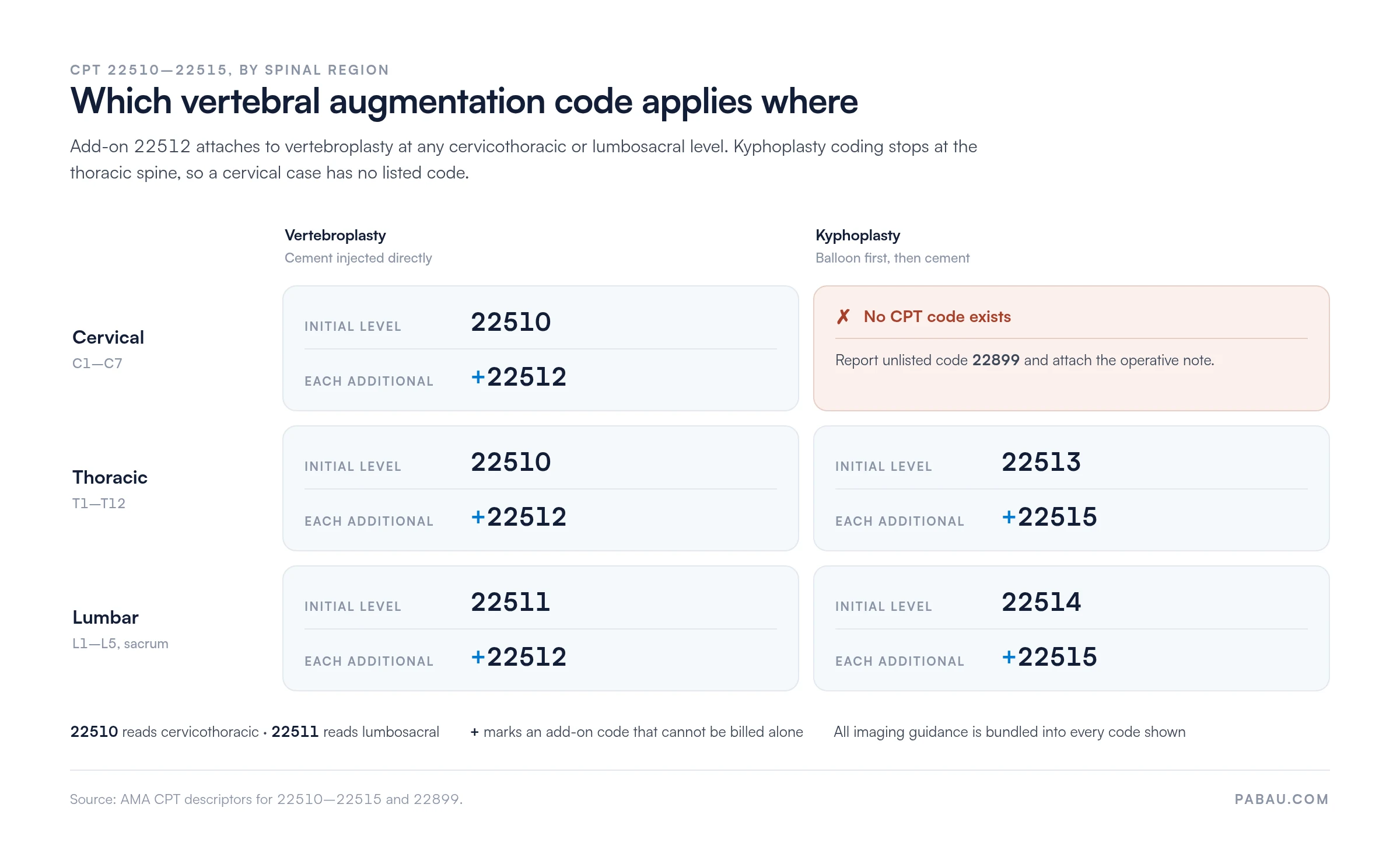
Never substitute 22512 for 22515, or the other way round. The procedures are not interchangeable. Vertebroplasty injects bone cement directly, while kyphoplasty inflates a balloon to restore vertebral height before cementing. Each add-on has to accompany a primary code from its own family.
Medical necessity for vertebroplasty rests on the ICD-10 diagnosis attached to the claim. According to the CMS ICD-10 codes page, the covered indications for vertebral augmentation are osteoporotic vertebral compression fractures and metastatic lesions. Pick the code that matches the documented vertebral level and fracture etiology as precisely as the record allows. The Medicare Benefits Schedule sets its own item structure, so a US code has no direct Australian counterpart. Practices that review a sample of notes each month catch documentation level drift before a payer does.
Because 22510 reads cervicothoracic, a cervical vertebroplasty is billable inside this family. The diagnosis has to match the level, so a cervical injury codes to something like S12.131D rather than a thoracic or lumbar entry. A pain-only diagnosis such as diagnosis such as M53.1 will not carry medical necessity on its own.
Use the CDC ICD-10-CM tool to confirm the seventh-character extension for the encounter type. A claim that carries an unspecified vertebra code when the operative report names a specific level will draw a request for additional documentation.
Modifier choice on 22512 is mostly a question of what not to append. Laterality is already inside the descriptor, which reads unilateral or bilateral injection. So the side modifiers do not belong on 22510 through 22515 at all.
That single rule removes a large share of the modifier errors on these claims. A side modifier on a code that already includes bilateral work reads as a contradiction, and reviewers treat it as one.
Modifier 59 is the one that needs judgment. NCCI edits sometimes bundle an imaging or evaluation code against a vertebroplasty code, and 59 is the bypass when the services really are separate. Check the pair status in the CMS NCCI edits files first.
When a line does come back, read the remittance denial codes before you resubmit. A pairing rejection and a modifier rejection look similar on a statement but need different fixes. Tracking which of the two keeps recurring is what turns denial management from rework into prevention.
Yes. All imaging guidance is bundled into CPT 22512, and the descriptor says so in as many words. That produces two opposite errors. Some practices bill a guidance code and get denied. Others hold 22512 back because they assume guidance needs its own line.
So do not report CPT 77003 or CPT 77012 alongside 22512 for the same level and session. The guidance work is already inside the code’s relative value units. The same principle governs other guided procedures, which is why 20611 pays for its ultrasound guidance inside the code.
Verify current bundling status against CMS NCCI edits before submission, because the pairs change in the annual rule cycles. Claims management software with NCCI validation flags these conflicts before the claim leaves the practice.
Medicare reimbursement for CPT 22512 varies by place of service and geographic locality. The CMS fee schedule lookup gives the national payment amount and the locality adjustment for each calendar year. Verify rates there before quoting a figure to clinical or administrative staff.
Two rate categories apply to CPT 22512, depending on where the procedure is performed:
Geographic practice cost indices then adjust those national amounts by locality. High-cost localities such as Manhattan or San Francisco pay more, and rural localities pay less. The CMS lookup applies the adjustment once you select the carrier and locality.
Relative value units determine how Medicare calculates payment for CPT 22512. The three components are work, practice expense, and malpractice. Each is multiplied by its matching geographic index, and the total is multiplied by the annual conversion factor.
CMS publishes current RVU values for 22512 each year in the Medicare Physician Fee Schedule final rule. Confirm the 2026 work, practice expense, and malpractice figures in the CMS lookup before you model revenue. The 2026 conversion factor sits in the final rule published in late 2025.
Place of service coding decides which rate Medicare applies. Hospital outpatient departments bill POS 22, ambulatory surgical centers bill POS 24, and office-based procedures bill POS 11. The wrong POS code creates a rate mismatch, and payers recoup overpayments during audits.
The non-facility rate is higher because the practice buys the imaging equipment, the cement, and the staffing time itself. At a facility, the institution bills for those resources separately, so the physician fee drops to match.
Multi-site orthopedic and sports medicine programs need a location profile on every claim line, which multi-location tools attach automatically.

Medicare coverage for vertebroplasty is governed by Local Coverage Determinations administered by Medicare Administrative Contractors. Criteria vary by jurisdiction. The requirements below reflect general CMS guidance, so always check the determination that applies to your own contractor.
Conservative care documentation often sits outside the surgical record, in the notes of the physical therapy team who saw the patient first. Pulling it together before the claim goes out is faster than answering a records request later. Where the payer requires it, start prior authorization before the procedure rather than after.
Payers audit vertebroplasty claims more closely than many other spinal procedures, because of historical overutilization concerns. Structured medical forms capture the required fields at the point of care, and EHR integration moves the operative note into the billing system without re-typing.
Entering CPT 22512 correctly takes more than typing the code number. The add-on designation creates dependencies that have to be enforced at charge entry. Five steps prevent most of the claim errors:
A clean claim on a multi-level case comes down to these five checks running before submission rather than after a rejection.
For multi-level vertebroplasty cases, have the billing team cross-reference the operative report’s documented levels against the claim lines before submission. A two-minute check prevents the most common vertebroplasty underbilling error: charging only for the primary level when two or three levels were treated.
In most billing workflows a missing parent code surfaces only after the payer rejects the line. That costs a week and a rebuild on a claim that was clinically correct all along. Practice management software like Pabau moves the check to the moment the charge is entered.
Pabau holds the parent-add-on relationship at charge entry, so a 22512 line cannot be saved without 22510 or 22511 on the claim. It runs the NCCI check on the pair, links the ICD-10 diagnosis to every line, and logs each edit for audit. The operative note that supports the extra levels lives on the same record.
Claims then leave through our Claim.MD integration, so a corrected multi-level claim can go out the same day it is fixed. Remittances come back against that same record, which means your billers read the payer response next to the note it relates to.

Pabau’s claims management enforces add-on code pairing, runs NCCI checks, and links the diagnosis to every line. So a three-level vertebroplasty claim goes out right the first time.

22512 is a simple code with a narrow set of rules, and the denials cluster in two places. Miss the parent code and the line is never reviewed. Under-specify the diagnosis and it gets reviewed, then rejected.
The region wording is worth committing to memory, because published summaries get it wrong more often than they get it right. Cervical vertebroplasty is billable under 22510 and 22512. Cervical kyphoplasty is not billable at all, and 22899 is the fallback.
Build those two checks into charge entry and the multi-level cases stop being the risky ones. Pabau’s practice management tools enforce the pairing and the diagnosis linkage before a claim is submitted.
Book a demo to see how Pabau handles a three-level vertebroplasty claim, from charge entry through to remittance.

Billing another percutaneous skeletal procedure? CPT code 20650 covers skeletal traction wires and pins, with the same parent-and-add-on discipline.
Coding a metabolic bone disease instead of age-related osteoporosis? ICD-10 code M83.0 shows how etiology changes the diagnosis you attach.
Documenting immobility after a vertebral fracture? ICD-10 code M62.3 covers the immobility syndrome that shows up in these records.
Billing a deep musculoskeletal insertion? CPT code 20700 sets out the bundling rules for drug-delivery device placement.
CPT code 22512 reports percutaneous vertebroplasty of each additional cervicothoracic or lumbosacral vertebral body treated beyond the initial level. It is an add-on code, so it must accompany primary code 22510 or 22511 on the same claim. All imaging guidance is bundled into the code and is not separately reportable.
Yes, CPT 22512 is designated as an add-on code by the AMA. It cannot be reported alone on a claim. It must appear on the same claim as CPT 22510 or 22511. A claim carrying only 22512, with no primary code on it, comes back rejected.
Medicare reimbursement for CPT 22512 depends on the place of service and the geographic locality. Facility rates, which cover hospital and ASC settings, are lower than non-facility office rates. Use the CMS Physician Fee Schedule lookup to find the current 2026 payment amount for your locality.
Only two apply in practice. Modifiers 50, LT, and RT do not belong on 22510 through 22515, because each descriptor already covers unilateral or bilateral injection. Modifier 59 applies when an NCCI edit bundles 22512 against a genuinely separate service, and modifier 80 covers an assistant surgeon subject to payer policy.
Vertebroplasty codes 22510, 22511 and 22512 cover cement injected directly into the fractured vertebra. Kyphoplasty codes 22513, 22514 and 22515 cover a balloon that restores vertebral height before the cement goes in. The families are not interchangeable, and kyphoplasty has no cervical code, so a cervical case uses unlisted code 22899.
Yes, all imaging guidance is bundled into CPT 22512, fluoroscopic and CT alike. Do not separately report CPT 77003 or CPT 77012 for the same session and vertebral level. Billing a separate guidance code alongside 22512 at the same level will be denied under NCCI bundling edits.
The most commonly crosswalked codes are M80.08XA and M80.08XD for age-related osteoporosis with a pathological vertebral fracture. M84.58XA covers a pathological fracture in neoplastic disease, and M48.56XA covers a collapsed lumbar vertebra. Select the code that matches the vertebral level and encounter type in the operative record.