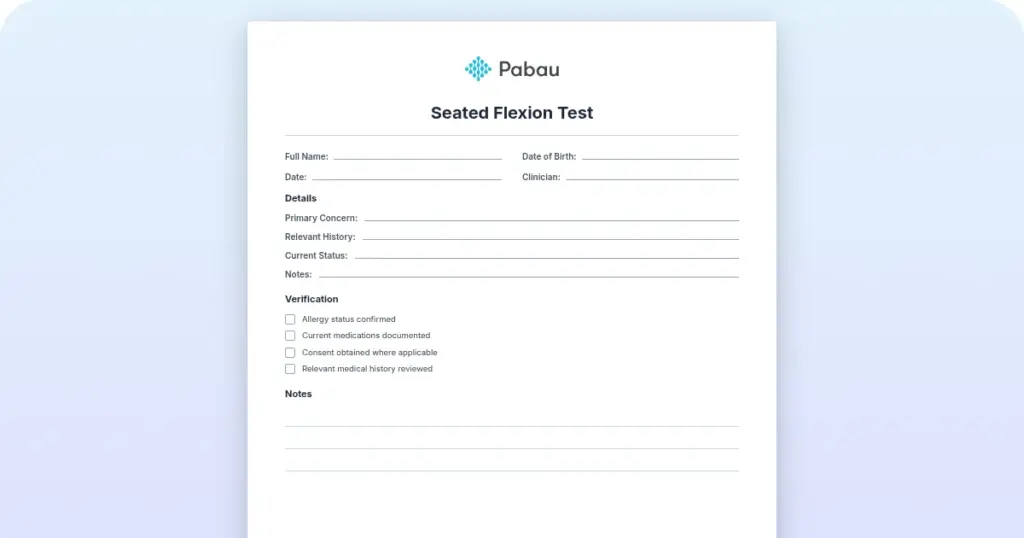
Seated flexion test
The seated flexion test is a palpation-based assessment of sacral motion at the ...

4
Last Updated: Oct 15, 2026
Billable Code Specific Code
M53.1 is the billable ICD-10-CM code for cervicobrachial syndrome.
The International Classification of Diseases, 10th Revision, Clinical Modification (ICD-10-CM) has two joint stewards. They are the Centers for Medicare and Medicaid Services (CMS) and the National Center for Health Statistics (NCHS). Annual updates take effect on October 1 each year. The 2026 edition became effective October 1, 2025, and it confirms M53.1 as an active, billable code.
Let Pabau's smart automation suggest the right codes, reduce claim denials, and keep your practice compliant—effortlessly.
Automate repetitive tasks and focus on what matters most—your patients.
Reduce coding errors and ensure compliance with the latest regulations.
Clean claims, fewer denials, and faster reimbursements.
Powerful insights and reporting to help your practice thrive.
HIPAA compliant SOC 2 certified GDPR-compliant Trusted by 4,000+ clinics worldwide

ICD-10 code M53.1 is the billable diagnosis code for cervicobrachial syndrome, valid for FY2026 from October 1, 2025.
M53.1 covers combined neck and upper extremity symptoms, and M54.12 becomes the more specific choice once nerve root compression is confirmed.
Documentation has to capture both the cervical and brachial components, the examination findings, and the symptom onset.
Pabau’s claims management software helps chiropractic, physical therapy, and orthopedic practices submit M53.1 with the record behind it.
M53.1 is classified as a billable, specific ICD-10-CM diagnosis code, so it carries enough detail for reimbursement. Providers can use it as a primary or secondary diagnosis on a claim, with no more granular sub-code required.
Per CMS ICD-10-CM guidance, a billable code is one that can be used as the principal or secondary diagnosis on a claim. M53.1 meets that standard as it stands.
Cervicobrachial syndrome is a clinical presentation involving neck and upper extremity symptoms at the same time. Both arise from dysfunction in the cervical spine and the brachial region. The term describes a recognizable cluster of signs and symptoms rather than one named pathology. That cluster spans the cervical spine and the brachial plexus, along with the nerves downstream of it.
Patients typically report some mix of neck pain, arm pain, and shoulder discomfort. Many also have neurological features such as paresthesias or weakness in the upper limb. The brachial component is what separates the syndrome from simpler neck pain codes, because the symptoms travel from the cervical region into the arm.
Common presentations that providers document under M53.1 include:
The CDC/NCHS ICD-10-CM tool lists M53.1 under the broader grouping of other and unspecified dorsopathies. That grouping collects conditions of the back and spine that do not fit a more specific category inside the M50-M54 block.
Knowing where M53.1 falls in the ICD-10-CM hierarchy helps coders pick the right level of specificity. It also makes the parent and sibling codes quicker to find. Its sibling ICD-10 code M53.0 covers cervicocranial syndrome, where the symptoms extend to the head instead of the arm.
The M53 category sits alongside M50 for cervical disc disorders, M51 for thoracic and lumbosacral disc disorders, and M54 for dorsalgia. Practices running chiropractic practice software or a rehab EHR tend to see M53.1 in the same billing batches as M54.2 and M54.12.
Several alternate descriptions appear in the ICD-10-CM index and in clinical literature. Coders meet these terms in provider notes, and each maps to M53.1 where the clinical picture supports it:
None of these terms carry their own billable code in the ICD-10-CM tabular list. When a provider writes “cervicobrachial neuralgia” or “cervico-brachial pain,” M53.1 is the correct assignment, as long as the cervical component is documented too. Solid clinical documentation captures both the anatomical location and the character of the symptoms, which is what makes that mapping defensible.
Practices migrating legacy data or auditing historical claims often need the ICD-9-CM equivalent. General Equivalence Mappings (GEMs) give approximate crosswalks rather than definitive equivalences. The ICD-9-CM approximate equivalent for M53.1 is:
GEM crosswalks are reference tools only. For a current encounter, assign the ICD-10-CM code from the clinical documentation and the FY2026 tabular list, never from a historical ICD-9 code alone. A medical coding cheat sheet is a quicker desk reference for the codes your team submits week after week.
The most common coding error here is choosing M53.1 when M54.12 is better supported, or the reverse. The distinction carries weight with payers. They may flag M53.1 as non-specific when imaging or nerve conduction studies confirm a radicular source, and the opposite swap understates clinical complexity.
The practical rule is straightforward. If the provider has documented both cervical and brachial symptoms without confirming a nerve root source, M53.1 is the right code. Once imaging or electrodiagnostic studies confirm radiculopathy, move to M54.12.
Provocation testing feeds that decision, and the Wright test helps separate thoracic outlet involvement from a cervical root problem. The same reasoning shapes medical necessity decisions for imaging authorizations and specialist referrals.
M53.1 rarely appears alone on a claim. Coders working with spinal and musculoskeletal diagnoses should know the adjacent codes used alongside it or in its place. Post-surgical spinal conditions sit outside this group and carry their own codes, such as such as M96.3.
When both M53.1 and M54.2 apply to the same encounter, you may code both if the record describes distinct cervical and brachial symptoms. Avoid using M54.9 as a catch-all when M53.1 captures the presentation more precisely.
Thin documentation is the leading cause of M53.1 claim denials. Payers reviewing a dorsopathy diagnosis expect the record to substantiate the cervical and the brachial component clearly. The standards that apply to musculoskeletal records generally line up with what commercial payers and Medicare want to see for M53.1.
Required elements for M53.1 documentation:
Capturing presenting symptoms systematically with digital intake forms keeps the record complete before it reaches a coder. When the form prompts for cervical and upper extremity detail, the note already holds what M53.1 needs.

Avoid vague descriptors such as “neck and shoulder pain” with nothing on the nature of the brachial involvement. Payers may accept that for M54.2, but they are far more likely to query or deny M53.1 without the brachial detail that defines the syndrome.
Most M53.1 denials come from one of three causes. The record is too thin, a more specific code was available, or the claim arrived without a procedure code that justifies the service. These guidelines address all three.
Practices running claims management software with built-in code validation can flag a thin M53.1 note before the claim leaves the building. That turns a denial three weeks from now into a two-minute fix today.

M53.1 shows up across more specialties than most dorsopathy codes, because cervicobrachial syndrome straddles musculoskeletal and neurological presentations. These provider types submit it regularly:
Practices in all of these settings lean on structured patient records to capture presenting complaints the same way every time. That consistency is what lets you substantiate M53.1 across the whole episode, from first visit to discharge.
Audit your M53.1 claims once a quarter and look for a shared pattern in the denials. Missing brachial symptom detail and absent provocation test results are the usual culprits. One targeted change to the intake or SOAP note template often clears recurring denials in a single cycle.
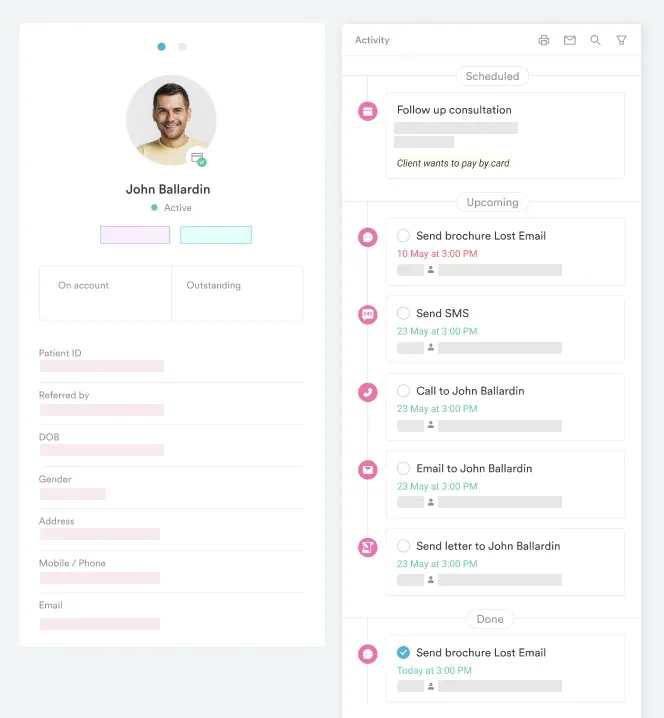
In most practices, the cervical and brachial detail behind an M53.1 claim lives in three places. Some of it is on a paper intake sheet, some in a free-text note, and some only in the clinician’s memory. A coder then reconstructs the encounter after the fact, and the thin notes are the ones that come back denied.
Practice management software like Pabau closes that loop at the source. Patients complete a structured intake form before the visit, and it prompts for neck and arm symptoms, onset, and duration. Those answers land straight in the patient record. The clinician’s provocation test results and treatment plan sit in the same file, alongside the diagnosis code.
Billing then works from that record rather than around it, so an M53.1 claim goes out with the documentation already attached. You spend less time rebuilding notes for an appeal, and your team gets paid on the first submission far more often.

Pabau captures the cervical and brachial detail that supports ICD-10 code M53.1 at intake, then carries it through to the claim. Chiropractic, physical therapy, and orthopedic teams submit once and get paid.

M53.1 is the honest code for a presentation you have not fully explained yet. That is its job, and coding it well means writing down what you found and what you have not ruled out. Reach for M54.12 the day imaging or nerve studies confirm a root, and not before.
The trade-off worth remembering is this. M53.1 stays defensible only while the record shows both symptom components and your differential reasoning. Fix that at intake and the code stops being a denial risk. Book a demo to see how Pabau keeps musculoskeletal documentation and billing in one place.

Coding a chest wound-check visit? Back thorax puncture wound code covers the details that decide whether this back thorax puncture wound claim survives review.
Coding a T4 vertebra fracture with nonunion? T4 vertebra fracture code explains why this T4 fracture code names the vertebra exactly despite the unspecified fracture type.
Coding an unstable T5-T6 fracture? T5-T6 burst fracture code covers the code for an unstable open burst fracture of the T5-T6 vertebra.
Coding a T7-T8 vertebra fracture? T7-T8 fracture coding guide covers the 7th character and documentation details this T7-T8 vertebra fracture code requires.
ICD-10 code M53.1 is used to diagnose cervicobrachial syndrome, which involves combined neck and upper extremity symptoms without confirmed nerve root compression. It is the correct code when a provider documents both the cervical and brachial components but has not yet confirmed radiculopathy.
Yes. ICD-10 code M53.1 is a billable, specific code valid for FY2026, effective October 1, 2025. It can be used as a primary or secondary diagnosis on insurance claims, with no more granular sub-code required.
M53.1 applies when cervical and brachial symptoms are present but nerve root compression is unconfirmed. M54.12 is more specific and applies once imaging or electrodiagnostic studies confirm nerve root involvement. Move from M53.1 to M54.12 as soon as that confirmation arrives.
No. M53.1 has no laterality sub-codes in the ICD-10-CM tabular list for FY2026. Do not append a modifier such as -RT or -LT, because the code does not support it and doing so may cause claim errors.
The codes cross-referenced most often are M54.2, M54.12, M53.0, M50.12, and G54.2. The right choice depends on which symptoms the record documents and whether radiculopathy has been confirmed. Check the current tabular list before you submit.
Chiropractic and physical therapy practices are the highest-volume submitters of M53.1. Orthopedic surgery, neurology, pain management, osteopathy, occupational medicine, and primary care also use it regularly, usually during initial assessment before imaging.