Skin clinic software Australia: 6 best picks, AUD prices
Skin clinic software in Australia costs a two-practitioner practice between A$84...

Last Updated: Sep 22, 2026

An MBS item number is a code in the Medicare Benefits Schedule that identifies one subsidized professional service.
Every item pairs that code with a descriptor, a schedule fee, and the benefit Medicare pays against that fee.
MBS Online is the only authoritative source, and each item page shows when the descriptor and the fee last changed.
Most schedule fees are indexed on 1 July, so a printed list has a shelf life of about a year.
The cheat sheet below covers the items a general practice front desk meets in a normal week, grouped by scenario.
Nine printable cards covering consults in rooms, home visits, aged care, after hours, video and phone, care plans, health assessments, mental health plans and ECGs. A final card shows how to read any MBS item, and every fee was verified on 14 August 2026.
Download templateBetween 2015 and 2020 the MBS Review Taskforce worked through more than 5,700 MBS items. A general practice front desk needs about 30 of them. If your general practice also offers cosmetic add-ons, our med spa management software guide compares platforms for that side of the business.
MBS Online holds all of them, and it is the only source worth trusting. It is also organized around the schedule, not around your Tuesday morning.
This guide covers the mechanics in plain English. Then it gives you the everyday item numbers grouped by the job you are doing. They are in the page, and in a cheat sheet you can pin up.
Every item number, schedule fee and rule below was checked against MBS Online on 14 August 2026. The fees are the 1 July 2026 figures.
An MBS item number is a unique code in the Medicare Benefits Schedule that identifies one subsidized professional service. Each item pairs that code with a descriptor, a schedule fee, and the benefit Medicare pays against that fee.
The descriptor decides whether you can claim. It sets out who must provide the service, how long it must take, where it happens, and what must be done.
Descriptor logic like that is not unique to the MBS. American practices bill from the CPT code set instead, where a blood draw is coded as 36410 or 36416. The detail in the record decides which one.
The schedule fee is the reference amount attached to the item. Medicare calculates a benefit from it, and that benefit is the money that reaches the patient or the practice.
Three benefit levels do most of the work. Non-referred GP attendances on non-admitted patients attract 100% of the schedule fee. Other out-of-hospital services attract 85%, and services provided as part of hospital treatment attract 75%.
The schedule’s authority comes from the Health Insurance Act 1973 and the Health Insurance Regulations 2018, plus the services tables made under them. Items can also be added by determination under section 3C of the Act.
One line on MBS Online is worth committing to memory. Its publications are not legal documents, and where they and the legislation disagree, the legislation decides what Medicare pays.
Reading an item is a separate question from being allowed to bill it. That depends on holding a provider number and on your Medicare billing privileges.
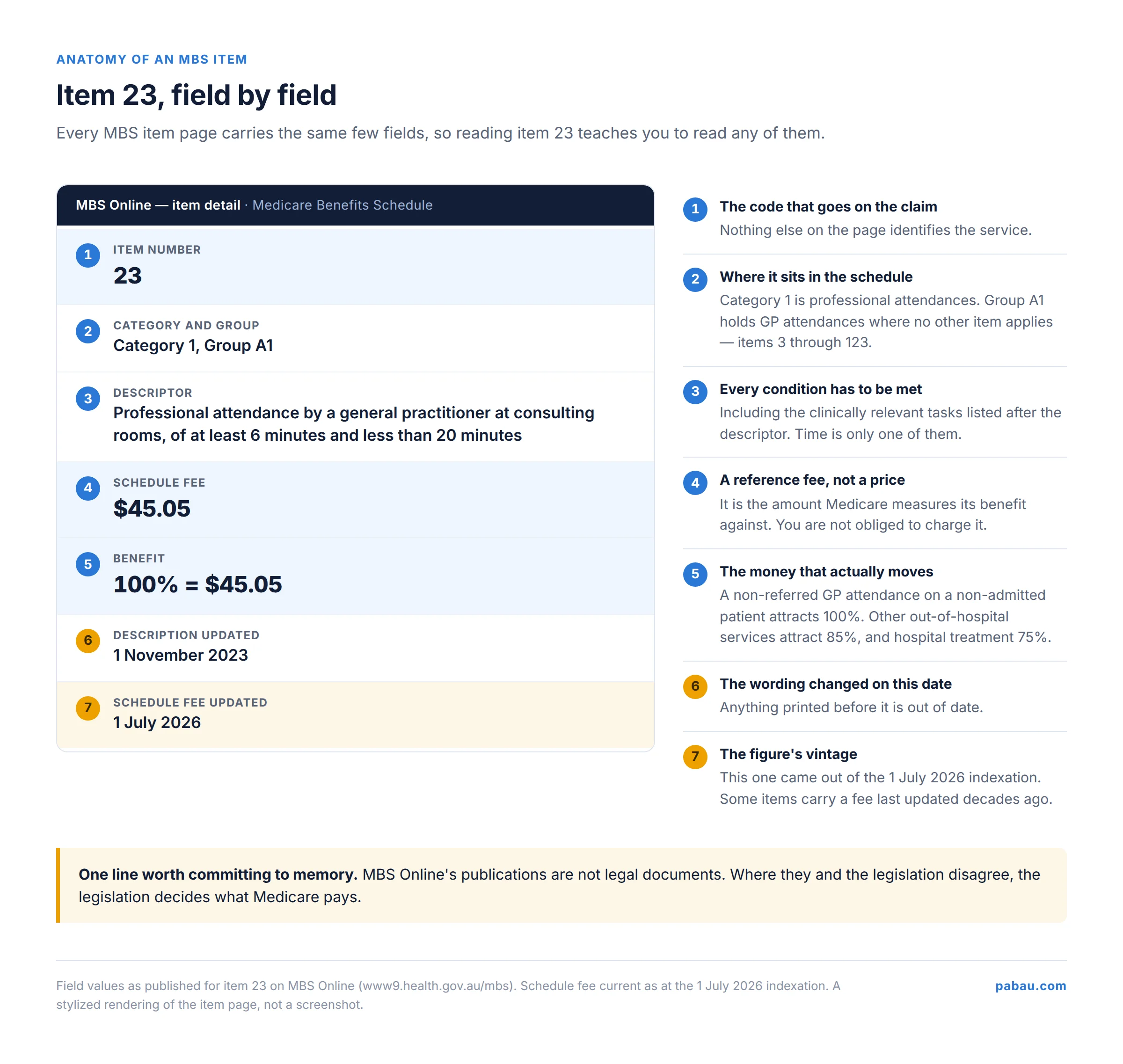
Item 23 is the most-billed consult in Australian general practice. Here is what each field on its MBS Online page is telling you.
| Field | What item 23 says | What it means for you |
|---|---|---|
| Item number | 23 | The code that goes on the claim |
| Category and group | Category 1, Group A1 | A professional attendance, in the group for GP attendances where no other item applies |
| Descriptor | GP attendance at consulting rooms, at least 6 minutes and less than 20 minutes | Every condition has to be met, including the clinically relevant tasks listed after it |
| Schedule fee | $45.05 | The reference fee Medicare measures against, not a price you have to charge |
| Benefit | 100% = $45.05 | A non-referred GP attendance on a non-admitted patient attracts the full schedule fee |
| Description updated | 1 November 2023 | The wording changed then, so anything printed earlier is out of date |
| Schedule fee updated | 1 July 2026 | The current figure came out of the 1 July 2026 indexation |
The Medicare Benefits Schedule is organized into eight categories, and each one splits into groups and subgroups.
Category 1 is the one general practice lives in. Attendances, care plans, health assessments, mental health items and telehealth all sit there.
Groups narrow it further. Group A1 holds GP attendances where no other item applies, which is where items 3 through 123 belong.
| Category | Name | What lives here | Example item |
|---|---|---|---|
| 1 | Professional attendances | Consults, care plans, health assessments, mental health items, telehealth | 23 |
| 2 | Diagnostic procedures and investigations | ECGs, spirometry, sleep studies and similar in-practice tests | 11714 |
| 3 | Therapeutic procedures | Surgical operations, skin procedures, obstetrics, radiation oncology | 30071 |
| 4 | Oral and maxillofacial services | Consultations and surgery by approved dental practitioners | 51700 |
| 5 | Diagnostic imaging services | Ultrasound, CT, diagnostic radiology, nuclear medicine imaging | 55028 |
| 6 | Pathology services | Haematology, chemistry, microbiology and other requested tests | 65070 |
| 7 | Cleft and craniofacial services | Treatment under the cleft lip and palate scheme | 75002 |
| 8 | Miscellaneous services | Bulk billing incentives, practice nurse services, allied health items | 10990 |
MBS Online’s search also offers categories 9 and 10. Those cover dental services and the Dental Benefits Schedule, so ignore them unless that is your work.
Other schedules cut the same work into different pieces. The American code 32555 bundles imaging guidance into the procedure itself, rather than leaving the imaging to a separate item.
Search MBS Online, open the item page, then read the explanatory notes linked from it. That is the whole method, and every other route is a shortcut back to it.
The HPOS checker has two limits worth knowing. It will not check in-hospital items, and it will not check eligibility that depends on a MyMedicare registration.
Reading past the descriptor is the habit that travels. A US biller working on 37215 checks the modifier rules and the payer fee schedule before the claim goes out.
There is also no official MBS app. Third-party apps exist and some are good, but only MBS Online is current by definition.
The checker asks for the provider number and location you are claiming under. A new starter therefore needs a Medicare provider number before anyone can check anything on their behalf.
These are the items a general practice meets most weeks, grouped by the job rather than by number. It is the same order the cheat sheet uses.
Every figure is the schedule fee as at 14 August 2026. What you charge on top of it is a separate decision, covered in our guide to Medicare billing.
Five time tiers cover a standard consult in consulting rooms during business hours. All five pay a benefit of 100% of the schedule fee.
| Item | Level | Time with the patient | Schedule fee |
|---|---|---|---|
| 3 | Level A | An obvious problem, short and straightforward | $20.55 |
| 23 | Level B | At least 6 minutes and less than 20 minutes | $45.05 |
| 36 | Level C | At least 20 minutes | $87.10 |
| 44 | Level D | At least 40 minutes | $128.35 |
| 123 | Level E | At least 60 minutes | $207.90 |
Only time spent with the patient counts toward the tier. Note-writing counts while the patient is present, and that is the distinction people miss.
One rule sits above all of them. If a more specific item describes the service, claim that item instead of a general attendance.
Specificity does the same job in the US code set. There, 36247 marks how far the catheter was advanced, and the note has to show it.
Level E only arrived on 1 November 2023. Plenty of cheat sheets in circulation still stop at Level D, so check whatever is taped to your desk.
A home visit has no flat schedule fee. Out-of-rooms attendance items use a derived fee built from the equivalent in-rooms item.
Item 24 shows how it works. Its fee is the fee for item 23, plus $31.50 divided by the number of patients seen, up to six patients.
For seven or more patients it becomes item 23’s fee plus $2.50 per patient. So a single home visit pays best per patient, and a full round pays less each.
Residential aged care is simpler. Those items carry the same schedule fees as the matching in-rooms tiers.
| Setting | Level A | Level B | Level C | Level D | Level E |
|---|---|---|---|---|---|
| In consulting rooms | 3 | 23 | 36 | 44 | 123 |
| Out of consulting rooms | 4 | 24 | 37 | 47 | 124 |
| Residential aged care | 90020 | 90035 | 90043 | 90051 | 90054 |
After-hours consults have their own item numbers and their own higher schedule fees. These are the in-rooms items.
| Item | Level | Time with the patient | Schedule fee |
|---|---|---|---|
| 5000 | Level A | An obvious problem, short and straightforward | $34.70 |
| 5020 | Level B | At least 6 minutes and less than 20 minutes | $58.65 |
| 5040 | Level C | At least 20 minutes | $100.55 |
| 5060 | Level D | At least 40 minutes | $140.95 |
| 5071 | Level E | At least 60 minutes | $239.45 |
In consulting rooms, after hours covers public holidays and Sundays. On a Saturday it means before 8am or after 1pm. On any other day it means before 8am or after 8pm.
Out of rooms and in residential aged care the cutoffs shift. There the Saturday line is noon and the weekday line is 6pm.
Those settings have their own item numbers, again on derived fees. Out of rooms runs 5003, 5023, 5043, 5063 and 5076, and aged care runs 5010, 5028, 5049, 5067 and 5077.
Two items now cover a GP chronic condition management plan. Item 965 prepares the plan and item 967 reviews it, each with a schedule fee of $160.60.
This is the change most likely to be wrong on an old cheat sheet. Items 721, 723 and 732 ceased on 1 July 2025.
GP management plans, team care arrangements and their review items all went at once. One preparation item and one review item replaced the whole set.
| Item | What it covers | Schedule fee | Notes |
|---|---|---|---|
| 965 | Preparing a GP chronic condition management plan | $160.60 | Started 1 July 2025, replacing item 721 |
| 967 | Reviewing a plan you or an associated practitioner prepared | $160.60 | Started 1 July 2025, replacing item 732 |
Dated guidance is the norm in coded billing. American billing guides for 36475 carry the year in the title, because the code set is revised annually.
Four items cover a GP health assessment, and length is the only thing that separates them. All four pay 100% of the schedule fee.
| Item | Assessment | Duration | Schedule fee |
|---|---|---|---|
| 701 | Brief | Not more than 30 minutes | $71.00 |
| 703 | Standard | More than 30 minutes, less than 45 | $165.05 |
| 705 | Long | At least 45 minutes, less than 60 | $227.75 |
| 707 | Prolonged | At least 60 minutes | $321.75 |
Four items cover preparing a GP mental health treatment plan. The item depends on the length and on whether the GP has completed mental health skills training.
| Item | Duration | Mental health skills training | Schedule fee |
|---|---|---|---|
| 2700 | At least 20 minutes, less than 40 | Not completed | $85.80 |
| 2701 | At least 40 minutes | Not completed | $126.35 |
| 2715 | At least 20 minutes, less than 40 | Completed | $108.95 |
| 2717 | At least 40 minutes | Completed | $160.50 |
The plan review and mental health consultation items came off the MBS on 1 November 2025. GPs now use ordinary general attendance items to review a plan or provide ongoing mental health care.
That is why items 2712 and 2713 return no result on MBS Online. If your software still offers them, the list behind it needs updating.
The ECG item most general practices bill is 11714, not 11707 or 11704. The three are not interchangeable, and the difference is who reports on the trace.
| Item | What it covers | Schedule fee | Benefit |
|---|---|---|---|
| 11714 | Trace and clinical note, by a medical practitioner | $29.00 | 85% = $24.65 |
| 11707 | Trace only, sent to a specialist or consultant physician for a formal report | $22.00 | 85% = $18.70 |
| 11704 | Trace and formal report by a specialist or consultant physician, on request | $37.40 | 85% = $31.80 |
These sit in Category 2, so the benefit is 85% rather than 100%. That catches people who assume every everyday item pays the full schedule fee.
Item 11714 also carries conditions in its descriptor. The clinical note must give the indication and interpret the trace, and a machine-generated reading alone will not do it.
Notes carry that weight under the US system as well. An operative record has to state that the catheter was not tunneled before 36556 holds up.
Telehealth has its own item numbers, and they mirror the in-rooms tiers at the same schedule fees. Video covers all five levels, and phone does not.
| Level | In rooms | Video | Phone | Schedule fee |
|---|---|---|---|---|
| Level A | 3 | 91790 | 91890 | $20.55 |
| Level B | 23 | 91800 | 91891 | $45.05 |
| Level C | 36 | 91801 | 91900 | $87.10 |
| Level D | 44 | 91802 | 91910 | $128.35 |
| Level E | 123 | 91920 | None | $207.90 |
Items 91900 and 91910 come with a condition. Those Level C and Level D phone items are only available for patients registered in MyMedicare.
Every item in the table also needs an eligibility test met before you claim it. One of three things has to be true.
Eligible telehealth practitioner is the term MBS Online adopted on 1 November 2025. It replaced established clinical relationship, and the underlying 12-month test did not change.
You qualify if you gave the patient a face-to-face service in the last 12 months. You also qualify if your practice arranged one for them in that time.
One trap catches practices out. A previous video or phone consult does not count as a face-to-face service for this test.
The patient-side exemptions cover infants under 12 months, people experiencing homelessness, and people in a natural disaster affected area. Patients of an Aboriginal Medical Service or an Aboriginal Community Controlled Health Service are also exempt.
Some services are exempt in their own right. Urgent after-hours services, specified mental health items, blood borne virus and sexual or reproductive health items, and GP chronic condition management plans all qualify.
Whichever exemption applies, record it. MBS Online requires the exemption and its clinical justification in the patient’s notes at the time of service.
Bulk billing incentives sit on top of the consult item rather than replacing it. Item 10990 is the standard one, with a schedule fee of $8.80.
Those items changed on 1 November 2025. The requirement that the patient be under 16 or hold a concession card came off, so any bulk billed Medicare-eligible patient now attracts the incentive.
Age often sits inside the code rather than the policy around it. The US code 36558 applies from age five, so the date of birth in the record settles it.
Most schedule fees change on 1 July, and the rules change on other dates through the year. Treat any printed list as dated from the day it is printed.
The indexation factor for 1 July 2026 was 2.6%. It applied to most general medical services items, most diagnostic imaging, and several pathology groups.
Indexation is never universal. The 1 July 2026 round left out PET items, nuclear medicine modifier items, and certain attendance items by doctors without vocational training.
Structural change lands on other dates entirely. Chronic condition management was rebuilt on 1 July 2025, and the mental health and telehealth rules moved on 1 November 2025.
That churn has a source. The MBS Review Taskforce examined more than 5,700 items between 2015 and 2020 and produced almost 1,400 recommendations. A continuous review has taken over since.
Two habits keep a desk reference honest. Subscribe to MBS Online news by email or RSS, and re-verify the sheet each July once indexation is in.
On any item page, check the “Description updated” and “Schedule fee updated” dates before you trust your memory. They are the fastest way to see whether something moved under you.
Picking the item number takes about 10 seconds. The booking, the note, the consent, the invoice and the recall take the rest of the day.
Practice management software like Pabau holds that side of the work in one place. Scheduling, client records, digital forms and consent, invoicing, payments, reminders and reporting all sit together.
Your claiming channel sends the claim itself. What Pabau does is keep the appointment, the note and the invoice behind it agreeing with each other. Once the code sits on the claim, the work shifts to submission, denials and appeals, which medical claims software covers.
That matters most when a query arrives months later. The time, the practitioner, the consent and the documentation are all in one client record instead of four systems.
So your front desk can check a schedule fee on MBS Online without also hunting for the note that justifies the item beside it.

Pabau keeps the appointment, the treatment note, the consent and the invoice in one client record. Your team can answer a billing query months later without opening four different systems.

Item numbers look like a memory test, and they are not one. They are a small set of rules about time, place, mode and who provided the service.
Learn those four variables and you can read any item on MBS Online, including ones you have never billed. The 5,700 stop being intimidating and start being searchable.
The reference at the front desk is the part that goes stale, not the reasoning. Print the cheat sheet, write the verification date on it, and swap it out each July.
The workflow around the item number is the part you control all year. Book a demo to see how Pabau keeps each consult’s record, consent and invoice in step.

Onboarding a new practitioner? How to get a Medicare provider number covers both application routes and the timeline you can plan around.
Stuck on the Ahpra billing privileges question? Billing privileges under the Medicare Australia Act 1973 explains what the form asks and how to answer it.
Setting up the billing side of the practice? Medicare billing for practices walks through the billing models, the claiming channels and the compliance rules.
An MBS item number is a code in the Medicare Benefits Schedule that identifies one subsidized professional service. Each item sets out a descriptor, a schedule fee, and the benefit Medicare pays against that fee. Item 23, for example, is a GP consult in consulting rooms lasting at least 6 minutes and less than 20 minutes.
Search MBS Online at www9.health.gov.au/mbs, either across all text or over item numbers only. Open the item page and read the descriptor, the schedule fee and the explanatory notes linked from it. To check one patient or your own claiming eligibility, use the MBS items online checker in HPOS.
Item 53 is a consultation at consulting rooms of more than 5 minutes and not more than 25 minutes. It is billed by a medical practitioner who is not a general practitioner, or by a Group A1 disqualified general practitioner. Its schedule fee is $21.00, and MBS Online records that fee as last updated on 1 December 1991.
The schedule fee is the reference amount the MBS attaches to an item, and the rebate is what Medicare actually pays. For a non-referred GP attendance on a non-admitted patient, the rebate is 100% of the schedule fee. Most other out-of-hospital services attract 85%, and services provided as part of hospital treatment attract 75%.
Schedule fees are indexed on 1 July most years, and the factor for 1 July 2026 was 2.6%. Item numbers and rules also change on other dates, including 1 November and 1 March. Re-verify any printed list at least once a year, straight after the July indexation.
Yes. GP video and phone items sit in the MBS as ongoing services, in Group A40, rather than as temporary measures. The eligibility conditions still apply. The patient must be registered in MyMedicare at your practice, or you must be their eligible telehealth practitioner. Otherwise an exemption has to apply.