

CPT Code 98981: RTM Treatment Management Billing Guide
CPT code 98981: Definition and official descriptor CPT code 98981 is an add-on c...

Last Updated: Nov 9, 2026
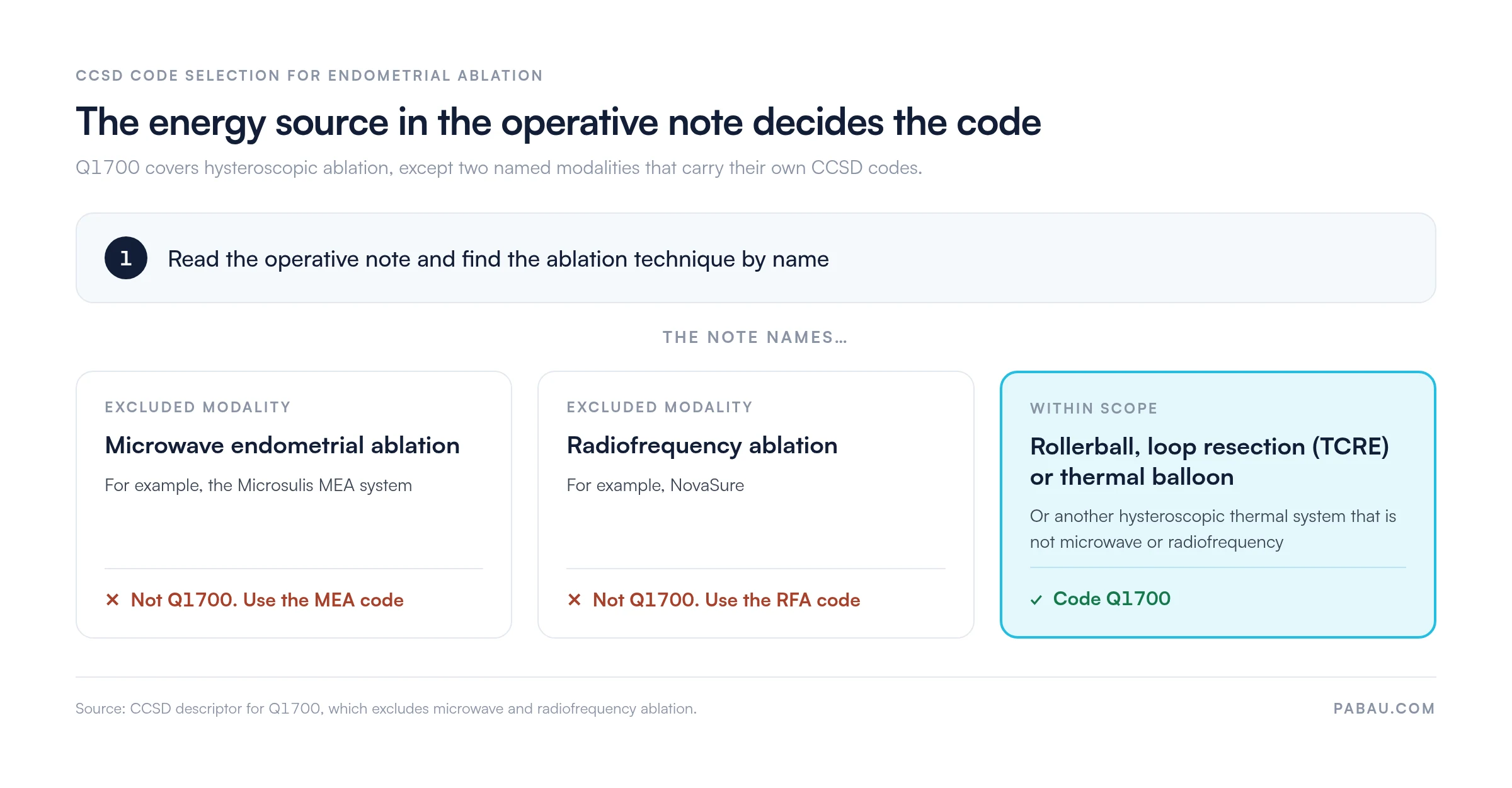
Q1700 is the CCSD code for therapeutic hysteroscopic operations on the uterus, including endometrial ablation, with or without Mirena coil insertion. It covers rollerball ablation, transcervical resection of the endometrium (TCRE) and thermal balloon systems.
Microwave and radiofrequency endometrial ablation are excluded from Q1700 and are billed under their own CCSD codes. The coder therefore confirms the energy source named in the operative note before assigning the code.
Let Pabau's smart automation suggest the right codes, reduce claim denials, and keep your practice compliant—effortlessly.
Automate repetitive tasks and focus on what matters most—your patients.
Reduce coding errors and ensure compliance with the latest regulations.
Clean claims, fewer denials, and faster reimbursements.
Powerful insights and reporting to help your practice thrive.
HIPAA compliant SOC 2 certified GDPR-compliant Trusted by 4,000+ clinics worldwide

CCSD code Q1700 covers hysteroscopic endometrial ablation, such as rollerball, loop resection and thermal fluid systems, with or without Mirena coil insertion.
Microwave and radiofrequency ablation are excluded from Q1700 and have their own CCSD codes.
The most common denial cause is coding a microwave or NovaSure procedure under Q1700, so confirm the operative technique before code selection.
Bupa, AXA Health, Aviva and Vitality all require pre-authorisation before endometrial ablation, and proceeding without it typically results in non-payment.
Pabau’s digital forms and claims tools help gynaecology practices capture the operative detail and authorisation codes that payers check on Q1700 claims.
CCSD code Q1700 is the Clinical Coding and Schedule Development code for therapeutic hysteroscopic operations on the uterus. Its official descriptor includes endometrial ablation, excludes microwave or radiofrequency ablation, and allows Mirena coil insertion in the same procedure. The CCSD schedule files it under Chapter 14, Uterus/Adnexa.
The code applies when the endometrium is destroyed with energy delivered through the hysteroscope, using any modality other than the two exclusions.
The “therapeutic endoscopic” descriptor distinguishes Q1700 from diagnostic hysteroscopy codes. A purely diagnostic hysteroscopy, with no operative intervention, falls under a different CCSD code. Q1700 applies only when a therapeutic procedure is carried out through the hysteroscope.
Therapeutic endoscopic operations on the uterus are hysteroscopic surgical procedures performed to treat abnormal uterine bleeding, most commonly menorrhagia. The procedure is typically performed as a day case under general or regional anaesthesia, with the hysteroscope introduced transcervically to access the uterine cavity.
Techniques within Q1700’s scope include:
The typical patient has abnormal uterine bleeding (ICD-10 N92.x or N93.x), has completed childbearing, and has not responded to medical management. NICE guidance NG88 sets out the clinical pathway, with hysterectomy as a further surgical option. That operation has its own CCSD codes, such as Q0880. The Royal College of Obstetricians and Gynaecologists (RCOG) and the British Society for Gynaecological Endoscopy (BSGE) provide clinical standards for the procedure.
The exclusion clause in the Q1700 descriptor is explicit. Microwave endometrial ablation and radiofrequency endometrial ablation are both carved out and require separate CCSD codes. Using CCSD code Q1700 for either of these techniques is a miscoding that payers will challenge.
When selecting a code from the operative note, the coder must identify the energy modality by name, as the diagram below shows. If the note says “NovaSure” or “Microsulis MEA system,” Q1700 does not apply. If the note describes hysteroscopic rollerball, loop resection, or thermal fluid delivery without naming a microwave or RF device, Q1700 is the correct code.
Several CCSD codes sit adjacent to Q1700 in the gynaecological endoscopy family. Knowing their boundaries prevents miscoding and supports accurate claim building. Billing guides for neighbouring procedures sit in the CCSD code library.
OPCS-4 is the NHS procedure classification used for NHS episodes and NHS reference costs. Practitioners working across NHS and private settings often need to cross-reference CCSD Q1700 to OPCS-4. Hysteroscopic therapeutic procedures sit in OPCS-4 category Q17, therapeutic endoscopic operations on uterus, and the subcode depends on the technique. Practices that also bill US payers report hysteroscopic endometrial ablation as CPT 58563.
OPCS-4 and CCSD do not map 1:1. The NHS Classifications Browser at classbrowser.nhs.uk provides authoritative OPCS-4 lookup. Treat any cross-reference as guidance only, and verify the subcode against the current OPCS-4 release for NHS coding purposes.
A complete private healthcare claim requires both the CCSD procedure code and the appropriate ICD-10 diagnosis code. Missing or mismatched diagnosis codes are a leading cause of claim rejection. The ICD-10 codes most commonly submitted alongside Q1700 are:
The principal diagnosis code should reflect the clinical reason the procedure was performed, not the procedure itself. If more than one diagnosis applies, list the primary indication first. Confirm coding with the consultant’s clinical letter and discharge summary before submission.
Payer adjudicators reviewing a Q1700 claim look for evidence in the operative note on two points. The procedure was performed hysteroscopically, and neither excluded modality was used. Vague documentation is the second most common trigger for claim queries after miscoding. Using digital operative note templates that prompt for each required field reduces the risk of incomplete records.
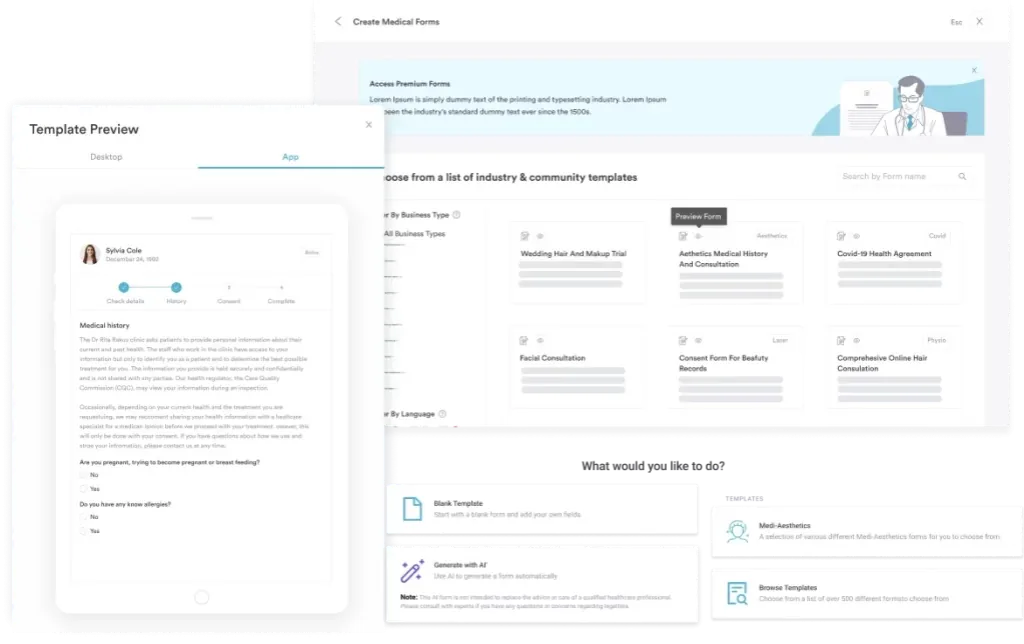
A valid operative note for a Q1700 claim should include:
If a concurrent procedure such as polypectomy was performed, document it as a distinct surgical step. Folding it into the ablation description undermines separate billing where the payer permits it. An endometrial biopsy taken at the same sitting has its own code, Q2020, and the same payer bundling check applies.
All major UK private health insurers require pre-authorisation before elective endometrial ablation. Proceeding without authorisation typically results in the claim being declined regardless of the coding accuracy. Payer rules change, so verify current policy on the insurer’s provider portal before the procedure date. For detailed guidance on submitting claims to Bupa, see Bupa’s CCSD billing requirements.
When authorisation is granted, retain the authorisation reference number. This number must appear on the claim invoice. If the procedure date changes, check whether the authorisation requires updating.
Bundling rules determine which CCSD codes can be billed concurrently with Q1700 on the same claim. Errors here cause two problems. Overbilling adds concurrent codes that Q1700 already includes, and underbilling misses a legitimately separate procedure.
Bundling rules are insurer-specific and may differ between Bupa, AXA Health, Aviva, and Vitality. Where the clinical record supports a concurrent procedure, add a brief explanation note to the claim. Reference the operative note section that documents the distinct surgical step.
Before billing a concurrent hysteroscopic polypectomy or myomectomy alongside Q1700, call the insurer’s provider helpline to confirm their current bundling policy. What one insurer bundles, another may allow as a separate line item. Keeping a log of payer-specific rulings saves time on future claims.
Understanding why Q1700 claims are rejected lets billing teams act before submission rather than after. The most frequent denial triggers and their preventive actions are listed below.
Claims software such as Pabau, the practice management platform we build, validates each claim before it leaves the practice. That check catches missing or invalid details, such as an absent authorisation code, before the insurer sees them.
Run a quarterly audit of Q1700 claims: pull every claim from the past 90 days and check the rejection rate and reason codes. If more than 5% are rejected for ‘incorrect code,’ review whether MEA or RFA cases are being miscoded as Q1700. If rejections cluster around ‘missing operative note,’ update your note template to include the energy modality field.
Most CCSD reference pages list code definitions but not the submission workflow. This step-by-step covers the path from operative list to paid invoice. Pabau’s claims management software sends the claim through Healthcode and tracks it from pending to paid.
Gynaecology practices billing under CCSD face the same tension as any specialty. The consultant spends the day in theatre, away from a billing workstation. Practice managers need the right detail captured during the patient journey, without phoning the consultant each time a payer queries a claim.
Pabau keeps the clinical record and the billing record on one patient file. Treatment note templates prompt for the hysteroscope, energy source and technique, so the operative note carries the evidence a coder needs for Q1700.
Each insurer’s pre-authorisation is stored as a case, and its authorisation code follows the appointment through to the claim. Claim validation flags missing details before the claim goes to Healthcode, and a rejected claim comes back with its reason attached.

Pabau helps gynaecology practices and private healthcare teams document procedures correctly, track pre-authorisation status, and submit accurate claims, all from one place.

Q1700 claims rarely fail on the code itself. They fail when the operative note never names the energy source, or when the claim reaches the insurer without its authorisation reference.
Fix both at the source. Build the modality into the operative note template, and log the authorisation before the theatre date. A coder can then choose between Q1700 and the MEA or RFA codes quickly, and defend the choice if the insurer queries it.
Book a demo to see how Pabau links the operative note, the pre-authorisation and the Healthcode claim for gynaecology practices.

Need a full reference for Bupa’s CCSD codes? Bupa CCSD billing guide covers how Bupa applies the CCSD schedule across specialties, including gynaecology.
Taking an endometrial sample at the same sitting? CCSD code Q2020 explains how to code and bill an endometrial biopsy or aspiration.
Moving on to surgery after a failed ablation? CCSD code Q0880 covers the documentation and billing for a hysterectomy claim.
Want to reduce claim rejections across your practice? Pabau’s claims management software helps private practices track submissions, spot rejection reasons and respond to payer queries faster.
CCSD code Q1700 covers therapeutic hysteroscopic operations on the uterus, with or without Mirena coil insertion. That includes endometrial ablation by rollerball, loop resection and non-microwave thermal fluid systems. Microwave and radiofrequency ablation are excluded and have their own CCSD codes.
No. Microwave endometrial ablation is explicitly excluded from CCSD code Q1700 by the official code descriptor. It has its own distinct CCSD code. Verify the current code number against the CCSD schedule before submission, as codes are periodically updated.
The most common ICD-10 pairings are N92.0 for menorrhagia with a regular cycle and N92.1 for excessive menstruation with an irregular cycle. N93.8 covers other specified abnormal uterine bleeding. Select the code that most accurately reflects the consultant’s documented indication.
Diagnostic hysteroscopy performed solely as access for the ablation is generally not separately billable alongside Q1700, as it is considered integral to the procedure. A concurrent therapeutic hysteroscopic procedure (polypectomy, myomectomy) may be separately billable, but rules vary by insurer, so confirm before billing.
OPCS-4 places therapeutic hysteroscopic procedures in category Q17, therapeutic endoscopic operations on uterus, and the subcode depends on the technique. OPCS-4 and CCSD do not map 1:1. Always verify against the current OPCS-4 release via the NHS Classifications Browser for NHS coding purposes.




