CCSD code S0923: Billing, documentation, and funder guide
CCSD code S0923: Official descriptor and procedure overview CCSD code S0923 is a...

Last Updated: Nov 19, 2026
Q2080 is the CCSD code for ventro-suspension of uterus (including laparoscopic). It's a gynecological operation that lifts the uterus forward and secures it in place, rather than removing it. The code sits in Chapter 14 of the CCSD schedule, Female reproductive organs. UK private medical insurers, including Bupa, AXA Health, Aviva and Vitality, use it on claims and set their own fees.
One code covers both the open and the laparoscopic route, so the approach rarely sinks a claim. The paperwork around it does. A missing pre-authorization, a vague operative note or a second pelvic procedure billed unchecked will stall payment.
Let Pabau's smart automation suggest the right codes, reduce claim denials, and keep your practice compliant—effortlessly.
Automate repetitive tasks and focus on what matters most—your patients.
Reduce coding errors and ensure compliance with the latest regulations.
Clean claims, fewer denials, and faster reimbursements.
Powerful insights and reporting to help your practice thrive.
HIPAA compliant SOC 2 certified GDPR-compliant Trusted by 4,000+ clinics worldwide

CCSD code Q2080 is ventro-suspension of uterus (including laparoscopic), a gynecological procedure in Chapter 14 of the CCSD schedule.
One code covers both the open and the laparoscopic route, so the operative note must say which approach the surgeon used.
Bupa, AXA Health, Aviva and Vitality pay Q2080 under their own policy terms, and pre-authorization rules differ by payer.
Most denials trace back to a missing pre-authorization, a second pelvic procedure billed without a schedule check, or a policy exclusion.
Pabau, the practice management platform we build, sends CCSD-coded claims through Healthcode and tracks each one to payment.
CCSD code Q2080 is the UK private-sector code for ventro-suspension of uterus (including laparoscopic).
The CCSD Technical Guide places codes starting with Q in Chapter 14, Female reproductive organs, and that’s where Q2080 sits. The surgeon lifts the uterus forward and secures it toward the front of the pelvis, so it’s repositioned rather than removed.
The CCSD Group maintains the schedule, and UK private medical insurers use it to identify procedures on a claim. Fees sit outside the schedule, because each insurer sets its own. Check the descriptor against the current release each year, since the schedule is updated.
Neighboring Chapter 14 codes, from hysteroscopy to oophorectomy, are listed in our full CCSD code library.
Common indications include a retroverted uterus linked to deep dyspareunia or pelvic pain, often treated alongside endometriosis surgery. Some gynecologists also use it for uterine prolapse when the patient wants to keep her uterus. When the uterus is removed through the vagina instead, with no laparoscope, the operation is billed under Q0800.
Whatever the reason, the indication has to be written down before the claim goes anywhere.
The adjudicator reads your claim next to the clinical record. If the two tell different stories, the claim stalls. Every Q2080 submission should be backed by these records before it leaves the practice:
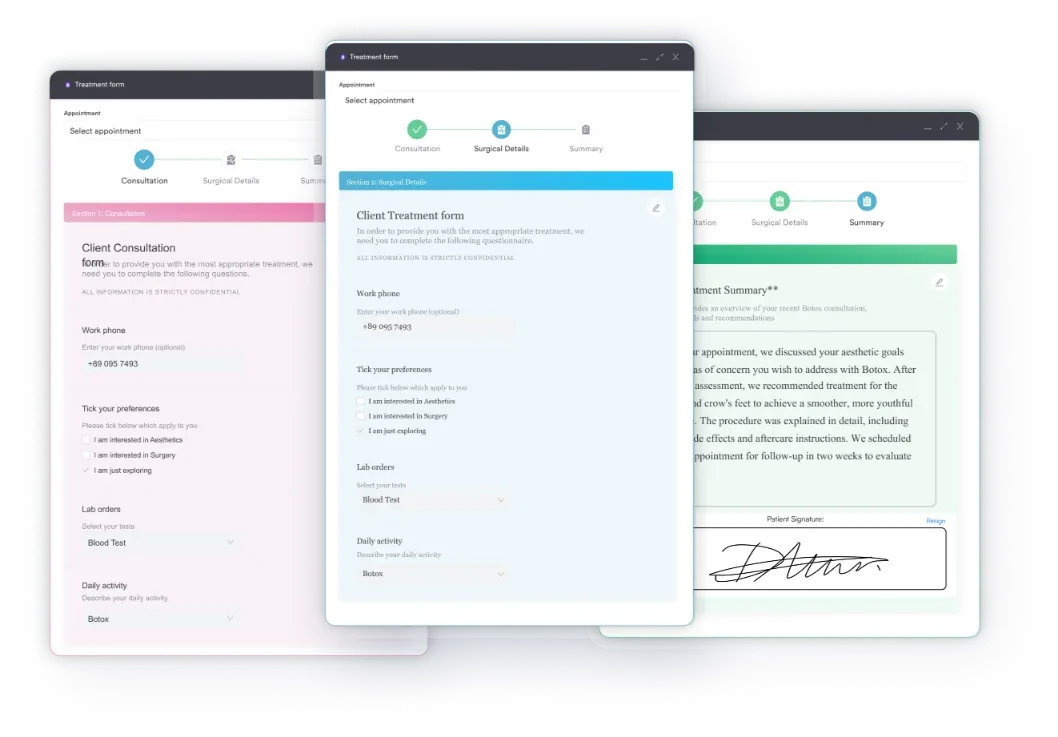
Practices that capture consent through digital forms keep it on the same record as the operative note. That makes the pre-submission check a two-minute job rather than a hunt through paper files.
The major UK private medical insurers work from the CCSD schedule. Whether they pay Q2080 for a given patient depends on the member’s policy, its exclusions and any benefit limits.
Use the payer’s own lookup before you book the theater date. For Bupa members, our Bupa CCSD codes guide covers its accepted codes and submission requirements.
Pre-authorization is a conditional approval, not a promise of payment. An insurer can authorize Q2080 and still decline the claim if the notes don’t match what it approved.
Most payers ask for the consultant’s details, the CCSD code and descriptor, the written indication and the planned date. If the date moves, or a second procedure joins the plan, update the authorization before surgery. Retrospective requests depend entirely on each payer’s rules, so don’t plan around one.
Most UK private practitioners submit CCSD-coded claims electronically through Healthcode, the clearing service the major insurers use.
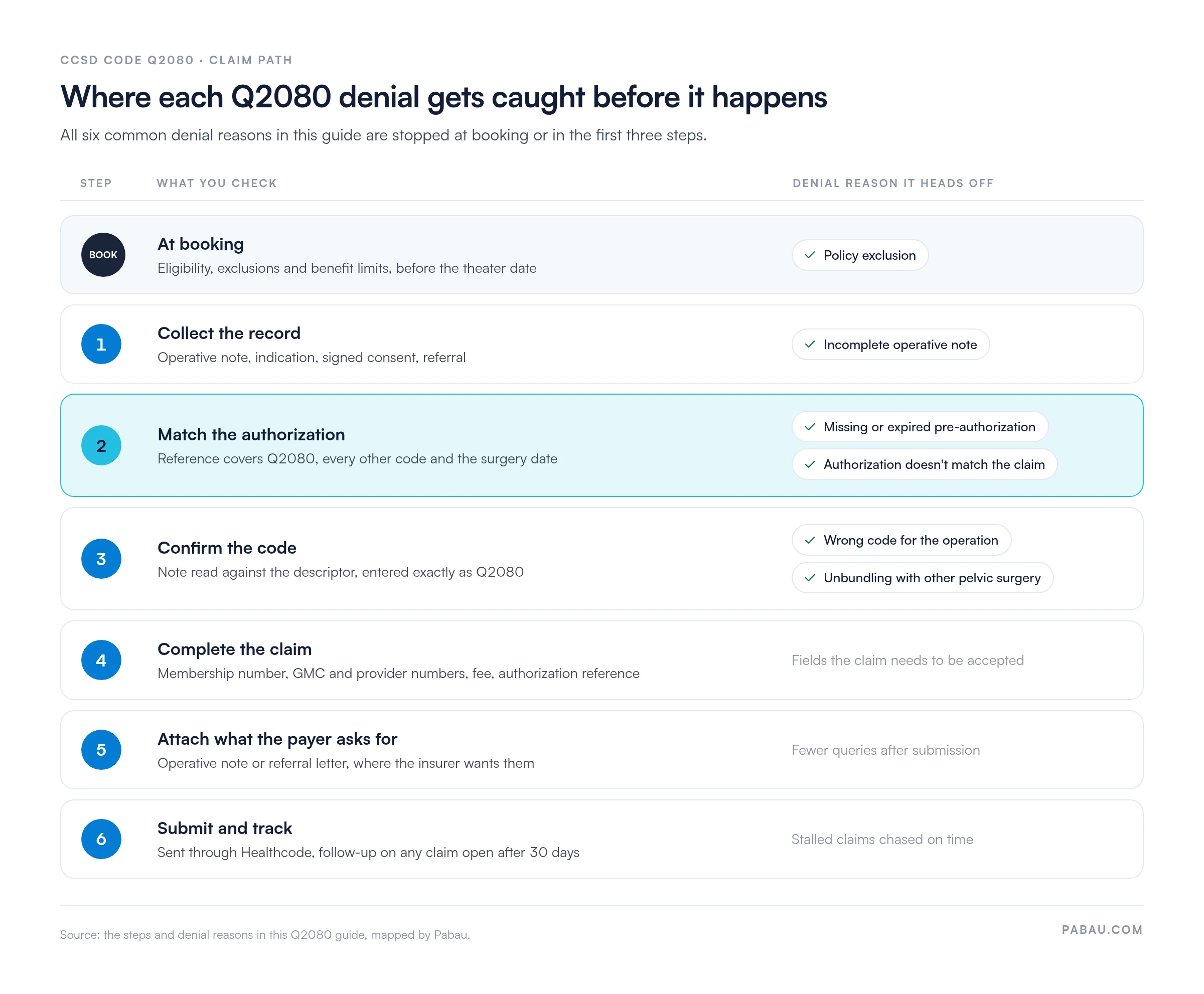
Here’s the route a clean Q2080 claim takes, and the chart shows which denial reason each step heads off.
A consultant gynecologist plans laparoscopic excision of endometriosis with ventro-suspension for an insured patient. The secretary’s pre-authorization request lists only the excision code, which depends on the extent of the disease.
Our Q3900 guide covers laparoscopy that includes minor endometriosis. During the pre-submission check a week before surgery, the billing lead notices Q2080 is missing.
She asks the insurer to add Q2080 to the authorization and records the new reference on the patient record. After surgery, the operative note describes each procedure in its own paragraph.
The claim lists both codes, and the adjudicator can match each one to the note. Found after surgery, the missing code would have meant a denial and an appeal.
Q2080 denials repeat the same few patterns. Match the rejection to a row below, and you’ll know what evidence to gather before you resubmit.
The CCSD Technical Guide backs up the unbundling row. It says each insurer has its own contractual rules on using two procedure codes, so contact the payer before you bill Q2080 alongside another code.
Review denied Q2080 claims once a month and sort them by reason. If authorization mismatches lead the list, fix the pre-authorization request form so it lists every planned procedure by code.
A denial isn’t the final word. UK insurers run formal review processes, and an appeal backed by clinical evidence often turns the decision.
In many private gynecology practices, the secretary re-keys the operative details into Healthcode by hand. The pre-authorization reference lives in a spreadsheet, and unpaid claims are chased by phone. Each handoff is a chance for the record and the claim to drift apart.
Pabau, the practice management platform we build, keeps the record and the claim together. Its Healthcode integration sends CCSD-coded claims straight from the patient record. Required fields, such as membership numbers and authorization codes, are checked before a claim can be sent.
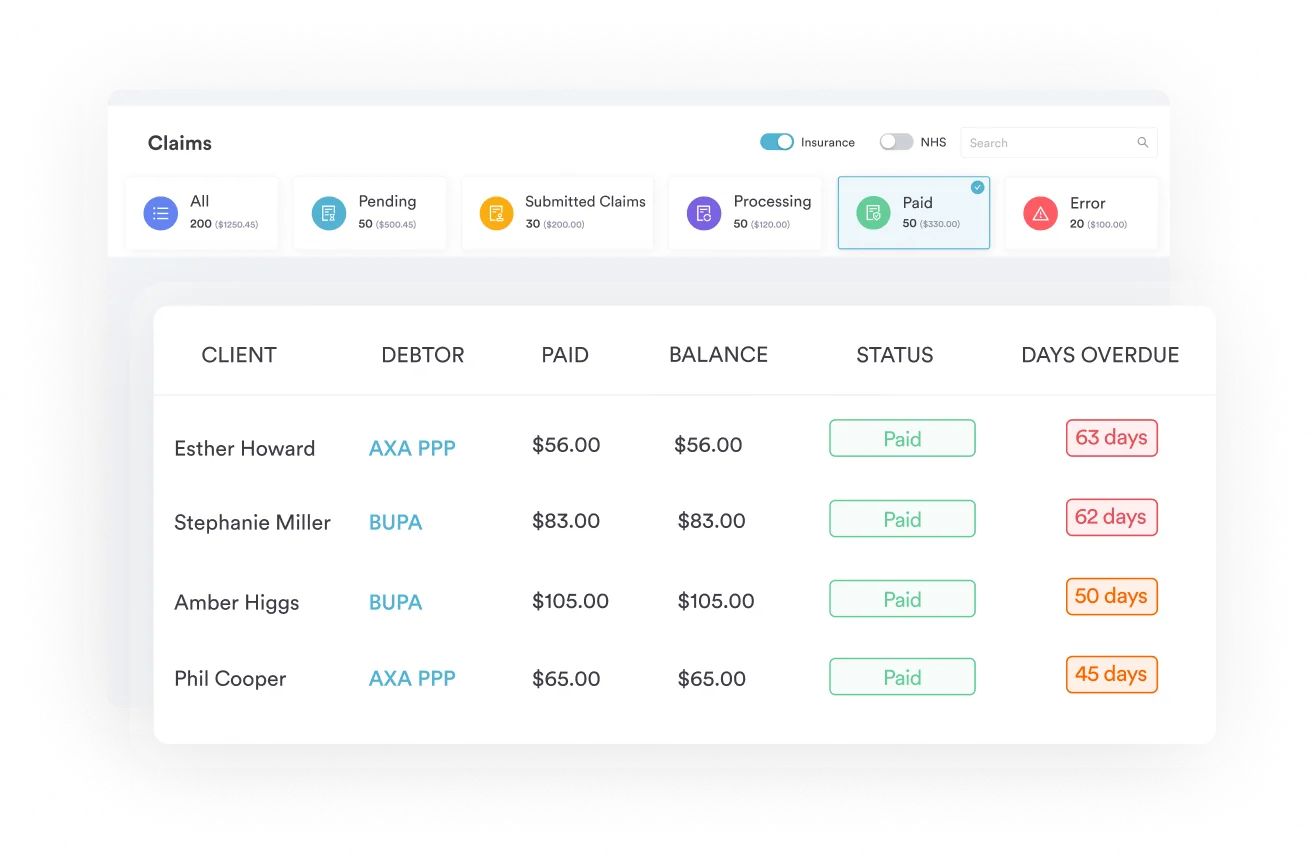
Your team still makes the coding decision. Pabau’s claims management software pre-fills the claim from the patient record, while consent forms, notes and the authorization reference sit on one record. Claim status tracking and payment reconciliation then show which claims are still open.

Pabau keeps consent, notes and the pre-authorization reference on the patient record, submits CCSD-coded claims through Healthcode and tracks each one to payment.

Q2080 is one of the easier CCSD codes to assign, because one entry covers both routes. The risk sits around it. Watch for an authorization that named the wrong procedures, a second pelvic procedure billed unchecked, or a vague note.
Fix the pre-authorization request first. When it lists every planned procedure by code and date, most later problems never start. Then make sure the operative note gives the suspension step its own paragraph.
If your team still copies operative details into Healthcode by hand, each claim carries a fresh chance of a mismatch. Book a demo to watch a Q2080 claim go from patient record to payment without re-keying.

Need the full Bupa CCSD coding reference? Bupa CCSD codes covers Bupa’s accepted procedure codes, fee structure and submission requirements.
Billing another gynecology procedure? CCSD code Q2020 walks through documentation and submission for endometrial biopsy or aspiration.
Coding hysteroscopic work too? CCSD code Q1700 covers therapeutic endoscopic operations on the uterus.
Removing ovaries and tubes at laparoscopy? CCSD code Q2230 covers bilateral laparoscopic oophorectomy and salpingectomy as a sole procedure.
Treating fibroids hysteroscopically? CCSD code Q1802 covers hysteroscopic resection of fibroids and its billing documentation.
Often, when it’s medically indicated and the policy covers gynecological surgery. Cover depends on the member’s plan, exclusions and benefit limits. Check eligibility and get pre-authorization before booking the theater date.
No. CCSD codes are used for private claims in the UK. NHS hospitals record procedures with OPCS-4 codes, so the same operation can carry two different codes.
It’s one form of it. Hysteropexy means suspending the uterus rather than removing it. Ventrosuspension anchors it toward the front of the pelvis, while sacrohysteropexy attaches it to the sacrum, usually with mesh.
The consultant gynecologist bills their fee under Q2080. The hospital invoices its own charges, and an anesthetist bills separately. All three invoices should match the authorized date and procedures.
Yes. The descriptor covers both routes, so a converted case stays under Q2080. Record the conversion and the reason in the operative note.