CPT code 34812: Open femoral artery exposure for endovascular repair
CPT code 34812: Official descriptor and procedure overview CPT code 34812 is off...

Last Updated: Nov 19, 2026
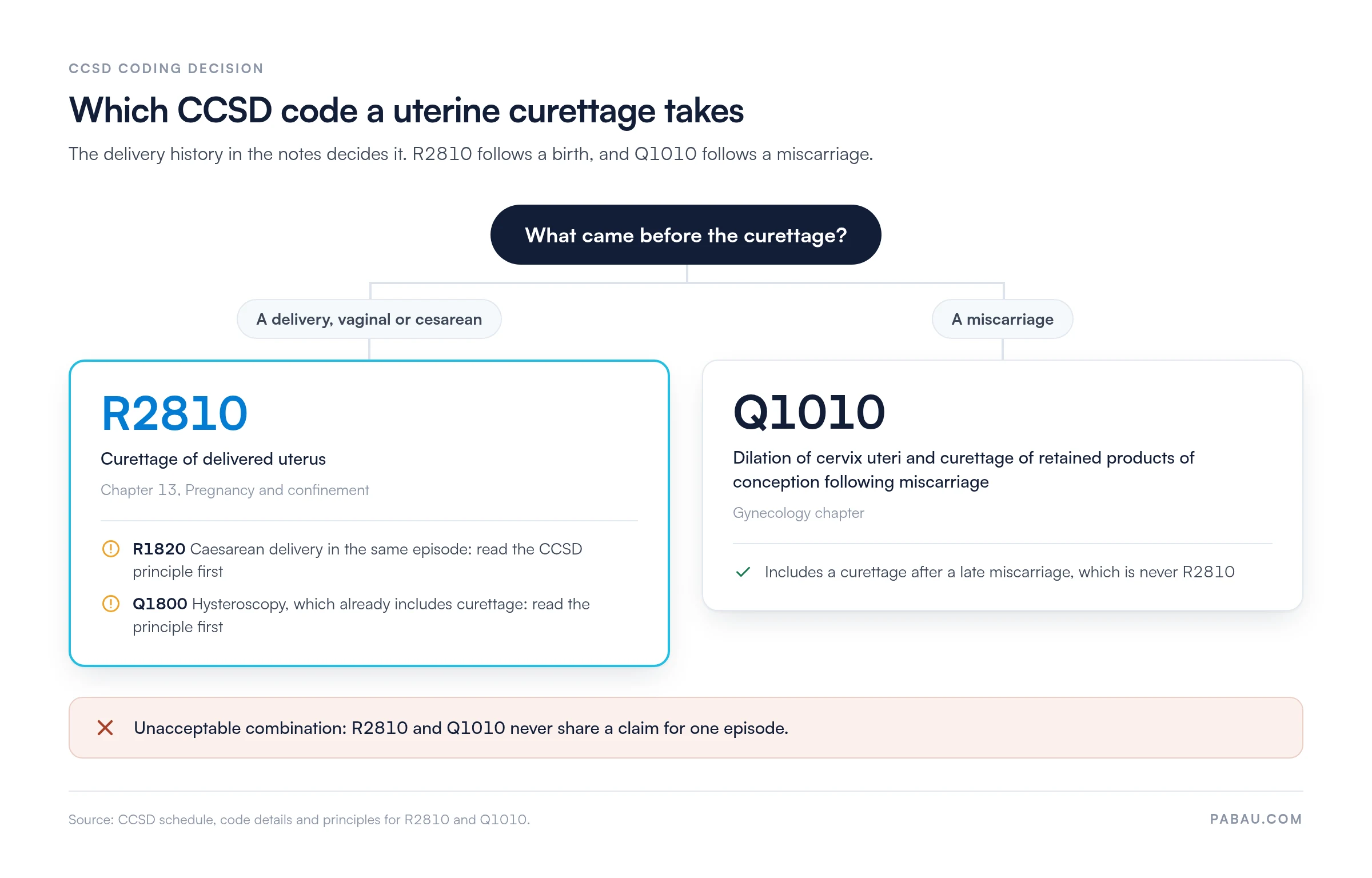
R2810 is the CCSD code for curettage of a delivered uterus, listed in Chapter 13, Pregnancy and confinement. A consultant bills it after curetting the uterus for retained placental tissue or bleeding following a vaginal or cesarean birth.
Curettage after a miscarriage is Q1010 instead. CCSD lists the two codes as an unacceptable combination, so they never share a claim for one episode.
Let Pabau's smart automation suggest the right codes, reduce claim denials, and keep your practice compliant—effortlessly.
Automate repetitive tasks and focus on what matters most—your patients.
Reduce coding errors and ensure compliance with the latest regulations.
Clean claims, fewer denials, and faster reimbursements.
Powerful insights and reporting to help your practice thrive.
HIPAA compliant SOC 2 certified GDPR-compliant Trusted by 4,000+ clinics worldwide

CCSD code R2810 is curettage of a delivered uterus, an obstetric procedure in CCSD Chapter 13, Pregnancy and confinement.
It’s for retained placental tissue or membranes after a birth, not for curettage after a miscarriage, which is Q1010.
CCSD lists Q1010 as an unacceptable combination with R2810, so never bill the two together for one episode.
The operative note should record the indication, time since delivery, anesthesia, findings and whether tissue went to histology.
Many UK policies exclude pregnancy and childbirth, so check cover and pre-authorization before the claim leaves your practice.
CCSD code R2810 covers curettage of a delivered uterus. It’s the procedure obstetric teams use to clear retained placental tissue or stop bleeding after a birth. CCSD is the Clinical Coding and Schedule Development group, which maintains the CCSD procedure codes that UK private medical insurers use.
The official descriptor is short: “Curettage of delivered uterus.” The word that matters is “delivered.” R2810 applies once a baby has been born, whether vaginally or by cesarean section. Curettage of retained products after a miscarriage has its own code, Q1010, in the gynecology chapter.
Insurers set their own fee for each code, so check the member’s insurer schedule rather than a figure quoted elsewhere. Our guide to Bupa CCSD codes shows how one large insurer works with the schedule.
Check the code’s status too, because the public CCSD record carries an unusual inactive date beside its 2010 creation date. Confirm R2810 is current in the logged-in schedule before you bill it.
Most R2810 cases fall into one of three situations. Each one leaves a different trail in the notes, so it helps to know which you’re coding.
In all three, the procedure is done under anesthesia in the operating room. The tissue removed is often sent to histology to confirm what it was.
Insurers rarely read the full notes on a routine claim. They do ask for them when a claim is queried, and a thin operative note is hard to defend. Make sure each of these is on file before you invoice.
CCSD’s coding principles link R2810 to three other codes. One of them is a flat no. The other two depend on what was performed, so read the principle wording in the logged-in schedule before you combine anything.
The Q1010 mix-up runs both ways. A curettage after a late miscarriage isn’t R2810, and a curettage after a birth isn’t Q1010. The delivery history in the notes settles it, as the decision below shows.
Here’s the usual path for a privately insured patient. Emergency cases follow the same steps, just with authorization chased afterward.
UK insurers expect a diagnosis that justifies the procedure. For R2810, that’s usually a code from the postpartum hemorrhage or retained placenta categories. The titles below are from the WHO’s ICD-10.
Pick the code that matches the operative note, not the one that seems most likely to pay. If your practice uses a clinical coder, have them confirm the pairing for complex cases.
Most rejections trace back to cover or coding, not to the surgery. The table maps the usual reasons to a fix.
Here’s an illustrative case. A privately insured patient gives birth vaginally, and the placenta is recorded as complete. Nine days later, she returns with heavy bleeding.
An ultrasound shows tissue in the uterine cavity. Her consultant performs a curettage under general anesthesia, and the tissue goes to histology. The operative note records the delivery date, the scan, the blood loss and the findings.
The practice codes R2810 with O72.2, delayed and secondary postpartum hemorrhage. The insurer confirms her policy covers this complication and issues an authorization number. The anesthetist and the pathology lab submit their own claims for the same episode.
R2810 is a surgical code, so it’s billed by the consultant who performs the procedure. In practice, that’s a consultant obstetrician and gynecologist recognized by the member’s insurer.
Other clinicians in the episode bill on their own claims. The anesthetist submits a separate claim, and the pathology provider bills for any histology. The hospital invoices separately for the facility side.
Postpartum curettage is often unplanned, which is exactly when paperwork slips. The operative note gets written late, the authorization is chased after the fact, and the claim sits in a queue.
Pabau, the practice management platform we build, keeps the clinical and billing sides on one patient record. You can build operative note templates, store insurer and authorization details with the patient and raise insurer invoices from the same record. Claims go out electronically through Healthcode, and remittances are tracked against each invoice.
Obstetric teams get end-to-end claims management, so each R2810 invoice is followed from submission to remittance.

Pabau keeps operative notes, authorization numbers and insurer invoices on one patient record, then submits claims through Healthcode.

R2810 comes down to one question: was there a delivery? If yes, and the uterus was curetted for retained tissue or bleeding, R2810 is your code. If the episode followed a miscarriage, it’s Q1010, and the two never share a claim.
Get the operative note right, pair it with a postpartum diagnosis and confirm cover before the invoice goes. Those three steps prevent most of the rejections this code attracts.
Book a demo to see how Pabau links your operative notes to insurer claims.

Billing other CCSD codes for UK insurers? Bupa CCSD codes explains how the schedule works across insurers.
Coding the same procedure for a US payer? CPT code 59160 covers postpartum curettage under CPT.
Coding a placenta delivery for a US payer? CPT code 59414 covers delivery of the placenta as a separate procedure.
Billing gynecology surgery too? CCSD code Q2230 covers laparoscopic bilateral oophorectomy and salpingectomy.
Not quite. ERPC, evacuation of retained products of conception, usually describes surgery after a miscarriage, which CCSD codes as Q1010. After a delivery, the curettage is R2810.
No. Manual removal is done by hand during the third stage of labor, and it isn’t a curettage. Check the CCSD schedule for the code that matches that procedure.
It depends on the policy. Many policies exclude pregnancy and childbirth, while some cover specified complications. Check the member’s policy wording and ask the insurer before treating where you can.
In the US, postpartum curettage is reported with CPT code 59160. CCSD and CPT codes aren’t interchangeable, so use the system the payer expects.
Yes. Many practices use the CCSD code on self-pay invoices too, which keeps records consistent if the patient later claims from an insurer.