CCSD code S0923: Billing, documentation, and funder guide
CCSD code S0923: Official descriptor and procedure overview CCSD code S0923 is a...

Last Updated: Nov 19, 2026
Q2230 is the CCSD code for bilateral laparoscopic oophorectomy and salpingectomy as a sole procedure. A biopsy of the omentum, peritoneum or a lymph node may be included. UK private medical insurers use it to identify keyhole removal of both ovaries and both fallopian tubes.
Q2231 covers the same operation on one side only. When another surgical procedure is performed in the same session, a different or combined CCSD code applies instead.
Let Pabau's smart automation suggest the right codes, reduce claim denials, and keep your practice compliant—effortlessly.
Automate repetitive tasks and focus on what matters most—your patients.
Reduce coding errors and ensure compliance with the latest regulations.
Clean claims, fewer denials, and faster reimbursements.
Powerful insights and reporting to help your practice thrive.
HIPAA compliant SOC 2 certified GDPR-compliant Trusted by 4,000+ clinics worldwide

CCSD code Q2230 covers laparoscopic removal of both ovaries and both fallopian tubes, billed as the sole procedure.
A biopsy of the omentum, peritoneum or a lymph node at the same sitting is part of Q2230, not a second code.
Q2231 is the unilateral equivalent. Use it when only one side is operated on, never Q2230.
UK insurers deny Q2230 claims most often for a breach of the sole procedure rule or a missing bilateral statement.
Pabau, the practice software we build, ties the CCSD code, the UK ICD-10 diagnosis and the pre-authorisation number to the operative record before submission.
CCSD code Q2230 describes laparoscopic oophorectomy and salpingectomy on both sides, performed as a sole procedure. A biopsy of the omentum, peritoneum or a lymph node may be included. Removing the uterus on its own through the vagina, with no laparoscope, is billed under CCSD code Q0800 instead.
The official descriptor, as printed in National Friendly’s schedule of fees, reads: Laparoscopic oophorectomy and salpingectomy, +/– biopsy eg. omentum, peritoneum, lymph node (as sole procedure) – bilateral.
CCSD (Clinical Coding & Schedule Development) is the procedure schedule UK private medical insurers use to identify surgery on a claim. Bupa, AXA Health, Aviva and Vitality maintain it, and Cigna, WPA, Healix and others use it too. It applies across England, Wales, Scotland and Northern Ireland.
Three elements of the descriptor need careful attention at billing time:
Q2230 sits in CCSD chapter 14 (Female reproductive organs), under sub-chapter 14.1 Uterus/Adnexa. The CCSD Technical Guide (October 2025) sets out the chapter structure and the business rules that govern unbundling. The same sub-chapter holds fertility-sparing cancer surgery on the cervix, such as radical trachelectomy under Q0712. Chapter 14 also holds code Q2080, for ventro-suspension of the uterus by an open or laparoscopic route.
Coders need to know the operative steps, because the operative report must reflect each element the descriptor covers. A coder who does not know what bilateral adnexal removal looks like laparoscopically cannot tell whether the documentation is complete.
The procedure follows this sequence:
Every biopsy site named in the note must match a specimen sent to pathology. A note that says “omental biopsy performed” with no matching pathology request is inconsistent. That can trigger an insurer query or a retrospective audit.
Q2230 suits a range of gynaecological conditions. The documented indication decides which UK ICD-10 code is paired on the claim, and it can affect whether the insurer pre-authorises the procedure.
The operative report must state the indication clearly, and it must agree with the UK ICD-10 code on the claim. An insurer reads a Q2230 claim paired with a benign cyst code differently from one paired with a malignancy code.
Before you submit a Q2230 claim for a risk-reducing BSO, check the operative report. It should name the BRCA1 or BRCA2 mutation status and the reason for risk-reducing surgery. Insurers review prophylactic procedures more closely than cancer surgery.
The sole procedure restriction means Q2230 describes the operation only when bilateral adnexal removal is the one surgical procedure performed in that session. CCSD’s business rules put it plainly: a code marked “as sole procedure” should not be coded in addition to another procedure.
What this rule does and does not permit:
If the plan pairs bilateral adnexal removal with another substantial procedure, agree the CCSD code with the billing team and the insurer before surgery. Settling it after the claim is submitted is slower and riskier.
Choosing the correct code means telling Q2230 apart from its unilateral twin. The table below compares the two.
Laterality, as documented in the operative report, decides the code. If the surgeon removed the ovary and tube on one side, Q2231 applies. If both sides were removed, Q2230 applies. Never select Q2230 when the report is unclear about whether both sides were addressed.
The approach matters as much as the laterality. The same operation through an abdominal incision moves to the open pair: Q2233 for both sides and Q2232 for one, as the grid below shows.
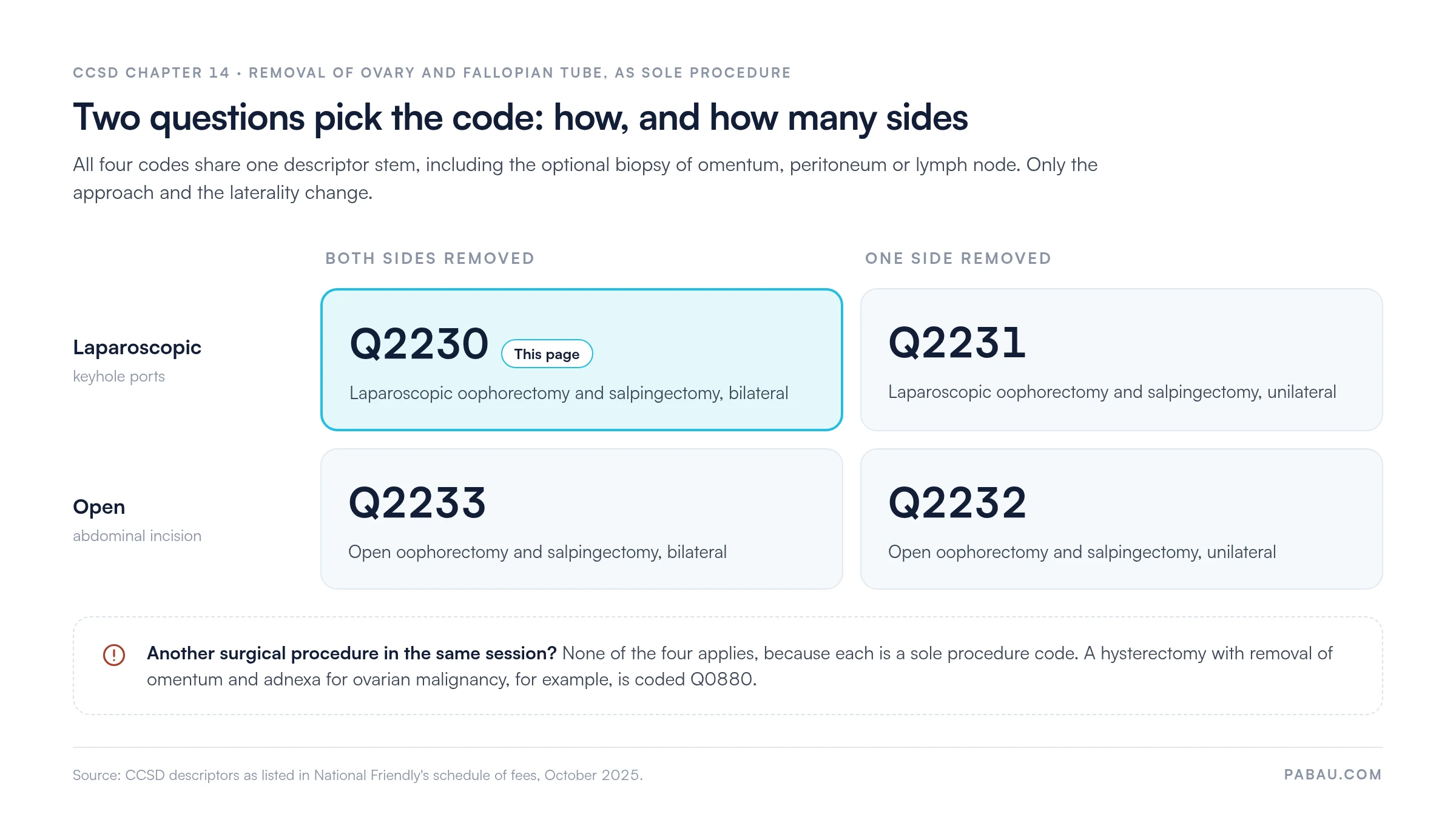
Check each descriptor against the current CCSD schedule before you submit, because CCSD reviews its codes periodically. Our library of CCSD procedure codes covers the rest of chapter 14.
Every Q2230 claim needs a paired diagnosis code from ICD-10, the WHO classification used in the UK. The code must reflect the documented indication, not a presumed or approximate diagnosis. The table lists the codes most often paired with each main indication.
UK ICD-10 has no dedicated code for BRCA carrier status, so the prophylactic indication is usually shown through Z40.0 plus a family history code. Confirm each insurer’s coding expectations before you submit, as some ask for the genetic test result in the pre-authorisation request.
A clean Q2230 claim depends on an operative report that confirms each element of the code descriptor. Along with the sole procedure rule, missing documentation is one of the two leading causes of rejected claims.
The operative report must include:
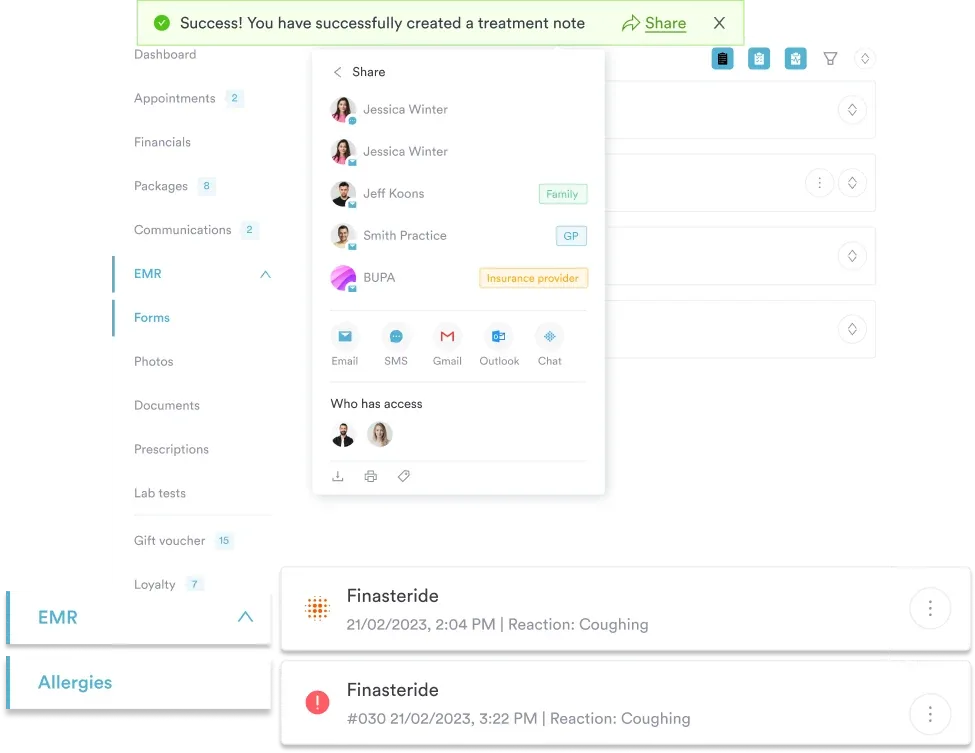
Structured patient records in a practice management system capture each part of the operative report, rather than relying on ad hoc dictation. If the report turns out to lack one of these elements after surgery, most insurers accept an addendum signed and dated by the operating surgeon.
Run five checks before you submit a Q2230 claim. Confirm bilateral removal in the operative report and name any biopsy sites. Match the indication to the UK ICD-10 code, attach the pre-authorisation number, and include both surgeon and anaesthetist details.
UK private medical insurers expect pre-authorisation for a planned procedure such as Q2230. The patient usually calls their insurer for an authorisation number before admission, and the practice quotes it on the claim. Requirements vary by insurer and by policy, so check them before each procedure.
A pre-authorisation request typically includes:
When emergency surgery rules out pre-authorisation, contact the insurer as soon as practicable to ask about retrospective approval. Record the clinical urgency in the operative report, because the insurer will ask for it.
CCSD sets no fees. The code tells the insurer which operation was performed. Each insurer’s own schedule and the patient’s policy then decide what Q2230 pays the surgeon and the anaesthetist.
Look up the current figure in each insurer’s provider tools before you quote a patient, such as the Healix fee schedule. If your fee is above the insurer’s schedule, tell the patient about the shortfall in writing before surgery.
Bilateral laparoscopic oophorectomy and salpingectomy claims fail for a predictable set of reasons. The table below maps each denial to its fix.
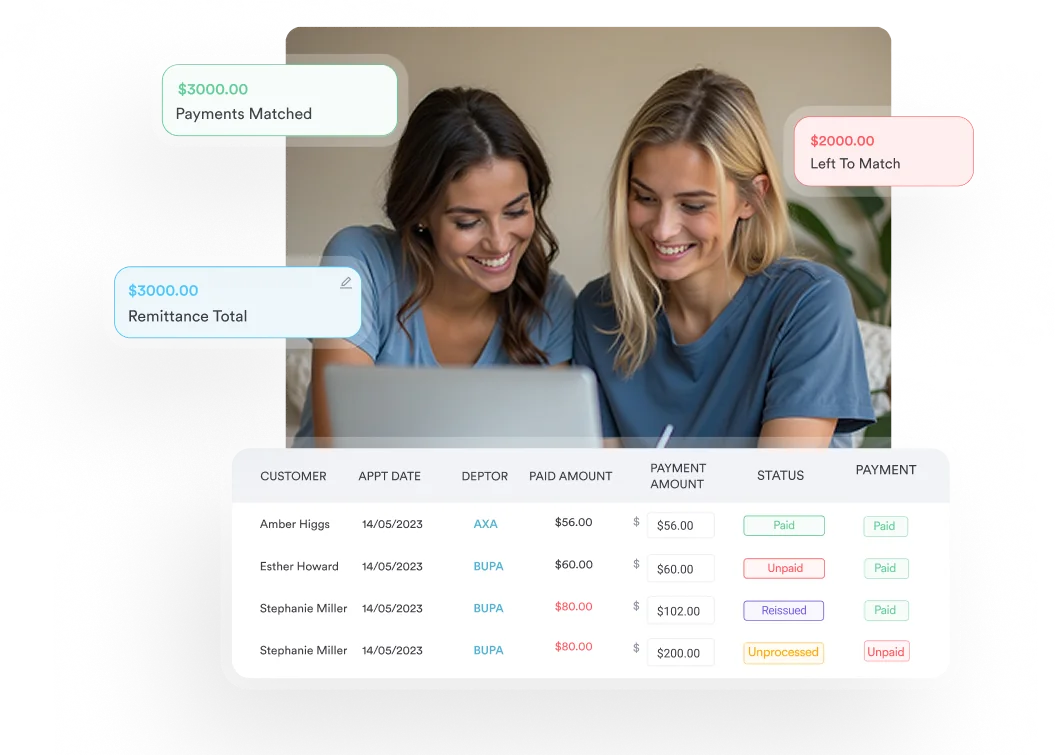
A clean Q2230 claim needs the right code, the right diagnosis and the right supporting details in place before submission. Pabau holds the CCSD code set and tracks pre-authorisation on the patient record, which removes several manual steps where errors creep in.
In Pabau’s medical billing software, a Q2230 claim for a UK private gynaecology practice moves through these steps:
Practices running gynaecology lists at scale use templates that pre-fill the CCSD code, the usual diagnosis options and a documentation checklist for each procedure.
Linking the surgical documentation to the billing record leaves an auditable trail for insurer queries. Our guide to Bupa CCSD codes covers the wider framework, including Bupa-specific rules.

Pabau supports CCSD code entry, diagnosis code pairing, pre-authorisation tracking, and claim submission workflows for UK private gynaecology practices. See how it handles the complexity of codes like Q2230.

A Q2230 claim is won or lost in the operating theatre, when the surgeon writes the operative summary. If that summary says “bilateral”, names every biopsy site and states the indication, the coder has an easy job. Leave any of those out and no amount of careful coding will rescue the claim.
That makes the operative template the best place to protect your income from this code. Build the bilateral statement, the biopsy sites and the indication into it, and pair the indication with the matching UK ICD-10 code.
Book a demo to see how Pabau ties operative documentation, pre-authorisation and insurer claims into one workflow.

Coding a smaller gynaecology procedure from the same chapter? CCSD code Q2020 covers endometrial biopsy or aspiration and the documentation behind a clean claim.
CCSD code Q2230 covers the laparoscopic removal of both ovaries and both fallopian tubes as a sole procedure. A biopsy of the omentum, peritoneum or a lymph node taken at the same sitting is included in the same code.
Q2230 covers the bilateral procedure, with both ovaries and both fallopian tubes removed. Q2231 covers the unilateral equivalent, on one side only. Laterality as documented in the operative report decides the code, so never use Q2230 when the report is unclear about both sides.
No. The sole procedure restriction means Q2230 is not combined with other CCSD surgical codes from the same session. When another procedure is performed, a different or combined CCSD code usually applies. Check with the patient’s insurer before the procedure date, not after the claim is rejected.
Each insurer does. CCSD identifies the procedure but sets no fees, so Bupa, AXA Health, Aviva, Vitality and other insurers each pay Q2230 at their own schedule rate. Check the current figure in the insurer’s provider tools, and tell the patient in writing about any shortfall before surgery.
Yes. Risk-reducing bilateral salpingo-oophorectomy in BRCA1 and BRCA2 carriers is a recognised indication for Q2230, and NICE guideline CG164 recommends discussing it with these women. Insurers typically ask for genetic counselling documentation and a letter confirming the mutation status with the pre-authorisation request.
The anaesthetist bills separately, under the same CCSD procedure code, at the rate in the insurer’s anaesthetist schedule. The sole procedure restriction applies to surgical codes, so it does not affect the anaesthetist’s claim. Surgical assistant fees, where an insurer pays them, are also billed separately.