HCPCS Code C1888: Catheter, ablation, non-cardiac, endovascular
What is HCPCS Code C1888? HCPCS Code C1888 is the Healthcare Common Procedure Co...

Last Updated: Nov 13, 2026
25000 is the CCSD code for incision and drainage (not elsewhere covered). It sits in Chapter 1 of the UK private healthcare schedule as a residual simple procedure code. Use it when a collection is incised and drained and no site-specific code applies.
Practitioners looking for trigger finger or De Quervain's release can land on it in error. Those procedures are coded T7231 for an open release and T7232 for a percutaneous release, both in Chapter 16. The confusion comes from US CPT code 25000, which shares the number but describes incision of the extensor tendon sheath at the wrist.
Let Pabau's smart automation suggest the right codes, reduce claim denials, and keep your practice compliant—effortlessly.
Automate repetitive tasks and focus on what matters most—your patients.
Reduce coding errors and ensure compliance with the latest regulations.
Clean claims, fewer denials, and faster reimbursements.
Powerful insights and reporting to help your practice thrive.
HIPAA compliant SOC 2 certified GDPR-compliant Trusted by 4,000+ clinics worldwide

CCSD code 25000 is a Chapter 1 residual code for incision and drainage not elsewhere covered. It is not a hand or wrist surgery code.
Trigger finger and De Quervain’s release are billed under Chapter 16 codes T7231 (open) and T7232 (percutaneous), both intermediate complexity.
The confusion comes from US CPT code 25000, which shares the number but describes incision of the extensor tendon sheath at the wrist.
National Friendly’s October 2025 schedule caps T7231 and T7232 at £348 and 25000 at £131, so coding a release as 25000 underbills it.
Pabau keeps the procedure note, forms and invoice in one patient record and submits UK claims through Healthcode and Bupa.
CCSD code 25000 is the UK private healthcare procedure code for “incision and drainage (not elsewhere covered).”
National Friendly’s October 2025 fee schedule lists it under that descriptor as a minor procedure. It sits in Chapter 1 of the CCSD schedule, alongside consultation and simple procedure codes. The code is a residual, so it applies only when no more specific CCSD code describes the site or the procedure.
The CCSD Group maintains the schedule that UK private medical insurers use to process consultant claims. Bupa, AXA Health, Aviva, Vitality and WPA all work from CCSD codes. Insurers read the code on the invoice to decide how the claim is handled and paid.
Insurer schedules band 25000 as a simple procedure. National Friendly grades it minor. H3 Insurance’s 2020 schedule of procedures files it under general procedures, beside entries such as echocardiography and ECG loop recorder insertion. That banding is the first clue that 25000 does not describe surgery on a tendon.
Searches for trigger finger and De Quervain’s release reach code 25000 because two unrelated coding systems share the number. In the US CPT system maintained by the American Medical Association, code 25000 reads “incision, extensor tendon sheath, wrist (eg, de Quervain’s disease).” In the UK CCSD schedule, the same five digits mean incision and drainage not elsewhere covered.
The two schedules were built independently, so a shared number carries no crosswalk, no equivalent descriptor and no shared fee logic. A practitioner moving from US practice to UK private work can carry the CPT meaning across without noticing. Searching the bare number, without naming the system, has the same effect.
The layout of the CCSD schedule points the same way. Tendon procedures sit in Chapter 16, the bones, joints and connective tissue chapter, and their codes carry a letter prefix, such as T7231. Code 25000 has no prefix and sits in Chapter 1, away from anatomical surgery.
Its numeric neighbors confirm it. The codes around 25000 in published insurer schedules are nerve blocks and regional anesthesia, such as paravertebral block 25010 and stellate ganglion block 25022. None of them is a tendon procedure.
Codes, descriptors and groupings are listed as published in H3 Insurance’s 2020 schedule, which is based on CCSD. Groupings and fees vary between insurer schedules, so confirm against the schedule that applies to your recognition agreement.
Release of a constricted tendon sheath is coded under Chapter 16, which covers bones, joints and connective tissue. Two codes apply, separated by surgical approach rather than by condition. Insurer schedules band both as intermediate complexity.
Fees are the maximum procedure fees in National Friendly’s October 2025 schedule of fees, which lists all three codes. Other insurers publish different figures, and rates also vary with the consultant’s recognition level.
Two points matter when you choose between them. The descriptor names trigger finger only as an example, so T7231 also covers open release for De Quervain’s tenosynovitis. None of the public insurer schedules we checked lists a De Quervain’s-specific code.
Older schedule copies may list a single combined code, T7230, for release of constriction of sheath of tendon. H3 Insurance’s 2020 schedule is one example. Current insurer schedules list the open and percutaneous pair instead. CCSD’s Bulletin 204 added “+/- image guidance” to the T7232 descriptor in October 2025. Check that your billing code list matches the current schedule.
Coding a tendon sheath release as 25000 risks a rejection, and it also underbills the procedure. In National Friendly’s October 2025 schedule, an open release billed as T7231 carries a maximum fee of £348, against £131 for 25000. Practices that have used 25000 for hand cases should audit those claims.
Code 25000 covers incision of a collection and evacuation of its contents. It applies where the schedule offers no more specific code for that site or presentation. Typical use is a straightforward abscess or fluid collection drained under local anesthetic, in a treatment room or day-case setting.
The “not elsewhere covered” qualifier does the defining work. It makes 25000 a fallback, reachable only after you have searched the schedule for a site-specific code and found none. Our CCSD codes for consultants library is a quick place to run that search. Where a specific code exists, it takes precedence, and the decision runs in a fixed order.
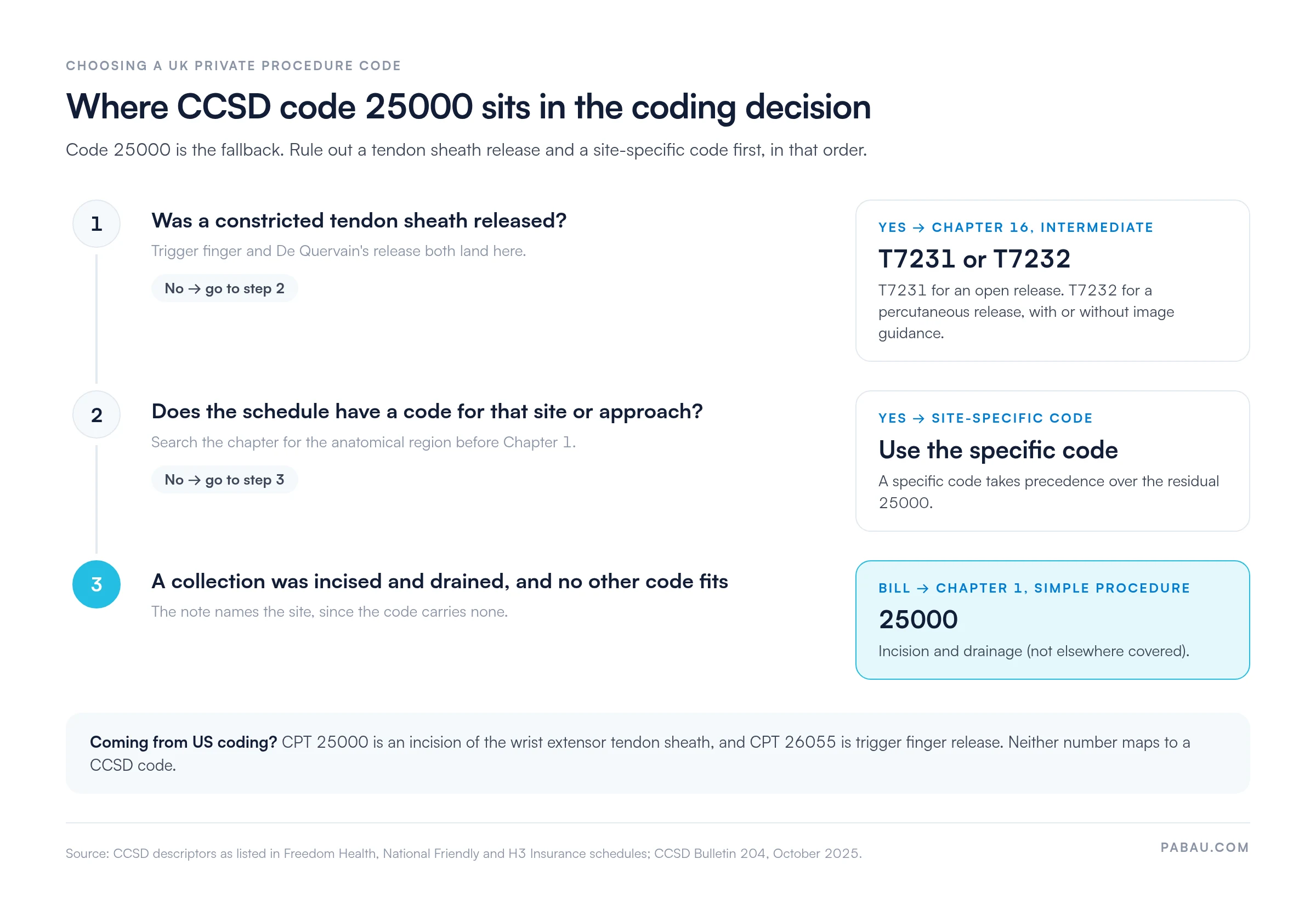
Four checks keep the residual code where it belongs:
UK private claims pair a CCSD procedure code with an ICD-10 diagnosis code. When the procedure code is residual, the diagnosis code carries almost all of the clinical specificity. An insurer reading a 25000 line depends on the diagnosis to understand what was treated.
That changes how you should choose it. The diagnosis needs to name the condition and the site precisely enough that the reviewer can see why no site-specific procedure code applied. An unspecified diagnosis paired with a residual procedure code gives the assessor little to work with, and it reliably generates a query.
Where the underlying condition is trigger finger or De Quervain’s tenosynovitis, this pairing is where the coding error shows. A De Quervain’s diagnosis such as M65.4 sitting against a generic incision and drainage code describes a procedure nobody performed. Correct the procedure code to T7231 or T7232 rather than adjusting the diagnosis to fit.
A residual code invites queries when the record is thin. Because the descriptor names no site, the note has to supply what the code does not. Each claim should rest on these entries:
UK GDPR applies to billing records that contain clinical data, which means secure storage, defined retention periods and subject access rights. In England, Care Quality Commission standards for private providers set the baseline for an acceptable record.
No single universal fee exists for CCSD code 25000. Reimbursement depends on the consultant’s recognized fee level, the insurer’s own schedule, and the setting in which the procedure was performed. Published schedules place it in the simple or minor procedure band, well below the intermediate band that Chapter 16 tendon releases attract. Chapter 1 also holds the keloid scar injection code, CCSD S5322, which Bupa lists with no category or fee at all.
Consultant fees are billed separately from facility fees. The consultant’s invoice carries the CCSD code, and the hospital or treatment center raises its own facility invoice. Combining both on one invoice usually produces a partial payment query. Our Bupa CCSD codes reference covers the invoicing rules in detail.
The two codes share five digits and nothing else. CCSD is the UK private healthcare schedule, and CPT is the US system maintained by the American Medical Association. Their descriptors, fee logic, modifier rules and payers are separate, and no official crosswalk links one number to the other.
The last row is the one that catches people out. Trigger finger release is not CPT 25000 either. The US code for tendon sheath incision at the finger is 26055. A practitioner who assumed CPT 25000 covered trigger finger had already taken a wrong turn. Our CPT code 25000 reference covers the US descriptor in full.
Practitioners moving between systems should treat the coding schedule as part of the clinical record, not a lookup performed afterward. Settle which schedule governs your invoices before the first private claim goes out.
Claims involving code 25000 are queried for a predictable set of reasons. Most trace back to the residual nature of the code rather than to the paperwork around it.
Practices seeing repeated queries on this code should audit the last 12 months of claims against the list above. Where hand or wrist cases appear under 25000, treat those as a recoding exercise rather than a documentation one. Checking the code at the point of entry catches the mismatch before an insurer rejects it.
Run a quarterly audit on every claim submitted under code 25000. Filter the last 90 days, then check the diagnosis on each line. Any tenosynovitis or trigger finger diagnosis sitting against 25000 is a miscoded claim. Recoding it to T7231 or T7232 moves it from the simple band to the intermediate one.
Manual CCSD billing creates risk at every handoff. Staff look a code up in a separate reference, type it into an invoice, then add the diagnosis by hand. On a residual code like 25000, that chain is also where a wrongly chosen code survives all the way to submission.
Pabau, the practice management platform we build, keeps the claim next to the clinical record. Its claims management software submits UK claims through Healthcode and Bupa, so the invoice goes out from the system that holds the procedure note. The authorization code, dates and sessions sit on the patient’s case, and Pabau warns the team when one is missing.
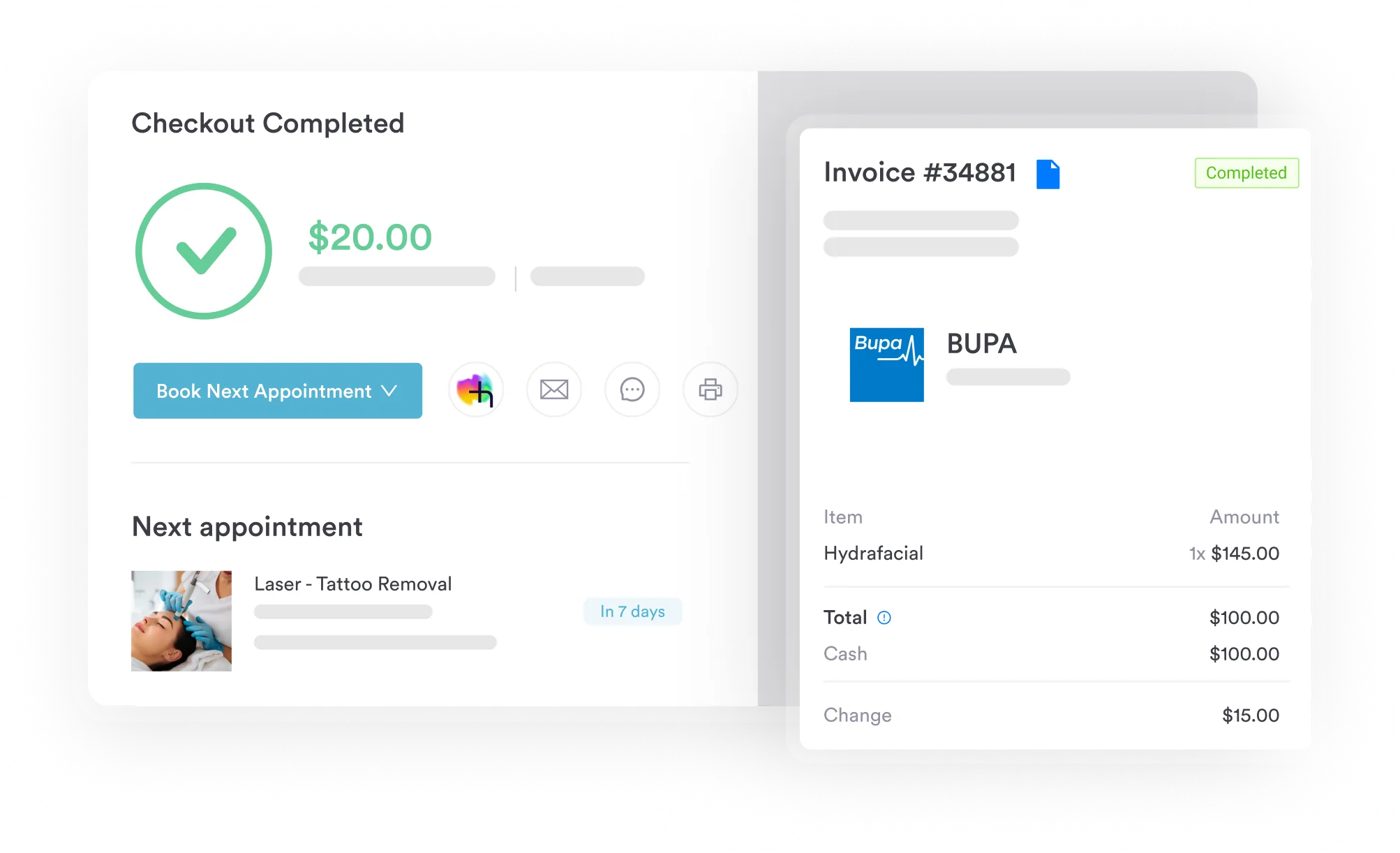
The procedure note, consent form and invoice live in the same patient record. An audit response then means opening one file rather than assembling documents from three systems. Digital intake and consent forms capture the site and indication that a residual code leaves unstated.
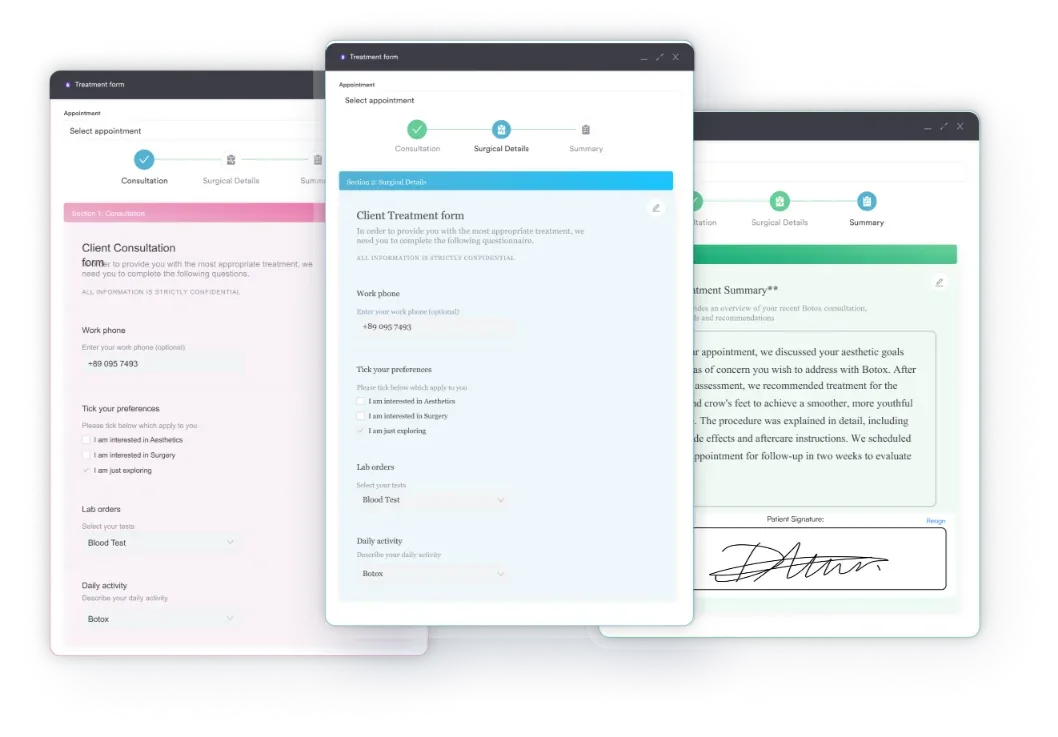
With the note, forms and claim in one place, a recoding audit stops being a records hunt. The billing team can check each 25000 line against its diagnosis and correct a miscoded release before resubmitting.

Pabau keeps the procedure note, consent forms and invoice in one patient record and submits UK claims through Healthcode and Bupa. See how it fits your specialty.

Treat 25000 as the last stop in the schedule, not the first. Before you bill it, rule out a tendon sheath release and any site-specific code, then write the site into the note.
For a practice that has billed hand cases under 25000, the fix is a recoding exercise, not a documentation one. Each corrected claim removes a predictable query and moves the procedure into the intermediate band where it belongs.
Pabau keeps the note, the forms and the claim in one record, so the code you bill matches the procedure performed. Book a demo to see how it handles CCSD claims for your specialty.

Looking for a site-specific drainage code? CCSD code F4600 shows how a named-site incision and drainage entry is billed instead of the residual code.
Billing a block from the same stretch of the schedule? CCSD code 25011 covers the paravertebral block done under x-ray control.
Need the sacral root block entry? CCSD code 25012 explains the descriptor and documentation for that injection.
Working through the 25xxx block codes? CCSD code 25100 covers the diagnostic coeliac plexus block.
Invoicing Bupa for CCSD-coded work? Bupa CCSD codes sets out how Bupa reads and pays consultant invoices.
CCSD code 25000 bills UK private medical insurers for incision and drainage of a collection. It applies where no more specific CCSD code covers the site or procedure. It sits in Chapter 1 of the schedule as a residual simple procedure code, and its descriptor carries no anatomical site.
No. Trigger finger release is coded T7231 for an open release and T7232 for a percutaneous release, both in Chapter 16 of the CCSD schedule. Code 25000 is a Chapter 1 residual code for incision and drainage and does not describe a tendon sheath procedure. Billing 25000 for a release risks rejection and underbills the procedure.
T7231 covers open release of constriction of a tendon sheath, and it applies to De Quervain’s release as well as to trigger finger. The descriptor names trigger finger only as an example rather than as a restriction. None of the public insurer schedules we checked lists a De Quervain’s-specific code, so T7231 is the entry for an open release.
No. The two share a number by coincidence and belong to separate systems. CCSD 25000 means incision and drainage not elsewhere covered in the UK private schedule. CPT 25000 is the US code for incision of the extensor tendon sheath at the wrist. Descriptors, fee schedules, modifier rules and payers are entirely different.
Insurers that work from the CCSD schedule, including Bupa, AXA Health, Aviva, Vitality Health and WPA, process CCSD-coded claims. A code’s place in the CCSD schedule does not guarantee that an insurer covers it. Check each insurer’s own schedule and the consultant’s recognition agreement before raising an invoice.
The record needs a procedure note describing what was incised and drained. It also needs the anatomical site, the diagnosis and its ICD-10 code, the anesthetic type, the named consultant, and the pre-authorization reference. Because the code names no site, the note has to supply it. A short line explaining why no site-specific code applied also helps.
Older schedule copies may list a single combined code, T7230, for release of constriction of sheath of tendon. H3 Insurance’s 2020 schedule is one example. Current insurer schedules list T7231 for an open release and T7232 for a percutaneous release, so bill from the current schedule.