

HCPCS Code E0272: Foam rubber mattress billing guide
HCPCS Code E0272: official descriptor and code overview HCPCS Code E0272 is the ...

Last Updated: Nov 6, 2026
K2700 is the CCSD code for replacement of the tricuspid valve, with any valvuloplasty included. Cardiac surgeons bill it to UK private medical insurers after removing a diseased tricuspid valve and implanting a prosthesis. The operation is done open, on cardiopulmonary bypass.
The bracket in the descriptor matters. Valvuloplasty on the same valve is already part of K2700, so it never goes on the claim as a second line. Catheter-based valve work belongs to a separate code family. Each insurer decides how it applies CCSD guidance, so check its rules before the operation date.
Let Pabau's smart automation suggest the right codes, reduce claim denials, and keep your practice compliant—effortlessly.
Automate repetitive tasks and focus on what matters most—your patients.
Reduce coding errors and ensure compliance with the latest regulations.
Clean claims, fewer denials, and faster reimbursements.
Powerful insights and reporting to help your practice thrive.
HIPAA compliant SOC 2 certified GDPR-compliant Trusted by 4,000+ clinics worldwide

CCSD code K2700 covers replacement of the tricuspid valve, and valvuloplasty on that valve is already included in the code.
K2700 sits in Chapter 8 of the CCSD schedule, under sub-chapter 8.8.0 Heart – Cardiac Surgery.
The CCSD Group writes the code and its principles, but each insurer sets its own fee and decides which principles to adopt.
Insurers check three things first: a matching pre-authorization, an operative note that names the valve, and a tricuspid diagnosis code.
Catheter-based valve work belongs to a separate transluminal code family, so it should not be billed as K2700.
CCSD code K2700 is the code for replacement of the tricuspid valve, including valvuloplasty. Cardiac surgeons use it to bill a UK private medical insurer for the operation. It describes the surgeon’s procedure, not the hospital stay or the valve prosthesis.
CCSD stands for Clinical Coding and Schedule Development. The CCSD Group brings together Aviva, AXA Health, Bupa and Vitality. It maintains one shared schedule of CCSD codes, so a procedure carries the same code at every insurer that uses it.
The table below collects the reference details for K2700 in one place.
The CCSD Group does not set fees or reimbursement. Its coding principles are also not exhaustive. Each insurer decides whether to adopt them, so the insurer’s own rules have the last word on any claim.
Tricuspid valve replacement is open-heart surgery. The surgeon removes the diseased valve tissue and sews in a prosthesis. A typical operation runs in five stages.
The heart’s conduction system runs close to the tricuspid annulus. As a result, heart block is a known risk after surgery, and some patients need a permanent pacemaker. That procedure carries its own code and needs its own authorization.
European valve guidelines generally favor repairing the tricuspid valve when the anatomy allows it. Replacement is kept for valves that cannot be repaired well. So an insurer reviewing a K2700 claim may ask why the valve came out.
The operative note should answer that before anyone asks. Common reasons include leaflets destroyed by endocarditis, rheumatic or carcinoid disease, and a failed earlier repair. A severely dilated annulus with tethered leaflets is another.
The diagnosis code then has to tell the same story. These ICD-10 codes are the usual matches for a tricuspid replacement.
UK insurers work with the WHO version of ICD-10. Where rheumatic disease affects both the aortic and tricuspid valves, the combined code is I08.2. Confirm each code against the insurer’s accepted list before you submit.
The CCSD principles page for K2700 lists codes that should not be claimed with it. That page sits behind a CCSD login, so we could only read its entries through a public search index.
Treat the table as a starting point and confirm each line in the CCSD schedule.
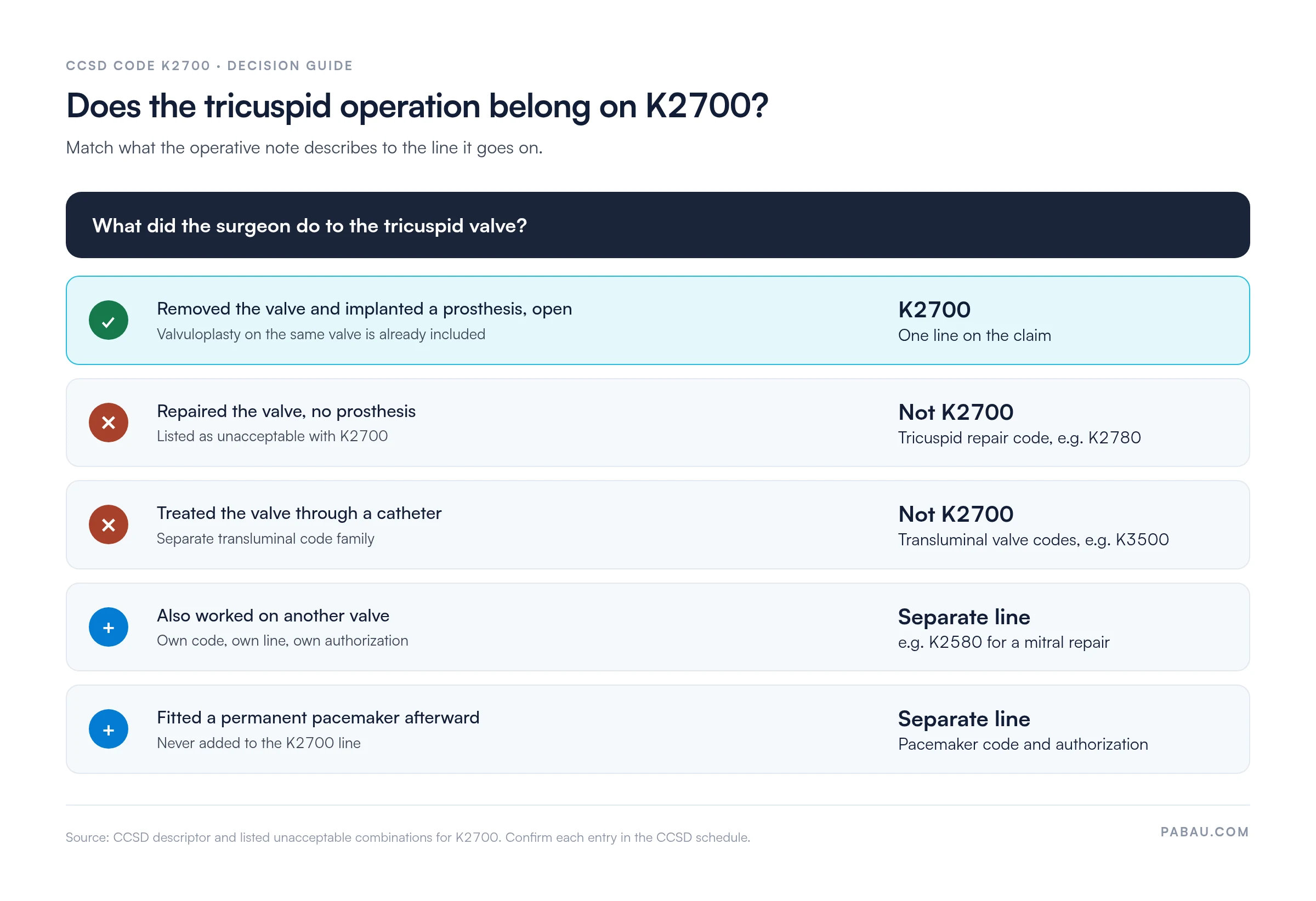
Each entry has a clear reason behind it. The descriptor already includes valvuloplasty, so a repair on the same valve adds nothing billable. An open valvotomy is a different operation as well, billed as K3100 when no prosthesis goes in.
Catheter-based valve work takes a different route altogether. Meanwhile, the L9110 entry suggests a central line placed for the operation counts as part of it.
Work on another valve is a separate matter. A mitral repair in the same operation has its own code, such as K2580, and its own line on the claim. Likewise, an aortic valve replacement done alongside it is billed as K2600. A pulmonary valve replaced in the same operation is billed as CCSD code K2800. Each insurer then applies its own rules on what it pays for a second procedure.
Aortic work in the same operation does not always stop at the valve. Where the surgeon replaces the root itself with a valve conduit or a homograft, the claim line is L2382 instead of K2600.
Revision work on the mitral valve has its own entry as well. Where the surgeon removes a mitral prosthesis already in place and fits a new one, the code is K2542. Revising the valve inside an existing cardiac conduit has its own code too, K1850.
Non-valve cardiac work follows the same principle. Where the surgeon reduces the volume of a dilated left ventricle in the same operation, that work is billed as K5530.
The guide below matches each kind of tricuspid operation to the claim line it belongs on.
Most UK private medical insurance policies require pre-authorization for planned inpatient surgery. The patient usually contacts the insurer, but the surgeon’s team supplies the clinical detail. A complete request carries these items.
Record the authorization number on the patient’s file as soon as it arrives. If the plan changes in the operating room, contact the insurer promptly. An authorization for one code does not cover another.
The operative note is the evidence behind the code. Insurers can request it before or after payment, so write it with the claim in mind. It should cover these points.
Run through this list before each invoice leaves the office. Every line maps to a reason a claim gets queried.
Healthcode is the electronic billing service most UK private insurers use for consultant invoices. Its bills reach the insurer faster than paper and are checked against insurer rules on the way. A K2700 invoice takes six steps.
Send the K2700 invoice only after the operative note is signed. Then, if the insurer queries the claim, you can reply the same day with the note attached.
Each of these errors can stall a K2700 claim, and each one has a straightforward fix.
A K2700 claim pulls paperwork from several places. The authorization letter sits in one inbox, the echo report in another system. The operative note may still be on paper. When a query lands weeks later, someone has to find all of it again.
Pabau, the practice management platform we build for private consultants, keeps those documents on the patient record. Its claims management software then sends the CCSD-coded claim through Healthcode from that same record. Required fields, such as the membership and authorization numbers, are checked before the claim goes out.
Your team can also track each claim’s status and reconcile payments without leaving Pabau. Queries get answered from one screen, so fewer invoices sit unpaid.

Pabau keeps authorizations, operative notes and invoices on one patient record. It then sends CCSD-coded claims to insurers through its Healthcode integration.

Code K2700 when a tricuspid valve came out and a prosthesis went in. If the surgeon only repaired the valve, or worked through a catheter, look elsewhere.
The code choice is rarely the hard part. Claims stall on an authorization that no longer matches, or a note that never says why repair was not enough. Fix both before the invoice goes out, and the insurer has little left to query.
Book a demo to see how Pabau links each authorization and operative note to the K2700 claim it supports.

Billing a mitral repair in the same operation? CCSD code K2580 covers mitral valve repair and the documentation insurers expect for it.
Was the valve opened rather than replaced? CCSD code K3100 explains how to bill an open valvotomy and where it differs from replacement.
Replacing the aortic valve in the same operation? CCSD code K2600 covers aortic valve replacement and what insurers expect on the claim.
Billing Bupa patients for cardiac surgery? Bupa CCSD codes walks through how Bupa applies the CCSD schedule.
Want fewer claims returned for missing details? Pabau’s claims management software checks required fields and sends claims through Healthcode.
K2700 covers replacement of the tricuspid valve, including valvuloplasty. A surgeon bills it after removing diseased valve tissue and implanting a prosthesis. It sits in CCSD Chapter 8, sub-chapter 8.8.0 Heart – Cardiac Surgery.
No. The descriptor includes valvuloplasty, so repair work on the same valve is part of K2700. CCSD also lists K2780, a tricuspid repair code, as unacceptable with K2700. Confirm that entry in the CCSD schedule.
Not as a rule. Catheter-based valve work belongs to the transluminal valve codes, such as K3500. Check the insurer’s position before the procedure, because policies on newer catheter techniques vary.
Each insurer sets its own fee. The CCSD Group maintains the codes and principles but does not set fees or reimbursement. Check the insurer’s fee schedule before quoting the patient.
Almost always. Planned inpatient heart surgery normally needs the insurer’s approval first. Put the authorization number on the claim, and contact the insurer if the procedure changes.
Common choices are I36.1 for nonrheumatic tricuspid insufficiency, I07.0 to I07.2 for rheumatic tricuspid disease and I33.0 for infective endocarditis. Pick the code that matches the operative note.




