CPT Code 74430: Cystography billing and coding guide
CPT code 74430: official descriptor and procedure overview CPT code 74430 is def...

Last Updated: Oct 22, 2026
K2542 is the CCSD code for revision replacement of mitral valve. It covers a redo operation that removes a previously implanted mitral prosthesis and implants a new mechanical or bioprosthetic valve. A first mitral valve replacement uses a different K25 code.
The code sits in Chapter 8 of the CCSD Schedule, under Heart – Cardiac Surgery. UK private medical insurers such as Bupa, AXA Health and Aviva generally require pre-authorisation, and the operative note has to show the redo context.
Let Pabau's smart automation suggest the right codes, reduce claim denials, and keep your practice compliant—effortlessly.
Automate repetitive tasks and focus on what matters most—your patients.
Reduce coding errors and ensure compliance with the latest regulations.
Clean claims, fewer denials, and faster reimbursements.
Powerful insights and reporting to help your practice thrive.
HIPAA compliant SOC 2 certified GDPR-compliant Trusted by 4,000+ clinics worldwide

CCSD code K2542 covers revision replacement of the mitral valve, a redo operation that replaces a previously implanted mitral prosthesis.
A first mitral valve replacement uses a different K25 code, so the operative note has to make the redo context unmistakable.
UK private medical insurers generally require pre-authorisation for cardiac surgery, and the rules vary by insurer.
Insurers commonly expect Z95.2 alongside the principal ICD-10 code, so check each insurer’s requirements before you submit.
Pabau, the practice management software we build, keeps the Healthcode claim and its supporting documents on one patient record.
CCSD code K2542 is the UK private healthcare code for revision replacement of the mitral valve. The official descriptor is “Revision replacement of mitral valve”. It sits in Chapter 8 of the CCSD Schedule, under Heart – Cardiac Surgery, alongside the other K25 mitral valve codes.
The CCSD Schedule is maintained by the Clinical Coding & Schedule Development Group. UK private medical insurers such as Bupa, AXA Health and Aviva use it, as do consultant surgeons and private hospitals. Our guide to CCSD codes explains how the schedule is organised.
K2542 applies when a cardiac surgeon returns to the mitral position to remove a previously implanted prosthesis and implant a new mechanical or bioprosthetic valve. The word “revision” matters. A patient’s first mitral valve replacement takes a different K25 code, however complex the operation is.
Where the earlier operation was a mitral repair rather than a replacement, check the CCSD technical guide or ask the insurer which code applies. The schedule entry itself sits behind the CCSD login.
Revision mitral valve surgery is more complex than a primary operation. Scar tissue from the earlier surgery obscures tissue planes, lengthens dissection and raises the risk of injury to nearby structures.
The operation typically follows these steps:
Redo mitral valve surgery carries higher operative risk than a primary replacement. That is why insurers look closely at the clinical case for the revision before they authorise it.
The operative note and the ICD-10 codes together have to show a clinically accepted reason for the revision. Common indications include:
Each indication maps to an ICD-10 code that should appear on the claim. An indication recorded in the notes but missing from the claim is a common reason for an insurer query.
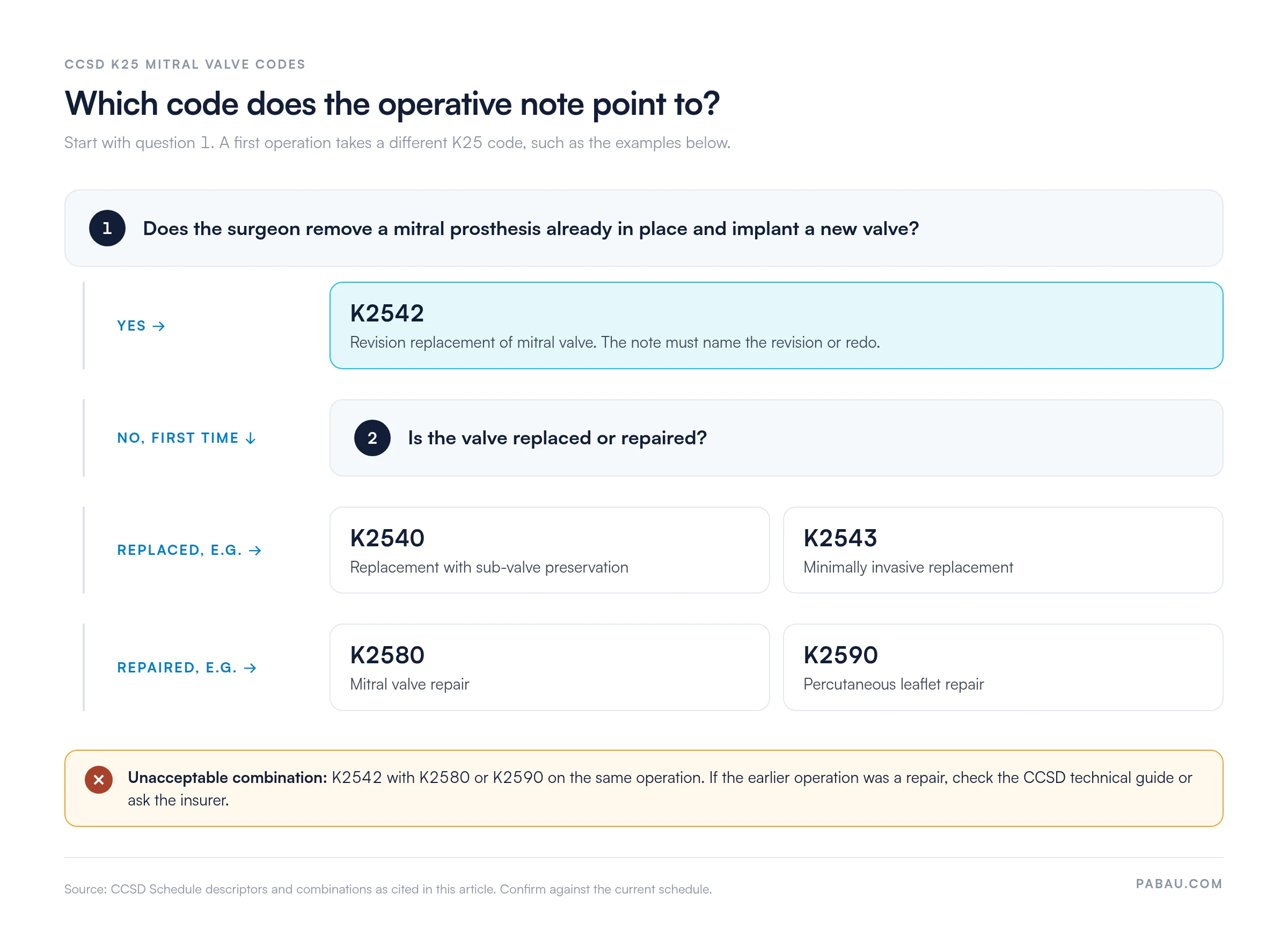
The K25 codes split mitral valve surgery by what the surgeon does to the valve and how they reach it. Picking the neighbour that matches the operative note is the main coding decision on these claims.
The CCSD Schedule lists K2542 as an unacceptable combination with K2580 and K2590. In practice, a repair and a revision replacement of the same valve are not billed together. Confirm the exact descriptors and combinations in the schedule before you code.
If there is doubt about whether the operation counts as a revision, the operative note decides. The surgeon’s statement that a prior mitral prosthesis was present and was removed and replaced is the basis for choosing K2542. The diagram below walks through that decision in the order a coder makes it.
Pair K2542 with a principal ICD-10 code that explains why the revision was needed. Insurers commonly expect a secondary code confirming a prosthetic heart valve, usually Z95.2, so check each insurer’s requirements.
Check every code against the edition of ICD-10 your insurers accept. The WHO ICD-10 browser shows the full classification hierarchy for reference.
Several people and providers send separate invoices for a revision mitral valve replacement. The CCSD technical guide sets out the principles for what a procedure code includes, so check it before you add extra lines.
A concurrent procedure on another valve takes its own CCSD code. Check the schedule and the insurer’s rules on multiple procedures before you bill both.
Before each billing cycle, check the CCSD Schedule for any change to K2542 or its unacceptable combinations. The CCSD Group publishes schedule changes in its bulletins, and insurers apply them to new claims.
A K2542 claim depends on its documentation. The operative note has to establish the redo context clearly enough for an insurer reviewer who was not in theatre.
The operative note should include:
Supporting documents to keep with the claim:
Keeping these documents on the patient record, next to the invoice, means none of them goes missing when the claim is sent.
UK private medical insurers generally require pre-authorisation before planned cardiac surgery, including a revision mitral valve replacement. The rules vary by insurer, so check each policy before you book theatre.
A typical pre-authorisation for K2542 follows these steps:
Emergency admissions follow each insurer’s own process, so call the insurer as soon as the patient is admitted. For coding principles, the CCSD technical guide is the reference.
Most K2542 rejections trace back to a few avoidable errors:
Most UK private medical insurers accept electronic claims through Healthcode. Our overview of Bupa CCSD codes shows how one large insurer applies the schedule.
Paperwork for a redo cardiac operation often ends up in several places. The operative note sits in one system, the invoice in another, and the claim is re-keyed into Healthcode. Each hand-off risks a wrong code or a lost authorisation number.
Pabau keeps those steps on one patient record. Its claims management turns the invoice you already raise into a Healthcode claim. The code, amounts and patient details carry over, and Healthcode’s validation checks the claim before it is sent.
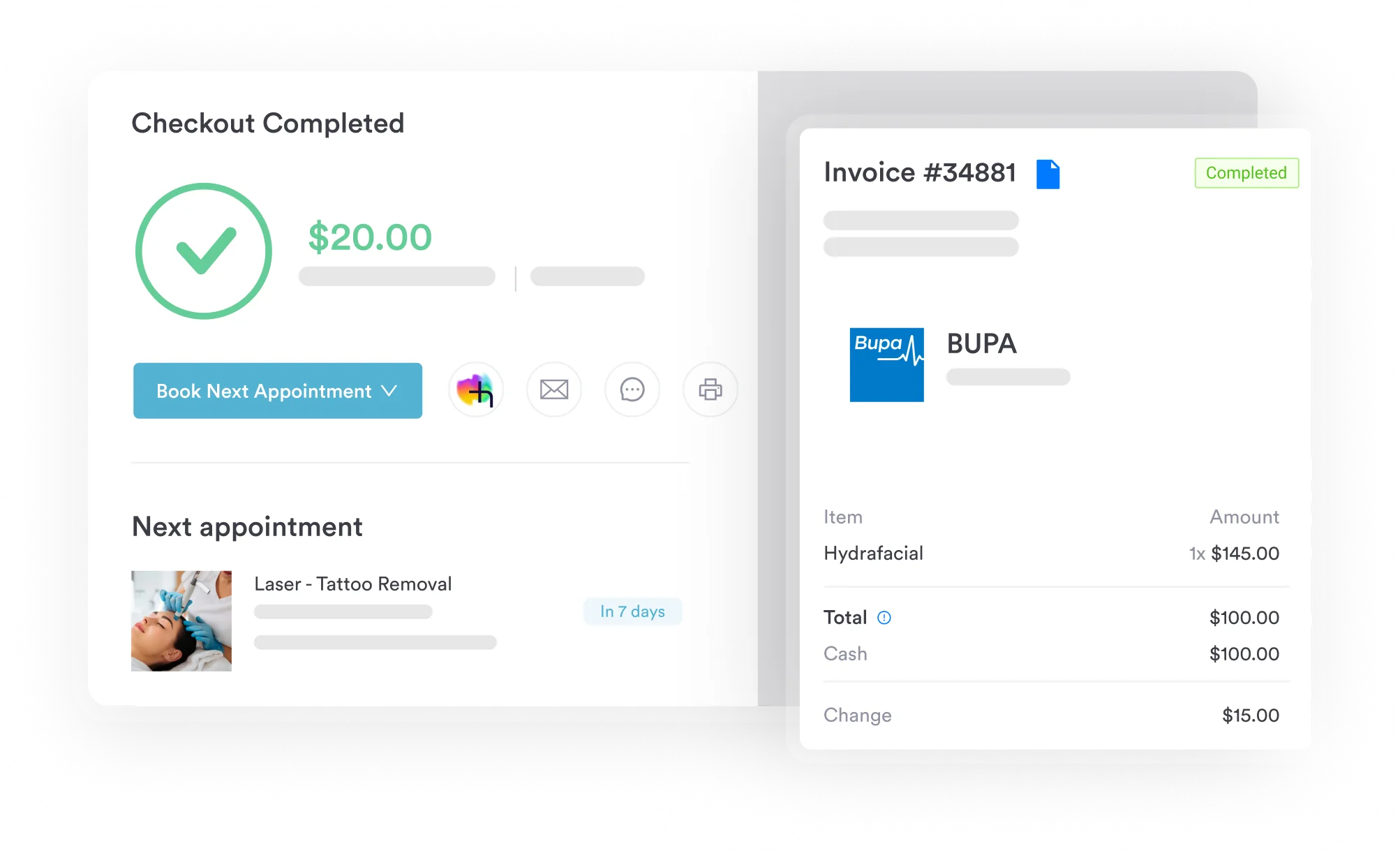
Operative notes, echocardiography reports and referral letters attach to the same patient record as the invoice. When an insurer queries a claim, your team finds the evidence in one place and can track the claim until it settles.

Pabau turns the invoice for a K2542 operation into a Healthcode claim and checks it before it is sent. The operative note stays on the same patient record.

Code K2542 only when the operation replaces a mitral prosthesis that was already in place. A first replacement belongs on a different K25 code, and a repair at the same operation is an unacceptable combination.
Before you submit, confirm three facts. The operative note names the revision, the insurer has issued an authorisation number for K2542, and the diagnosis codes show why the valve failed. If one is missing, hold the claim, because a short delay costs less than a rejection.
To see how Pabau turns cardiac surgery invoices into Healthcode claims you can track, book a demo.

New to the CCSD Schedule? Our guide to CCSD codes explains how the schedule is organised and who uses it.
Billing Bupa patients? Bupa CCSD codes covers how Bupa applies the schedule to private claims.
Checking what an insurer pays? The Bupa procedure codes fee schedule explains how Bupa sets fees by code.
Choosing billing software for a UK practice? The best medical billing software in the UK compares the main options.
Coding other cardiac surgery? CCSD code K2310 covers excision of a cardiac tumour in the same chapter of the schedule.
CCSD code K2542 covers revision replacement of the mitral valve. It applies to a redo operation in which a previously implanted mitral prosthesis is removed and a new mechanical or bioprosthetic valve is implanted. A first mitral valve replacement uses a different K25 code.
CCSD codes are used across UK private healthcare. Consultant cardiac surgeons and private hospitals use K2542 to bill revision mitral valve replacement. Private medical insurers such as Bupa, AXA Health and Aviva use it to authorise and pay the claim.
The CCSD Schedule lists K2542 as an unacceptable combination with the mitral repair code K2580 and the percutaneous leaflet repair code K2590. Check the schedule before billing more than one mitral valve code for the same operation.
The principal code explains the revision, such as T82.0 for a mechanical complication or T82.6 for prosthetic valve infection. Insurers commonly expect Z95.2, presence of prosthetic heart valve, as a secondary code. Check each insurer’s requirements.
UK private medical insurers generally require pre-authorisation before planned cardiac surgery. The rules vary by insurer, so confirm the process with each one and record the authorisation number before the operation.
Common reasons include the wrong K25 code, an operative note that never names the revision, a missing authorisation number and missing diagnosis codes. Billing an unacceptable combination, such as K2542 with K2580, also leads to rejection.