CPT code 93503: Swan-Ganz catheter billing and modifiers
CPT code 93503: Official descriptor and procedure overview In the AMA CPT code s...

Last Updated: Oct 23, 2026
CCSD Code K2580 covers annuloplasty, leaflet resection, neochordae and commissurotomy when they are combined in one repair under cardiopulmonary bypass.
If the valve is replaced instead, K2580 no longer applies and the claim moves to a replacement code such as K2540. Bupa publishes its own fee for K2580 alongside the other Bupa CCSD codes in the cardiac K-series.

CCSD Code K2580 is the private billing code for repair of the mitral valve, distinct from K2540, which covers replacement with sub-valve preservation.
Annuloplasty ring placement, leaflet resection, neochordae repair, and commissurotomy all fall within K2580 when performed as part of a single repair procedure.
If a planned repair converts to replacement in theatre, bill only the replacement code and tell the insurer about the change.
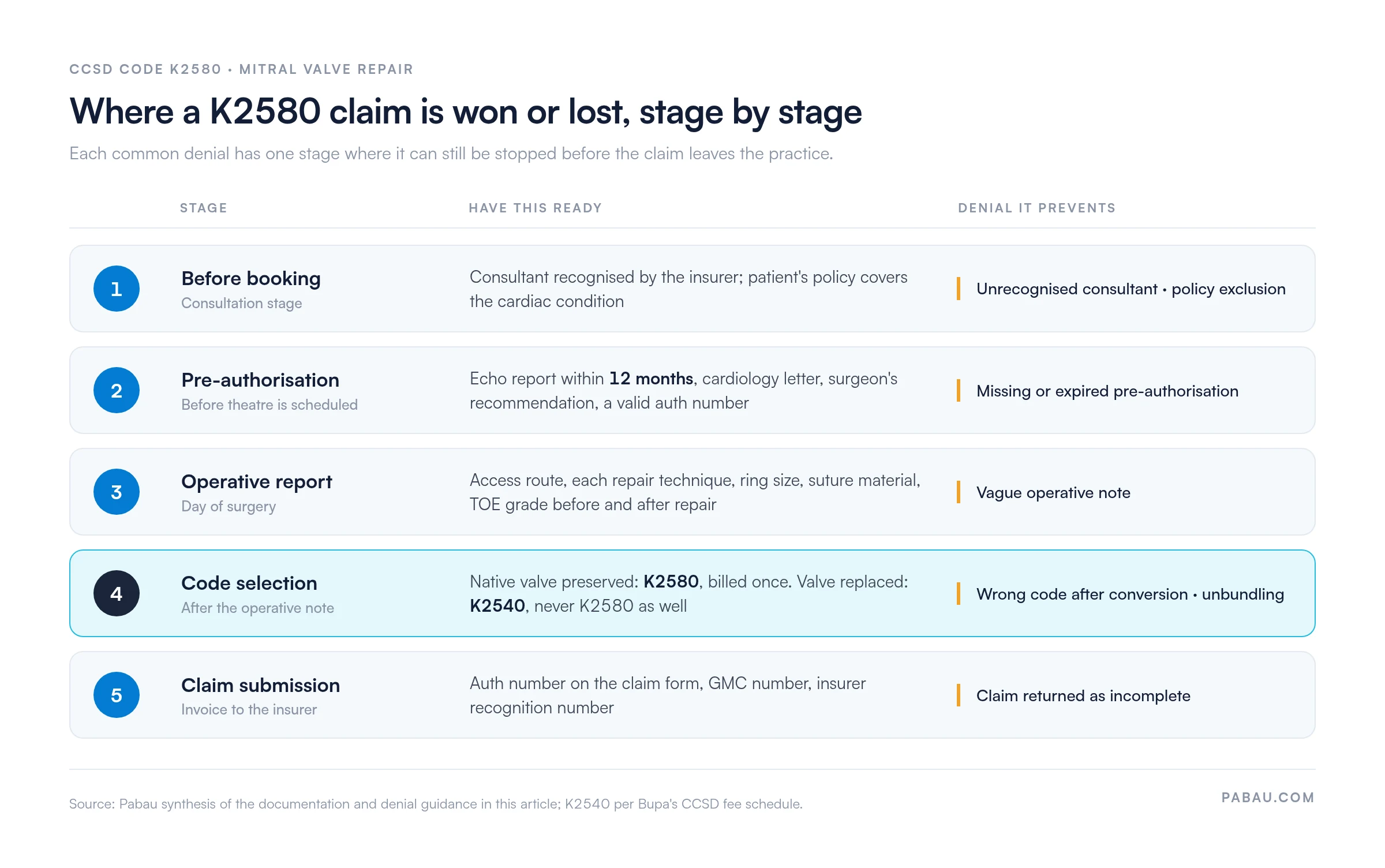
Every UK private insurer requires pre-authorisation before K2580 is performed. A missing authorisation number is the leading cause of cardiac claim denials.
Pabau, our practice management software, stores each pre-authorisation as a case and sends K2580 claims to UK insurers through Healthcode.
CCSD Code K2580 describes the surgical repair of a diseased or damaged mitral valve, as classified in the CCSD schedule. The schedule is maintained by the CCSD Group, which is made up of representatives from four major private insurers: Bupa, AXA Health, Aviva and Vitality. The official descriptor is: Repair of mitral valve.
This code applies only to private healthcare billing in the United Kingdom. It is not interchangeable with NHS OPCS-4 codes or US CPT codes covering the same procedure.
K2580 is used when a consultant cardiothoracic surgeon reconstructs the mitral valve without replacing it. The code sits within the K-series of CCSD codes, which covers cardiac and thoracic procedures. It is submitted by the operating surgeon or their billing administrator as part of an itemised invoice to the patient’s private medical insurer.
The following surgical techniques fall within K2580 when performed as part of a mitral valve repair procedure. Multiple techniques are commonly combined during the same operation and should not be unbundled into separate codes.
Cardiopulmonary bypass (CPB) is required for virtually all open mitral valve repair procedures. Whether CPB is bundled into K2580 or separately billable depends on the current CCSD schedule and the specific insurer’s fee schedule. Practices should verify this against the CCSD technical guide and confirm with each insurer before submission.
K2580 is most commonly submitted following surgery for primary mitral regurgitation caused by degenerative valve disease. Mitral valve prolapse (MVP) is the most prevalent aetiology in the private sector.
Secondary indications include ischaemic mitral regurgitation and, less frequently, rheumatic mitral valve disease with mixed stenosis and regurgitation.
Most private insurers require echocardiographic evidence of valve pathology as part of the pre-authorisation documentation. The echo report should include the mechanism of regurgitation, severity grading (moderate-to-severe or severe), left ventricular dimensions, and ejection fraction.
NICE guideline NG208 on valvular heart disease provides the clinical thresholds that surgeons reference when documenting the indication for intervention.
Attach the transthoracic echo report and any cardiology referral letter to the pre-authorisation request, not only to the post-operative claim. Insurers decide authorisation on clinical need, so sending the supporting evidence upfront reduces the risk of conditional or refused authorisation.
The operative sequence below reflects the documentation that must appear in the consultant’s operative report for K2580 to be supported by the clinical record.
Selecting the correct CCSD code depends on the operative outcome. If repair is abandoned intraoperatively and the valve is replaced instead, K2580 cannot be submitted. The table below maps the key adjacent codes in the CCSD cardiac valve category.
K2540 is taken from Bupa’s published CCSD fee schedule. *The K26xx range is indicative, based on the CCSD K-series structure. Confirm exact current codes against the Bupa code search portal or the current CCSD schedule before submitting any claim.
Insurers reviewing K2580 claims look for specific clinical evidence that a repair (not a replacement) was performed and that the surgery was medically indicated. Vague or incomplete operative notes are the leading cause of cardiac valve claim queries and denials.
The patient record submitted with or held to support a K2580 claim should include all of the following.
Private practices using claims management software can attach scanned operative notes and echo reports directly to the patient record before submission. That lowers the risk of an incomplete claim package.
Cardiac valve repair surgery is a high-cost elective procedure. Every major UK private medical insurer requires pre-authorisation before K2580 is performed. Submitting a claim for cardiac surgery without a pre-authorisation number is grounds for automatic denial at most insurers.
The clinical evidence typically required for K2580 pre-authorisation includes a recent echocardiogram, a referring cardiologist’s letter and the operating surgeon’s recommendation. The insurer also needs confirmation that it recognises the hospital facility. Requirements vary by insurer and may change annually. Check the current guidance from each insurer before submitting:
Keep a copy of every pre-authorisation letter or reference number in the patient’s record before the surgery date. If a claim is later queried, the pre-auth document is your first line of defence. Never assume a verbal or informal agreement constitutes valid authorisation.
Most K2580 denials are preventable. The table below lists the most common causes and the corrective action for each.
Mapped onto the claim timeline, each of these denials has a stage where it can still be caught, as the diagram below shows.
To cut denial rates across insurers, private practices can use medical billing compliance workflows that flag incomplete documentation before a claim leaves the practice.
CCSD, OPCS-4, and ICD-10 serve different purposes in UK healthcare coding. Understanding which system applies to which setting avoids errors in hybrid NHS/private practice environments.
For consultants who split their time between NHS and private practice, CCSD K2580 and OPCS-4 K25.x codes are maintained by separate bodies and updated independently.
Do not assume CCSD and OPCS-4 codes remain in parallel after annual schedule updates. Verify current OPCS-4 codes via the NHS Classifications Browser.
Degenerative regurgitation repaired under K2580 is commonly paired with I34.0, the diagnosis code for non-rheumatic mitral regurgitation. The ICD-10 diagnosis codes listed above are drawn from the UK fifth edition. Confirm them against current NHS Digital guidance before pairing them with private claims.
Robotic-assisted and mini-thoracotomy approaches to mitral valve repair are increasingly used at specialist UK private cardiac centres. The core procedure (repair of the mitral valve) remains K2580 regardless of access route. The CCSD code describes the procedure performed, not the technology used to access the operative field.
However, practices billing for robotic or minimally invasive cases should be aware of two practical points. First, some insurers require explicit pre-authorisation for robotic-assisted approaches, in addition to authorisation for the valve repair itself.
Second, adjunct procedure codes may apply for the robotic access component. Check the current CCSD technical guide and the specific insurer’s coverage policy before submitting.
Name the access approach clearly in the operative report, for example “right mini-thoracotomy” or “robotic-assisted via three-port approach”. That detail supports the claim if the insurer’s clinical reviewer queries the technique.
Many private cardiac practices track K2580 claims across a spreadsheet of authorisation numbers, a shared drive of operative notes and each insurer’s own portal. Every hand-off is a chance for the auth number or the operative note to drop off the claim.
Pabau stores each pre-authorisation as a case on the patient’s record. Attach the case when you book theatre, and the authorisation code follows the appointment through to the claim. The insurer and policy details sit on the client card, so the invoice goes to the right insurer at its agreed rate.
UK practices send claims to Bupa, AXA Health, Aviva, Vitality and WPA through Healthcode. The claims dashboard then tracks each K2580 claim from Pending to Paid and flags any that need action. Insurance claiming is included in every Pabau subscription.

Pabau’s claims management tools help UK private practices track pre-authorisation numbers, attach operative documentation, and submit clean insurer claims. See how it fits a cardiothoracic billing workflow.

Code K2580 only once the operative note is signed. The note decides the claim. A preserved native valve with each technique named supports K2580, while a replacement moves the claim to a code such as K2540.
The work that protects the payment happens earlier. Confirm the pre-authorisation, the consultant’s recognition and the policy cover before theatre is booked, because none of them can be fixed after surgery.
The trade-off is a little more admin before the operation in exchange for fewer queried claims afterwards. Book a demo to see how Pabau keeps authorisation codes, operative notes and Healthcode claims together for private cardiac surgeons.

Billing another cardiac procedure? CCSD code K2310 sets out the coding and documentation for excision of a cardiac tumour.
CCSD Code K2580 is the UK private healthcare billing code for repair of the mitral valve. Consultant cardiothoracic surgeons use it when submitting claims to private medical insurers. It covers surgical techniques that reconstruct the valve without replacing it, including annuloplasty ring placement, leaflet resection, and neochordae implantation.
Repair uses K2580, while replacement uses a separate code such as K2540, replacement of mitral valve with sub-valve preservation. The two codes cannot be claimed together for the same operative episode. If a repair converts to replacement intraoperatively, submit only the replacement code and inform the insurer of the change.
Bundling of cardiopulmonary bypass with K2580 depends on the current CCSD schedule and the individual insurer’s fee policy. Practices should verify CPB billing rules against the CCSD technical guide and confirm them with each insurer. Unbundling errors are common in this part of the claim.
Yes. Both Bupa and AXA Health require pre-authorisation before cardiac valve repair surgery is performed. Submitting a K2580 claim without a valid pre-authorisation number is the most common reason cardiac surgery claims are denied. Obtain the authorisation number before the procedure date and record it in the patient file.
CCSD K2580 is used for private insurer billing. OPCS-4 K25.x codes are used by NHS clinical coders for hospital episode statistics. They are maintained by different bodies and are not interchangeable. Consultants in hybrid NHS/private practice must use the correct coding system for each setting.
The most common denial reason is a missing or expired pre-authorisation number. Others are a vague operative note, K2580 billed when the valve was replaced, and repair components unbundled into separate codes. A pre-submission documentation checklist addresses most of these issues.