CCSD code J1900: Gallbladder anastomosis billing guide
CCSD code J1900 joins the gallbladder to another organ CCSD code J1900 is the UK...

Last Updated: Oct 22, 2026
K2600 is the CCSD code for replacement or repair of aortic valve. Cardiac surgeons bill it when they fit a new aortic valve or repair the patient's own. It sits in Chapter 8 of the CCSD schedule, under Heart - Cardiac Surgery.
UK private medical insurers use CCSD codes to authorize and pay specialist claims, but each insurer applies its own fees. Several neighboring codes describe more specific valve operations, such as the Ross procedure or a transluminal approach. CCSD lists those as unacceptable combinations with K2600, so K2600 is never billed alongside them for the same operation.
Let Pabau's smart automation suggest the right codes, reduce claim denials, and keep your practice compliant—effortlessly.
Automate repetitive tasks and focus on what matters most—your patients.
Reduce coding errors and ensure compliance with the latest regulations.
Clean claims, fewer denials, and faster reimbursements.
Powerful insights and reporting to help your practice thrive.
HIPAA compliant SOC 2 certified GDPR-compliant Trusted by 4,000+ clinics worldwide

CCSD code K2600 covers replacement or repair of the aortic valve and sits in Chapter 8, under Heart – Cardiac Surgery.
CCSD lists K2601, K2602, K2610, K2612, K2613 and K3500 as unacceptable combinations with K2600, so bill one valve code per operation.
The operation note should state whether the valve was replaced or repaired, the approach, and the prosthesis fitted.
CCSD sets codes and narratives, not fees, so each insurer pays K2600 against its own schedule.
Get pre-authorization for K2600 before admission, and update it if the operation changes in theater.
CCSD code K2600 is the code UK private medical insurers use for replacement or repair of the aortic valve. The consultant cardiac surgeon who performs the operation bills it. It sits in Chapter 8 of the CCSD schedule, under Heart – Cardiac Surgery.
CCSD stands for the Clinical Coding and Schedule Development Group. It publishes the procedure codes that Bupa, AXA Health, Aviva, Vitality and other insurers recognize. However, it does not set fees. Each insurer pays against its own schedule, so the same code can attract different benefit amounts.
The section’s guidance notes apply to K2600 as well. Read them alongside the code before you build the claim.
K2600 covers two outcomes on the same valve. The surgeon either replaces the aortic valve with a prosthesis or repairs the patient’s own valve. The descriptor treats both as one code, so the claim does not change with the outcome.
The usual reasons for surgery are aortic stenosis, where the valve narrows, and aortic regurgitation, where it leaks. A replacement valve is either mechanical or biological. That choice matters for the patient’s long-term care, and the operation note should record it.
K2600 does not describe every aortic valve operation, though. Several neighboring codes name a more specific technique. When one of them fits, it replaces K2600 rather than sitting beside it.
CCSD lists six codes as unacceptable combinations with K2600. Each one describes an aortic valve operation in its own right. Billing it next to K2600 would charge for the same valve twice.
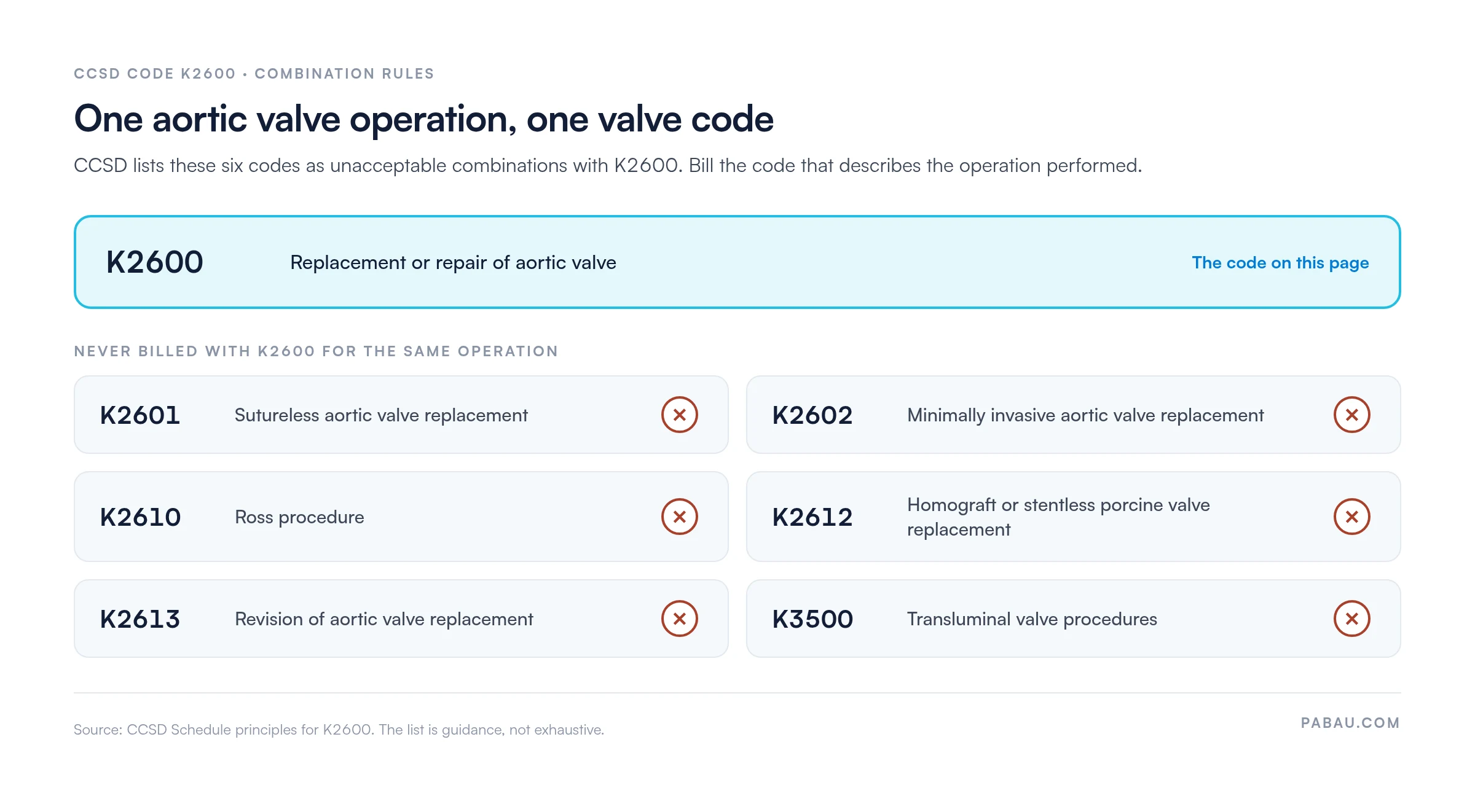
Treat the list as guidance rather than a complete rulebook. Insurers can apply their own bundling rules on top. If the operation included a second procedure, check the CCSD code library before you add another code.
A surgeon is authorized for K2600 and plans a conventional valve replacement. In theater, the team fits a sutureless valve instead. The claim should now carry K2601 alone, not K2600 plus K2601. The billing team should also tell the insurer, because the authorized code no longer matches the operation.
Insurers rarely ask for records on a clean claim. When they do query a K2600 claim, the operation note is what settles it. So the note needs to answer the coder’s questions without a phone call.
Keep the consent form and the pre-authorization reference with the record too. Together, they show the insurer agreed to fund this operation for this patient.
Cardiac surgery claims involve several billers, which is where delays creep in. Here is the usual route for an insured patient.
Tell the patient about a possible shortfall before surgery. A surprise bill after a heart operation damages trust far more than the fee itself.
Most problems trace back to a mismatch between three documents: the authorization, the operation note and the claim. These are the patterns to watch.
If an insurer still rejects the claim, ask for the reason in writing. Then reply with the operation note and the authorization history.
A short check at the desk saves weeks of back-and-forth. Run through this list for each claim.
Surgical practices often track authorizations in one place and claims in another. That split is how a code mismatch slips through. Pabau, the practice management platform we build, keeps the authorization number, the code and the claim on the patient record.
Its claims management software sends CCSD-coded claims through Healthcode and checks required fields before submission. Your team can then follow claim status and reconcile payments without leaving the record.

Send CCSD-coded claims through Healthcode from the patient record, with required fields checked before submission, so fewer cardiac claims come back queried.

K2600 is simple to choose and easy to undermine. The code itself rarely causes trouble. Instead, claims stall when the authorization, the operation note and the claim stop agreeing.
So treat any change in theater as a billing event, not just a clinical one. Update the insurer, bill the one code that fits, and keep the note specific. Book a demo to see how your practice can send surgical claims with fewer queries.

Need the wider Bupa code list? Bupa CCSD codes explains how Bupa uses CCSD codes across specialties.
Wondering how insurer fees are set? Bupa procedure codes fee schedule walks through how benefit maximums work.
Billing other surgical CCSD codes? CCSD code A4010 shows the same documentation logic for a neurosurgery code.
Coding another heart operation? CCSD code K2310 covers billing for excision of a cardiac tumor.
No. CCSD codes are for private medical insurance claims. NHS hospitals record procedures with OPCS-4 codes instead, so an NHS valve operation never carries K2600.
No. K2600 applies to the aortic valve only. Surgery on another heart valve has its own CCSD code, so check the cardiac surgery section of the schedule for the right one.
The operating consultant surgeon bills K2600 for the procedure. The anesthetist and the hospital send their own invoices to the insurer, under their own billing arrangements.
A self-pay patient pays the agreed price directly, so no insurer claim is needed. Some hospitals still record the CCSD code for reference, but it does not set the price.
CCSD updates its schedule on a regular publication cycle. New codes and revised guidance can appear, so check the current version on the CCSD website before coding.