

HCPCS Code E0272: Foam rubber mattress billing guide
HCPCS Code E0272: official descriptor and code overview HCPCS Code E0272 is the ...

Last Updated: Nov 6, 2026
K1850 is the CCSD code for revision placement of valve to cardiac conduit. It covers an open re-operation under cardiopulmonary bypass. The surgeon replaces or refashions a failing valve inside an existing conduit, and the conduit wall stays in place.
The code sits in CCSD chapter 8.8.0, Heart - Cardiac Surgery. A first valve placed in a conduit is coded K1800 instead, and a catheter-based valve implant takes a separate code.
Let Pabau's smart automation suggest the right codes, reduce claim denials, and keep your practice compliant—effortlessly.
Automate repetitive tasks and focus on what matters most—your patients.
Reduce coding errors and ensure compliance with the latest regulations.
Clean claims, fewer denials, and faster reimbursements.
Powerful insights and reporting to help your practice thrive.
HIPAA compliant SOC 2 certified GDPR-compliant Trusted by 4,000+ clinics worldwide

CCSD code K1850 covers open surgical revision of a failing valve inside an existing cardiac conduit. It does not cover a first valve placement or a catheter-based valve implant.
Tetralogy of Fallot and pulmonary atresia with VSD are the most common underlying diagnoses. Children and adults with repaired congenital heart disease both undergo the procedure.
K1850 is most often confused with K1800, the primary placement code, and with percutaneous pulmonary valve implantation. The deciding evidence is a prior conduit whose wall was kept.
Every K1850 claim needs an operative note confirming the existing conduit, the valve failure, cardiopulmonary bypass use, and the revision technique.
CCSD code K1850 is titled “Revision placement of valve to cardiac conduit” in the CCSD procedure code schedule. It covers an open re-operation in which a surgeon returns to an existing surgically created conduit and places, refashions, or replaces the valve inside it. The conduit wall stays in place, and only the valve mechanism is revised.
K1850 sits in CCSD chapter 8.8.0, Heart – Cardiac Surgery, alongside K1800, the primary placement code. They are the only two conduit-valve codes in that chapter, so the choice between them turns on whether a valve was already in the conduit. The other chapters are listed in our CCSD codes for insurers reference.
The defining feature of K1850 is that the original conduit stays in situ. When the entire conduit is excised and replaced with a new homograft or synthetic graft, a different code applies, chosen from the CCSD schedule.
Revision placement of valve to cardiac conduit is an open cardiac re-operation performed under cardiopulmonary bypass. The surgeon reaches a previously implanted conduit, typically one connecting the right ventricle to the pulmonary arteries, and treats the failing valve inside it. The conduit wall is not removed.
The operative steps coders should expect to see documented include:
Because this is a re-operation on an already-scarred chest, bypass times are typically longer than for primary conduit surgery. Taking down the adhesions adds to the operative risk and to the HRG grouping.
The clinical trigger for CCSD code K1850 is failure of the valve component within an existing right-heart conduit. The conduit itself may remain structurally adequate while the valve inside has degenerated. Two broad failure modes prompt the procedure:
The diagnoses most often behind K1850 are tetralogy of Fallot, pulmonary atresia with ventricular septal defect, and other congenital heart disease repaired by RVOT reconstruction. Children and adults with repaired congenital heart disease both undergo conduit valve revisions, so K1850 is not limited to pediatric episodes. Patients whose Ross procedure was coded K2610 also carry a pulmonary homograft, which can fail in the same way.
Conduit valve failure is an expected long-term sequela of primary RVOT reconstruction. Most homograft and bioprosthetic conduit valves last 10 to 20 years, so specialist congenital cardiac centers plan repeat operations at follow-up. Expect K1850 to appear in the same patient’s record several times across a lifetime.
Check the operative note for the phrase ‘conduit valve revision’ or ‘valve replacement within conduit’, as opposed to ‘conduit replacement’ or ‘conduit excision and interposition’. The second pair means the whole conduit was replaced, so a conduit replacement code applies instead. This one wording difference is the most common source of K1850 miscoding.
Correct code selection turns on three questions from the operative note, asked in order. Was the valve placed by catheter? Was the whole conduit replaced? Did the conduit already hold a valve?
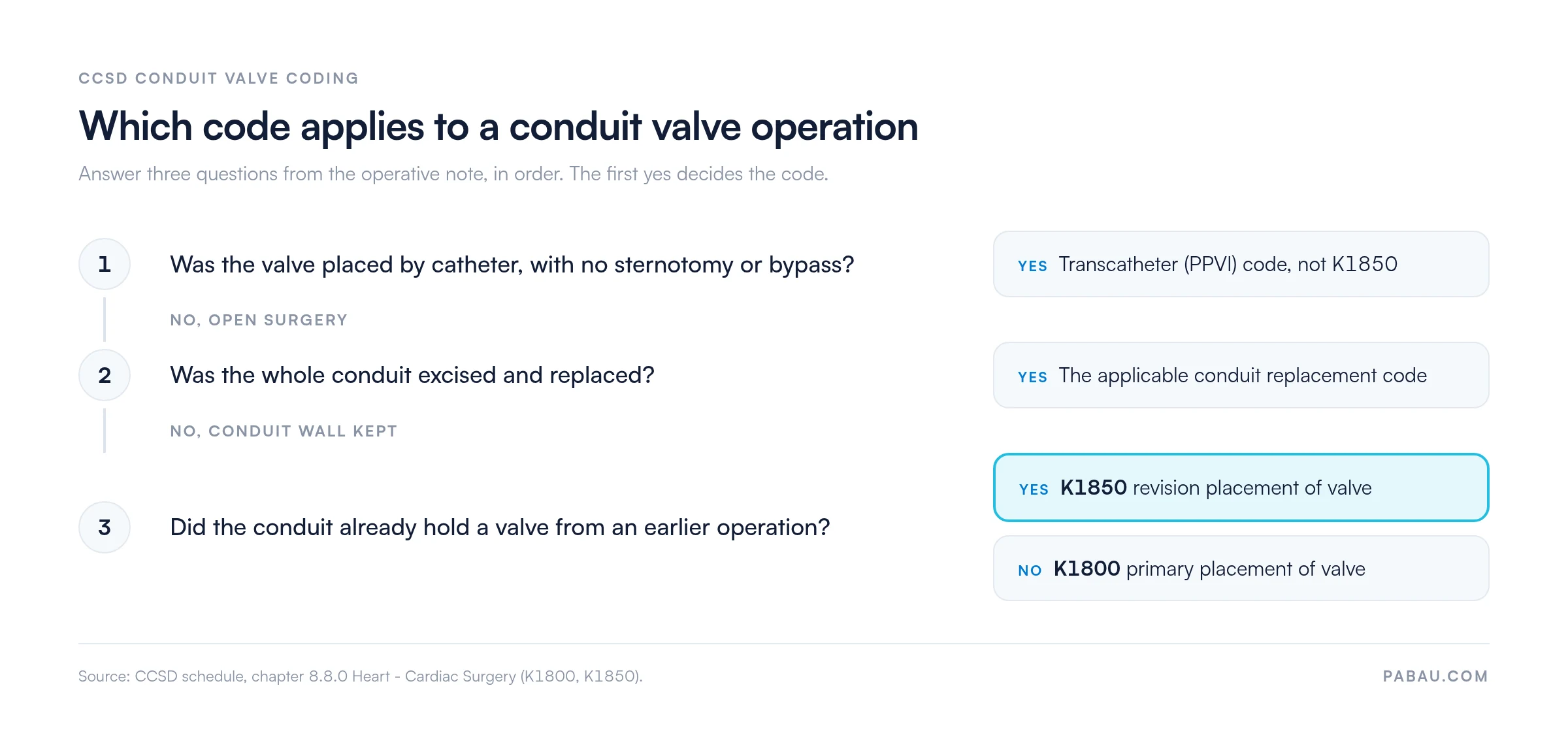
The table below maps the same scenarios to the evidence a coder should find in the notes.
Percutaneous pulmonary valve implantation, most often with the Medtronic Melody transcatheter valve, takes a separate CCSD code for catheter-based cardiac interventions. K1850 applies only to open surgery under cardiopulmonary bypass. Payers typically reject K1850 on a Melody valve episode, because the bypass and operative complexity behind the K1850 fee are absent.
A K1850 claim holds up only when the operative note explicitly confirms each of the elements below. If any one is missing, payers may query or reject the code.
Inaccurate coding invites payer queries and governance scrutiny. An operative note thin enough to prompt a coding query is a governance risk as well as a revenue risk.
Private providers billing through Bupa, AXA Health, or Aviva also need to submit clinical justification. Bupa verifies codes against its published fee schedule through the Bupa code search portal. A structured clinical summary sent with the CCSD claim lowers the chance that a manual review delays payment.
NHS trusts code admitted patient care with OPCS-4, the Classification of Interventions and Procedures maintained by NHS England. Private medical insurers use CCSD codes instead, and the two systems overlap clinically without being interchangeable.
For the K1850 procedure, the matching OPCS-4 chapter is Chapter K, operations on the heart, which includes codes for RVOT conduit revision. Confirm the exact OPCS-4 code in the NHS Classifications Browser. Crosswalks are not always one-to-one and can change at each annual coding year.
The NHS Payment Scheme uses Healthcare Resource Groups (HRGs), derived from OPCS-4 codes, to set episode prices. A conduit valve re-operation groups within the cardiothoracic surgery HRG subchapter. It attracts a substantially higher price than a primary cardiac procedure, reflecting the redo sternotomy and bypass.
HRG prices change annually with the NHS Payment Scheme, so verify any pound figure for a conduit valve revision against NHS England’s current documents. Comorbidities such as pulmonary hypertension or several prior re-operations can trigger a complication or comorbidity (CC) split. That split moves the episode to a higher-paying HRG.
Private medical insurers using CCSD codes maintain their own fee schedules. Healix and similar payers publish CCSD-mapped fee schedules for cardiac surgical procedures. These differ from NHS tariff values and are updated periodically outside the NHS annual cycle.
The errors below are the ones that recur on K1850 claims. Good claims management software can flag a code mismatch before submission, but the coding decision itself still needs a clinical coder’s judgment.
When a K1850 claim is queried, payers typically ask for the operative note and the pre-operative imaging report. Sending both with a complex cardiac re-operation claim shortens the turnaround. The same principle holds whether the invoice goes through Healthcode or straight to the insurer.
UK private medical insurers and NHS commissioners each set conditions before they authorize and pay for K1850. Payer policies vary and change, so treat the points below as commonly reported requirements, not one insurer’s current policy.
For NHS care, conduit valve revisions at specialist congenital cardiac centers are typically commissioned under NHS England specialized services contracts. Approval sits in the network referral pathway, with no separate authorization step. Accurate OPCS-4 coding still decides the HRG grouping and payment.
Private insurers including Bupa, AXA Health, and Aviva generally require pre-authorization for cardiac re-operations. A request should include:
Insurers typically authorize each episode separately, so a repeat revision needs a new request.
In UK private healthcare, K1850 goes through standard medical billing channels, including Healthcode’s electronic invoicing platform. For Bupa specifically, the Bupa CCSD procedure codes guide covers how CCSD-coded claims are submitted.
In many private cardiac practices, the operative note lives in one system and the insurer invoice is built in another. Someone in billing reads the note, chooses between K1800 and K1850, and retypes the pre-authorization number. Each handoff is a chance for the wrong code or a missing reference to reach the insurer.
Pabau, the practice management platform we build, keeps those steps in one patient record. Each insurer pre-authorization is stored as a case and attached when the operation is booked. The authorization code then follows the appointment through to the claim, which goes to Bupa, AXA Health or Vitality through Healthcode.
The outcome is fewer queries about a missing authorization or a mismatched code. When an insurer asks for the operative note and the imaging report, both sit in the same record as the invoice.

Pabau keeps procedure codes, pre-authorizations and patient records in one place for specialist cardiac practices. Your clinical team spends less time on billing paperwork.

Code K1850 from evidence in the note, not from the patient’s history. Confirm three facts before submitting: open surgery under bypass, a conduit wall left in place, and a valve that was already there. With all three documented, K1850 is right, and applying K1800 (primary placement) to that re-operation underclaims it.
The trade-off is time spent up front. Querying a vague note with the surgeon delays submission by a day or two. An insurer query after submission holds the whole payment until it is answered.
Book a demo to see how Pabau keeps the pre-authorization, the operative note and the K1850 claim in one record for your cardiac practice.

Coding the first valve placed in a conduit? CCSD code K1800 covers primary placement of a valve to a cardiac conduit, the counterpart to K1850.
Billing a Ross procedure? CCSD code K2610 explains how the Ross procedure is coded and billed in UK private practice.
Need a broader CCSD billing reference for Bupa procedures? Bupa CCSD procedure codes covers the CCSD codes Bupa accepts, with fee schedule context and submission guidance.
Looking for the full Bupa CCSD fee schedule? Bupa procedure codes fee schedule gives a structured reference for CCSD-coded procedure fees across specialties.
CCSD code K1850 is the procedure code for revision placement of valve to cardiac conduit. It covers an open re-operation in which a surgeon replaces or refashions a failing valve within an existing right-heart conduit, without removing the conduit itself.
K1800 applies when a valve is placed inside a conduit for the first time. K1850 applies only when a valve previously placed within that conduit is being revised during a re-operation. If the operative note documents a primary procedure with no prior valve in the conduit, K1800 is correct.
No. K1850 covers open surgery under cardiopulmonary bypass. Percutaneous pulmonary valve implantation with the Medtronic Melody valve or another transcatheter device takes a separate CCSD code for catheter-based cardiac interventions. Without a sternotomy and bypass, K1850 does not apply.
The operative note must confirm that an existing conduit was present and describe the valve failure, with the stenosis grade or regurgitation severity. It must also confirm cardiopulmonary bypass, name the revision technique, and state that the conduit wall was preserved rather than excised.
CCSD and OPCS-4 are separate coding systems used in different settings. NHS trusts use OPCS-4 for inpatient coding and HRG grouping, while private insurers use CCSD. The K1850 procedure maps to an OPCS-4 code in Chapter K covering RVOT conduit revisions. Verify the exact crosswalk in the current NHS Classifications Browser, because mappings are updated annually.
Conduit valve revisions typically group into a cardiothoracic surgery HRG that reflects re-operation complexity. The specific HRG and its price change annually with the NHS Payment Scheme. Always check the current year’s NHS England documents rather than relying on a fixed figure.




