CPT code 93503: Swan-Ganz catheter billing and modifiers
CPT code 93503: Official descriptor and procedure overview In the AMA CPT code s...

Last Updated: Oct 23, 2026
K3100 is the CCSD code for open valvotomy, an operation that splits fused or narrowed heart valve leaflets under direct vision. The surgeon opens the chest and places the patient on cardiopulmonary bypass. The code applies to any cardiac valve.
K3100 sits in Chapter 8 (Thorax and intra-thoracic organs) of the CCSD schedule, under cardiac surgery, in the Complex band. Bupa lists it as CMO 5 with a fee of £2,172. A closed mitral valvotomy bills under K3210 instead, and a catheter-based balloon procedure under K3500.
Let Pabau's smart automation suggest the right codes, reduce claim denials, and keep your practice compliant—effortlessly.
Automate repetitive tasks and focus on what matters most—your patients.
Reduce coding errors and ensure compliance with the latest regulations.
Clean claims, fewer denials, and faster reimbursements.
Powerful insights and reporting to help your practice thrive.
HIPAA compliant SOC 2 certified GDPR-compliant Trusted by 4,000+ clinics worldwide

CCSD Code K3100 covers open surgical valvotomy of any heart valve, performed under direct vision on cardiopulmonary bypass.
A closed mitral valvotomy on the beating heart bills under K3210, and a catheter-based balloon procedure under K3500.
The operative note must confirm the open approach, the valve operated on, bypass use and the nature of the incision.
UK private insurers including Bupa, AXA Health and Aviva expect prior authorisation before open valvotomy, and a missing reference is a common cause of denial.
Claims software such as Pabau stores each pre-authorisation as a case, so the authorisation code follows the appointment through to the claim.
CCSD Code K3100 is the Clinical Coding and Schedule Development (CCSD) Group’s code for “Open valvotomy”. The surgeon opens the chest, places the patient on cardiopulmonary bypass and splits the fused valve leaflets under direct vision. The code applies to any cardiac valve.
K3100 is a standalone code. It is the only code in the K31xx range of the current Bupa schedule. There is no valve-specific open valvotomy sub-code to rule out. Bupa’s February 2026 schedule lists it in Chapter 8, under Heart – Cardiac Surgery, in band CMO 5 with a fee of £2,172.
The CCSD schedule is the standard coding framework for UK private medical insurance (PMI) billing. The responsible consultant surgeon submits K3100 when an open valvotomy is billed to an insurer such as Bupa, AXA Health, Aviva or Vitality. Our CCSD codes for consultants library lists the neighbouring codes in the same chapter.
Always check which schedule edition the insurer is using, because descriptors and fee bands are reviewed periodically.
Open valvotomy is a cardiac operation in which the surgeon incises or splits fused valve leaflets (commissurotomy) to relieve stenosis. It is performed under direct vision through an open chest. It differs from closed valvotomy, coded K3210, and from percutaneous balloon valvuloplasty, which is catheter-based and needs no sternotomy.
The typical surgical sequence involves:
The primary indication is valvular stenosis, a narrowing of a heart valve that restricts blood flow. Open valvotomy may be chosen when percutaneous options are unsuitable, when the valve anatomy is complex, or when other cardiac surgery is planned. The operative note should describe each step clearly enough to support K3100.
K3100 covers open valvotomy of any cardiac valve. The current schedule has no valve-specific open valvotomy code, so all four valves below map to K3100:
The one valve-specific valvotomy code sits next door. K3210 covers closed mitral valvotomy, done on the beating heart without bypass. The operative note’s record of the valve and of bypass use is therefore both a clinical and a coding requirement.
Open valvotomy sits among several valve codes in the Heart – Cardiac Surgery section of the schedule. Picking the wrong neighbour is a common source of claim queries and rejections. Two questions about the operative note settle most cases, as the diagram below shows.
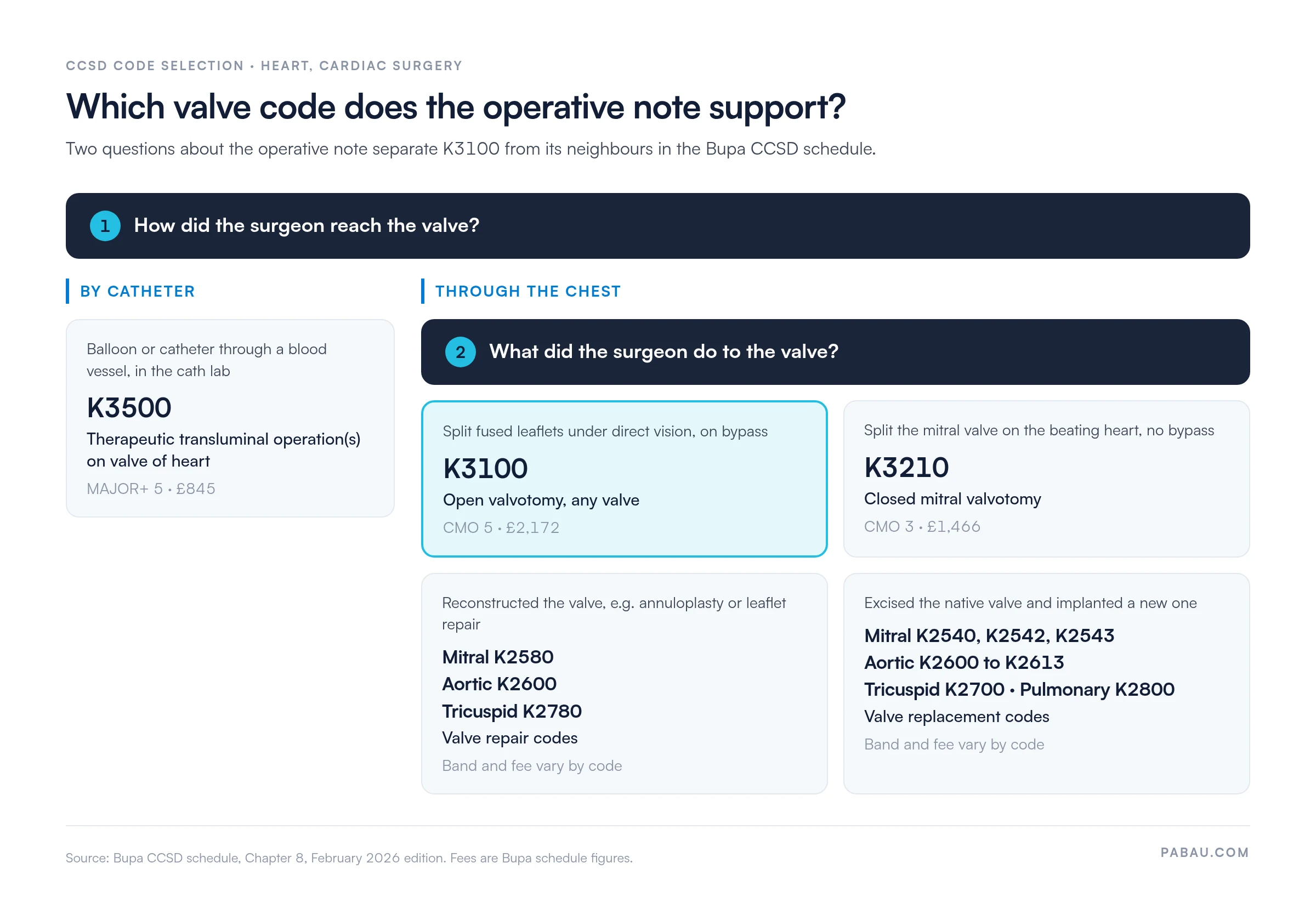
The table sets K3100 beside those codes, with each code’s band and fee from the February 2026 Bupa schedule where one code applies. Check descriptors against the Bupa CCSD procedure codes reference before billing.
The most common coding error on K3100 claims is swapping it with a percutaneous valvuloplasty code, or the reverse. The two are clinically distinct operations with different codes. Bupa’s schedule lists £2,172 for K3100 against £845 for K3500, so the error also changes the fee.
The documentary test is straightforward. If the procedure report describes an operating theatre, sternotomy and direct valve incision, code K3100. If it describes a catheterisation lab, vascular access and balloon inflation, code K3500. When an operative note describes only a “valve procedure”, query the responsible surgeon before submitting the claim.
A K3100 claim needs documentation that clearly supports the open surgical approach and the valvotomy as the primary procedure. Using claims management software to attach and track operative documents reduces the risk of a claim leaving without its evidence.
The operative note must contain all of the following:
Insurers also expect the consultant surgeon’s name and GMC number, the procedure date, the clinical indication and the hospital on the invoice. An invoice missing any of these details gives the insurer grounds to query or deny the claim.
Review the operative note before submitting a K3100 claim. Confirm it contains the word ‘open’, the named valve, bypass use and a description of the incision or commissurotomy. A report that says only ‘valve procedure performed’ will not support the claim. Query the surgeon for an addendum before submission rather than after a denial.
Open valvotomy is a major elective cardiac operation, and mainstream UK private medical insurers require prior authorisation before treatment begins. Claims submitted without a valid pre-authorisation reference number are routinely rejected, whatever their clinical merit.
Specific requirements vary and should be confirmed with each insurer before the procedure. Typical pre-authorisation evidence includes:
Each insurer publishes its own pre-authorisation pathways and coding requirements, through Bupa’s code lookup, AXA Health’s procedure code portal and Aviva’s fee schedule.
Check the K3100 pathway on the insurer’s provider portal before the procedure date. Portal guidance takes precedence over any third-party summary, including this one.
The pre-authorisation reference number issued by the insurer must appear on the invoice. If the procedure date, the procedure performed or the consultant differs from the pre-authorised details, contact the insurer before billing.
K3100 claim denials cluster around a few predictable failures. Most are avoidable with a pre-submission check against the documentation requirements above.
When a denial arrives, request the denial reason code in writing. Review a denial citing “incorrect procedure code” against the operative note first. If the note supports K3100, submit a formal reconsideration with the note attached. A “not pre-authorised” denial needs escalating to the insurer’s provider relations team if authorisation was obtained.
Open valvotomy is rarely the only procedure on an operative list. Knowing what can be billed alongside K3100, and what it already includes, is essential for accurate claim submission.
Cardiopulmonary bypass: Whether bypass is separately billable alongside K3100 depends on the insurer’s contract and the current schedule edition. Some insurers treat it as part of the primary cardiac surgical code, while others allow a separate bypass code. Confirm against the CCSD technical guide and the insurer’s fee schedule before billing it separately.
Surgical assistant: A recognised surgical assistant may be coded separately if the operative note documents their involvement. The insurer’s terms must also recognise assistant fees for this category of procedure. Confirm the assistant’s recognition status and the applicable code with the insurer before billing.
Anaesthetic codes: The anaesthetist bills separately, under their own CCSD codes and insurer recognition. The surgeon’s K3100 claim and the anaesthetist’s claim are submitted independently.
Concurrent cardiac procedures: When a second cardiac procedure is performed at the same sitting, both may be coded subject to the insurer’s unbundling rules. Coronary artery bypass grafting alongside the valvotomy is one example. Each concurrent procedure needs its own pre-authorisation reference. Check the Bupa procedure fee schedule and the insurer’s multiple-procedure reduction policy before invoicing.
When K3100 is performed alongside a second cardiac procedure, obtain separate pre-authorisation for each CCSD code before the operative date. Insurers apply multiple-procedure reduction policies that cut the fee for the secondary procedure. Confirm the reduction percentage with the insurer so the invoice reflects the expected reimbursement.
Billing a K3100 claim often means chasing paperwork across email, insurer portals and spreadsheets. The pre-auth reference sits in one place, the operative note in another and the invoice in a third.
Pabau, the practice management platform we build, keeps those pieces on the patient record. Each insurer pre-authorisation is stored as a case. Attach the case when booking the operation, and the authorisation code follows the appointment through to the claim.
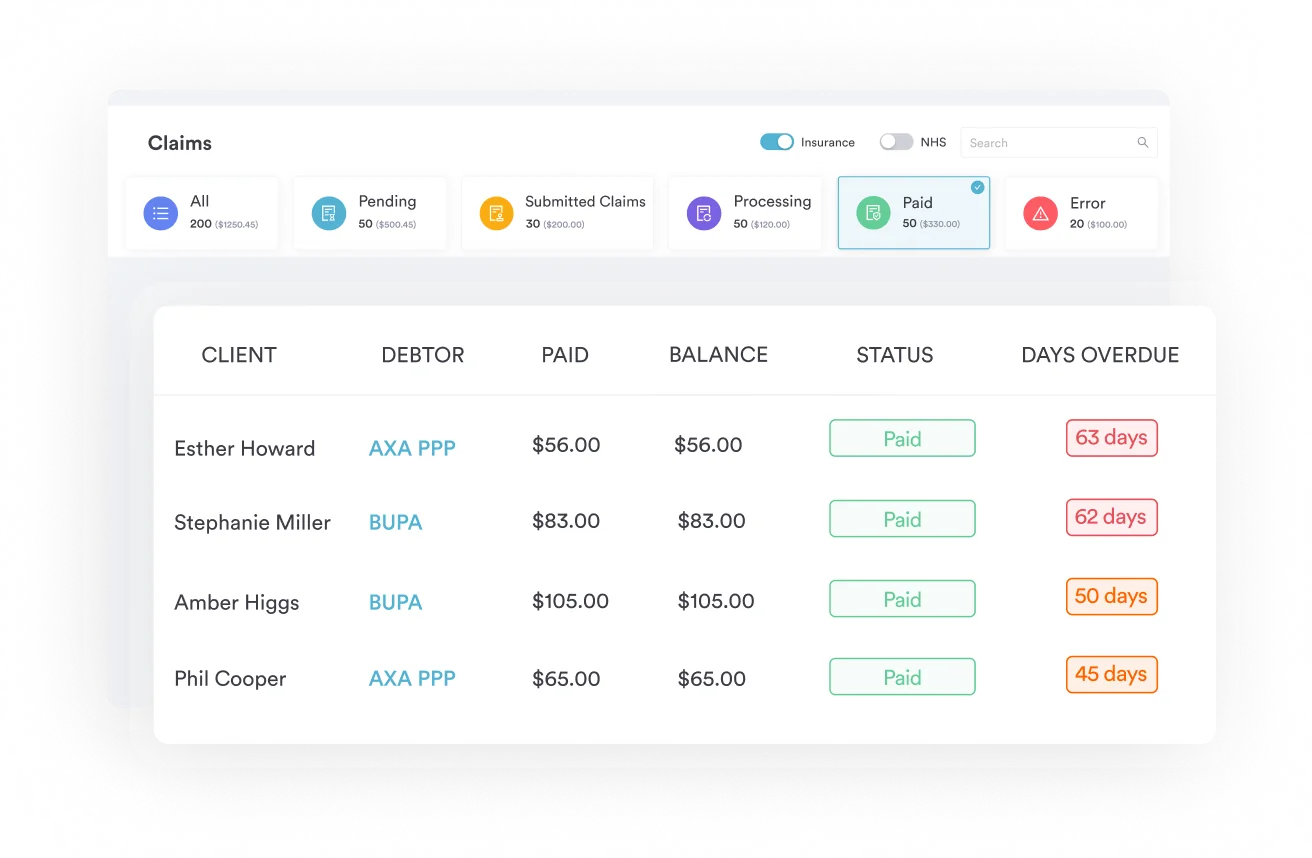
Pabau then raises the invoice to the insurer at its contract rate. It sends private medical insurance claims through Healthcode to insurers such as Bupa, AXA Health and Vitality. Every outstanding K3100 balance sits in one claims dashboard, so your team can see which claims are still waiting on payment.

Pabau helps UK private healthcare practices track prior authorisation, attach operative documents, and submit CCSD-coded claims without the manual chasing. See how it works for cardiothoracic and specialist practices.

Code K3100 when the operative note shows an open chest, bypass and a direct incision of fused leaflets, on any valve. When the note describes a beating-heart mitral procedure or a catheter route, the insurer expects K3210 or K3500 instead.
The coding decision is rarely where these claims fail. They stall on a lapsed pre-authorisation, or on an operative note that never states the approach. Fixing either before the operation takes a phone call, while fixing it after a denial means a reconsideration and a delayed fee.
Book a demo to see how Pabau links each pre-authorisation to the operation and the claim, so K3100 invoices reach the insurer complete.

Coding a valve repair rather than a valvotomy? CCSD code K2580 covers open repair of the mitral valve, including the documentation insurers expect.
Did the surgeon replace the valve instead? CCSD code K2600 explains how to bill an aortic valve replacement and when it applies.
Billing a redo mitral procedure? CCSD code K2542 sets out the revision replacement code and how it differs from a first-time operation.
Is the valve going into an existing conduit? CCSD code K1800 covers placing a valve into a cardiac conduit, plus the codes it cannot be billed with.
CCSD Code K3100 covers open valvotomy, the surgical incision of fused heart valve leaflets through an open chest (sternotomy) under direct vision. It does not cover catheter-based valve procedures, which are coded K3500.
Open valvotomy is a cardiac operation in which a surgeon opens the chest via sternotomy and splits the fused commissures of a stenotic heart valve. This restores a wider valve opening. It differs from balloon valvuloplasty, which achieves a similar effect through a catheter without opening the chest.
Open valvotomy is a surgical procedure in which the surgeon cuts fused valve leaflets through an open chest. Valvuloplasty is a catheter-based technique that inflates a balloon inside the valve to widen it without an incision. Open valvotomy bills under K3100, and balloon valvuloplasty under K3500.
K3100 applies to open valvotomy of any cardiac valve, whether mitral, aortic, pulmonary or tricuspid. The current CCSD schedule has no valve-specific open valvotomy code, so the valve does not change the code. A closed mitral valvotomy on the beating heart is a different procedure, coded K3210.
The operative note must confirm the open surgical approach (sternotomy), the valve operated on and the nature of the incision. It must also record bypass use and the intraoperative valve assessment. The invoice must link to an ICD-10 diagnosis code confirming valvular stenosis. It must also carry the insurer’s prior authorisation reference number.
The most common denial reasons are missing prior authorisation and an operative note that does not confirm the open surgical approach. Others include an incorrect adjacent code such as K3500, a mismatched ICD-10 diagnosis, or a consultant whose insurer recognition has lapsed.
K3100 is an open surgical code, while percutaneous balloon valvuloplasty bills under K3500 in the same cardiac surgery section of the schedule. An operating theatre, sternotomy and direct leaflet incision support K3100. A catheterisation lab, vascular catheter access and balloon inflation support K3500.