HCPCS code P9058: Red blood cells, leukocytes reduced, CMV-negative, irradiated
HCPCS code P9058: Official descriptor and key attributes HCPCS code P9058 report...

Last Updated: Oct 26, 2026
K5530 is the CCSD code for ventriculoplasty (including ventriculectomy), the Batista operation. It covers open resection of a wedge of left ventricular wall under cardiopulmonary bypass, to shrink a dilated chamber in dilated cardiomyopathy.
UK private insurers expect prior authorisation before surgery, and the claim is usually paired with ICD-10 code I42.0. A concurrent mitral valve repair is coded separately with K2580.
Let Pabau's smart automation suggest the right codes, reduce claim denials, and keep your practice compliant—effortlessly.
Automate repetitive tasks and focus on what matters most—your patients.
Reduce coding errors and ensure compliance with the latest regulations.
Clean claims, fewer denials, and faster reimbursements.
Powerful insights and reporting to help your practice thrive.
HIPAA compliant SOC 2 certified GDPR-compliant Trusted by 4,000+ clinics worldwide

CCSD Code K5530 covers ventriculoplasty (including ventriculectomy), the Batista operation, which resects a wedge of left ventricular wall to shrink a dilated chamber.
The main supporting ICD-10 codes are I42.0 for dilated cardiomyopathy and the I50 heart failure codes, and each must match the clinical record.
All major UK private insurers expect prior authorisation before K5530 is performed, and proceeding without it risks full claim repudiation.
Pabau, the practice management platform we build, submits CCSD claims to Healthcode and tracks their status, so a high-value K5530 claim does not stall unnoticed.
CCSD Code K5530 covers ventriculoplasty (including ventriculectomy), also known as the Batista operation. It is a single-stage cardiac operation in which a surgeon resects a full-thickness wedge of the lateral left ventricular wall. As a result, this reduces the dilated chamber to a more normal geometry.
The Clinical Coding and Schedule Development (CCSD) Group, whose members are Aviva, AXA Health, Bupa and VitalityHealth, maintains the CCSD schedule. In addition, it lists K5530 in chapter 8, Thorax and intra-thoracic organs, under Heart – Cardiac Surgery.
Two procedure terms appear in the official descriptor, and both refer to the same operation. First, ventriculoplasty describes reshaping or reconstructing the ventricular wall. Second, ventriculectomy describes the partial excision of ventricular muscle. Overall, clinical and coding literature use the two terms interchangeably for K5530.
The eponym comes from the Brazilian cardiac surgeon Randas Batista, who developed and popularised the technique in the mid-1990s.
K5530 sits in a coding family with other complex ventricular procedures. However, it does not cover ventricular aneurysm repair (K5380), LVAD support or cardiac transplantation, which each carry their own code. Our CCSD codes guide lists the wider schedule. Therefore, coders must confirm from the operative report which procedure the surgeon performed before assigning K5530.
Surgeons perform the Batista operation under cardiopulmonary bypass (CPB), with the patient anaesthetised and the heart arrested. The consultant cardiothoracic surgeon identifies the lateral wall of the left ventricle, between the anterior and posterior papillary muscles.
The surgeon then excises a full-thickness crescent or wedge of myocardium. Next, the surgeon reapproximates and sutures the remaining ventricular edges to restore a smaller, more elliptical chamber.
The operative report should record these surgical steps:
Surgeons add a mitral valve repair to many Batista operations, because DCM often causes functional mitral regurgitation. When they do, the mitral valve repair code K2580 applies with K5530. However, the two procedures are distinct and separately codeable, as the concurrent coding section below explains.
K5530 applies when the documented indication is dilated cardiomyopathy (DCM) with severely impaired left ventricular function. Patients usually have New York Heart Association (NYHA) class III or IV heart failure that has not responded to optimised medical therapy. However, the procedure is rarely indicated for ischaemic cardiomyopathy.
Patient selection for a Batista operation follows a multidisciplinary heart team (MDT) decision. The MDT considers and documents why LVAD implantation or cardiac transplantation is not the preferred pathway. Insurers rely on that record, because without it you cannot show a payer why K5530 beats the standard alternatives.
The usual clinical profile for a K5530 patient includes:
Surgeons now rarely perform the Batista operation, so its use outside a tertiary cardiac surgery centre is unusual. In addition, some UK private insurers may require extra expert opinion before authorising the procedure.
Every K5530 claim must be paired with at least one ICD-10 diagnosis code that establishes clinical necessity. The table below lists the primary ICD-10 codes used with K5530 and notes on insurer acceptability for each.
Verify all ICD-10 codes against the current NHS Classifications Browser before submission, as annual updates may affect code validity. In fact, incorrect primary diagnosis coding is a common cause of claim queries. Each insurer decides its own reimbursement, so check how your payer handles a diagnosis query.
Understanding what is bundled into K5530 prevents both unbundling errors and under-coding. The table below summarises what is included in the K5530 fee and what may be additionally coded.
When in doubt about bundling, consult the current CCSD Technical Guide for the definitive bundling rules applicable to complex cardiac procedures. Otherwise, applying a concurrent code for an item already included in K5530 counts as unbundling and will trigger a claim query or repudiation.
K5530 occupies a narrow clinical space alongside several other complex cardiac codes. The table below shows the related codes most often confused with it, and what sets each one apart.
Ultimately, the decision comes down to what the operative note says the surgeon did, as the diagram below shows.
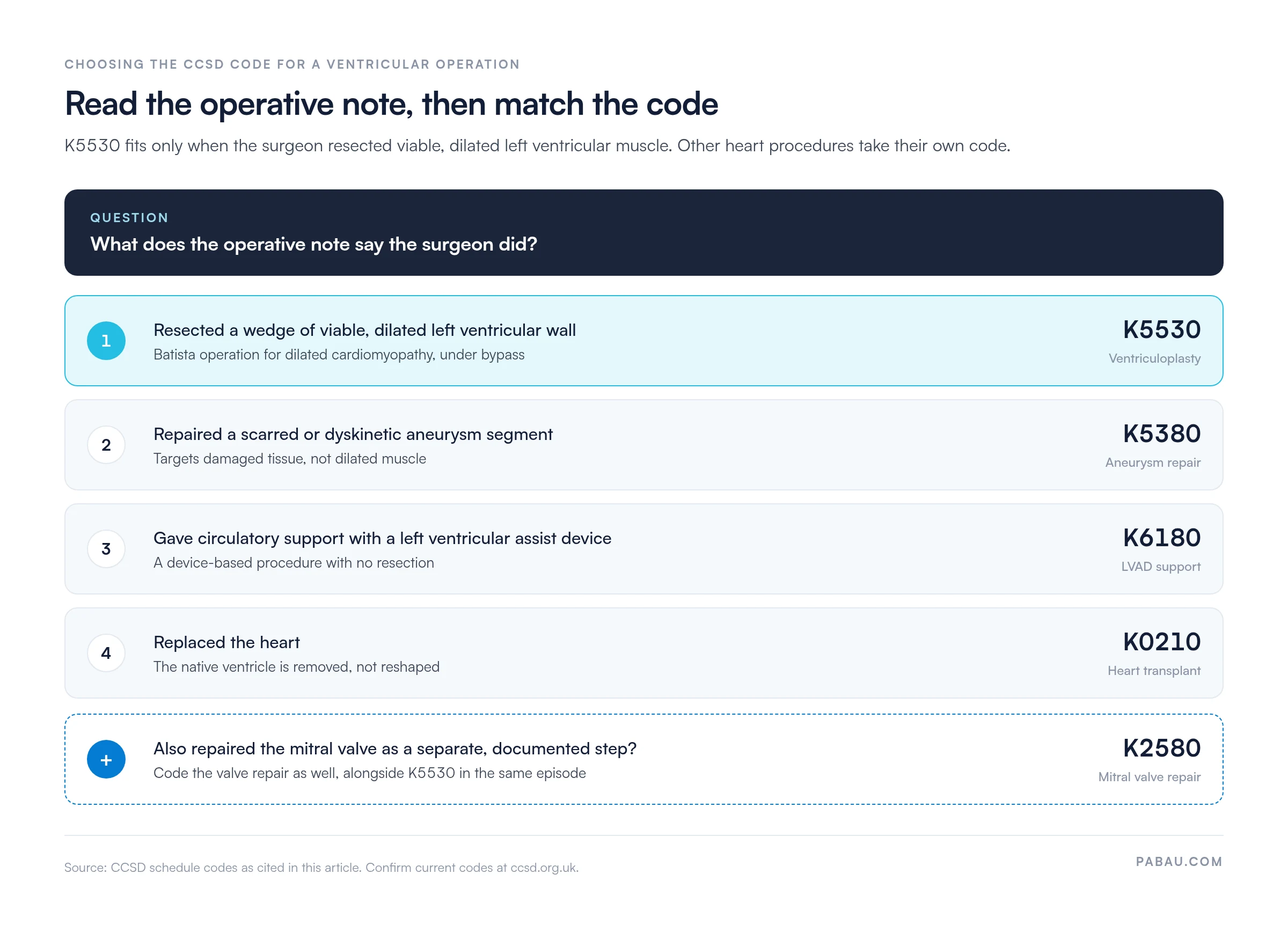
Before assigning K5530, read the operative report in full and confirm the surgeon resected viable left ventricular myocardium to reduce chamber volume. If the note describes aneurysm excision, patch repair, or LVAD insertion, a different K-chapter code applies. The Batista operation is a distinct and precisely described technique; do not assign K5530 based on procedure name alone.
Insurers will query or deny a K5530 claim that lacks complete documentation. Also, they assess the operative evidence in detail for high-value cardiac surgical codes. Overall, the documentation checklist below covers every record a coder must have in hand before submitting.
A missing record does not automatically invalidate a claim. Each absent document does make a medical review request more likely, and that delays payment. Therefore, a pre-submission checklist specific to K5530 keeps the pack complete.
Build a K5530 pre-submission checklist: operative note, MDT decision letter, pre-operative echo, NYHA classification and prior authorisation reference. Running it before every Healthcode submission catches the most common denial causes for this code.
All major UK private medical insurers require pre-authorisation before the surgeon performs K5530. Proceeding without authorisation does not guarantee that payment will be withheld. However, it does greatly increase that risk, and it removes the patient’s protection under their policy terms.
For Bupa’s own code requirements and authorisation process, see our guide to Bupa CCSD procedure codes. The table below summarises what each major insurer typically requires for complex cardiac surgical codes such as K5530.
Lead times vary by insurer and by case, so confirm the expected turnaround with the insurer when you submit the request.
Pre-authorisation does not guarantee payment. Also, insurers retain the right to review the case after surgery. For example, they may decline payment if the documented procedure does not match the authorised treatment, or if the operative evidence does not support clinical necessity.
Healthcode eBilling is the primary electronic claim submission platform for UK private healthcare. The steps below cover the specific fields relevant to a K5530 cardiac surgical episode.
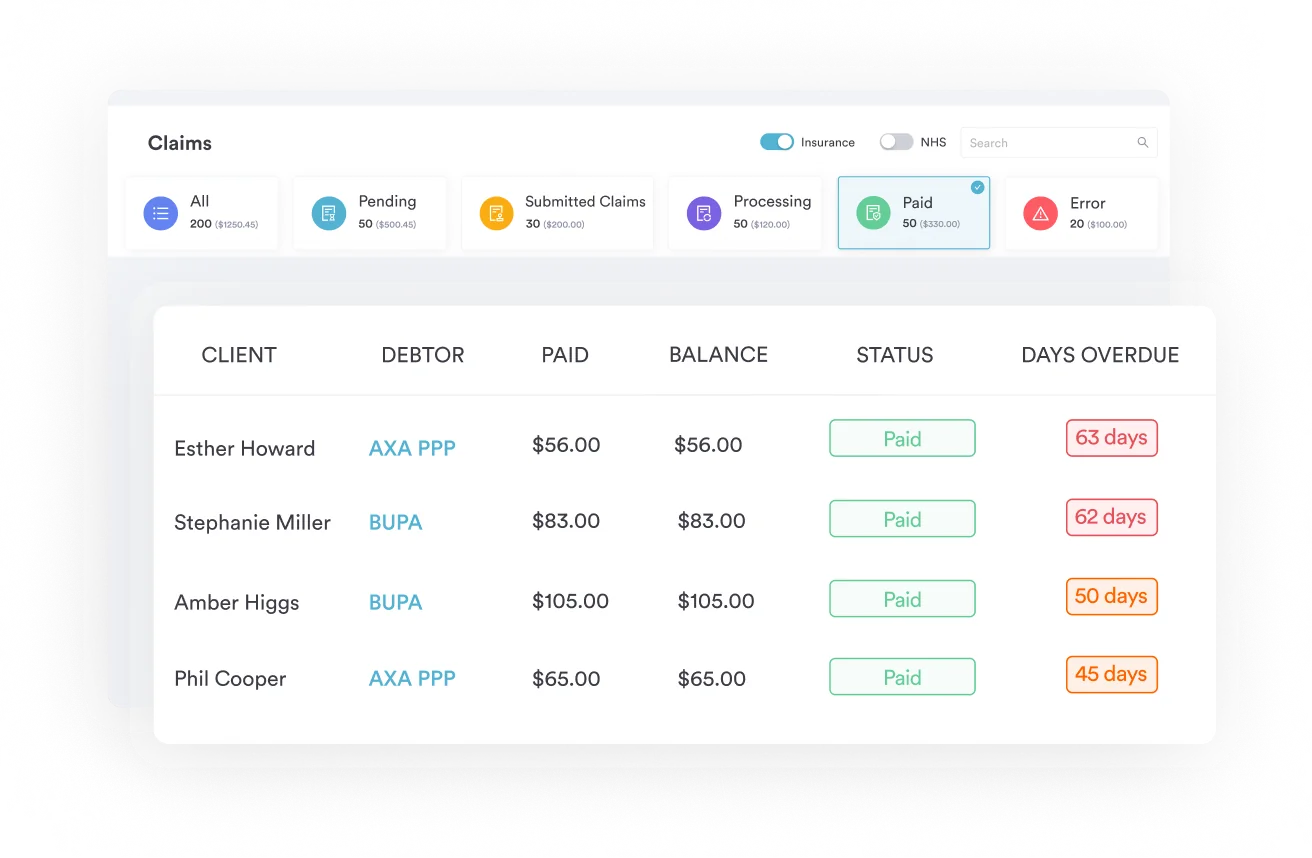
Pabau’s claims management software submits claims to Healthcode and tracks their status. As a result, cardiothoracic billing teams can see which K5530 claims are paid, pending or in error, alongside the patient record.
K5530 claims fail for predictable reasons. The table below lists the most common denial causes, the typical insurer response, and the corrective action for each.
Surgeons sometimes perform the Batista operation with other cardiac procedures. Each procedure the surgeon performs and records separately may generate its own CCSD code. Also, the extra procedure must be clinically separate from the ventriculectomy, and the operative note must record it as a distinct surgical step.
Concurrent mitral valve repair is the most common example. Functional mitral regurgitation is a frequent consequence of DCM, and many surgeons address it in the same session. When the operative note documents the ventricular resection and a distinct mitral valve repair, K5530 and K2580 both apply. On the diagnosis side, I34.0 records the regurgitation that supports the valve step.
The primary procedure is generally the one with the higher relative value, which in most K5530 cases is the ventriculoplasty. Confirm the primary and secondary designation with the submitting consultant and the insurer’s billing policy. In addition, some payers apply a multiple-procedure reduction to the secondary code.
Cardiothoracic billing teams handling K5530 juggle prior authorisation across several insurers, a long documentation pack and a high-value claim that often goes to manual review. However, many still chase each claim through separate insurer portals and spreadsheets.
Pabau’s claims management submits CCSD claims to Healthcode from the same system that holds the patient record. Each claim then shows as pending, submitted, processing, paid or in error, so the team can see which K5530 claims need chasing.
As a result, the team gets one view of every outstanding insurer claim, kept with the patient’s records rather than in a separate tracker.

Pabau submits CCSD claims to Healthcode and tracks each claim’s status, so your billing team can follow high-value cardiac claims without switching systems.

K5530 is a rare code, and insurers read every claim for it closely. In fact, the coding itself is seldom what holds a claim up. Instead, claims stall when the pre-authorisation reference, the MDT decision record or a detailed operative note is missing.
So build the pack before the operation, not after the query arrives. Agree prior authorisation, confirm I42.0 against the echo report, and code a separate mitral repair with K2580. Overall, a claim that arrives complete stands the best chance of payment on first review.
Book a demo to see how Pabau submits and tracks CCSD claims through Healthcode for UK private cardiac practices.

Billing another Bupa patient? Bupa CCSD procedure codes covers how to find, submit and manage Bupa-specific billing codes for UK private practice.
Need to check a fee before you bill? Bupa procedure codes fee schedule explains how Bupa fee schedules are structured and how CCSD codes map to published rates.
Coding another open-heart operation? CCSD code K2310 covers excision of a cardiac tumour, another heart procedure in the same chapter.
Adding a valve diagnosis to the claim? ICD-10 code I34.0 explains the mitral regurgitation code that supports a concurrent valve repair.
CCSD Code K5530 covers ventriculoplasty (including ventriculectomy), the Batista operation. A surgeon resects a wedge of left ventricular wall under cardiopulmonary bypass to shrink a dilated chamber in dilated cardiomyopathy. The code includes the resection, wall closure and bypass. Code concurrent valve procedures and device implantation separately.
The Batista operation is a partial left ventriculectomy. A cardiac surgeon removes a full-thickness wedge of the lateral left ventricular wall to normalise the dilated chamber. Surgeons reserve it for end-stage dilated cardiomyopathy, typically NYHA class III or IV, when an MDT decides LVAD implantation and transplantation are unsuitable.
The primary supporting code is I42.0 (dilated cardiomyopathy). Secondary codes I50.0 (congestive heart failure) or I50.1 (left ventricular failure) may be added to document the functional manifestation. Where concurrent mitral valve repair is performed, I34.0 (mitral regurgitation) is also applicable. Avoid unspecified codes such as I50.9 where a more precise code applies.
Under K5530, both terms describe the same operation. Ventriculoplasty means reshaping or reconstructing the ventricular chamber, and ventriculectomy means partial excision of ventricular muscle. The CCSD descriptor uses both because the literature uses them interchangeably for the Batista procedure. Coders should not bill them as separate procedures.