HCPCS Code G0278: Iliac and femoral angiography billing guide
What is HCPCS Code G0278? HCPCS Code G0278 is the add-on code for non-selective ...

Last Updated: Nov 2, 2026
Billable Code
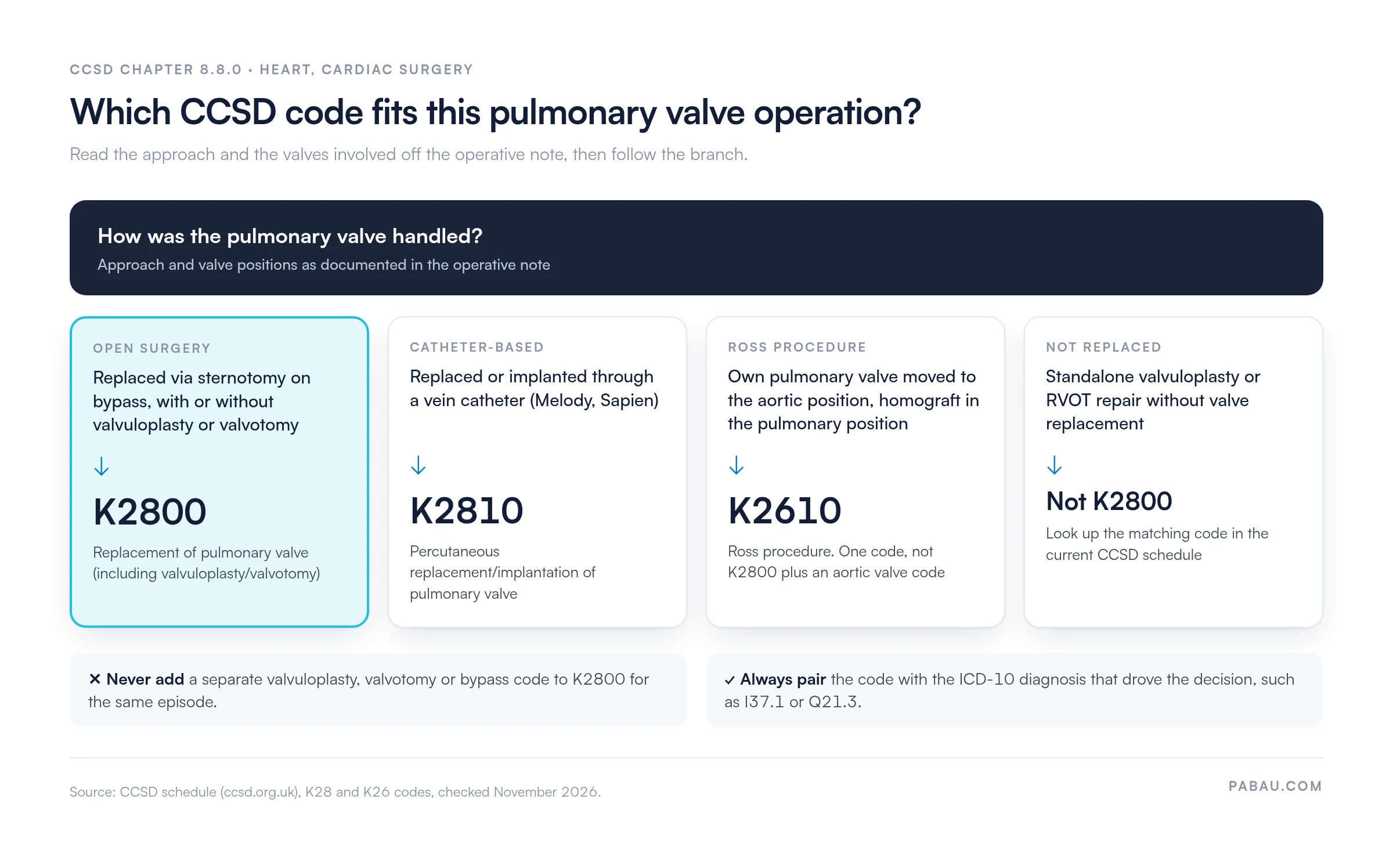
K2800 is the CCSD code for replacement of pulmonary valve (including valvuloplasty/valvotomy). It covers open surgical replacement of the pulmonary valve on cardiopulmonary bypass, using a tissue, mechanical or homograft prosthesis. Valvuloplasty or valvotomy done in the same episode is included and not billed separately.
Catheter-based replacement has its own code, K2810, and a Ross procedure is coded K2610. UK private insurers such as Bupa, AXA Health, Aviva and Vitality expect prior authorization before elective K2800 surgery.
Let Pabau's smart automation suggest the right codes, reduce claim denials, and keep your practice compliant—effortlessly.
Automate repetitive tasks and focus on what matters most—your patients.
Reduce coding errors and ensure compliance with the latest regulations.
Clean claims, fewer denials, and faster reimbursements.
Powerful insights and reporting to help your practice thrive.
HIPAA compliant SOC 2 certified GDPR-compliant Trusted by 4,000+ clinics worldwide

CCSD code K2800 covers open surgical replacement of the pulmonary valve, with valvuloplasty and valvotomy included when done in the same episode.
Valvuloplasty, valvotomy and cardiopulmonary bypass are not billed separately alongside K2800 for the same episode.
Catheter-based pulmonary valve replacement is coded K2810, and a Ross procedure is coded K2610, not K2800.
Bupa, AXA Health, Aviva and Vitality expect prior authorization before elective K2800 surgery, and a missing reference is a common cause of full denial.
Pabau, the practice management platform we build, keeps the operative note, pre-authorization reference and insurer invoice on one patient record.
CCSD code K2800 is defined by its official descriptor as “Replacement of pulmonary valve (including valvuloplasty/valvotomy).” That parenthetical matters for billing. Valvuloplasty is balloon or open reshaping of the valve leaflets, and valvotomy is incision of fused or stenotic leaflets. Both are included when performed as part of the replacement episode. They are not separately billable, so a claim that adds a valvuloplasty code alongside K2800 for the same encounter will be rejected for unbundling.
The code covers open surgical access to the pulmonary valve, under cardiopulmonary bypass, with implantation of a prosthetic replacement. Percutaneous, catheter-based replacement has its own code, K2810. A Ross procedure, which moves the patient’s own pulmonary valve into the aortic position, is coded K2610.
K2800 sits in CCSD sub-chapter 8.8.0, Heart – Cardiac Surgery. Pabau’s library of CCSD billing guides covers other codes in the schedule, including neighboring cardiac procedures.
Open pulmonary valve replacement is a cardiothoracic procedure performed under general anesthesia through a median sternotomy. The patient is placed on cardiopulmonary bypass (CPB), and the diseased pulmonary valve is excised and replaced with a prosthesis. The surgeon may also perform valvuloplasty (leaflet repair or dilation) or valvotomy (commissurotomy) during the same episode. K2800 captures both when they accompany replacement.
Three prosthesis types are commonly implanted under K2800:
A Ross procedure uses the patient’s own pulmonary valve as an autograft in the aortic position. It is coded K2610 rather than K2800, as covered in the Ross procedure section below.
Medical necessity documentation must link a recognized clinical indication to the operative decision. These conditions are the primary indications for pulmonary valve replacement in UK private practice:
Tetralogy of Fallot (ToF) is the most common congenital indication for pulmonary valve replacement in adults. After primary ToF repair, typically in infancy, the reconstructed RVOT and transannular patch often become regurgitant over time. Adult patients present 20 to 30 years after repair with significant pulmonary regurgitation and progressive right ventricular dysfunction. At that point, K2800 is indicated.
When other congenital repairs are performed in the same episode, such as tricuspid annuloplasty or septal work, each procedure needs its own CCSD code. The operative note must separate the components clearly, so the billing team can identify every codeable element without ambiguity.
RVOT obstruction treated without valve replacement is captured by a different CCSD code. K2800 applies when pulmonary valve replacement is the primary operative goal, even if RVOT reconstruction is performed concurrently. Where the surgeon performs a formal RVOT reconstruction as a distinct component, check whether a separate CCSD code applies alongside K2800.
The answer depends on the CCSD schedule rules and the insurer’s unbundling policy. Either way, the operative note should describe the RVOT anatomy and the surgical work performed there.
The CCSD code K2800 does not change with valve type. Insurers auditing private practice invoices still expect the operative note to state exactly what was implanted. The table below summarizes documentation requirements by valve type.
The Ross procedure is a dual-valve operation. The patient’s own pulmonary valve (the autograft) is harvested and implanted in the aortic position, while a homograft is placed in the pulmonary position. CCSD gives the whole operation one dedicated code, K2610, described as “Ross procedure.”
Do not bill a Ross procedure as K2800 plus a separate aortic valve replacement code. The pulmonary homograft is part of the K2610 operation, not a K2800 replacement in its own right. Insurers may still ask for the full operative note, so it should describe both valve positions clearly.
Transcatheter pulmonary valve replacement (TPVR) uses a catheter-delivered device, such as the Medtronic Melody or Edwards Sapien valve, to implant a prosthetic pulmonary valve. It avoids open sternotomy and cardiopulmonary bypass. CCSD codes it as K2810, “Percutaneous replacement/implantation of pulmonary valve.”
Never bill TPVR under K2800. Check the approach documented in the operative note before assigning the code: Sternotomy and bypass point to K2800, while catheter access points to K2810.
The K28 series holds two codes: K2800 for open replacement, and K2810 for percutaneous replacement/implantation of pulmonary valve. Choosing the wrong one is a common denial trigger. The table below sets out when each applies, alongside the related procedures that sit outside the series.
Fee values change with each schedule revision, so they are not reproduced here. Always refer to the current CCSD schedule for authoritative code descriptions and fees.
The key decision point: If the valve is replaced through open surgery, K2800 is correct whether or not valvuloplasty or valvotomy is also performed. Catheter-based replacement is K2810. If the valve is not replaced, the procedure falls outside K2800 and needs its own code from the schedule. The diagram below maps each approach to its code.
Cardiopulmonary bypass (CPB) is integral to open pulmonary valve replacement and is generally considered bundled within K2800 under CCSD rules. Billing CPB as a separate code alongside K2800 for the same episode typically constitutes unbundling and will result in rejection or clawback.
Where a perfusionist submits a separate invoice for CPB services, it is typically handled as a professional fee, not a distinct surgical procedure code. The operative note should document CPB use, including cannulation site, bypass time and cardioplegia method.
Confirm with each insurer whether it recognizes a separate perfusion fee or expects CPB costs to be absorbed within K2800. Policies vary across Bupa, AXA Health, Aviva and Vitality.
Document CPB time, cannulation sites, and cross-clamp duration explicitly in the operative note. Insurers auditing complex cardiac claims look for these details to confirm procedure complexity. A K2800 claim without them often prompts a request for the full notes.
A complete operative note is the most important document supporting a K2800 claim. Insurers reviewing cardiac surgery claims expect it to contain each of the elements below. A structured operative note template makes sure none of them is left out at the point of dictation.
The diagnosis code submitted with the CCSD procedure code must match the clinical indication. Mismatched or missing ICD-10 codes are a frequent denial trigger. These ICD-10 codes are most commonly paired with K2800 in UK private practice:
Pulmonary regurgitation after ToF repair, the most common adult indication, is coded I37.1 and usually leads the claim. For UK private practice, ICD-10 codes should reflect the version in current use in the NHS Classifications Browser, so verify each code there before submitting.
All major UK private medical insurers require prior authorization for elective cardiac surgery, including K2800 procedures. A missing pre-authorization reference on an elective case is one of the most common reasons these claims are denied in full. Policies and turnaround times vary, so treat the table below as typical and verify directly with each insurer before every case.
For urgent or emergency cases performed without prior authorization, notify the insurer immediately after the procedure. Submit the operative note with a retrospective clinical justification. Most insurers have a formal retrospective review process, but approval is not guaranteed, particularly if the case was semi-elective rather than urgent.
For Bupa’s own coding and invoicing rules, see Pabau’s guide to Bupa CCSD procedure codes.
CCSD code K2800 claims are denied for a predictable set of reasons. Most are preventable with a systematic pre-submission checklist.
Cardiothoracic billing involves higher-value claims, complex multi-code episodes, and greater insurer scrutiny than most specialties. These workflow habits reduce rejection rates for K2800 and adjacent cardiac codes.
Private billing for cardiac surgery starts before the patient is listed. Trigger the prior authorization request as soon as the decision to operate is confirmed, and record the pre-auth reference on the patient record immediately. If the insurer needs more clinical information, that exchange takes time. A slow response can push authorization past the planned date of surgery.
After the procedure, the billing team should review the operative note within 48 hours. Check that every element in the documentation checklist above is present before submitting the claim. Private practice billing software can flag incomplete records before the invoice is generated.
Reconcile insurer payments against the CCSD schedule fee for K2800. Where an insurer pays less than the schedule rate, check whether the shortfall reflects a co-payment, a benefit limit, or a code query. Challenge unexplained underpayments in writing within the insurer’s appeal window, attaching the operative note and the CCSD schedule reference.
For each K2800 case, a cardiothoracic billing team usually chases three documents by hand: The pre-authorization reference, the signed operative note and the insurer invoice. When one of them is missing, the claim waits or comes back.
Pabau, the practice management platform we build, keeps all three on the same patient record. Operative note templates can make the approach, bypass details and prosthesis lot number required fields. The insurer invoice is raised from that record with the CCSD code attached, so nobody retypes the case.
The result is fewer claims held for a notes request, and a shorter wait between surgery and payment.

Pabau supports UK private practice billing teams with CCSD claim workflows, operative documentation, and insurer reconciliation. See how it works for cardiothoracic practices.

K2800 is the right code only when the pulmonary valve is replaced through open surgery. Read the approach off the operative note before you code. Catheter access means K2810, and a Ross procedure means K2610.
Denials on this code are cheaper to prevent at the desk than to overturn on appeal. Secure the pre-authorization reference before listing, keep valvuloplasty and bypass inside K2800, and hold the claim until the note names the prosthesis.
Book a demo to see how Pabau keeps operative notes, authorization references and insurer invoices together for cardiothoracic billing teams.

Working with Bupa on CCSD-coded cardiac claims? Bupa CCSD procedure codes covers Bupa’s code lookup, fee schedules, and invoicing requirements for UK private practitioners.
Billing other congenital heart operations? CCSD code K0500 explains coding for atrial inversion in transposition of the great vessels.
Coding the catheter lab work that precedes surgery? CCSD code K6510 walks through billing for cardiac catheterization.
Repairing the pulmonary artery as well as the valve? CCSD code L1080 covers open repair of the pulmonary artery.
Handling aortic surgery claims too? CCSD code L1910 sets out billing for ascending aortic aneurysm repair.
CCSD code K2800 covers open surgical replacement of the pulmonary valve, including valvuloplasty and valvotomy when performed as part of the same operative episode. Those inclusions in the official descriptor mean both techniques are bundled into K2800, not billed separately alongside the replacement.
Yes. The official CCSD descriptor states “including valvuloplasty/valvotomy.” Both are included in K2800 when performed during the same replacement episode. Coding either separately alongside K2800 for the same encounter is unbundling and will trigger a claim rejection.
No. Transcatheter pulmonary valve replacement (TPVR) is coded K2810, “Percutaneous replacement/implantation of pulmonary valve.” K2800 covers open surgical replacement through a sternotomy on cardiopulmonary bypass. An operative note documenting catheter access rather than sternotomy signals that K2810 is the correct code.
No. CCSD has a dedicated code for the Ross procedure, K2610, which covers both the aortic autograft and the pulmonary homograft. Do not bill it as K2800 plus a separate aortic valve code. Make sure the operative note clearly describes both valve positions.
Generally no. Cardiopulmonary bypass is considered integral to open pulmonary valve replacement and is typically bundled within K2800 under CCSD rules. Billing CPB as a separate procedure code for the same episode is likely to be rejected as unbundling. Perfusionist professional fees may be treated differently, so verify each insurer’s position directly.
All major UK private medical insurers, including Bupa, AXA Health, Aviva, and Vitality Health, require prior authorization for elective K2800 procedures. Submit the request as soon as the decision to operate is confirmed. Include echocardiography, a consultant letter stating the clinical indication, and the proposed CCSD code. Verify specific requirements with each insurer before listing the patient.