HCPCS Code E0272: Foam rubber mattress billing guide
HCPCS Code E0272: official descriptor and code overview HCPCS Code E0272 is the ...

Last Updated: Nov 6, 2026
J6200 is the CCSD code for incision of pancreas, an operation, usually open, that cuts into the pancreatic tissue or the main pancreatic duct. UK private medical insurers such as Bupa, AXA Health and Aviva use it to price and pay surgical claims.
J6200 sits in CCSD chapter 11.0.0 (Abdomen) under sub-chapter 11.7.0, other organs (mainly digestive). Drainage of a pancreatic collection, necrosectomy and ductal anastomosis are separate operations with their own codes.
Let Pabau's smart automation suggest the right codes, reduce claim denials, and keep your practice compliant—effortlessly.
Automate repetitive tasks and focus on what matters most—your patients.
Reduce coding errors and ensure compliance with the latest regulations.
Clean claims, fewer denials, and faster reimbursements.
Powerful insights and reporting to help your practice thrive.
HIPAA compliant SOC 2 certified GDPR-compliant Trusted by 4,000+ clinics worldwide

CCSD code J6200 covers incision of the pancreas, an open operation billed to UK private medical insurers such as Bupa, AXA Health and Aviva.
The code sits in CCSD chapter 11.0.0 (Abdomen) under sub-chapter 11.7.0, other organs (mainly digestive).
J6200 covers the incision itself. Drainage of a collection, necrosectomy, resection and ductal anastomosis need their own codes when documented as separate steps.
Insurers expect pre-authorization and an operative note that names the indication, the site of the incision and any extra steps.
Pabau, the practice management platform we build, sends private medical insurance claims through Healthcode and keeps each authorization with the patient record.
CCSD code J6200 is defined by its official descriptor: “Incision of pancreas.” In clinical terms, this is a formal pancreatotomy. The surgeon makes a deliberate, controlled incision into the pancreatic gland or its ductal system under general anesthesia. Most coded cases are performed through an open laparotomy.
The CCSD schedule is the UK private healthcare coding schedule. It is run by the Clinical Coding and Schedule Development Group, whose members are Aviva, AXA Health, Bupa and VitalityHealth. UK private hospitals and NHS trusts hold licenses to use it. Its alphanumeric codes follow the OPCS-4 style, which is why J6200 opens with the letter J.
J6200 covers the core surgical act of opening the pancreas. It does not automatically include drainage of a collection, biopsy specimens taken in the same episode or reconstruction of the ductal system. Each of those may need a separate code, depending on what the operative record shows.
J6200 sits in CCSD chapter 11.0.0, which covers the abdomen excluding urinary and reproductive organs. Its sub-chapter is 11.7.0, other organs (mainly digestive). Within the CCSD procedure codes, that sub-chapter groups the open operations on the pancreas, bile ducts and neighboring organs. Open puncture of the liver, CCSD code J1400, sits in the same sub-chapter.
Read the CCSD Technical Guide alongside the descriptor. It sets the coding principles that decide how J6200 interacts with adjacent codes. Questions about a specific code go to the CCSD team at CCSD@uk.gt.com, and the official CCSD site holds the licensed schedule.
An incision of the pancreas is performed when the surgeon needs direct access to the gland or its main duct. That usually means necrotizing pancreatitis, ductal obstruction or an abscess. The operative report has to record the indication before the coder assigns J6200. The main indications are:
Each scenario produces a different operative note, and the coder must match the documented indication to the descriptor. When the pancreas is incised as part of a larger resection, such as a Whipple procedure, the incision is part of that operation. It is not coded separately as J6200.
Knowing the surgical steps helps coders see what is in scope for J6200 and what falls outside it. A standard open pancreatotomy follows this sequence:
A planned laparoscopic incision of the pancreas is less common. When the note documents a laparoscopic approach, confirm with the insurer that J6200 applies before you assign it.
UK insurers expect a WHO ICD-10 diagnosis code alongside the CCSD procedure code. The principal diagnosis should reflect the condition that made the incision necessary. Confirm each code in the WHO ICD-10 browser before submission.
These are WHO ICD-10 codes, not the US ICD-10-CM variants. For acute pancreatitis, pick the fourth character that matches the cause the surgeon documented, such as K85.1 for biliary acute pancreatitis. The treating surgeon’s documented diagnosis is the authoritative source for the final choice.
The boundaries of J6200 are where miscoding most often happens. The table below sets out what the code covers and what needs a separate code. For insurer-specific bundling rules, check the insurer’s own fee schedule. The Bupa code search tool and the Pabau Bupa CCSD billing guide are useful starting points.
Several CCSD codes for pancreatic surgery sit close to J6200 and are routinely confused with it. The deciding factor is the primary operative intent: Incision, drainage, excision or anastomosis. Each covers a different scope of work, and the wrong choice is a common audit trigger.
A pancreatic duct joined to the bowel is coded as J5900, and removal of the whole gland as J5520. Open removal of the body and tail alone is coded as CCSD code J5700.
If the main purpose was to open the pancreas, J6200 applies. If it was to empty a collection through a drainage approach, the drainage code applies. The flow below puts both questions in the order a coder should ask them.
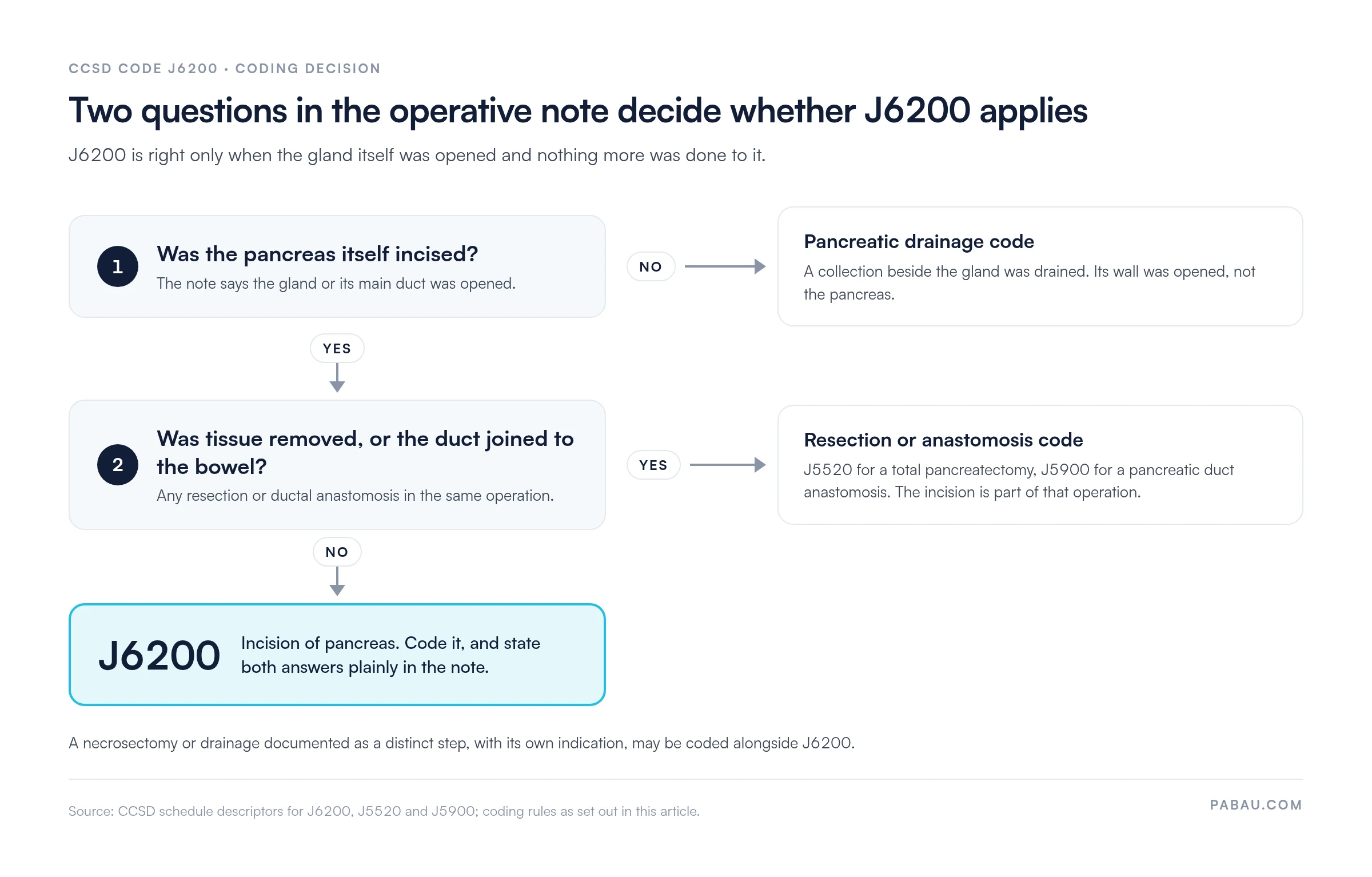
When both happen in one session, the note must record them as distinct steps, each with its own indication, technique and finding. Bundling rules differ by insurer, and the Healix fee schedule guidelines show how one administrator applies them to CCSD surgical codes.
A J6200 claim stands or falls on the operative note. UK private medical insurers do not pay on the procedure code alone. They expect the operative record to show that the procedure matches the descriptor “incision of pancreas.” Effective surgical billing compliance therefore starts with the surgeon who writes the note.
The operative note must address each of these elements before the claim is submitted:
UK private medical insurers expect the patient to get pre-authorization before elective surgery such as J6200. The patient contacts the insurer, which checks the policy covers the procedure and issues an authorization number. The specialist must also be recognized by that insurer. Requirements vary by insurer:
Each insurer sets its own fee for J6200, and fee schedules change, so never rely on a prior-year figure. If the specialist charges more than the insurer pays, the patient may face a shortfall. Agree fees before surgery and check the current figure with the insurer before invoicing.
Emergency cases, such as urgent necrosectomy for necrotizing pancreatitis, cannot wait for authorization. Contact the insurer as soon as possible afterward and follow its process for urgent admissions. Record the clinical urgency in the notes.
Insurers query or decline J6200 claims for a predictable set of reasons. Each one below carries a fix that billing staff and surgeons can apply before the first submission:
Practices with structured denial management workflows catch most of these issues before submission. That beats waiting for an insurer query on a complex surgical claim.
An incision of the pancreas is performed under general anesthesia and often involves a second surgeon or surgical assistant. Each of those services follows its own billing route, separate from the surgeon’s J6200 fee.
In UK private practice, the anesthetist invoices the insurer separately from the surgeon. The anesthetist uses the CCSD procedure code for the operation and is paid against the insurer’s own anesthetist fee schedule. The surgeon’s J6200 fee does not include anesthesia, so confirm the anesthetist’s billing arrangements with their practice.
Many UK insurers do not pay a separate fee for a surgical assistant, and those that do set their own conditions. Check the insurer’s terms before adding an assistant line to the claim. Where an assistant is billed, the operative note must name them and describe their role, not just list them as present.
Before billing a surgical assistant on a J6200 case, confirm in writing that the insurer pays for one on this procedure. Store the confirmation reference with the claim record. A missing confirmation causes more assistant queries than ineligibility does.
Billing teams should follow the same steps on every J6200 claim to avoid the common query triggers. They apply whatever portal or system the practice uses:
Many billing teams build a pancreatic surgery claim from several places. The operative note sits in one system, the pre-authorization letter in an inbox and the fee schedule in an insurer portal. Each handoff is a chance for the wrong code or a missing number to slip through.
Pabau keeps the clinical notes, the insurer authorization and the claim together in the patient record. It stores each pre-authorization as a case, so the authorization code follows the appointment through to the claim. The claim then goes through Healthcode to insurers such as Bupa, AXA Health and Vitality.
When an insurer queries the claim months later, the documentation is already in that record. Your team can answer without switching systems. Insurance claiming is included in every Pabau subscription.

Pabau keeps operative notes, insurer authorizations and Healthcode claim submission in one patient record. Your team can submit J6200 claims to UK insurers such as Bupa, AXA Health and Aviva without switching systems.

Code J6200 only after the operative note settles two questions. Was the pancreas itself incised, rather than a collection beside it drained? Was any tissue removed or any duct joined to the bowel? A clear yes and a clear no make J6200 the right code, and the note should state both plainly.
That extra line of documentation pays off when an insurer reviews the claim. It keeps an authorized major operation from coming back as a query months later.
Pabau keeps the code, the diagnosis and the authorization number in one record. Book a demo to see how your team can get J6200 claims right the first time.

Need a broader CCSD billing reference? Bupa CCSD codes and fee schedule covers the Bupa-recognized procedure codes, fee lookups and practical billing guidance for UK private medical insurance.
Trying to reduce surgical claim denials? Denial management in healthcare outlines the workflow steps that catch documentation gaps before a claim reaches the insurer.
Looking to understand the broader billing picture? What is medical billing explains how private health insurance billing workflows connect from procedure to payment.
Coding other operations in CCSD sub-chapter 11.7.0? CCSD code J3000 covers anastomosis of the common bile duct and how UK insurers expect it documented.
CCSD code J6200 covers incision of the pancreas, a planned surgical cut into the pancreatic tissue or the main pancreatic duct. It includes the incision, hemostasis, drains placed for the incision and closure. Drainage of a separate collection, biopsy, necrosectomy and ductal anastomosis may need their own codes.
UK private medical insurers such as Bupa, AXA Health, Aviva and Vitality use J6200 to price and pay pancreatic surgery claims. The CCSD schedule is run by the Clinical Coding and Schedule Development Group. UK private hospitals and NHS trusts hold licenses, and code queries go to CCSD@uk.gt.com.
No. J6200 covers the incision into the ductal system but not a drainage anastomosis or formal ductal decompression. When the duct is opened as a step toward a pancreaticojejunostomy, the anastomosis takes its own code. The incision is then part of that operation, so confirm with the insurer before submitting both.
The descriptor does not name an approach, but open laparotomy is the approach most often linked to J6200. Insurers treat laparoscopic cases differently. Confirm with the insurer, and check the CCSD schedule for a code that matches the approach, before you submit a laparoscopic claim.
Each insurer sets its own fee for J6200, so the amount paid differs between Bupa, Aviva and AXA Health. Look up the current fee in the insurer’s schedule, such as codes.bupa.co.uk or the Aviva practitioner fee schedule. If the specialist charges more than that fee, the patient may face a shortfall.
The most common reasons are a missing pre-authorization number and an operative note that omits the site or technique. Insurers also query J6200 when the note describes a resection, or when drainage is claimed without a distinct documented step. An unconfirmed laparoscopic approach causes queries too.
The anesthetist bills the insurer separately, using the CCSD procedure code against the insurer’s anesthetist fee schedule. A drainage or necrosectomy code may be added when the operative note documents that step separately. Many insurers do not pay a surgical assistant fee, so check the insurer’s terms first.