CCSD code J1900: Gallbladder anastomosis billing guide
CCSD code J1900 joins the gallbladder to another organ CCSD code J1900 is the UK...

Last Updated: Oct 22, 2026
J5900 is the CCSD code for anastomosis of pancreatic duct (to another viscus). It covers surgically joining the main pancreatic duct to a loop of jejunum or, less often, the stomach. Pancreatic secretions then drain past a blocked or strictured segment.
UK private medical insurers see it most often for lateral pancreaticojejunostomy in chronic pancreatitis. The code sits in CCSD chapter 11, section 11.7.0 Other Organs (Mainly Digestive). A Whipple resection takes its own code, J5610.
Let Pabau's smart automation suggest the right codes, reduce claim denials, and keep your practice compliant—effortlessly.
Automate repetitive tasks and focus on what matters most—your patients.
Reduce coding errors and ensure compliance with the latest regulations.
Clean claims, fewer denials, and faster reimbursements.
Powerful insights and reporting to help your practice thrive.
HIPAA compliant SOC 2 certified GDPR-compliant Trusted by 4,000+ clinics worldwide

CCSD code J5900 describes anastomosis of the pancreatic duct to another viscus. It is a standalone drainage code, not a component of pancreatectomy codes.
Lateral pancreaticojejunostomy (Puestow or Partington-Rochelle) is the named procedure most often billed under J5900.
ICD-10 K86.0 and K86.1, both forms of chronic pancreatitis, are the primary supporting diagnoses.
All major UK private medical insurers require pre-authorisation for J5900, and a missing pre-auth number is the most common reason for outright rejection.
Pabau’s claims management software stores the pre-auth number and operative note against each episode, then sends the claim through Healthcode.
CCSD code J5900 covers anastomosis of the pancreatic duct to another viscus, usually a loop of jejunum and less often the stomach. Surgeons bill it for drainage operations such as lateral pancreaticojejunostomy in chronic pancreatitis. UK private medical insurers (PMIs) expect pre-authorisation before the operation.
The code sits in chapter 11 of the schedule, Abdomen, alongside the other CCSD codes for digestive organs. The table below summarises its reference data. Check the descriptor against the CCSD official schedule and the fee against each insurer’s current list before you submit.
J5900 is one of the more demanding hepatopancreatobiliary (HPB) codes in private billing. The operation itself is easy to recognise in the notes. Claims run into trouble on bundling, documentation and pre-authorisation instead.
Anastomosis of the pancreatic duct to another viscus means creating a new drainage channel from the main duct into bowel or, less commonly, the stomach. The procedure decompresses an obstructed or hypertensive duct by bypassing the pathological segment and allowing pancreatic secretions to drain freely.
Two forms account for the overwhelming majority of J5900 claims:
The approach is typically open, through a midline or subcostal incision. Laparoscopic execution remains specialist-unit practice and is not universally available.
The CCSD schedule does not distinguish between open and laparoscopic technique for J5900, so both go under the same code. Don’t add a laparoscopic modifier the schedule does not recognise, as it creates a denial risk.
Insurers validate a J5900 claim by checking that the submitted ICD-10 diagnosis code is clinically consistent with the need for pancreatic duct anastomosis. The table below maps accepted indications to their ICD-10 codes and notes the frequency with which each pairing is queried by UK PMIs.
K86.0 and K86.1 together account for the large majority of J5900 claims submitted to UK PMIs. Imaging evidence of ductal dilation strengthens the clinical justification when the insurer queries the claim.
The usual threshold is a main pancreatic duct diameter of 5 mm or more on magnetic resonance cholangiopancreatography (MRCP) or CT.
Several eponymous procedures fall within the J5900 descriptor:
The Whipple procedure has its own CCSD code, J5610, and J5900 does not describe the full operation. Sometimes the duct-to-viscus anastomosis is the reconstruction step inside a pancreaticoduodenectomy. The bundling rules in the CCSD technical guide then decide whether J5900 can be added or is already included.
Check the guide’s current position before submitting both codes on the same episode. Claiming J5900 on top of a resection code that already covers reconstruction is a significant unbundling risk. The insurer may also treat it as a compliance issue.
Four codes are most frequently confused with J5900. The distinction matters because the wrong code on a pancreatic HPB claim often produces a downcode rather than a rejection. The practice is then paid at a lower rate with no obvious error signal.
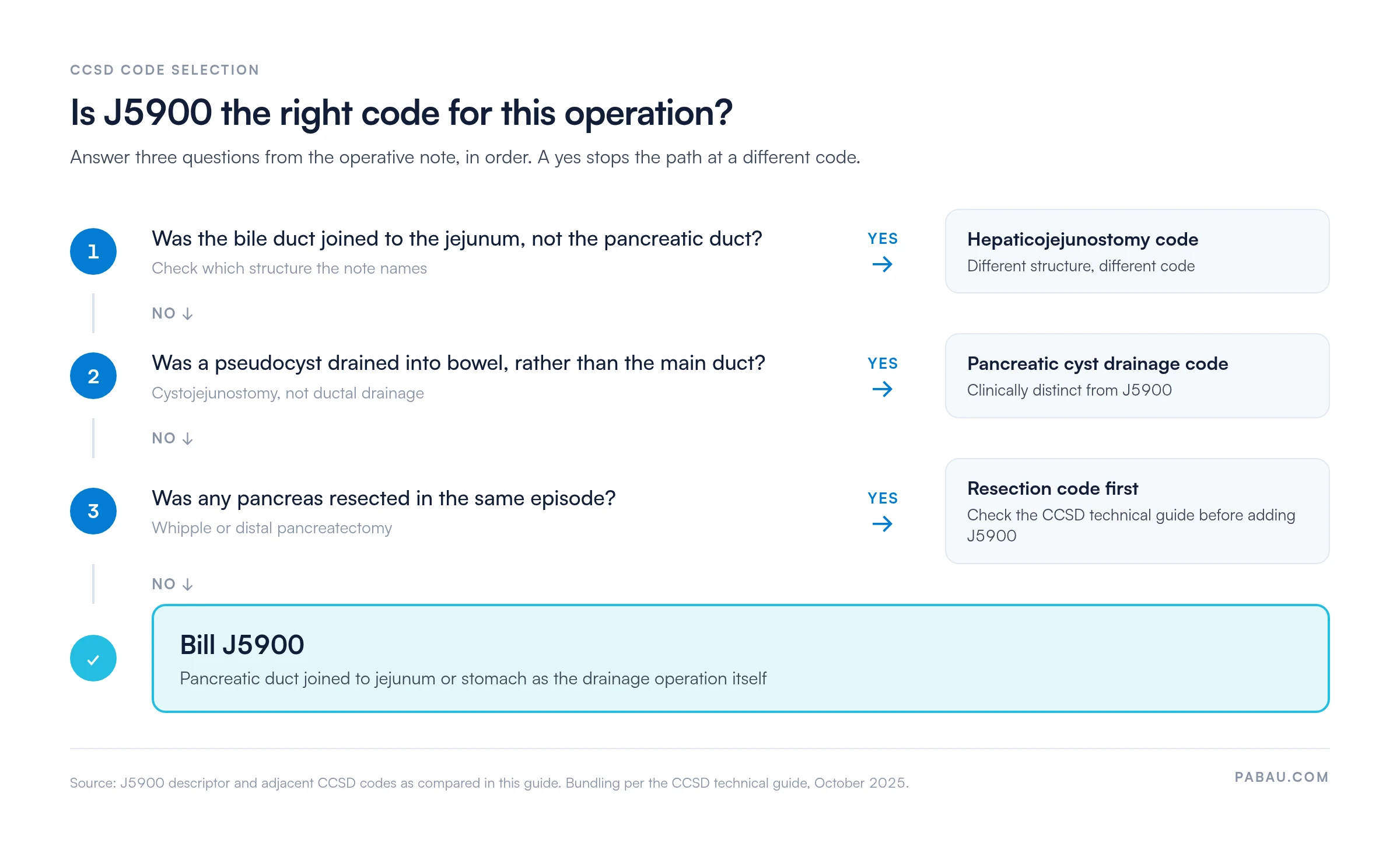
The same comparison works as a short decision path. Run it against the operative note before you choose the code.
Poor operative documentation is the leading cause of J5900 claim denial by UK PMIs. For the claim to pass on first submission, the operative note must contain all six of these elements:
Store the operative note against the episode and attach it when the claim goes in. That way the evidence and the claim reach the insurer together.
All major UK private medical insurers treat pancreatic duct anastomosis as an inpatient surgical procedure requiring pre-authorisation before the operation takes place. Claiming J5900 without a valid pre-authorisation number almost always results in outright rejection rather than a request for further information.
The table below summarises the pre-authorisation approach across the main UK PMIs. Requirements change year on year, so check each insurer’s current provider manual before submitting a pre-auth request. The Bupa CCSD code guidance page provides context on how Bupa structures CCSD-based authorisation.
A Bupa-contracted surgeon may face different rate implications than a non-contracted one. The pre-authorisation number does not guarantee payment at the surgeon’s full fee.
Settlement follows the contracted or guided rate for J5900, so confirm it against the Bupa fee schedule before agreeing the procedure with the patient.
J5900 attracts a higher-than-average denial rate among HPB CCSD codes. Most rejections are preventable. The causes and corrections below follow the error patterns seen in private billing workflows.
Most UK private practices submit J5900 claims electronically via the Healthcode EDI platform. The required fields are consistent across insurers, though each PMI’s portal may present them differently.
Benchmark the J5900 fee against each insurer’s own fee list. Bupa, AXA Health, Aviva and Vitality each publish one. The Healix fee schedule is one of the more transparent references for HPB surgical rates. Settlement still depends on the surgeon’s contracted status with each insurer.
Inpatient HPB procedures as complex as J5900 generally sit in the upper fee bands. Confirm the current figure with each insurer before quoting a patient. For the Bupa rate, look the code up in the Bupa code search portal.
Before the procedure, confirm both the pre-authorisation number and the insurer’s contracted rate for J5900 in writing. Rates for HPB procedures can vary significantly between contracted and non-contracted surgeons. A post-procedure fee dispute is far harder to resolve than a pre-authorisation query.
A J5900 episode usually touches three places. The pre-auth number lives in the insurer portal, the operative note sits in a shared folder, and the invoice is built in Healthcode. Each hand-off is a chance for the number or the note to drop off the claim.
Pabau, the practice management platform we build, keeps those pieces on one patient record. Its claims management software stores each insurer authorisation as a case, so the pre-auth number follows the appointment. The invoice is raised to the insurer at its contract rate, and the claim is pre-filled from it and sent through Healthcode.
Your billing team stops re-keying the same episode into three systems. When Bupa or AXA Health queries the claim, the operative note and imaging report are already filed against it.

Pabau stores pre-authorisation numbers, operative notes and insurer invoices against each episode, so CCSD claims leave complete. See how it fits your billing team.

Bill J5900 when draining the pancreatic duct into bowel or stomach is the operation itself. When the anastomosis rebuilds the gut after a resection, read the CCSD technical guide before the code goes anywhere near the claim.
The work that protects the fee happens before the first incision. Secure the pre-authorisation number and confirm the contracted rate in writing. Then agree an operative note template that records the viscus, the technique and the duct findings. Do that, and the insurer has little left to query.
Book a demo to see how Pabau keeps pre-authorisations, operative notes and insurer invoices on one record for your surgical billing team.

Coding a Whipple or duct drainage for pancreatic cancer? ICD-10 code C25.7 covers malignant neoplasm of other parts of the pancreas, beyond the head and body.
Pancreatic disease secondary to another condition? ICD-10 code K87 explains how to code pancreatic and biliary disorders in diseases classified elsewhere.
Planning post-operative nursing after pancreatic surgery? Our pancreatitis nursing care plan sets out NANDA-I diagnoses, interventions and expected outcomes.
Choosing software to bill UK private insurers? The best medical billing software in the UK compares the options for CCSD-coded claims.
CCSD code J5900 covers anastomosis of the pancreatic duct to another viscus. The surgeon joins the main pancreatic duct to a section of bowel, most commonly a jejunal Roux-en-Y loop, or to the stomach to restore drainage. Pancreatic resections have separate CCSD codes.
Yes. The CCSD schedule does not distinguish between open and laparoscopic technique for J5900, so both approaches go under the same code. Don’t add a laparoscopic modifier the schedule does not recognise, as it creates a denial risk with UK PMIs.
Every major UK private medical insurer requires pre-authorisation before J5900 can be claimed, including Bupa, AXA Health, Aviva, Cigna and Vitality Health. Send the referral letter, imaging confirming ductal pathology, and the proposed CCSD code. Claiming without a valid pre-auth number typically ends in outright rejection.
Not without checking the CCSD technical guide first. When the duct anastomosis is a reconstruction step inside a pancreaticoduodenectomy, its bundling rules decide whether J5900 is claimed separately or already included. Submitting both without checking carries a significant unbundling risk.
The primary supporting codes are K86.0 (chronic alcoholic pancreatitis) and K86.1 (other chronic pancreatitis). Insurers also accept K86.8 for ductal stricture, and C25.0 to C25.1 for pancreatic neoplasms needing reconstruction. A diagnosis that does not clinically justify ductal anastomosis triggers an insurer query or denial.
The most common reason is a missing pre-authorisation number. Next come operative notes without technique detail and ICD-10 diagnoses that don’t justify the procedure. Unbundling J5900 with a resection code that already includes reconstruction is another, and so is late submission outside the insurer’s claim window.