HCPCS Code E0272: Foam rubber mattress billing guide
HCPCS Code E0272: official descriptor and code overview HCPCS Code E0272 is the ...

Last Updated: Nov 6, 2026
J1400 is the CCSD code for open puncture of liver. The surgeon opens the abdomen and punctures the liver under direct vision, for example to drain an abscess or a collection. UK private medical insurers such as Bupa and AXA Health use it to price and pay surgical claims.
J1400 sits in CCSD chapter 11.0.0 (Abdomen) under sub-chapter 11.7.0, other organs (mainly digestive), with schedule reference Fk.130. A percutaneous biopsy of a liver lesion is coded J1300 instead.
Let Pabau's smart automation suggest the right codes, reduce claim denials, and keep your practice compliant—effortlessly.
Automate repetitive tasks and focus on what matters most—your patients.
Reduce coding errors and ensure compliance with the latest regulations.
Clean claims, fewer denials, and faster reimbursements.
Powerful insights and reporting to help your practice thrive.
HIPAA compliant SOC 2 certified GDPR-compliant Trusted by 4,000+ clinics worldwide

CCSD code J1400 covers open puncture of the liver, billed to UK private medical insurers such as Bupa and AXA Health.
J1400 sits in CCSD chapter 11.0.0 (Abdomen) under sub-chapter 11.7.0, other organs (mainly digestive), with schedule reference Fk.130.
A percutaneous liver biopsy is coded J1300, percutaneous biopsy of lesion of liver, so the approach in the operative note decides the code.
Insurers expect pre-authorization and an operative note that states the open approach, the site and the indication.
Pabau, the practice management platform we build, sends private medical insurance claims through Healthcode and keeps each authorization with the patient record.
CCSD code J1400 is defined by its official descriptor: “Open puncture of liver.” The surgeon opens the abdomen and punctures the liver under direct vision. The open approach is what separates J1400 from a needle procedure through the skin.
The CCSD schedule is the UK private healthcare coding schedule. It is run by the Clinical Coding and Schedule Development Group, whose members are Aviva, AXA Health, Bupa and VitalityHealth. UK private hospitals and NHS trusts hold licenses to use it, and its alphanumeric codes follow the OPCS-4 style.
J1400 covers the puncture itself, performed through an open incision. A liver resection or gallbladder operation in the same session is a separate operation. It needs its own code when the note documents it as a distinct step.
J1400 sits in CCSD chapter 11.0.0, which covers the abdomen excluding urinary and reproductive organs. Its sub-chapter is 11.7.0, other organs (mainly digestive), and its schedule reference is Fk.130. Within the CCSD procedure codes, that sub-chapter groups operations on the liver, bile ducts, pancreas and neighboring organs.
Read the CCSD Technical Guide alongside the descriptor. It sets the coding principles that decide how J1400 interacts with adjacent codes. Questions about a specific code go to the CCSD team at CCSD@uk.gt.com.
Surgeons usually reach the liver with a needle through the skin, guided by ultrasound or CT. An open puncture is chosen when that route has failed or is unsafe, or when the abdomen is already open. Common scenarios include:
Was the operation an open biopsy or excision of a liver lesion? Then check the CCSD schedule for a code that names that operation before you choose J1400. The descriptor is “puncture,” and the operative note should support that word.
Knowing the surgical steps helps coders see what falls within J1400. A typical open puncture of the liver follows this sequence:
The most common coding error on liver puncture claims is a mismatch between the code and the approach. The table below sets out the distinctions to check against the operative note.
If the operative note does not describe an open approach, J1400 does not apply. A percutaneous needle biopsy of a liver lesion goes to J1300 instead. The code follows the documentation, not the other way around.
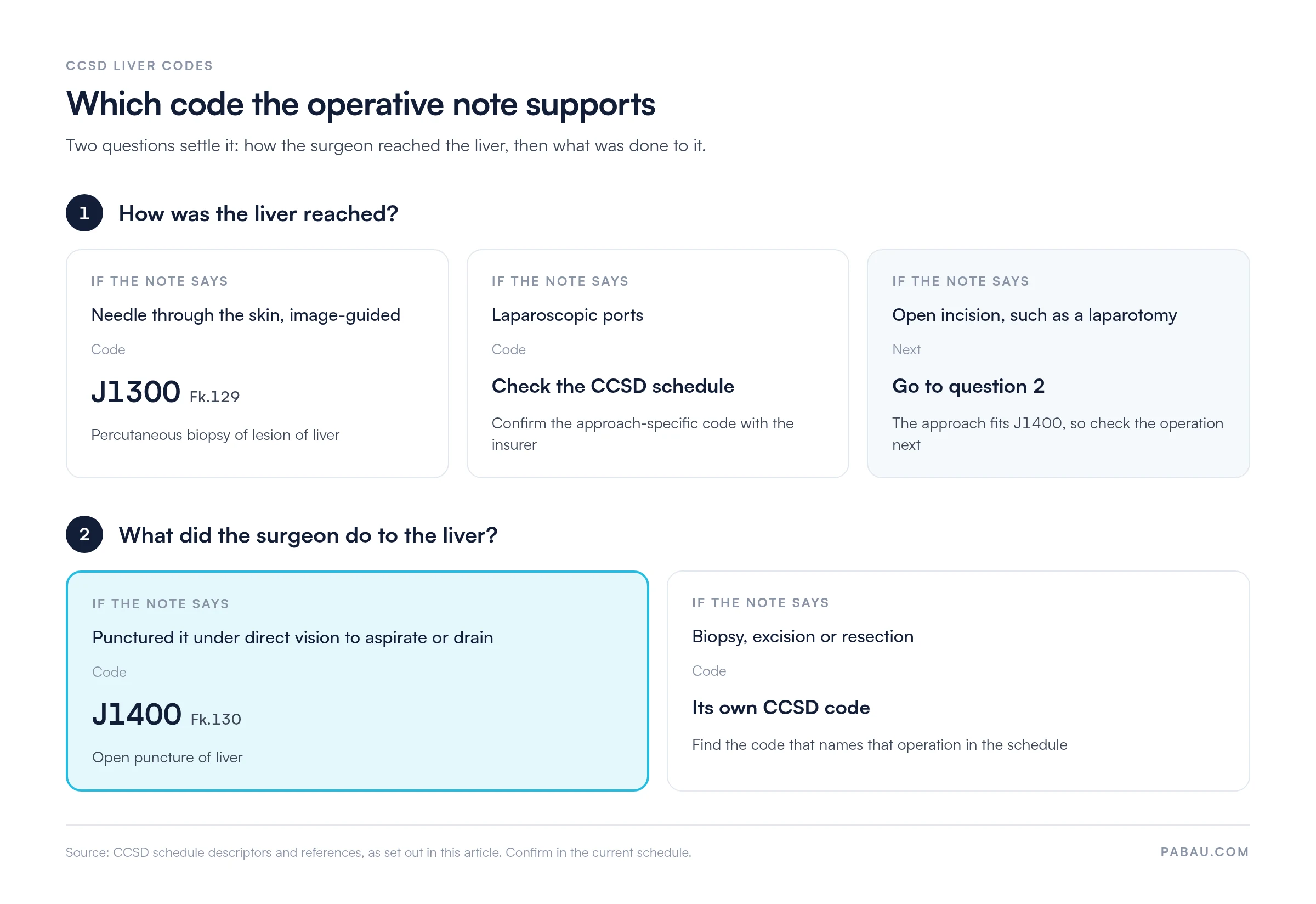
Two questions about the note settle the choice: How did the surgeon reach the liver, and what was done to it once it was reached?
UK insurers expect a WHO ICD-10 diagnosis code alongside the CCSD procedure code. The principal diagnosis should reflect the condition that made the puncture necessary. Confirm each code in the WHO ICD-10 browser before submission.
These are WHO ICD-10 codes, not the US ICD-10-CM variants. The treating surgeon’s documented diagnosis is the authoritative source for the final choice.
A J1400 claim stands or falls on the operative note. UK private medical insurers do not pay on the procedure code alone. They expect the record to show that the operation matches the descriptor “open puncture of liver.”
The operative note must address each of these elements before the claim is submitted:
Insurers may also ask for pre-operative imaging, pathology reports or operating room notes. Digital clinical documentation that prompts for each element cuts down on omissions. Good medical billing compliance starts with the surgeon who writes the note.
UK private medical insurers expect the patient to get pre-authorization before elective surgery such as J1400. The patient contacts the insurer, which checks the policy covers the procedure and issues an authorization number. The specialist must also be recognized by that insurer.
Each insurer sets its own fee for J1400, and fee schedules change, so never rely on a prior-year figure. Look up the current fee in the insurer’s own schedule, and see the Bupa CCSD codes guide for how Bupa’s lookup works. If the specialist charges more than the insurer pays, the patient may face a shortfall.
An urgent open puncture, such as drainage of a liver abscess in a septic patient, cannot always wait for authorization. Contact the insurer as soon as possible afterward and follow its process for urgent admissions. Record the clinical urgency in the notes.
Insurers query or decline J1400 claims for a predictable set of reasons. Each one below carries a fix that billing staff and surgeons can apply before the first submission:
Practices with structured denial management workflows catch most of these issues before submission. When an insurer does query a claim, answer the reason it gives rather than resubmitting the same claim.
An open puncture of the liver is performed under general anesthesia and may involve a surgical assistant. Each of those services follows its own billing route, separate from the surgeon’s J1400 fee.
In UK private practice, the anesthetist invoices the insurer separately from the surgeon. The anesthetist uses the CCSD procedure code for the operation and is paid against the insurer’s own anesthetist fee schedule. Both claims should carry the same authorization number and diagnosis.
Many UK insurers do not pay a separate fee for a surgical assistant, and those that do set their own conditions. Check the insurer’s terms before adding an assistant line. Where an assistant is billed, the note must name them and describe their role.
The incision, closure, drains placed for the puncture and intraoperative ultrasound used to find the site are part of the operation. Do not code them separately. A distinct operation in the same session, such as a resection or a cholecystectomy, takes its own code when documented as a separate step.
Before you add a second code to a J1400 claim, ask whether the operative note describes that step as a separate, independently indicated procedure. If it could not stand without the puncture, it is part of J1400. Check the insurer’s bundling rules before you submit both.
Many billing teams build a surgical claim from several places. The operative note sits in one system, the pre-authorization letter in an inbox and the fee schedule in an insurer portal. Each handoff is a chance for the wrong code or a missing number to slip through.
Practice management software like Pabau keeps the clinical notes, the insurer authorization and the claim together in the patient record. It stores each pre-authorization as a case, so the authorization code follows the appointment through to the claim. Pabau’s claims software for private practices then sends the claim through Healthcode to insurers such as Bupa, AXA Health and Vitality.
Claim validation checks for missing or invalid details before the claim leaves Pabau. If an insurer rejects it, Pabau shows the reason so your team can correct it and resubmit. Insurance claiming is included in every Pabau subscription.

Pabau keeps operative notes, insurer pre-authorizations and Healthcode claim submission in one patient record. Your team can submit J1400 claims to UK insurers such as Bupa and AXA Health without switching systems.

Code J1400 only after the operative note settles two questions. Was the liver reached through an open incision rather than a needle through the skin? Was the operation a puncture, rather than a biopsy, excision or resection with its own code? Clear answers make J1400 the right code, and the note should state both plainly.
That extra line of documentation pays off when an insurer reviews the claim. It keeps an authorized open operation from coming back as a query months later.
Pabau keeps the code, the diagnosis and the authorization number in one record. Book a demo to see how your team can get J1400 claims right the first time.

Need a broader CCSD billing reference? Bupa CCSD codes and fee schedule covers Bupa-recognized procedure codes, fee lookups and billing guidance for UK private medical insurance.
Coding a needle biopsy of the liver instead? CCSD code J1300 covers percutaneous biopsy of lesion of liver and how UK insurers expect it documented.
Trying to reduce surgical claim denials? Denial management in healthcare outlines the workflow steps that catch a missing note or authorization number before a claim reaches the insurer.
Need to understand how claims are managed in practice? Claims management software for practices explains how Pabau tracks claim status from submission through payment.
CCSD code J1400 covers open puncture of the liver. The surgeon opens the abdomen and punctures the liver under direct vision, for example to drain an abscess or a collection. It sits in CCSD sub-chapter 11.7.0, other organs (mainly digestive), with schedule reference Fk.130.
UK private medical insurers such as Bupa, AXA Health, Aviva and Vitality use J1400 to price and pay liver surgery claims. The CCSD schedule is run by the Clinical Coding and Schedule Development Group. Code queries go to CCSD@uk.gt.com.
J1400 is an open puncture of the liver, performed through an abdominal incision. J1300 is a percutaneous biopsy of a liver lesion, taken with a needle through the skin under image guidance. The approach recorded in the operative note decides which code applies.
For elective surgery, yes. UK insurers expect the patient to get pre-authorization and an authorization number before the operation. In an emergency, contact the insurer as soon as possible afterward and follow its process for urgent admissions.
Common WHO ICD-10 pairings are K75.0 (abscess of liver), K76.8 (other specified diseases of liver) and S36.1 (injury of liver or gallbladder). C22.0 (liver cell carcinoma) and C78.7 (secondary malignant neoplasm of liver) also apply. The diagnosis must match the operative finding.
The most common reasons are a missing pre-authorization number and an approach mismatch, where a needle biopsy is claimed as J1400. Insurers also query claims when the note describes a different operation, or when the diagnosis does not support open surgery.
Yes. The anesthetist invoices the insurer separately, using the CCSD procedure code against the insurer’s anesthetist fee schedule. The surgeon’s J1400 fee does not include anesthesia. Both claims should carry the same authorization number and diagnosis.