CPT Code 31653: EBUS With 3+ Mediastinal Stations
CPT code 31653: Official descriptor and clinical scope CPT code 31653 is the pro...

Last Updated: Oct 20, 2026
J5520 is the CCSD code for total pancreatectomy, the surgical removal of the whole pancreas. UK private medical insurers use it to authorise and pay for the operation.
The code covers en-bloc resection of the gland, usually with the duodenum, spleen, gallbladder and common bile duct. Partial resections such as the Whipple procedure take separate codes, and islet cell autotransplantation is billed on its own.
Let Pabau's smart automation suggest the right codes, reduce claim denials, and keep your practice compliant—effortlessly.
Automate repetitive tasks and focus on what matters most—your patients.
Reduce coding errors and ensure compliance with the latest regulations.
Clean claims, fewer denials, and faster reimbursements.
Powerful insights and reporting to help your practice thrive.
HIPAA compliant SOC 2 certified GDPR-compliant Trusted by 4,000+ clinics worldwide

CCSD Code J5520 covers complete removal of the pancreas and is distinct from partial resection codes such as the Whipple procedure.
Prior authorisation from the private insurer is required before elective surgery in the vast majority of cases.
Islet cell autotransplantation is a separate procedure billed under a distinct CCSD code and cannot be bundled into J5520.
Every J5520 claim needs a full operative note, ICD-10 diagnosis codes, and the operating consultant’s GMC number.
CCSD Code J5520 describes a total pancreatectomy, the surgical removal of the entire pancreas. It covers en-bloc resection of the whole gland, with no pancreatic tissue left behind.
Partial resections take other codes. A distal pancreatectomy preserves the head. The Whipple procedure (pancreaticoduodenectomy) preserves the body and tail, and it’s billed under J5610.
A total resection nearly always removes the duodenum, spleen, gallbladder and common bile duct as well. Their blood supply and ducts can’t be separated from the pancreas once the whole gland comes out.
The CCSD schedule classifies J5520 within Chapter 11 (Abdomen, excluding urinary and reproductive organs), section 11.7, Other organs (mainly digestive). You can look up the neighbouring procedures in our CCSD codes library.
Scope decides whether the claim stands. If any pancreatic tissue was preserved, the insurer will review a J5520 claim for downcoding.
Total pancreatectomy is one of the most complex gastrointestinal operations performed in UK private hospitals. A standard procedure follows this sequence:
Theatre time typically runs four to eight hours, depending on vascular involvement. The operative note must document each of these steps explicitly. An insurer reviewing a J5520 claim looks for evidence of a total rather than partial resection.
Total pancreatectomy is reserved for conditions where preserving any pancreatic tissue carries unacceptable risk or is technically impossible.
The most common indications are listed below, alongside the ICD-10 diagnosis codes that private insurers require to establish medical necessity. Always verify codes against WHO ICD-10 (5th edition), the classification UK insurers use, before submission.
A tumour in the neck of the pancreas takes C25.7 rather than one of the site codes in the table.
The most consequential coding decision in pancreatic surgery is whether the resection was total or partial. Getting it wrong is a common trigger for downcoding on insurer review. The four resections below differ in which parts of the gland come out.
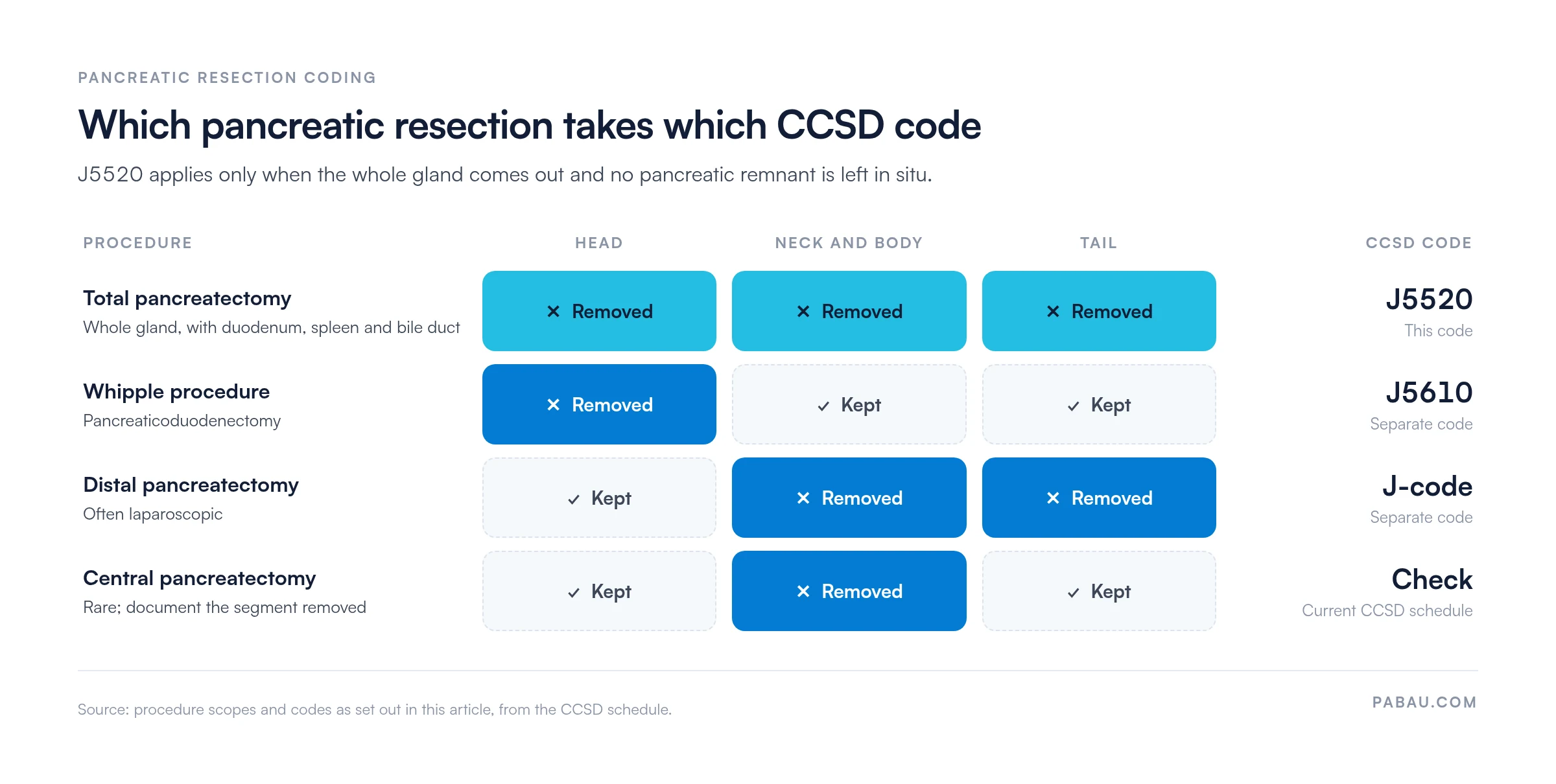
The operative note’s concluding statement must specify “total pancreatectomy” and confirm no remnant pancreatic tissue was left. Ambiguous wording such as “near-total” or “extended” invites insurer scrutiny and may lead to reassignment to a lower-complexity code.
No. Islet cell autotransplantation (IAT) is a distinct procedure billed under a separate CCSD code, and it can’t be bundled into J5520. The surgical team harvests islets from the resected pancreas and reinfuses them into the patient’s portal vein to preserve some insulin function. That work carries its own resource cost, anaesthesia time and laboratory processing.
Billing teams should keep two more points in mind. First, not every private insurer covers IAT as a benefit. Coverage varies between Bupa, AXA Health, Vitality and Aviva, so pre-authorisation for IAT must be sought separately from the J5520 authorisation.
Second, check the CCSD code for IAT against the current schedule at the time of billing. Codes for newer or infrequent procedures can be reassigned. When in doubt, contact the insurer’s provider services team before the procedure date.
Several procedures are commonly performed alongside total pancreatectomy and may be separately billable under CCSD rules. A concurrent procedure is separately codable only when it’s a distinct surgical service. A step that forms part of the primary resection isn’t.
Verify all concurrent code assignments against the CCSD Technical Guide (October 2025) and the relevant insurer’s own fee schedule before submission. Unbundling errors are a frequent denial trigger.
A complete J5520 claim submission must include each item below. If one is missing, the insurer can suspend payment pending further information, which in practice means a delay of weeks.
Keeping the operative note, imaging reports and correspondence in one patient record makes claim assembly much faster. A checklist workflow can then flag incomplete documentation before the claim is submitted.
Request the histopathology report before submitting the J5520 claim. Insurers regularly query malignancy-coded claims where the operative note references cancer but the pathology report is absent. A two-week wait for histology does not have to delay the claim if you build the report into your submission checklist from the outset.
Every major UK private medical insurer requires prior authorisation before elective total pancreatectomy. For J5520 the process typically follows this pathway with Bupa, AXA Health, Vitality and Aviva. Specific requirements vary by insurer and policy type.
Emergency presentations follow an accelerated pathway, for example a patient who needs urgent pancreatectomy for uncontrolled bleeding or malignant obstruction.
Most insurers accept notification within 24 to 48 hours of surgery, but it must still be completed. CQC-regulated private hospitals typically have their own pre-authorisation notification protocols for out-of-hours emergencies.
Denials for CCSD Code J5520 cluster around five recurring causes. Fixing each one at source, before the appeal stage, is the core of good denial management.
When a denial arrives, the appeal should include the original claim, the denial letter, the full operative note and the pre-authorisation correspondence. Add a clinical justification letter from the operating consultant.
A structured medical appeal form keeps these documents in one submission. Most major insurers allow a formal clinical appeal within 30 to 90 days of the denial date.
CCSD does not publish a single fixed fee for J5520. Each insurer sets reimbursement in its own benefit schedule, which it updates periodically.
Rates vary between Bupa, AXA Health, Vitality, Aviva, WPA, Healix, Allianz Care and Cigna. Billing teams should consult each insurer’s published schedule before advising patients on expected shortfall.
Key points to check for each insurer:
Bupa’s procedure code portal, Vitality’s fee guidelines and Healix’s fee schedule all let you look up fees by CCSD code. Verify current figures before quoting patients, as schedules are updated at least annually.
Bupa applies the schedule with its own rules, which our guide to Bupa CCSD codes sets out across surgical specialties.
Total pancreatectomy creates permanent, predictable clinical consequences that generate their own coding stream in follow-up appointments. Billing teams working with pancreatic surgery consultants should know these codes, because post-operative outpatient visits are a sustained revenue line for the practice.
Every patient who undergoes J5520 develops type 3c diabetes (pancreatogenic diabetes) immediately after surgery, because the insulin-producing beta cells are removed with the gland. Treat it as a certain outcome of the operation when you code follow-up visits.
The usual ICD-10 code is E13.9 (other specified diabetes mellitus, without complications). Where hypoglycaemia is documented, use E13.6 (other specified diabetes mellitus with other specified complications). Some coders use E89.1 (postprocedural hypoinsulinaemia) as a secondary code.
Pancreatic exocrine insufficiency (PEI) is similarly universal. All digestive enzyme function is lost, requiring permanent pancreatic enzyme replacement therapy (PERT).
WHO ICD-10 has no dedicated code for exocrine pancreatic insufficiency, so it’s coded to K86.8 (other specified diseases of pancreas). PERT prescriptions and associated follow-up consultations are separately billable under outpatient CCSD codes.
Practices can set up structured recall workflows that trigger review appointments at regular intervals, without manual diary management. Code each recall visit with the appropriate outpatient CCSD code and the ICD-10 codes for type 3c diabetes and PEI. Add any prescription-related CCSD codes if the consultant adjusts PERT dosing.
Create a post-operative coding template for J5520 patients that pre-populates E13.9 (type 3c diabetes) and K86.8 (exocrine insufficiency) as expected secondary diagnoses. This cuts per-appointment coding time and stops these universal conditions being left off follow-up claims. Omissions there can affect the practice’s chronic disease coding audit trail.
For many private surgical teams, a J5520 claim is still assembled by hand. The pre-authorisation number sits in an email, the operative note in a Word file and the histology report in someone’s inbox. If one of them goes astray, payment can stall for weeks.
Pabau, the practice management platform we build, keeps those documents on the patient record and raises the claim from the invoice. Its claims management software stores each insurer pre-authorisation as a case, so the authorisation code follows the booking through to the claim. Claims reach Bupa, AXA Health, Vitality, Aviva and WPA through Healthcode.
Claim validation flags missing or invalid details before you submit, and a rejected claim is marked Needs action with the reason. Automated reminders bring each patient back for diabetes and enzyme reviews, so the follow-up visits get booked and coded too.

Pabau helps UK private practice teams handle CCSD claim submission, prior authorisation tracking, and clinical documentation without switching between systems. Book a demo to see how it works.

If your team bills J5520 more than occasionally, the operative note is where to invest. A note that says “total pancreatectomy”, lists every structure removed and confirms no remnant heads off the downcoding disputes described above.
Pair it with a written pre-authorisation reference and a pathology report on file, and appeals become the exception. The trade-off is extra effort from the surgeon and medical secretary on every case. That is still less work than building an appeal after a claim has been downcoded.
Book a demo to see how Pabau keeps pre-authorisations, operative notes and CCSD claims together for your surgical patients.

Billing the pre-operative work-up? CCSD code J4300 explains how to code a diagnostic ERCP with forceps biopsy.
CCSD Code J5520 is the billing code for total pancreatectomy, the complete surgical removal of the pancreas. The operation typically removes the duodenum, spleen, gallbladder, and common bile duct as well. It does not include islet cell autotransplantation, which requires a separate CCSD code.
Yes. All major UK private medical insurers require prior authorisation before elective total pancreatectomy. A written authorisation reference number must be obtained before surgery; verbal approvals are not accepted on J5520 claims.
J5520 covers complete removal of the entire pancreas with no remnant left in situ. The Whipple procedure (pancreaticoduodenectomy) removes only the pancreatic head and duodenum, leaving the body and tail, and is classified under a separate CCSD J-code. Billing the wrong code is a leading cause of insurer downcoding.
A valid J5520 submission requires the operating consultant’s name and GMC number, plus a full operative note confirming total resection. It also needs a histopathology report, pre-operative imaging reports, the relevant ICD-10 diagnosis codes, and the insurer’s pre-authorisation reference number.
The most common supporting diagnosis codes are C25.0-C25.9 (pancreatic malignancy by site), K86.1 (chronic pancreatitis), and D13.6 (benign pancreatic neoplasm). The chosen code should reflect the specific indication documented in the operative and imaging reports. Coders should verify it against WHO ICD-10, the classification UK insurers use.
Yes. The operating surgeon and the anaesthetist submit separate CCSD claims. The anaesthetist uses applicable time-based CCSD anaesthetic codes referencing the same procedure date and J5520 code. Both practitioners must be individually recognised by the insurer.