

HCPCS Code L0472: Hyperextension TLSO billing guide
HCPCS code L0472: Official descriptor and device definition HCPCS code L0472 des...

Last Updated: Nov 5, 2026
48140 is the CPT code for pancreatectomy, distal subtotal, with or without splenectomy; without pancreaticojejunostomy.
The code covers removal of the body and tail of the pancreas when the surgeon closes the remaining stump without an anastomosis. If a pancreaticojejunostomy drains the remnant into the jejunum, report 48145 instead. Splenectomy is included in the code for any indication, so CPT 38100 is not billed alongside it.
CPT has no laparoscopic or robotic distal pancreatectomy code, so a case completed that way goes to unlisted code 48999. The code carries a 90-day global surgery period and a high work RVU, which makes it a frequent audit target.
Let Pabau's smart automation suggest the right codes, reduce claim denials, and keep your practice compliant—effortlessly.
Automate repetitive tasks and focus on what matters most—your patients.
Reduce coding errors and ensure compliance with the latest regulations.
Clean claims, fewer denials, and faster reimbursements.
Powerful insights and reporting to help your practice thrive.
HIPAA compliant SOC 2 certified GDPR-compliant Trusted by 4,000+ clinics worldwide

CPT code 48140 reports a distal subtotal pancreatectomy, with or without splenectomy, when no pancreaticojejunostomy is created. If the remnant is drained into the jejunum, the code is 48145.
CPT has no laparoscopic or robotic distal pancreatectomy code. A case completed that way is reported with unlisted code 48999 and 48140 as the comparator.
Splenectomy is included in 48140 by its descriptor, whatever the indication. Modifier 59 or XS on CPT 38100 is rarely supportable, so report substantial added work with modifier 22 instead.
The code carries a 90-day global surgery period. An unrelated E/M visit in that window needs modifier 24, and an unrelated procedure needs modifier 79.
Pabau’s claims management software submits 48140 claims through its Claim.MD integration and tracks each claim’s status from the patient record.
CPT code 48140 is defined by the American Medical Association as: Pancreatectomy, distal subtotal, with or without splenectomy; without pancreaticojejunostomy. The phrase “with or without splenectomy” means the spleen’s fate is already accounted for inside the code. Separately billing a splenectomy on the same claim is almost always incorrect.
The second clause matters just as much. CPT 48140 applies only when the surgeon closes the pancreatic stump without an anastomosis. When the remnant is drained into a loop of jejunum (a pancreaticojejunostomy), the correct code is 48145.
The procedure targets the body and tail of the pancreas, leaving the head and the pancreaticoduodenal junction intact. That distinction separates 48140 from the Whipple procedure (CPT 48150-48154), which removes the pancreatic head with the duodenum and distal bile duct. The classic Whipple also removes part of the stomach, while the pylorus-preserving version does not.
Medical necessity for CPT code 48140 hinges on a documented diagnosis that justifies resection of the distal pancreas. The operative report and pre-operative notes must establish why the procedure was performed, and the linked ICD-10-CM code must be clinically appropriate.
CPT 48140 and 48145 describe the same distal subtotal resection, with or without splenectomy. The only difference is what happens to the pancreatic remnant. Under 48140 the surgeon closes the stump, while under 48145 the remnant is anastomosed to a jejunal limb to drain the duct.
When a laparoscopic or robotic case is converted to open, report the open code that matches the remnant handling and document the reason for conversion.
A case completed laparoscopically has no dedicated code. Report 48999 and send the operative note with a cover letter naming the comparator code, since payers price the unlisted code case by case. The decision path below reduces the choice to two facts in the operative note.
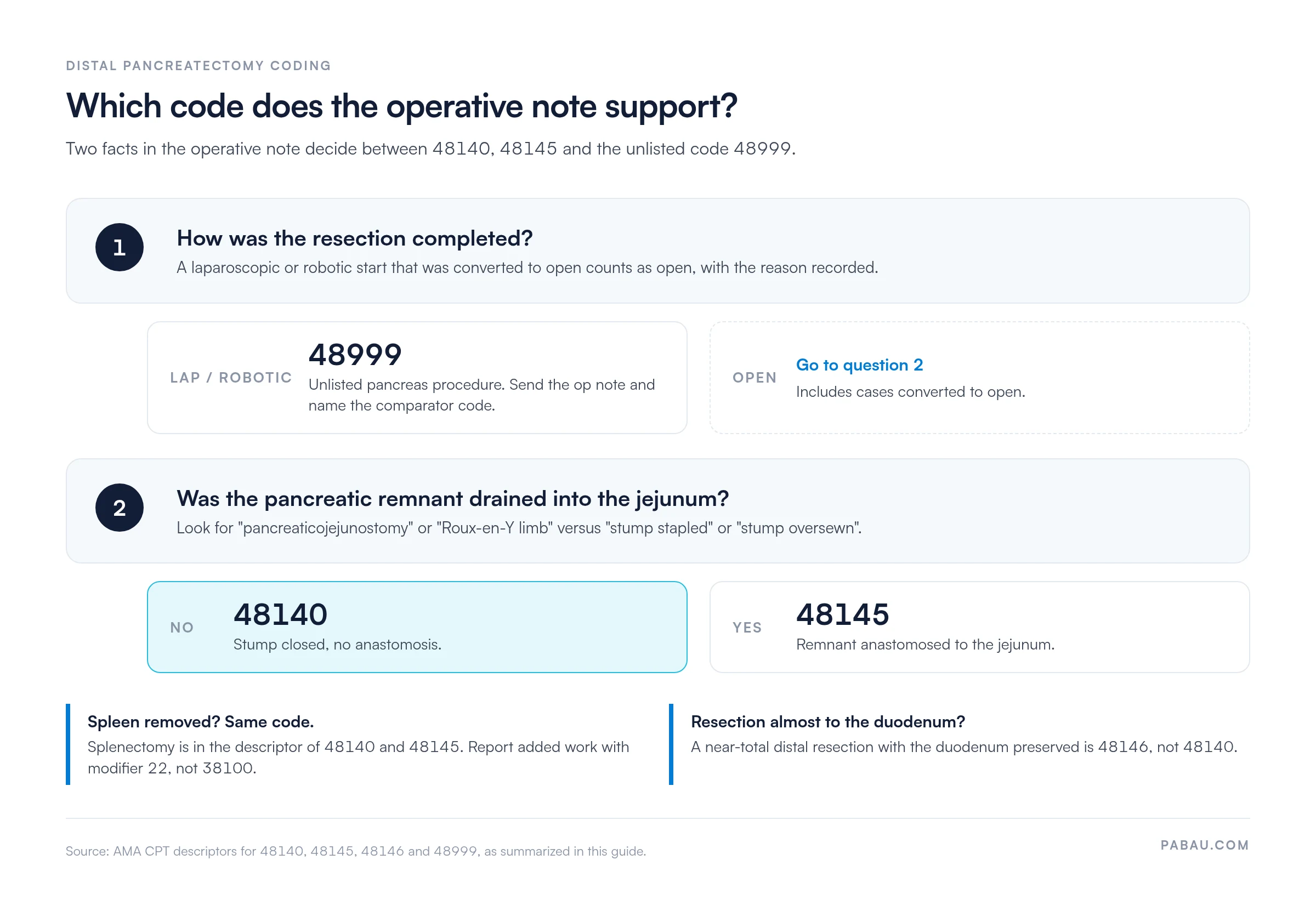
Codes 48140 through 48155 cover the pancreatectomy variants, and none of them describes a laparoscopic approach. Each one turns on a detail of the operative report, which is why medical billing fundamentals start with reading the note before choosing a code.
The short answer is yes, splenectomy is bundled into CPT code 48140. The descriptor explicitly states “with or without splenectomy,” which signals that the spleen’s removal or preservation is already priced into the procedure. Separately billing CPT 38100 (splenectomy) alongside 48140 triggers an NCCI edit and will be denied on most claims.
Modifier 59, or its subset modifier XS, is rarely supportable on 38100 here. The descriptor covers splenectomy for any indication, so a separate splenic diagnosis does not make it a distinct service.
When the splenectomy added substantial work, append modifier 22 to 48140 and attach a cover letter that quantifies it. Verify the current NCCI edit before submitting, because edit tables change quarterly.
Each modifier on a CPT code 48140 claim needs specific support in the operative report. The wrong modifier, or one without documentation, leads to a denial or a payer audit.
When billing modifier 22 on CPT code 48140, attach a narrative letter to the claim. It should describe exactly what made the procedure more complex than typical. Vague language like ‘difficult anatomy’ is routinely rejected. Quantify: operative time was X minutes versus the typical Y, or adhesions from prior abdominal surgery required Z additional minutes of lysis.
Medicare pays for CPT code 48140 under the Medicare Physician Fee Schedule using the resource-based relative value scale. The final payment amount is calculated as: total RVUs x Geographic Practice Cost Indices (GPCI) x conversion factor.
Use the CMS Physician Fee Schedule look-up tool to retrieve the current-year payment for your locality. Rates change with each annual MPFS update, so verify any figure here against the fee schedule for the billing year.
For the current-year work RVU, facility rate, and non-facility rate, look up CPT 48140 in the FastRVU 2026 lookup tool. As a major open abdominal surgery, 48140 carries a high work RVU, listed at 25.66 for 2026.
CMS resets the value each year, so check it for the billing year in question. Practices on Pabau, the practice management platform we build, send 48140 claims through Claim.MD, which submits electronic claims to thousands of US payers.
CPT code 48140 carries a 90-day global surgery period. Routine pre-operative evaluation the day before, the surgery itself, and routine post-operative care for 90 days are all bundled into the single 48140 payment. Billing a separate E/M visit during this window for a complication or follow-up that is directly related to the pancreatectomy will be denied.
Three modifiers allow for separately billable services during the global period:
The operative report is the primary audit target for CPT code 48140. Payers and the OIG both flag high-value open abdominal surgeries for documentation review. Incomplete op reports are the most common reason a paid claim is later recouped. A superbill for a pancreatectomy is only as strong as the clinical record behind it.
The operative report must contain all of the following to support CPT 48140 on audit. Submitting a clean claim starts with confirming every element before the claim leaves the practice.
Traditional Medicare (Parts A and B) does not require prior authorization for most surgical procedures, including CPT code 48140. Medicare Advantage plans and commercial insurers vary significantly, and medical billing compliance requires verifying each plan’s authorization requirements before scheduling.
Commercial payers and Medicare Advantage plans that require prior authorization for 48140 usually ask for this clinical documentation:
Prior authorization rules change with each plan year and vary by payer, so never assume approval is not required. Call the payer’s provider line or check the payer portal to confirm. A claim denied for missing prior authorization on a surgery of this magnitude is exceptionally difficult to appeal successfully.
CPT code 48140 denials follow predictable patterns. Knowing them in advance means a biller can catch the error before submission rather than managing an appeal after denial.
Understanding denial management workflows at the practice level reduces the average days in accounts receivable for these high-value claims. Review common denial codes to map each remittance advice code to the underlying billing error.
Build a 48140 pre-submission checklist for your billing team. Confirm the open approach (laparoscopic cases go to 48999) and the pancreaticojejunostomy status. Check that the splenectomy disposition is documented and the ICD-10 code matches pathology. Confirm prior authorization where the plan requires it, and attach the modifier 22 narrative if used. Running it before claims leave the practice catches the errors behind most 48140 denials.
Surgical practices often keep pre-operative imaging, operative notes, and claims in separate systems. That split is where remnant-handling and splenectomy details drop out before the claim is coded.
Pabau keeps them together in one patient record. Customizable note templates can prompt the surgeon to record whether a pancreaticojejunostomy was created and why the spleen was removed or kept.
The claim then goes out electronically through Pabau’s Claim.MD integration. Your team gets less manual claims management, following each claim’s status without leaving the patient record.
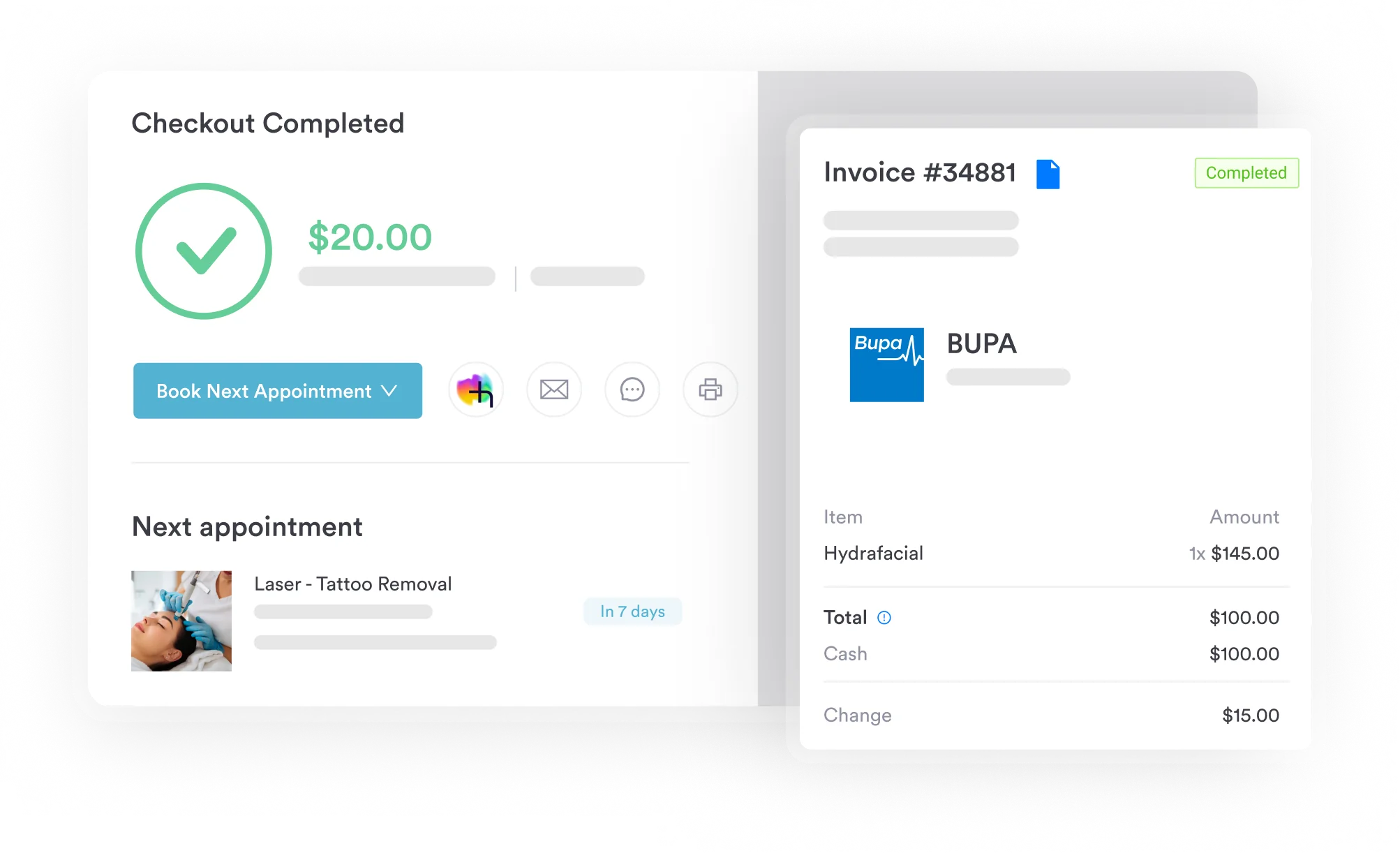

Pabau keeps operative notes and claims in one patient record, then submits claims through Claim.MD. Your billing team spends less time chasing missing details.

Read the operative note for two facts before choosing the code: how the pancreatic remnant was handled and how the procedure was performed. A closed stump supports 48140, and a pancreaticojejunostomy moves the claim to 48145. A case finished laparoscopically goes to 48999.
Splenectomy stays inside the code whatever the reason for it, and extra work belongs on modifier 22 rather than a second line for 38100. A coder who confirms these facts before submission avoids the denials that cost the most on high-value surgical cases.
Book a demo to see how Pabau keeps operative documentation and claims in one place for your surgical billing team.

Need to understand how clearinghouse submission works for surgical claims? How a medical claims clearinghouse works explains the end-to-end path from practice to payer.
Want to see how electronic remittance advice speeds up payment posting for 48140? Electronic remittance advice in medical billing covers how ERAs automate the reconciliation step.
Billing a procedure that required insurance eligibility verification before surgery? Insurance eligibility verification for medical practices outlines the pre-visit checks that prevent downstream denials.
CPT code 48140 covers a distal subtotal pancreatectomy, the removal of the body and tail of the pancreas, with or without removal of the spleen. It applies only when no pancreaticojejunostomy is created. The same resection with one is CPT 48145, and proximal resections such as the Whipple are CPT 48150-48154.
Both codes report a distal subtotal pancreatectomy with or without splenectomy. CPT 48140 applies when the pancreatic stump is closed without an anastomosis. CPT 48145 applies when the surgeon drains the remnant into the jejunum with a pancreaticojejunostomy, so the operative report must state which was done.
Yes. The descriptor reads with or without splenectomy, so removing the spleen is bundled into 48140 for any indication. Modifier 59 or XS on CPT 38100 is rarely supportable. If the splenectomy added substantial work, append modifier 22 to 48140 with a cover letter. Verify the current NCCI edit before submitting.
The Whipple procedure (pancreaticoduodenectomy) is reported with CPT 48150 through 48154. CPT 48150 and 48152 describe the classic version with partial gastrectomy, with and without a pancreatojejunostomy. CPT 48153 and 48154 describe the pylorus-preserving version, again with and without one. None of these codes is laparoscopic, and none applies to a distal resection.
The most common reason is the wrong distal code. A case with a pancreaticojejunostomy belongs under 48145, and a laparoscopic case belongs under 48999. Other causes are a splenectomy billed separately as 38100 and a diagnosis code that does not support the procedure. Missing prior authorization and modifier 22 without a narrative also cause denials.



