CCSD code M2920: Endoscopic ureteric prosthesis billing guide
CCSD code M2920 is the ureteric stent insertion and removal code CCSD code M2920...

Last Updated: Nov 9, 2026
H3364 is the CCSD code for a laparoscopic high anterior resection, with the colorectal anastomosis formed above the peritoneal reflection. The surgeon removes the diseased upper rectum through keyhole incisions and joins the colon to the rectal stump.
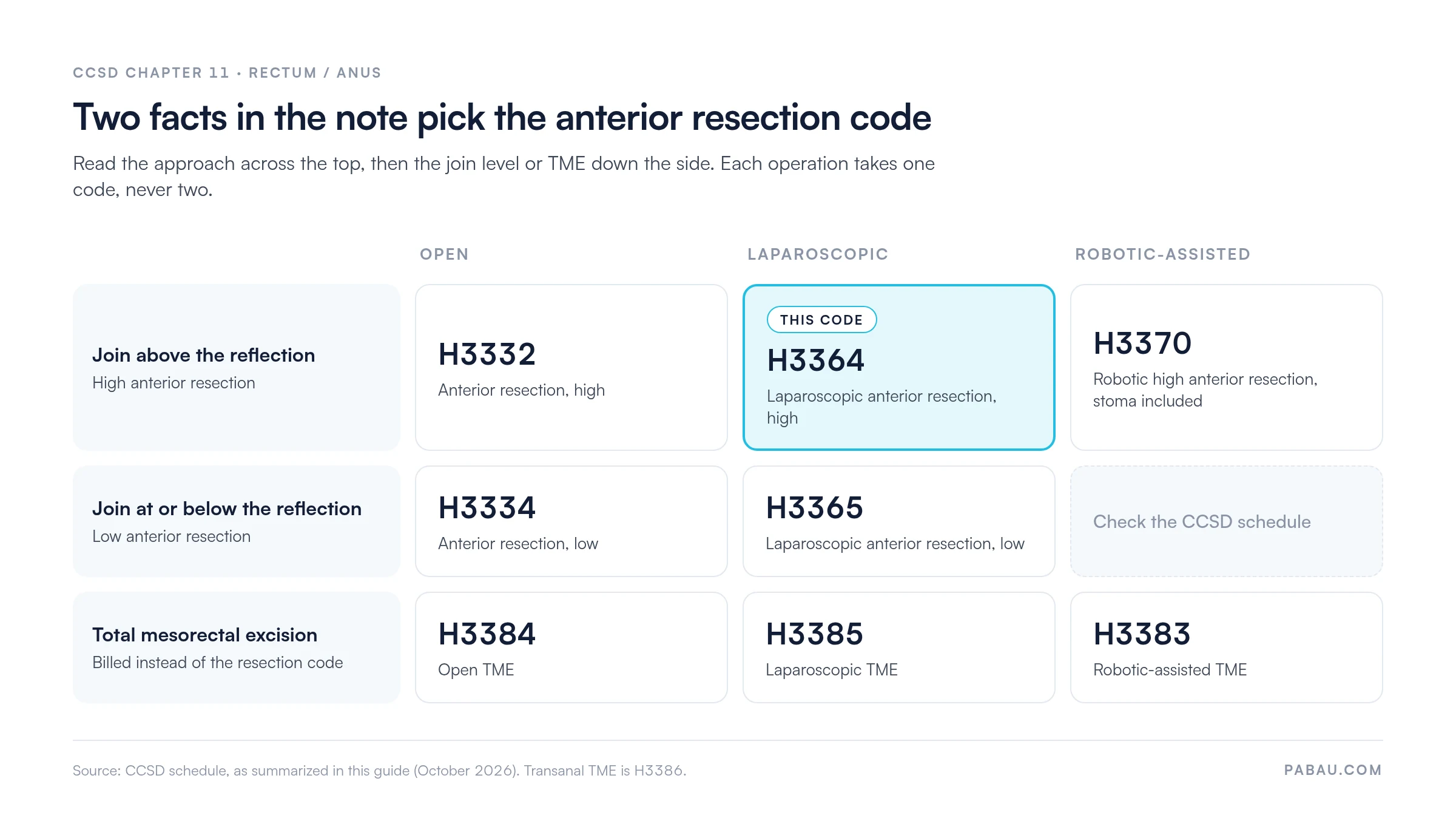
The single detail that decides the code is where that join sits. At or below the reflection, it becomes H3365, while open and robotic high resections take H3332 and H3370. Insurers query any note that leaves the join level unclear, so the sections below show what to record and how to claim.
Let Pabau's smart automation suggest the right codes, reduce claim denials, and keep your practice compliant—effortlessly.
Automate repetitive tasks and focus on what matters most—your patients.
Reduce coding errors and ensure compliance with the latest regulations.
Clean claims, fewer denials, and faster reimbursements.
Powerful insights and reporting to help your practice thrive.
HIPAA compliant SOC 2 certified GDPR-compliant Trusted by 4,000+ clinics worldwide

CCSD code H3364 covers a laparoscopic high anterior resection, with the colorectal anastomosis formed above the peritoneal reflection. It sits in Chapter 11, under Rectum / Anus.
The anastomosis level and the approach decide the code. A laparoscopic low join is H3365, the open high resection is H3332, and the robotic-assisted high resection is H3370.
CCSD lists H3364 as unacceptable with Hartmann’s procedure (H3362), both open anterior resections (H3332, H3334), left hemicolectomy (H0900) and laparoscopic adhesiolysis (T4300).
Total mesorectal excision has its own codes. CCSD refuses laparoscopic TME (H3385) and robotic TME (H3383) alongside H3364, so bill the one code that matches the operation.
Insurers query notes that give only the join height, so state in words that the join sits above the peritoneal reflection.
CCSD code H3364 covers a laparoscopic anterior resection of the rectum, where the colorectal anastomosis is formed above the peritoneal reflection. CCSD calls this a high anterior resection.
The Clinical Coding & Schedule Development (CCSD) Group lists it in Chapter 11, Abdomen (excluding urinary and reproductive organs). It sits in sub-chapter 11.6.0, Rectum / Anus, and entered the schedule on January 20, 2010.
Three facts in the operative note decide whether H3364 fits. The approach is laparoscopic, the rectum is resected with a colorectal join, and that join sits above the peritoneal reflection. Change any one of them and the code changes.
High anterior resection is most often performed for cancer of the upper rectum or the rectosigmoid junction. Other indications include complicated sigmoid diverticular disease and benign tumors too large for local excision. Our CCSD guides for surgeons cover the other Chapter 11 procedures.
Before submitting H3364, the coder needs specific wording from the operation note. Knowing the operative steps tells them where to look.
UK private medical insurers expect a diagnosis code with every H3364 claim. The table lists the indications that most often lead to a high anterior resection, with their ICD-10 codes.
Check each code against the NHS Classifications Browser before submission, since annual updates apply. The diagnosis should also match the indication recorded in the pre-authorization request.
For the cancer cases, our pages on C20 and C19 walk through how each tumor site is coded.
The peritoneal reflection is where the peritoneum folds from the pelvic wall onto the front of the rectum. A join above that fold makes the operation a high anterior resection. At or below it, the laparoscopic code becomes H3365.
The surgeon judges the reflection under direct vision, and its position varies between patients. A note that gives only the anastomosis height, such as “join at 12 cm”, leaves the code level open to query.
Write the reflection into the operative note: ‘Colorectal anastomosis formed at [X] cm from the anal verge, above the peritoneal reflection.’ That one line settles H3364 versus H3365.
CCSD gives each approach to an anterior resection its own code, and the join level splits each approach again. An open or robotic case billed as H3364 is miscoded, even when the insurer’s fee happens to match.
A laparoscopic case sometimes converts to open. Record the point of conversion and the reason in the note, then ask the insurer whether it wants H3364 or H3332 for that claim.
H3370 arrived in the schedule on April 15, 2024. Its descriptor already allows for a stoma, so a separate stoma code never goes on the same claim.
No. CCSD codes total mesorectal excision (TME) as a procedure in its own right. The codes are H3384 for open, H3385 for laparoscopic, H3386 for transanal and H3383 for robotic-assisted TME.
CCSD lists both H3385 and H3383 as unacceptable combinations with H3364. If the note records a TME, choose the one code that describes the operation performed rather than billing the pair.
The grid below puts the approach, the join level and TME side by side. Read the note against it and one code drops out.
The CCSD schedule names the codes that cannot be billed with H3364 for the same operation. Most describe a different resection of the same bowel, an endoscopy within the procedure, or a different route.
H0900, the open excision of left hemicolon, sits on that list. Only the code matching the segment and approach in the operative note belongs on the claim.
The CCSD Group publishes these pairs but does not set fees or decide reimbursement. Each insurer applies its own view, so confirm any borderline pairing before submission. The CCSD technical guide (October 2025) sets out the general unbundling principles.
A few procedures performed in the same episode can be claimed alongside H3364. Each one needs its own supporting line in the operative note.
Other codes come up later, after the resection has healed. A defunctioning ileostomy that narrows, retracts or prolapses can be revised locally under G7512. If the join itself narrows in the rectum, dilation is coded H4480, with each session on its own claim.
The open low resection, with its own stoma and TME guidance, is covered in our page on H3334.
The operative note is the evidence behind every H3364 claim. When an insurer queries this code, one of these seven details is usually missing.
Anterior resection is major elective surgery, and UK private medical insurers check it before admission. Requirements vary between insurers and policies, so confirm the steps with each one before you list the patient.
Each insurer also publishes its own code lookup, which shows its fee and any code-level rules for its members.
Most UK private practices send H3364 claims electronically through Healthcode, though some insurers also accept claims through their own portals.
Rejections on H3364 tend to repeat, and most trace back to the operative note or the code choice. The table maps each one to its fix.
Run through these five checks on every H3364 claim before it goes out. Each one maps to a rejection in the table above.
Many colorectal practices still track claims across operation notes, spreadsheets and insurer portals. Each handoff is a chance to lose the authorization number or key in the wrong approach code.
Pabau, the practice management platform we build, puts the CCSD code, the ICD-10 diagnosis and the authorization number on one claim record. Its claims management software checks that the required claim fields are filled before you send, then submits through Healthcode.
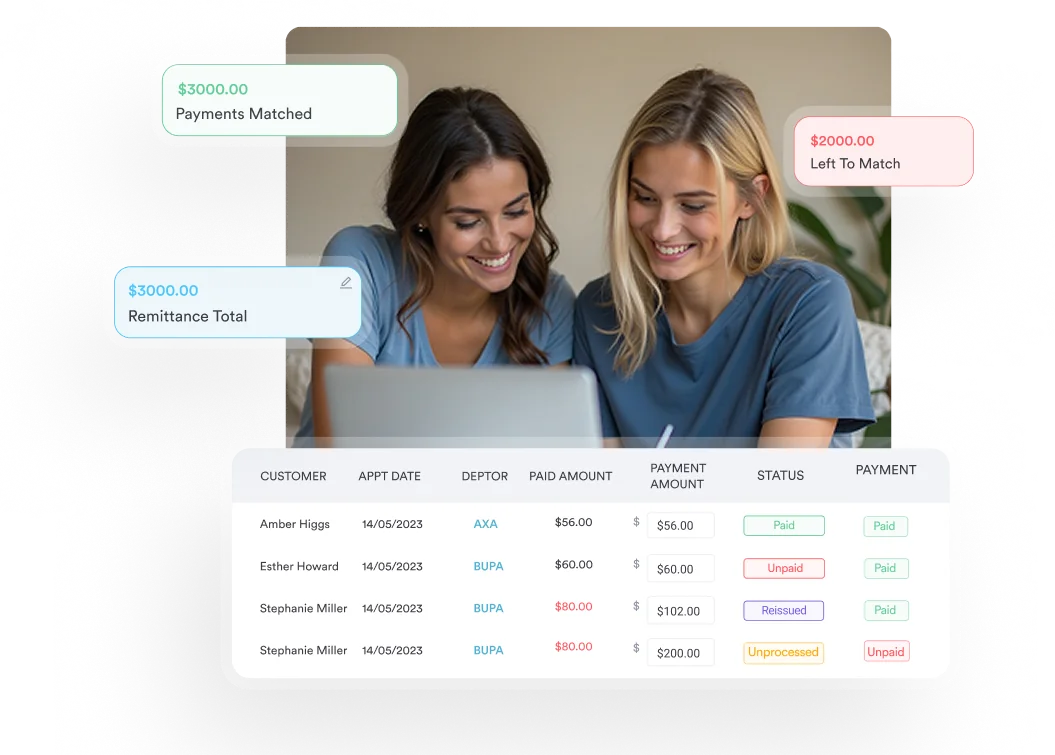
You track each claim’s status against the patient record, so a query from the insurer lands with the documents needed to answer it. Pabau does not choose the code for you, so the level and approach checks above still apply.
Groups with several consultants or sites can run the same billing process at every location.

Pabau helps colorectal surgery teams keep the CCSD code, diagnosis and authorization number on one claim and submit it through Healthcode.

H3364 is settled in the operating room, long before anyone opens the claim. Once the surgeon records the route, the join level and any TME, the coding is mostly done.
That means a little more detail in every note. In return, the billing team stops chasing surgeons for answers weeks after the operation, and insurers have less reason to query.
So build the reflection line into your operative note template, and keep CCSD’s unacceptable list beside the person who submits. If you’d like to see how Pabau holds the code, diagnosis and authorization on one claim, book a demo.

Coding an open low resection instead? CCSD code H3334 covers the open anterior resection with the join at or below the peritoneal reflection.
Removing the rectum and anus with no join? CCSD code H3320 walks through abdominoperineal resection and its permanent colostomy.
Checking what Bupa pays for colorectal codes? The Bupa procedure codes and fee schedule guide links each code to its published fee before you invoice.
Choosing software to bill UK insurers? Our roundup of the best medical billing software in the UK compares tools for insurer claims, invoicing and payment tracking.
Coding the diagnosis for a rectal cancer case? ICD-10 code C20 explains the diagnosis code for malignant neoplasm of rectum.
The level of the join. A high anterior resection joins the colon to the rectum above the peritoneal reflection, which is H3364 when done laparoscopically. A low resection places the join at or below it, which is H3365.
The Clinical Coding and Schedule Development Group maintains the schedule. It was formed by UK private medical insurers, including Aviva, AXA Health, Bupa and Vitality. It sets codes and descriptors, not fees, so each insurer publishes its own rate.
No. Hospitals record the operation in OPCS-4, the NHS procedure classification, for their own returns. The consultant’s insurer invoice carries the CCSD code, so check that the claim shows H3364 rather than the hospital’s code.
Ask the insurer, because policies differ between H3364 and the open code, H3332. Record the point of conversion and the reason in the operative note, so either choice is supported.
Often, yes. A separate Chapter 11 ileostomy code may apply when a temporary stoma protects the join. Some insurers fold it into the resection fee, so confirm first. The robotic code H3370 already includes a stoma.
Confirm with Bupa before the operation, since authorization rules vary by policy. Have the membership number, consultant details, diagnosis and planned approach ready. Bupa’s code search portal shows the code’s current status and fee.