CPT code 93503: Swan-Ganz catheter billing and modifiers
CPT code 93503: Official descriptor and procedure overview In the AMA CPT code s...

Last Updated: Oct 23, 2026
H4480 is the CCSD code for dilation of stricture of rectum. Colorectal surgeons and gastroenterologists bill it when they stretch a narrowed section of the rectum to reopen it. The narrowing often follows rectal surgery, pelvic radiotherapy or Crohn's disease, so many patients need more than one session.
H4480 sits in Chapter 11 of the CCSD schedule, Rectum/Anus, under sub-chapter 11.6.0. The schedule names H4430, H5400 and H4200 among its unacceptable combinations. A claim that pairs H4480 with a listed code for the same session is likely to be rejected. The full list sits behind the CCSD login, so check it there.
Let Pabau's smart automation suggest the right codes, reduce claim denials, and keep your practice compliant—effortlessly.
Automate repetitive tasks and focus on what matters most—your patients.
Reduce coding errors and ensure compliance with the latest regulations.
Clean claims, fewer denials, and faster reimbursements.
Powerful insights and reporting to help your practice thrive.
HIPAA compliant SOC 2 certified GDPR-compliant Trusted by 4,000+ clinics worldwide

CCSD code H4480 covers dilation of stricture of rectum, a Chapter 11 Rectum/Anus procedure in sub-chapter 11.6.0.
H4430, H5400 and H4200 are among the codes the CCSD schedule bars from an H4480 claim. Check the full list in CCSD.
The operative note should name the cause of the stricture, its level in the rectum and the dilation technique.
Strictures often need repeat dilations, so ask the insurer whether each session needs its own authorization.
Each insurer sets its own H4480 fee, so check the insurer’s schedule rather than the CCSD site.
CCSD code H4480 covers dilation of stricture of rectum. A colorectal surgeon or gastroenterologist stretches a narrowed section of the rectum to reopen it.
The code sits in Chapter 11 of the CCSD schedule, Rectum/Anus, under sub-chapter 11.6.0. It has been in the schedule since January 2010.
A rectal stricture is a fixed narrowing of the bowel wall. Common causes include a tight join after rectal surgery, pelvic radiotherapy and Crohn’s disease. Patients may report straining, thin stools, incomplete emptying or signs of obstruction.
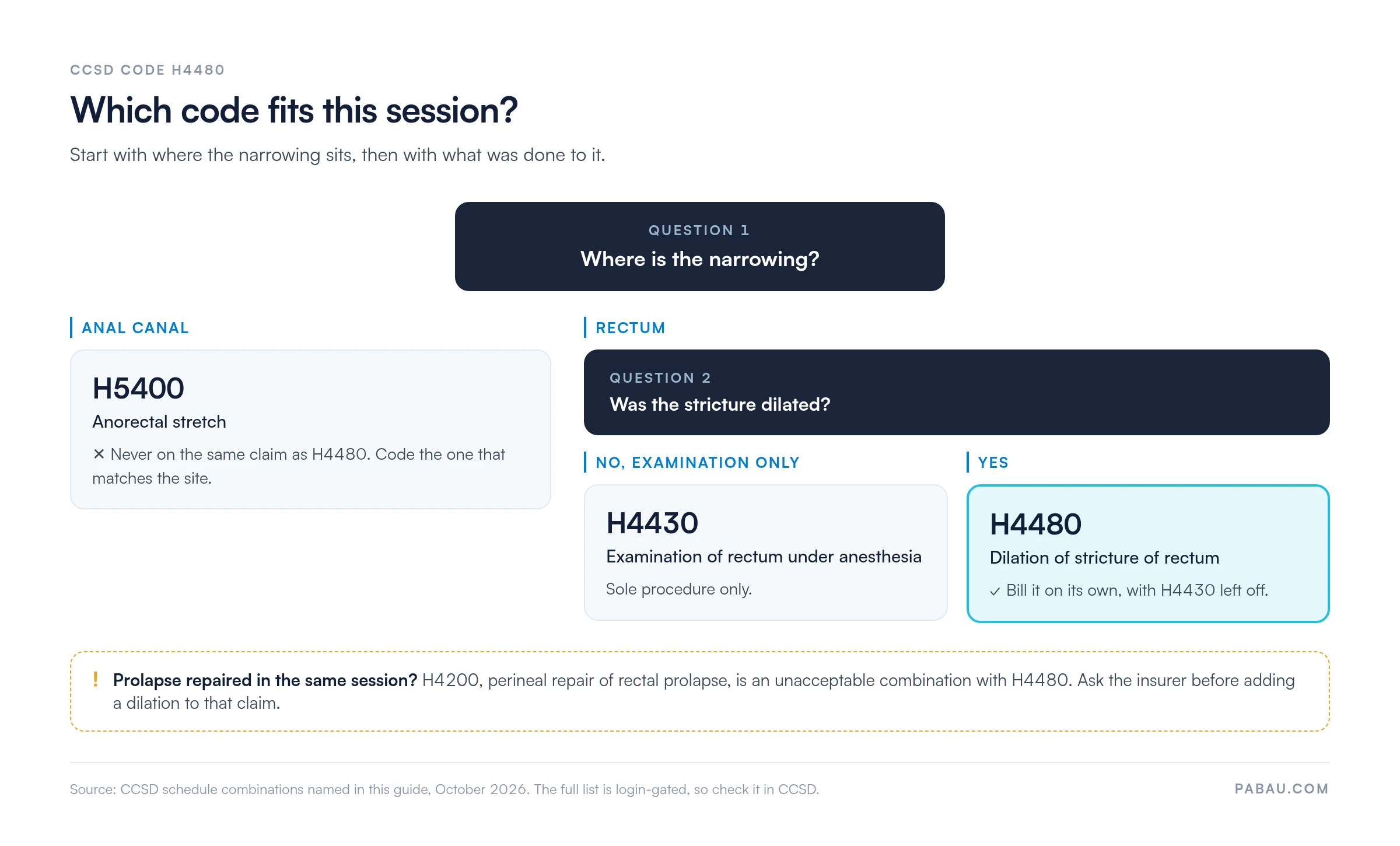
The descriptor names the rectum, so the narrowing has to sit there rather than in the anal canal. Dilation can be done digitally, with graduated dilators or with a balloon. When a flexible scope guides the balloon, check the live schedule for a code that describes the whole session more closely.
Two questions settle most sessions: where the narrowing sits, and what was done to it.
UK private medical insurers use CCSD codes to identify the procedure on the invoice. The CCSD Group sets the codes and their narratives, not the fees. Each insurer sets its own fee and its own authorization rules for H4480.
The CCSD schedule names H4430, H5400 and H4200 among the unacceptable combinations for H4480. Pair H4480 with one of them for the same session, and the claim is likely to be rejected or queried.
These three are the ones this guide can confirm. The full combination list sits behind the login on the CCSD schedule, and it may name more codes. Check it before you submit, because combinations are reviewed over time.
The Bupa code search is useful for a second check on Bupa claims. It shows whether Bupa recognizes the code before you treat the patient.
Insurers read the note against the descriptor. For H4480, it has to show a rectal stricture and a dilation of that stricture. Record these points at the time of the procedure:
Here’s the difference in practice. A note that reads “Rectal dilation performed” leaves the insurer guessing.
Compare it with this example: “Stricture at the anastomosis after anterior resection, 6 cm from the anal verge. Dilated with graduated dilators. No bleeding.” That version answers the insurer’s questions before they’re asked. Keep the signed consent on the same record, so both reach the insurer together.

Run through this list before the claim leaves the practice:
The Bupa CCSD billing guide covers Bupa’s own submission rules in more detail.
When notes and invoices live in separate systems, staff retype the authorization and membership numbers. One wrong digit is enough to stall a claim.
Pabau connects to Healthcode. Staff add H4480 to the invoice from the patient record and send the claim from there. Required fields such as membership and authorization numbers must be complete before the claim can go.
Pabau’s claims management software then shows every claim’s status in one list. Your team can chase a pending dilation claim early, instead of finding it weeks later.

An H4480 claim gets paid when the note, the code and the authorization all describe the same rectal stricture. That match is cheapest to build on the day, while the details are fresh.
Repeat dilations carry the heaviest admin load. Agree the authorization pattern with the insurer before the first session, not after the third. Book a demo to see how Pabau sends CCSD claims to Healthcode from the patient record.
H4480 is the CCSD code for dilation of stricture of rectum. It sits in Chapter 11, Rectum/Anus, under sub-chapter 11.6.0. UK private medical insurers use it to identify the procedure on a claim.
The CCSD Group doesn’t set one. Each insurer publishes its own fee for H4480, and fees vary between insurers. Check the insurer’s fee schedule or code search before you quote the patient.
The CCSD schedule names H4430, H5400 and H4200 among its unacceptable combinations. The full list sits behind the CCSD login and may include more codes, so check it before you submit.
Yes, each dilation has its own date of service and goes on its own claim. Ask the insurer before the first session whether one authorization covers the planned series.
No. OPCS-4 is the procedure classification the NHS uses. CCSD codes are the schedule UK private insurers use for billing, so a private claim carries H4480.