CPT Code 62284: Injection procedure for myelography
CPT Code 62284: official descriptor and procedure overview The American Medical ...

Last Updated: Oct 19, 2026
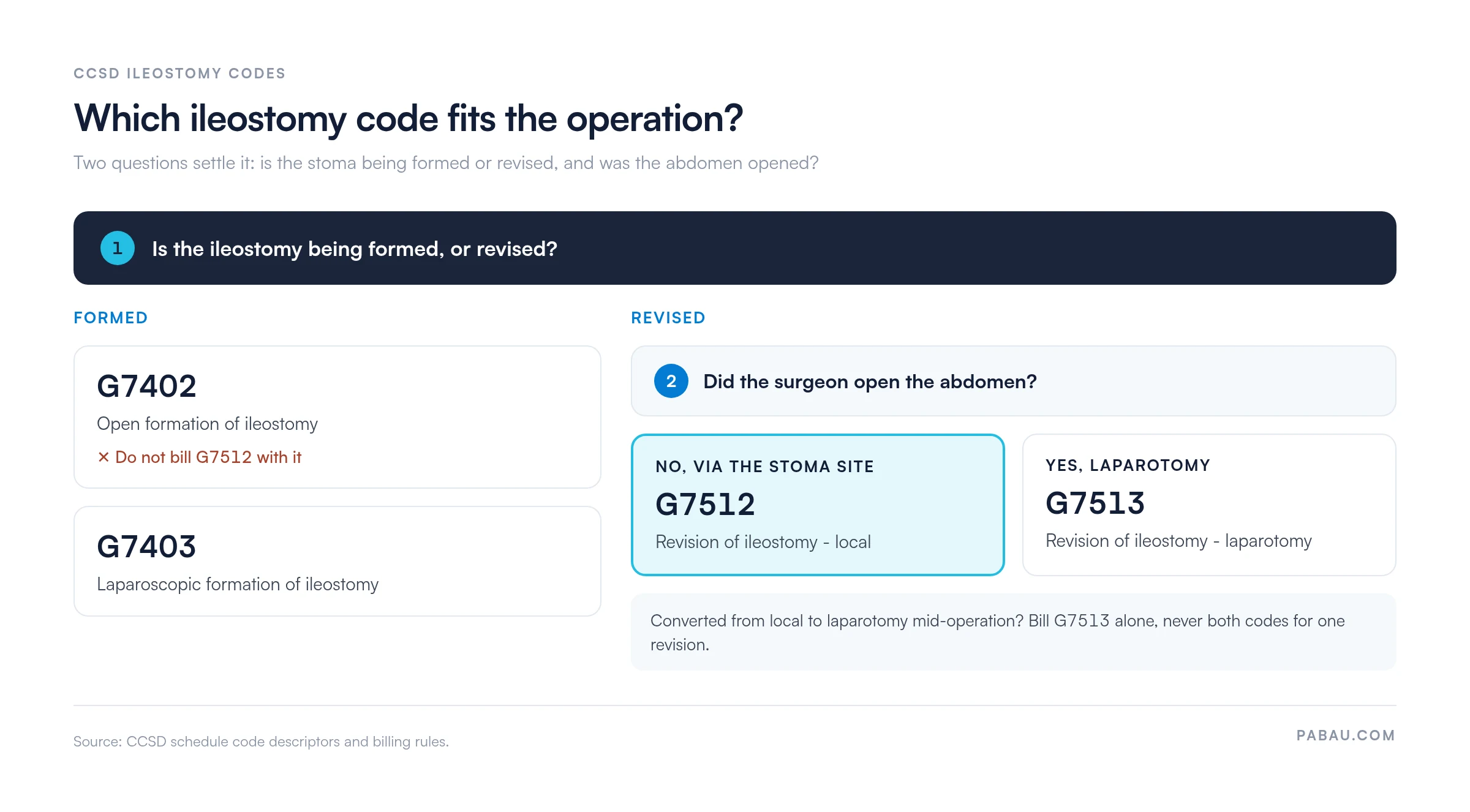
G7512 is the CCSD code for revision of ileostomy - local. The surgeon repairs an existing ileostomy through the stoma site, without opening the abdomen. It is typically used when a stoma has narrowed, retracted or prolapsed, often long after the original operation.
That local approach is what decides the claim. If the surgeon needs a laparotomy, the revision is billed as G7513 instead. CCSD also lists G7512 among the codes that should not be billed alongside G7402, the open formation of an ileostomy.
Let Pabau's smart automation suggest the right codes, reduce claim denials, and keep your practice compliant—effortlessly.
Automate repetitive tasks and focus on what matters most—your patients.
Reduce coding errors and ensure compliance with the latest regulations.
Clean claims, fewer denials, and faster reimbursements.
Powerful insights and reporting to help your practice thrive.
HIPAA compliant SOC 2 certified GDPR-compliant Trusted by 4,000+ clinics worldwide

CCSD code G7512 covers revision of an ileostomy done locally through the stoma site, without a laparotomy.
A revision that needs the abdomen opened is billed as G7513, and CCSD lists G7512 as not billable with G7402.
The operative note should name the stoma type, the site, the indication and the local approach.
Preauthorization rules belong to each insurer, so confirm cover and record an authorization number before the operation.
CCSD does not set fees, so check the insurer’s own benefit limit and warn the patient about any shortfall early.
CCSD code G7512 is the private insurance code for revision of ileostomy – local. The surgeon works through the stoma site to repair the ileostomy, and the abdomen is not opened.
Typical reasons include a stoma that has narrowed, retracted or prolapsed. The patient usually already has an end or loop ileostomy, often formed months or years earlier.
The code comes from the CCSD schedule, short for the Clinical Coding and Schedule Development Group. Representatives of UK private insurers, including Bupa, AXA Health, Aviva and Vitality, maintain it. Surgeons, private hospitals and medical secretaries use it to tell insurers which operation took place.
The word that drives the whole claim is “local”. Once the operation needs a laparotomy, G7512 is no longer the right code.
Start with the approach, because CCSD divides ileostomy revisions by how the surgeon reaches the bowel. G7512 fits work done around the stoma itself, such as:
Several related operations sit outside the code and are coded on their own terms:
Most coding errors on this code come down to one question. Did the surgeon open the abdomen, or not?
Here is how that plays out. A patient has a retracted end ileostomy a year after a colectomy. The surgeon frees the stoma through a peristomal incision and refashions it, so the claim goes in as G7512.
Now change one detail. Adhesions stop the local repair, and the surgeon converts to a laparotomy. The operative note records the conversion, and the claim moves to G7513. It never carries both codes for one revision.
The same test extends to the formation codes, and the decision path below covers all four ileostomy codes.
Insurer queries on G7512 usually turn on whether the operative note supports a local approach. Before the secretary raises the invoice, check the operative note covers each of these points:
The CCSD technical guide sets out the schedule’s general coding rules, so keep it to hand for unusual cases.
Preauthorization works differently with every insurer and policy, so treat it as a short Q&A with each one.
Does this patient need approval? Ask the insurer, or check its provider portal. Bupa, for example, offers a code search tool for recognized providers.
What should you quote? Give the code G7512, the diagnosis and the planned date. If the plan might change to a laparotomy, ask how the insurer wants that handled.
What do you keep? Record the authorization number in the patient file. You will need it again on the invoice.
Once the patient is home, the billing work follows a fixed order. Walk through it the same way each time:
Rejections on this code tend to repeat, which makes them easy to prevent. These are the ones to watch:
That last point deserves a word. Insurers publish their own rates, such as the Vitality fee finder. If your fee is higher, tell the patient about the shortfall in writing before surgery.
A two-minute check catches most of the problems above. Tick each line before the claim leaves the office:
Most surgical secretaries juggle the operative note, the authorization email and the invoice in separate places. When an insurer queries a claim, someone has to find all three.
Pabau, the practice management platform we build, keeps those pieces in one patient record. The secretary raises the insurer invoice from that record with Pabau’s medical billing software, and UK claims can go to insurers through its Healthcode integration.
You still choose the code and check the notes yourself. The difference is that the evidence and the payment status sit together, so a query takes minutes rather than an afternoon.

Pabau stores operative notes, insurer invoices and payment status in one patient record, so private surgical claims are easier to send and follow up.

G7512 is a narrow code, and that works in your favor. If the operative note shows a local revision, the indication is clear and approval is on file, the claim has little to argue about.
The risk sits at the edges. A conversion to laparotomy, a pairing with G7402 or an unexplained shortfall will stall payment. Settle those before surgery and the claim usually settles itself.
Book a demo to see how Pabau keeps operative notes and insurer invoices together for private surgical practices.

Billing the original stoma? CCSD code G7403 explains how a laparoscopic ileostomy is coded and documented.
Need the wider schedule? CCSD codes covers how the schedule is organized and how insurers use it.
Working with Bupa? Bupa CCSD codes walks through how Bupa applies CCSD codes to private claims.
Coding a procedure through the stoma? CCSD code G7900 covers ileoscopy via stoma with therapy.
No. G7512 describes an ileostomy, which is made from the small bowel. A colostomy revision has its own CCSD codes, so check the schedule for the right one.
It often is, but cover depends on the patient’s policy. Confirm eligibility and any excess with the insurer, and get preauthorization where it is required.
The anesthetist bills the insurer separately for their own work. The surgeon’s invoice carries G7512 only.
No. CCSD publishes codes and coding rules, not fees. Each insurer sets its own benefit for the code, and the surgeon sets their own charge.
If the operation converts to a laparotomy, the claim uses G7513 instead of G7512. The operative note should record why the surgeon converted.