HCPCS code G0257: Unscheduled or emergency dialysis billing guide
HCPCS code G0257: Official descriptor and code overview HCPCS code G0257 is defi...

Last Updated: Oct 27, 2026
H0900 is the CCSD code for excision of left hemicolon, the open left hemicolectomy. UK private medical insurers such as Bupa and AXA Health use it to identify the surgeon's procedure.
H0900 sits in section 11.5.0 Large Intestine of the CCSD Schedule, under reference Fk.065. A laparoscopically assisted left colon resection is coded H1880, and a robotic-assisted left hemicolectomy is coded H1882.
Let Pabau's smart automation suggest the right codes, reduce claim denials, and keep your practice compliant—effortlessly.
Automate repetitive tasks and focus on what matters most—your patients.
Reduce coding errors and ensure compliance with the latest regulations.
Clean claims, fewer denials, and faster reimbursements.
Powerful insights and reporting to help your practice thrive.
HIPAA compliant SOC 2 certified GDPR-compliant Trusted by 4,000+ clinics worldwide

CCSD code H0900 covers excision of the left hemicolon in UK private healthcare, under CCSD reference Fk.065.
The approach picks the code: H0900 for the open operation, H1880 for laparoscopic assistance and H1882 for robotic assistance.
No H09 series exists, because H0900 is the only H09xx code. Right-sided and total colon resections take H0700, H0610 or H0510.
UK private medical insurers such as Bupa and AXA Health expect pre-authorization, and the authorization number belongs on the invoice.
Pair H0900 with an ICD-10 diagnosis that matches the segment removed, such as C18.6 for a descending colon tumor.
CCSD code H0900 is the UK private healthcare code for excision of the left hemicolon, an operation surgeons usually call a left hemicolectomy. It sits in section 11.5.0 Large Intestine, within chapter 11.0.0 Abdomen (Excl. Urinary & Reproductive Organs) of the CCSD Schedule. Its CCSD reference is Fk.065.
CCSD stands for Clinical Coding and Schedule Development. The CCSD Group maintains the codes UK private consultants quote on their invoices. Private medical insurers such as Bupa, AXA Health, Aviva, Vitality and WPA use them to identify the procedure they are paying for.
The official descriptor is “Excision of left hemicolon.” Quote that wording on invoices and insurer correspondence. You can confirm any code and its descriptor on the CCSD website.
The CCSD Group does not set fees or decide reimbursement. Each insurer applies its own fee schedule and benefit rules to H0900. For Bupa patients, check how Bupa uses CCSD codes before you quote a fee.
A left hemicolectomy removes the descending colon, the part of the large intestine supplied by the inferior mesenteric artery. How much of the neighboring bowel comes out depends on the diagnosis and the margins the surgeon needs.
In an open operation, the surgeon works through an abdominal incision. The left colon is mobilized and the inferior mesenteric vessels, or their branches, are divided. The segment is removed, and the bowel ends are joined with an anastomosis or brought out as a stoma.
Code from what the operation note says came out, not from the name on the operating schedule. If the note describes a different segment or extent, one of the related codes below fits better.
The CCSD Schedule separates left colon resection by surgical approach. It does this with separate codes, not with an approach modifier added to H0900.
So a laparoscopic left hemicolectomy is billed as CCSD code H1880, not as H0900 with a modifier. Read the approach from the operation note, never from the booking.
Some laparoscopic operations are converted to open surgery. CCSD’s coding principles and the insurer’s rules decide which code applies after a conversion. Check both before you submit, and record the conversion and its reason in the operation note.
There is no “H09 series” of colectomy codes. H0900 is the only code in the H09xx range, so the neighboring codes below describe other segments, extents or approaches.
Each descriptor above is quoted from the CCSD Schedule. If the note shows only the sigmoid colon came out, H1000 is the code to check. For a right-sided operation, start with H0700. The grid below sorts the left and right codes by segment and approach.
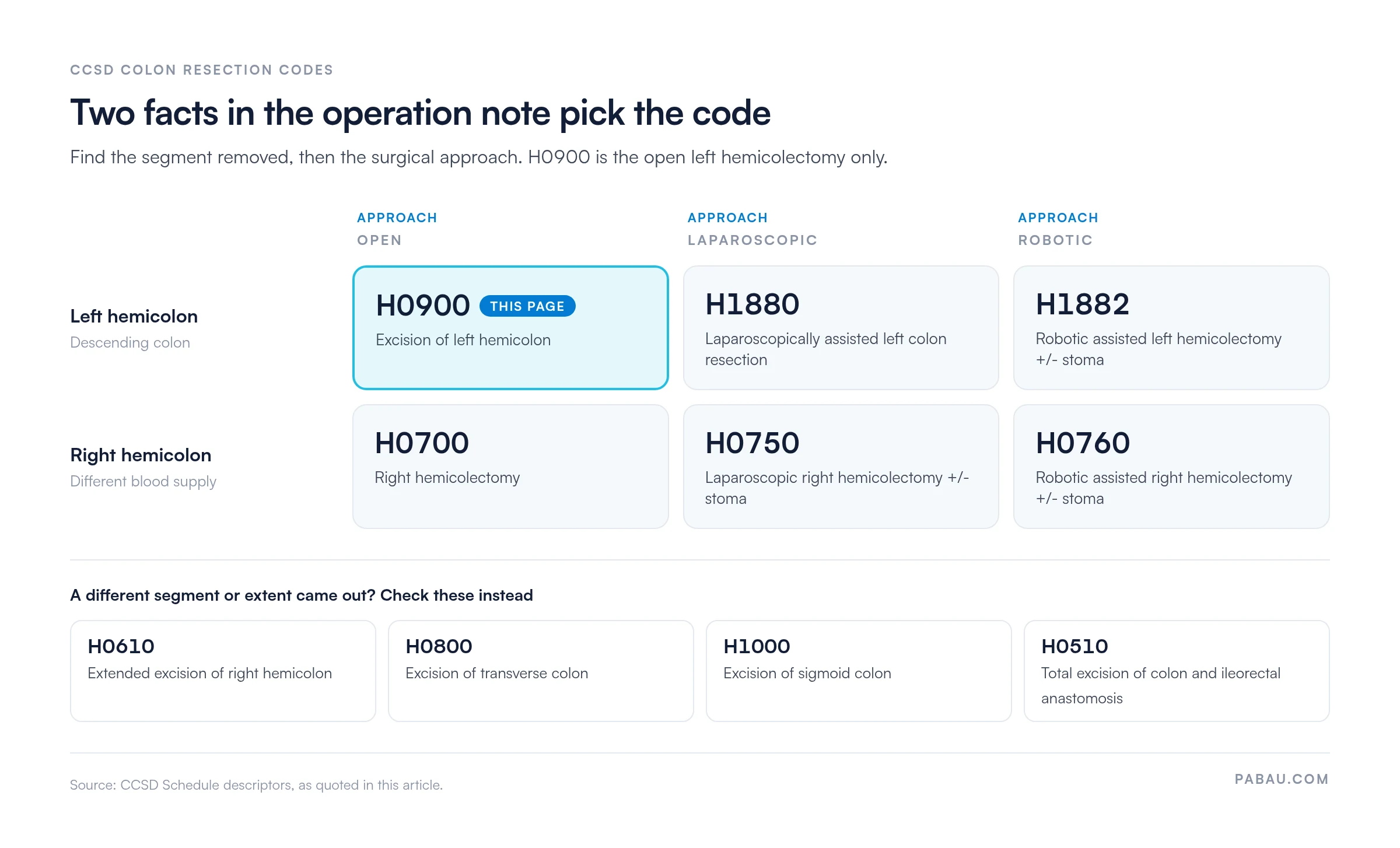
Before you assign H0900, confirm two points in the operation note. First, the descending colon was removed. Second, the operation was done through an open incision, without laparoscopic or robotic assistance.
H0900 fits disease in the left colon. Insurers ask for the diagnosis at pre-authorization, and the ICD-10 code should match the segment removed.
The WHO ICD-10 browser gives the official description for each code. For cancer cases, include the staging in the pre-authorization request. A diagnosis that points elsewhere in the colon, such as C18.3 for the hepatic flexure, does not support H0900.
Insurers can ask for clinical records before they pay a surgical claim. Keep this set on file for every H0900 operation:
A missing operation note or authorization number causes avoidable delays. A short checklist for each code, part of everyday medical billing compliance, confirms both are on file before the claim goes out.
Patients with private medical insurance normally need their insurer’s authorization before planned treatment. A left hemicolectomy is major surgery, so contact the insurer well before the operation date.
Insurers set their own rules, and those rules change. Confirm the current process with the patient’s insurer. A typical request includes:
The insurer confirms what the policy covers and issues an authorization number. If the approach changes after authorization, tell the insurer, because the code changes with it.
H0900 describes the surgeon’s procedure. The anesthetist and the hospital invoice for their own part of the same admission, quoting the same date and authorization number.
Steps that are part of the resection, such as mobilizing the colon and closing the wound, belong inside H0900. Adding a code for an incidental step invites an unbundling query.
A separate procedure is different, such as a stoma formed when no anastomosis is made. The CCSD entry for H0900 links to coding principles that set out which combinations are allowed. Check them, and the insurer’s rules, before you put a second code on the claim.
H0900 rejections follow a predictable pattern, and most can be prevented before submission. Effective denial management in healthcare starts with knowing why claims fail.
Start with the cause on the rejection notice. An administrative error, such as a missing authorization number, usually needs a corrected claim rather than a complaint.
The Financial Ombudsman Service is free for consumers. Each insurer publishes its own complaints process, so follow the steps on its website.
Paperwork for a colon resection often ends up in several places. The operation note sits in one system, the consent form in another, and the invoice in a third. Each hand-off risks a wrong approach code or a lost authorization number.
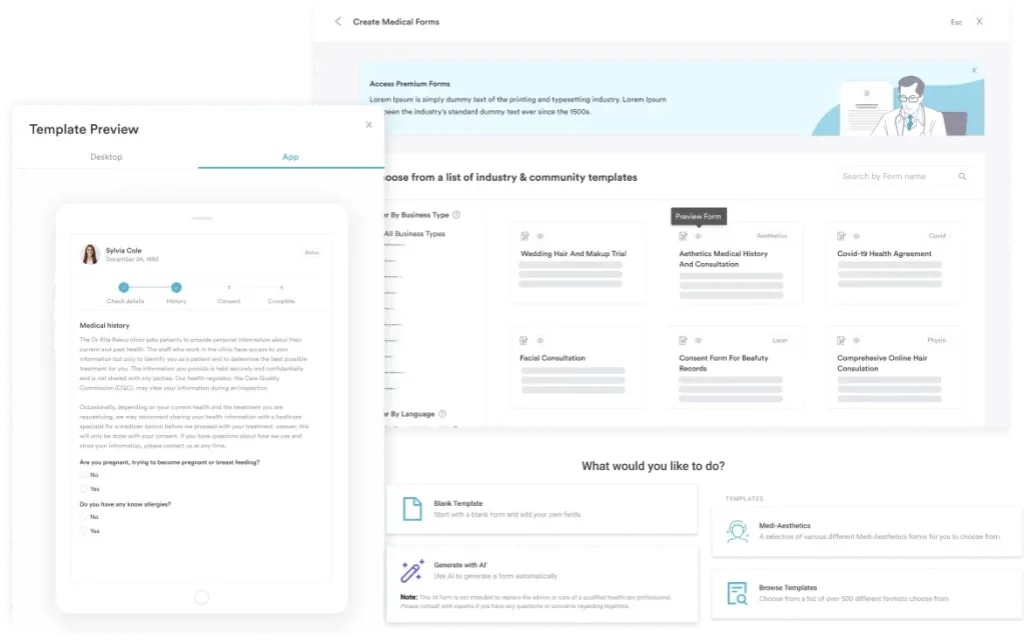
Pabau keeps those documents on one patient record. Patients sign consent and medical history forms online, and the signed copies land on the same file. Pabau Scribe, our AI scribe, drafts clinical notes, so the record of each consultation is ready sooner.
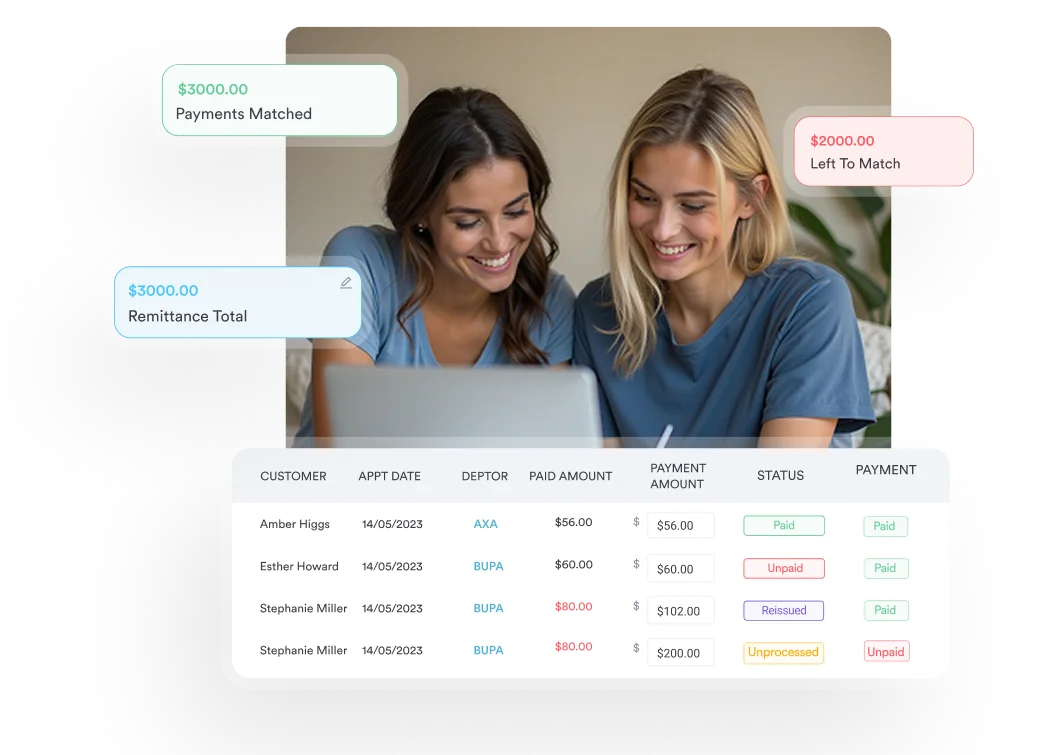
Your team still chooses the code. Invoicing runs through Pabau’s claims software for consultants, from the same patient record. The authorization number and the operation note then sit next to the invoice when you check it.

Pabau keeps the operation note, signed consent and invoice on one patient record, so your team can check each claim before it goes out.

Code H0900 only when the left hemicolon was removed through an open incision. A laparoscopic operation goes on H1880 and a robotic-assisted one on H1882, so the operation note decides the code.
Before you submit, confirm three facts. The note states the approach, the authorization number is on the invoice, and the ICD-10 code matches the left colon. A short check costs less than a rejection and a resubmission.
To see how Pabau keeps notes, consent forms and invoices on one record, book a demo.

Looking for a structured CCSD code reference for private insurers? Pabau’s Bupa CCSD code guide explains how Bupa applies the CCSD Schedule.
Want to understand the CCSD Schedule as a whole? Pabau’s guide to CCSD codes covers how UK private consultants use them.
Was the left colon removed laparoscopically? CCSD code H1880 covers laparoscopically assisted left colon resection.
Billing a right-sided colon resection? CCSD code H0700 explains how to code a right hemicolectomy.
Billing the colonoscopy that came before surgery? CCSD code H2002 explains how to bill a diagnostic colonoscopy.
CCSD code H0900 covers excision of the left hemicolon, usually called a left hemicolectomy. UK private medical insurers use it for the open operation, under CCSD reference Fk.065.
No. CCSD sets the approach by code, not by a modifier. A laparoscopically assisted left colon resection is H1880, and a robotic-assisted left hemicolectomy is H1882.
A right hemicolectomy is H0700. The laparoscopic operation is H0750, the robotic-assisted one is H0760, and an extended right resection is H0610.
No. H0900 is the only code in the H09xx range. Nearby codes such as H0510, H0800 and H1000 cover other segments of the colon.
Common pairings include C18.6 for a descending colon cancer and K57.2 or K57.3 for diverticular disease. K51.5, left sided colitis, fits only the uncommon limited left resection. The diagnosis must match the segment removed.
Patients with private medical insurance normally need their insurer’s authorization before planned surgery. Each insurer sets its own process, so confirm it with the patient’s insurer and put the authorization number on the invoice.