

CCSD code G5100: Bypass of duodenum billing guide
CCSD code G5100 bills a bypass that leaves the duodenum in place CCSD code G5100...

Last Updated: Oct 16, 2026
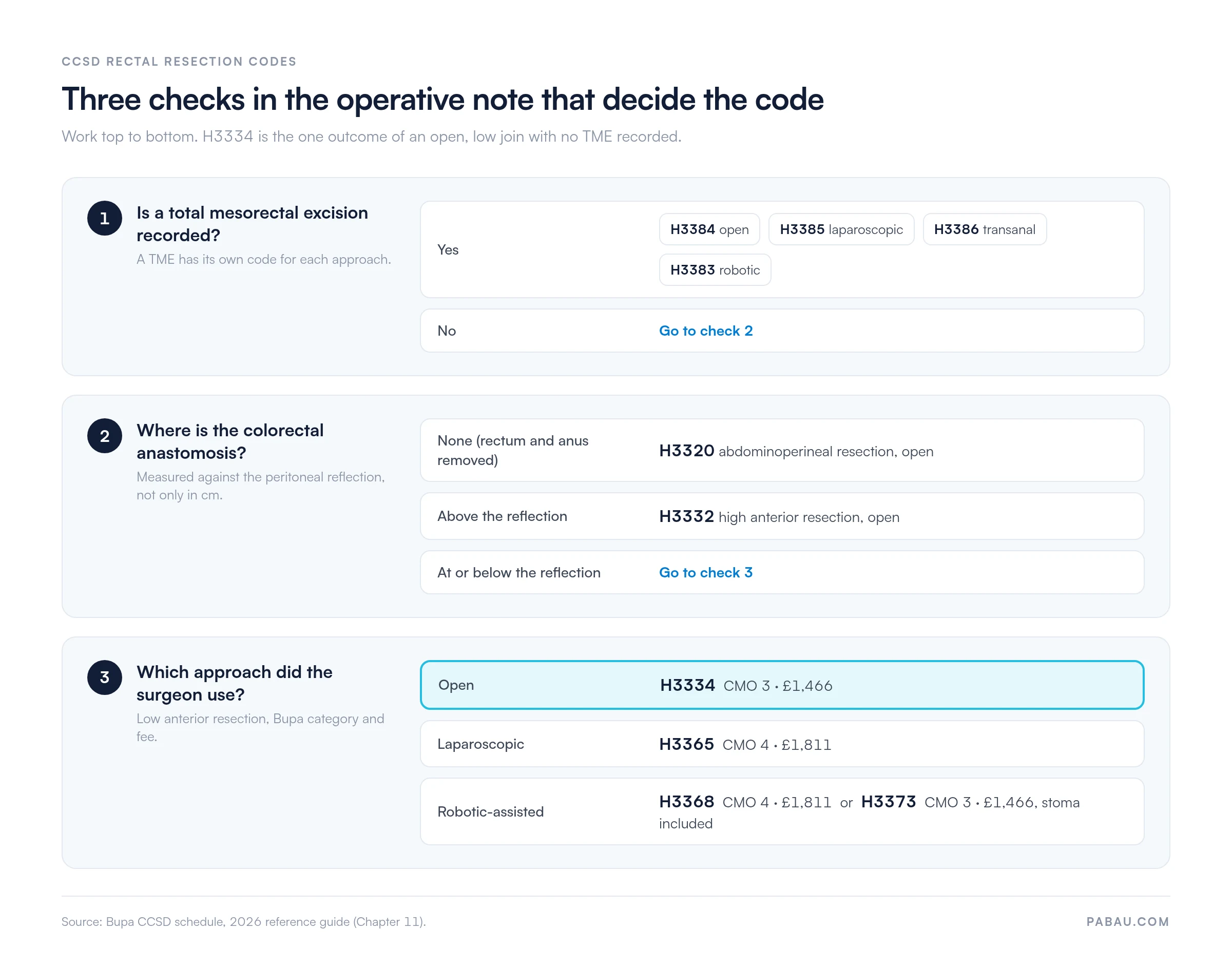
H3334 is the CCSD code for an open low anterior resection. The diseased rectum is removed, and the colon is joined to the rectal stump at or below the peritoneal reflection.
Laparoscopic (H3365) and robotic-assisted (H3368 or H3373) low anterior resections have their own codes. A high anterior resection, with the join above the reflection, is H3332. Total mesorectal excision has separate codes, H3383 to H3386.
Let Pabau's smart automation suggest the right codes, reduce claim denials, and keep your practice compliant—effortlessly.
Automate repetitive tasks and focus on what matters most—your patients.
Reduce coding errors and ensure compliance with the latest regulations.
Clean claims, fewer denials, and faster reimbursements.
Powerful insights and reporting to help your practice thrive.
HIPAA compliant SOC 2 certified GDPR-compliant Trusted by 4,000+ clinics worldwide

CCSD code H3334 covers an open low anterior resection, with the colorectal anastomosis at or below the peritoneal reflection. A join above the reflection is a high anterior resection, H3332.
The code changes with the surgical approach. A laparoscopic low anterior resection is H3365, a robotic-assisted one is H3368 or H3373, and the Bupa fee changes too.
Total mesorectal excision (TME) is not bundled into H3334. It has its own codes: H3384 open, H3385 laparoscopic, H3386 transanal and H3383 robotic-assisted.
The most common denial reason is a missing anastomosis level in the operative note. State ‘colorectal anastomosis at or below the peritoneal reflection’ explicitly.
Pabau, our practice management software, keeps the CCSD code, diagnosis and authorisation number on one claim record. It then sends the claim to UK insurers through Healthcode.
CCSD Code H3334 covers an open anterior resection of the rectum in which the colorectal anastomosis is formed at or below the peritoneal reflection.
The Clinical Coding & Schedule Development (CCSD) schedule lists it in Chapter 11 (Abdomen), under Rectum / Anus. Bupa places it in complexity band CMO 3.
Two facts decide whether H3334 is the right code: the level of the anastomosis and the surgical approach. A join above the reflection is a high anterior resection, H3332. Laparoscopic and robotic low resections have codes of their own, and so does total mesorectal excision. Our CCSD guides for surgeons cover other Chapter 11 procedures, from colectomy to ileostomy.
In clinical practice, H3334 is most often performed for mid- and low-rectal cancer. Other indications include complicated sigmoid diverticular disease and large benign rectal tumours that local excision cannot remove.
The operative note must show a rectal resection with pelvic dissection, a colorectal join at or below the anterior peritoneal fold, and an open approach.
Understanding the operative steps helps coders find, and verify, the language they need in an operation note before submitting an H3334 claim.
UK private medical insurers require a diagnosis code to accompany H3334 at claim submission. The table below lists the main indications with the ICD-10 codes commonly used in UK private practice. Check each code against the current NHS Classifications Browser before submission, as annual updates apply.
For UK private billing, the diagnosis code must match the indication confirmed by histology or imaging before surgery. Insurers cross-reference the diagnosis against the staging investigations in the pre-authorisation record, particularly for rectal cancer.
The peritoneal reflection is where the peritoneum folds from the pelvic wall onto the front of the rectum, forming a recognizable shelf in the pelvis. An anastomosis at or below this fold is a low anterior resection; one above it is a high anterior resection.
The position of the reflection varies with sex, body habitus, and prior pelvic surgery or radiotherapy. The surgeon identifies it under direct vision during the operation, so no fixed distance from the anal verge defines a low join.
A note that cites only the anastomosis height, such as “anastomosis at 6 cm”, gives insurers grounds to query the code level.
Document the peritoneal reflection level explicitly in the operative note, not only the anastomosis height. Write: ‘Colorectal anastomosis formed at [X] cm from the anal verge, at or below the anterior peritoneal reflection.’ This one sentence prevents the most common H3334 query.
H3334 is the open-approach code. The Bupa CCSD schedule gives each approach to a low anterior resection its own code, and the fee can change with it. A laparoscopic or robotic case billed as H3334 is miscoded, even where the fee happens to match.
Figures come from Bupa’s 2026 CCSD schedule, and our Bupa CCSD codes guide explains how it is organised. AXA Health, Aviva and other insurers set their own fees for the same codes.
Bupa lists two robotic codes for a low resection. H3368 describes a robotic-assisted laparoscopic resection, while H3373 describes a robotic-assisted resection with or without a stoma. Check which one the insurer expects, and never add a separate stoma code to H3373.
A laparoscopic or robotic case sometimes converts to open. Record the point of conversion and the reason in the operative note. Then confirm with the insurer whether it wants the open or the minimally invasive code for that claim.
No. The Bupa CCSD schedule lists TME as a procedure in its own right, with a code for each approach. They are H3384 open, H3385 laparoscopic, H3386 transanal and H3383 robotic-assisted. The schedule does not bundle TME into H3334.
TME is the standard operation for mid- and low-rectal cancer, as set out by the Association of Coloproctology of Great Britain and Ireland (ACPGBI). So a rectal cancer resection may fit a TME code better than an anterior resection code.
Billing a TME code and an anterior resection code for one operation invites an unbundling query. Bill one primary code unless the insurer confirms in writing that it accepts the pair.
The flow below runs the same three checks in order, with the Bupa category and fee for each low resection code.
Beyond the approach variants, two open-approach codes are easily confused with H3334. The table below compares them. Selecting the wrong level is the second most common denial trigger after poor documentation.
The H3334 vs H3320 distinction also arises when a planned low anterior resection converts to an abdominoperineal resection (APR). This happens when a safe distal margin and anastomosis cannot be achieved, usually because the tumour sits close to the sphincters.
The claim must then reflect the operation performed: H3320 for an open APR, H3322 laparoscopic or H3324 robotic. The operative note must record the decision to convert and the clinical reason.
A few additional procedures are legitimately performed in the same episode as a low anterior resection. Each needs its own supporting documentation in the operative note.
Bundling rules vary by CCSD edition and by insurer. The CCSD technical guide (October 2025) sets out the general unbundling principles.
Confirm the co-billing position with the insurer before submitting, particularly for stoma codes, which some insurers treat as included in the resection fee. For a laparoscopic loop ileostomy, our G7403 guide covers the stoma side of the claim.
The operative note is the primary clinical record behind an H3334 claim. When insurers query an H3334 claim, they usually point to the same few details missing from the note. Structured digital templates for the operative note make it harder to skip a mandatory element.
Every H3334 operative note must include the following:
Most UK private medical insurers treat low anterior resection as a major elective colorectal procedure that needs pre-authorisation before the patient is listed. Surgeons moving into private practice from the NHS often underestimate this step, particularly for cancer cases that need staging information upfront.
The pathway typically follows these steps, though requirements vary by insurer. Always check directly with the relevant insurer before proceeding.
Claim denials for H3334 follow predictable patterns. The table below maps the most common denial reasons to prevention steps for billing teams and surgical secretaries.
Systematic claim tracking through private practice billing software cuts the time spent chasing denials. It also creates an audit trail that supports resubmission with the right documents.
Review every H3334 denial within 5 working days of receipt. The usual fix is to resubmit with the peritoneal reflection statement or the correct approach code from the operative note. Resubmission deadlines vary by insurer, so do not let a denial sit.
Many colorectal practices still track claims across operation notes, spreadsheets and insurer portals. Each handoff is a chance to lose the authorisation number or key in the wrong approach code.
Pabau’s billing software keeps the CCSD code, the ICD-10 diagnosis and the authorisation number on one claim record. You submit the claim through Healthcode and track its status in the same place. Pabau does not choose the code, so the approach and TME checks above still apply.

Pabau helps colorectal surgery teams track pre-authorisation, capture structured operative notes and monitor claims across UK private medical insurers.

H3334 fits one operation only: an open low anterior resection with the join at or below the peritoneal reflection. Change the approach and the code changes with it. Record a total mesorectal excision and the TME codes come into play.
The code is effectively chosen in the operating room, when the surgeon writes the note. A note that states the anastomosis level, the approach and any TME lets the billing team pick the code with confidence.
Check those three facts before each claim leaves the practice. To see how Pabau keeps the code, diagnosis and authorisation number on one claim, book a demo.

Reversing a Hartmann’s procedure instead? CCSD code H3390 covers restoring bowel continuity after an earlier Hartmann’s operation.
Resecting the sigmoid colon rather than the rectum? CCSD code H1000 walks through sigmoid colectomy billing and its robotic counterpart.
Checking what Bupa pays for other colorectal codes? The Bupa procedure codes and fee schedule guide links each code to its published fee so you can spot shortfalls before you invoice.
Choosing software to bill UK insurers? Our roundup of the best medical billing software in the UK compares tools for insurer claims, invoicing and payment tracking.
CCSD Code H3334 covers an open anterior resection of the rectum with the colorectal anastomosis at or below the peritoneal reflection. The operation removes the diseased rectum and restores bowel continuity with a low colorectal join. Laparoscopic and robotic cases have their own codes. Operations without an anastomosis, such as abdominoperineal resection (H3320), are coded separately.
H3332 covers a high anterior resection, where the colorectal anastomosis is formed above the peritoneal reflection. H3334 covers a low anterior resection, where the anastomosis is at or below it. Both are open-approach codes. The operative note must state the anastomosis level relative to the peritoneal reflection, not only its height above the anal verge.
No. H3334 is the open-approach code. A laparoscopic low anterior resection is H3365, and a robotic-assisted one is H3368 or H3373. In the Bupa schedule, H3365 and H3368 pay £1,811, against £1,466 for H3334. Record the approach in the operative note, because it decides the code.
TME is not bundled into H3334. It has its own codes: H3384 open, H3385 laparoscopic, H3386 transanal and H3383 robotic-assisted. When the note records a TME, check whether the matching TME code describes the operation better than the resection code. Bill both together only if the insurer confirms it accepts the pair.
Often, yes. A defunctioning loop ileostomy is a separate procedure with its own Chapter 11 codes, such as G7402 (open formation of ileostomy) or G7403 (laparoscopic ileostomy). Some insurers treat the stoma as included in the resection fee, so confirm the position before submission. Never add a stoma code to H3373, whose descriptor already includes a stoma.
The claim must reflect the procedure performed. If a safe anastomosis cannot be achieved and the surgeon converts to an abdominoperineal resection, the code changes to H3320 for an open operation. The laparoscopic and robotic equivalents are H3322 and H3324. The operative note must record the decision to convert and the clinical reason.
The most common reason is an operative note that does not place the anastomosis at or below the peritoneal reflection. Other causes are a laparoscopic or robotic case billed under the open code, or a TME code billed alongside the resection. A missing authorisation number or an unconfirmed stoma code also triggers denials. A structured pre-submission checklist prevents each of these.



