HCPCS Code E0272: Foam rubber mattress billing guide
HCPCS Code E0272: official descriptor and code overview HCPCS Code E0272 is the ...

Last Updated: Nov 6, 2026
H3320 is the CCSD code for abdominoperineal resection of rectum and anus. It covers the open operation that removes the rectum, anal canal and sphincters through abdominal and perineal incisions, leaving a permanent end colostomy.
H3320 sits in CCSD sub-chapter 11.6 Rectum/anus. Laparoscopic APR is coded H3322 and robotic-assisted APR is coded H3324. UK private medical insurers such as Bupa, AXA Health, Aviva and Vitality use CCSD codes, with claims usually sent through Healthcode.
Let Pabau's smart automation suggest the right codes, reduce claim denials, and keep your practice compliant—effortlessly.
Automate repetitive tasks and focus on what matters most—your patients.
Reduce coding errors and ensure compliance with the latest regulations.
Clean claims, fewer denials, and faster reimbursements.
Powerful insights and reporting to help your practice thrive.
HIPAA compliant SOC 2 certified GDPR-compliant Trusted by 4,000+ clinics worldwide

CCSD code H3320 covers open abdominoperineal resection of the rectum and anus, which removes the anal sphincter and leaves a permanent end colostomy.
The operative approach decides the code: laparoscopic APR is H3322 and robotic-assisted APR is H3324, so H3320 is for the open operation only.
Sphincter-preserving anterior resections have their own codes: H3332 and H3334 (open), H3364 and H3365 (laparoscopic), and H3370, H3373 or the H3367/H3368 pair (robotic).
CCSD lists H3310, H3322, H3332 and H3334 among the unacceptable combinations with H3320, so they are never billed together for one operation.
Pabau, the practice management platform we build, sends insurer claims through Healthcode and tracks each one using the details already on the patient record.
CCSD code H3320 is the UK private-insurance procedure code for open abdominoperineal resection of the rectum and anus. The operation removes the rectum, the anal canal and the anal sphincters in one combined procedure. Because the anus is excised, bowel continuity cannot be restored, and the patient leaves theatre with a permanent end colostomy.
The code belongs to the Clinical Coding and Schedule Development (CCSD) schedule, which UK private medical insurers use to identify procedures. Bupa, AXA Health, Aviva and Vitality all work from it, and practices usually submit claims through Healthcode. H3320 sits in CCSD sub-chapter 11.6 Rectum/anus. Guides to other codes in the schedule sit in our CCSD procedure codes index.
The procedure is also known as APR or the Miles operation, after William Ernest Miles, who described the combined abdominal and perineal approach in 1908. H3320 applies only when the whole operation is performed open. Laparoscopic and robotic-assisted versions have codes of their own.
APR is a two-phase operation, performed in sequence by one surgeon or at the same time by two teams. Coders need to recognise both phases in the operative note to support an H3320 claim.
Surgeons choose APR when the sphincter cannot be kept without compromising the operation. The main indications are:
The indication should appear in the operative note and match the ICD-10 code on the claim. The diagnosis section below lists the usual pairings.
Knowing what H3320 covers prevents under-billing and unbundling. The table sets out the main components and where each one sits.
CCSD splits abdominoperineal surgery by approach and by what happens to the anus. Picking the wrong sibling is the most common way an H3320 claim goes back to the practice.
If a laparoscopic APR is converted to open, record the conversion and the stage at which it happened. Then check the CCSD coding principles and the insurer’s policy before choosing between H3322 and H3320. Where the abdominal phase stays laparoscopic, H3322 is the code to bill.
The CCSD schedule also keeps one non-resection code off an H3320 claim. H4430, examination of rectum under anaesthetic, applies only when the examination is the sole procedure. Its entry names H3320 as an unacceptable combination, so an examination under anaesthetic drops off the APR claim.
The deciding question for any rectal resection is whether the anal sphincter survives. An anterior resection keeps it and joins the colon to the rectum, while H3320 removes it. CCSD codes anterior resections by approach and by the level of the join.
Where the sphincter is preserved, the level of the join decides the laparoscopic code. H3364 covers a laparoscopic high anterior resection, with the colorectal anastomosis above the peritoneal reflection. H3365 applies once that join sits at or below it. The open codes divide at the same point. H3332 is the open high anterior resection, and H3334 applies once the join sits at or below the peritoneal reflection.
CCSD lists H3332 and H3334 among the unacceptable combinations with H3320. If the operative note describes a colorectal or colo-anal anastomosis, the sphincter was kept and H3320 does not apply. If it confirms perineal dissection and a permanent end colostomy, H3320 is correct for an open operation.
The grid below puts the two deciding facts together. Read the sphincter outcome first, then the approach, and the code follows.
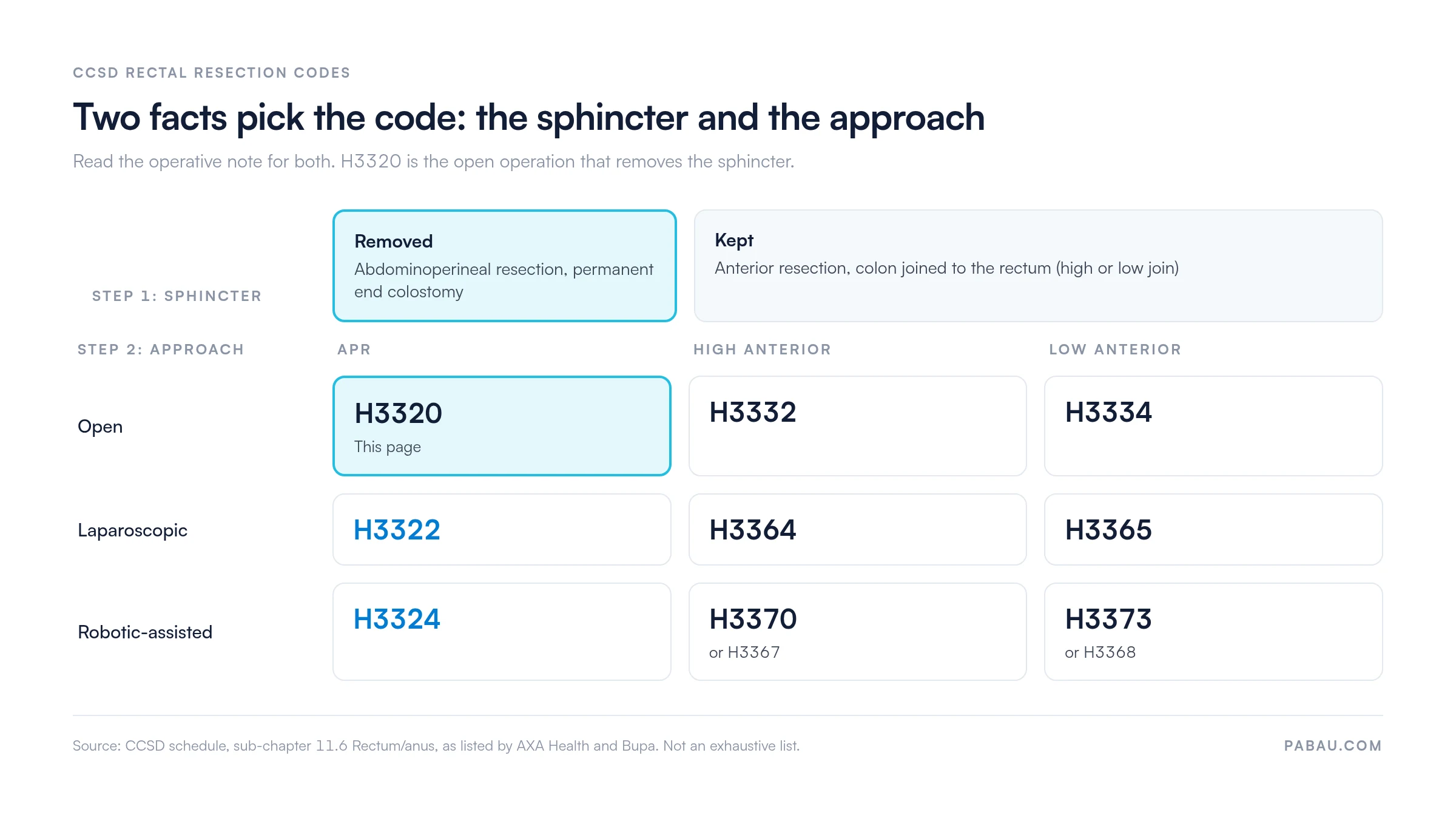
Code from the operative note, not from the theatre list. A list entry of AR or APR does not tell you the approach or whether the sphincter was removed. Those two facts decide between at least eight rectal resection codes.
UK insurers expect a diagnosis code that matches the documented operative findings. UK practice uses the WHO ICD-10 classification, and these are the codes most often paired with H3320.
The diagnosis code should reflect the operative and histology findings, not only the pre-operative diagnosis. If histology reclassifies the tumour, for example from C20 to C21.1, an amended claim with the corrected ICD-10 code may be needed.
UK private medical insurers generally expect the patient to obtain pre-authorisation before planned surgery such as APR. The authorisation number should appear on the claim, and it should name the same procedure the surgeon performed.
If the plan changes, for example from a laparoscopic to an open approach, tell the insurer. An authorisation issued for H3322 does not automatically cover a claim coded H3320. Each insurer sets its own rules, so confirm them before the operation date.
Insurers review major colorectal claims closely. The operative note should confirm the following to support H3320:
APR claims draw more questions than most colorectal codes because the clinical and administrative records have to agree. The most frequent causes are:
Surgical practices billing H3320 tend to lose time in the same places: authorisation numbers kept in emails, invoices typed twice, and claims nobody follows up. Pabau keeps the patient, the insurer details and the invoice on one record.
From that record, Pabau’s claims management software builds the claim from the details already on file and sends it through Healthcode. Your team then tracks each claim’s status in one place. Pabau does not choose the CCSD or ICD-10 codes, so the coder’s decision stays with the coder.
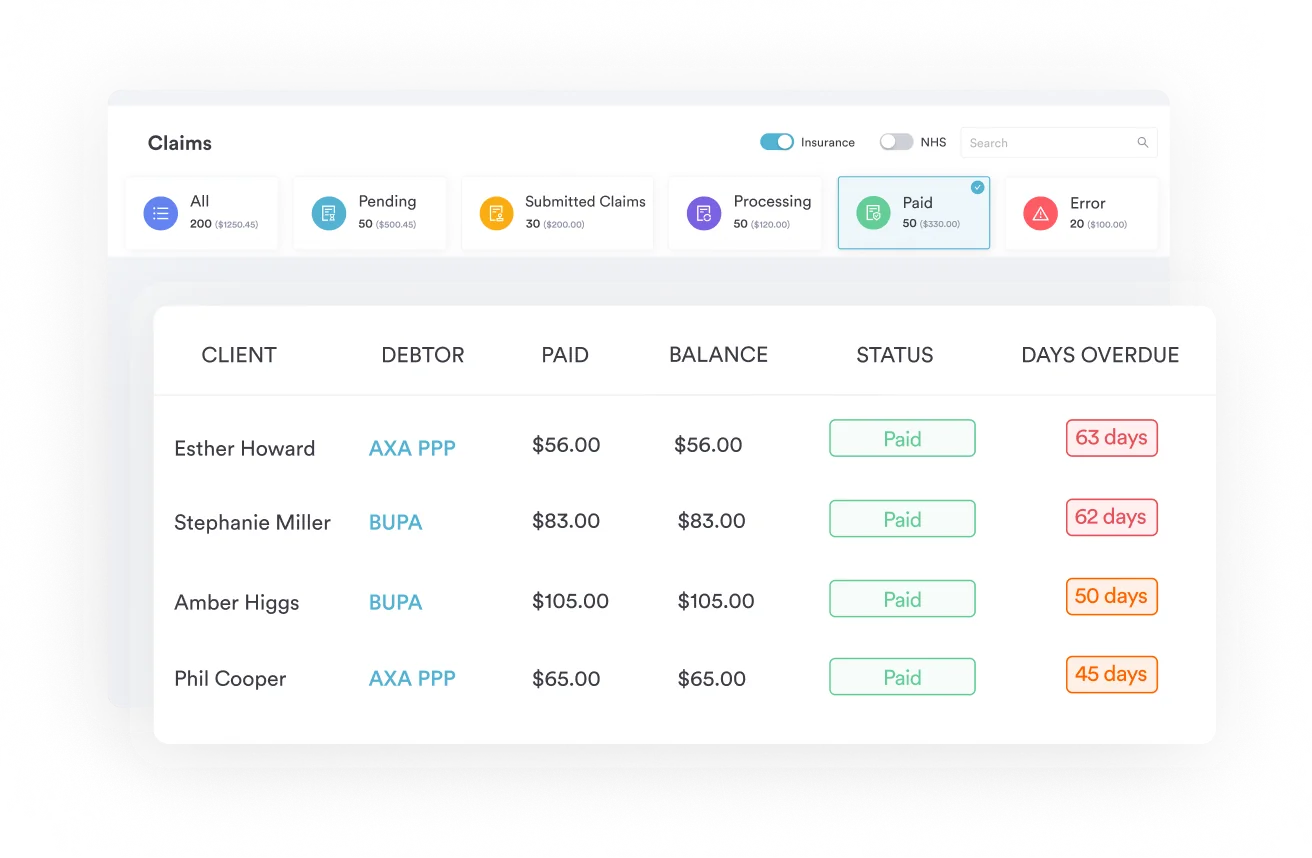
The outcome is fewer claims stuck in a spreadsheet and a clear view of which insurer owes a response. For the wider picture of how insurers apply the schedule, see the Bupa CCSD codes guide.

Pabau builds each claim from the patient, insurer and invoice details already on file. It sends the claim through Healthcode and tracks it until it is settled.

H3320 is a narrow code: open abdominoperineal resection, sphincters removed, permanent end colostomy. Every other rectal resection, whether laparoscopic, robotic or sphincter-preserving, has its own CCSD code. The operative note is what proves which one applies.
Code from the note, authorise the exact procedure and match the ICD-10 code to the tumour site. Those three habits remove the most common reasons for a query. To see how Pabau keeps CCSD claims moving through Healthcode, book a demo.

Need a broader view of CCSD procedure codes? Bupa CCSD codes explains how the CCSD schedule is structured and how UK insurers apply it.
Coding another Chapter 11 abdominal operation? CCSD code G5000 covers open excision of a duodenal lesion and how it differs from the endoscopic code.
Want fewer insurer queries on surgical claims? Claims management software shows how Pabau submits and tracks claims through Healthcode.
CCSD code H3320 covers open abdominoperineal resection of the rectum and anus. The operation removes the rectum, anal canal and sphincters through abdominal and perineal incisions. It leaves the patient with a permanent end colostomy.
An anterior resection preserves the anal sphincter and joins the bowel back together, while H3320 removes the sphincter for good. Open anterior resections use H3332 or H3334. Laparoscopic ones use H3364 or H3365, and robotic ones use H3370, H3373 or the H3367/H3368 pair.
A laparoscopic abdominoperineal resection is coded H3322, and a robotic-assisted one is coded H3324. H3320 is reserved for the open operation. The operative note should state the approach so the insurer can match it to the code.
No. CCSD lists H3310, H3322, H3332 and H3334 among the unacceptable combinations with H3320. Each describes a different way of removing the rectum, so only one of them fits a single operation.
UK private medical insurers that use the CCSD schedule accept H3320, including Bupa, AXA Health, Aviva and Vitality. Practices usually submit these claims electronically through Healthcode. Each insurer sets its own fees and pre-authorisation rules.
The usual triggers are a missing pre-authorisation number or a code that does not match the documented approach. An operative note that never confirms sphincter removal is another. An ICD-10 code that does not match the tumour site causes queries too.