HCPCS Code G0278: Iliac and femoral angiography billing guide
What is HCPCS Code G0278? HCPCS Code G0278 is the add-on code for non-selective ...

Last Updated: Nov 2, 2026
H3580 is the CCSD code for laparoscopic ventral rectopexy not requiring mesh. It covers keyhole fixation of the rectum to the sacral promontory with sutures alone, used for rectal prolapse, internal rectal prolapse and obstructed defecation syndrome.
The code sits in CCSD chapter 11.6.0 Rectum/Anus. If mesh is implanted, the claim moves to H3582. Robotic-assisted and open rectopexy each carry their own codes.
Let Pabau's smart automation suggest the right codes, reduce claim denials, and keep your practice compliant—effortlessly.
Automate repetitive tasks and focus on what matters most—your patients.
Reduce coding errors and ensure compliance with the latest regulations.
Clean claims, fewer denials, and faster reimbursements.
Powerful insights and reporting to help your practice thrive.
HIPAA compliant SOC 2 certified GDPR-compliant Trusted by 4,000+ clinics worldwide

CCSD code H3580 covers laparoscopic ventral rectopexy without mesh only. The same operation with mesh bills under H3582.
K62.3 (rectal prolapse) is the primary ICD-10 pairing. K59.8 and N81.6 may apply, depending on the clinical presentation.
All major UK private insurers treat laparoscopic rectopexy as elective and require pre-authorization before the procedure.
The operative note must state that no mesh was implanted. Without that statement, insurers often query the claim against H3582.
Pabau, the practice management platform we build, tracks CCSD codes, pre-authorization status and operative note fields for private colorectal practices.
CCSD code H3580 is defined by the Clinical Coding and Schedule Development (CCSD) group as “laparoscopic ventral rectopexy not requiring mesh.” It is the UK private healthcare billing code for the mesh-free laparoscopic approach to rectal fixation. The code sits within CCSD chapter 11.6.0 Rectum/Anus (under 11.0.0 Abdomen, excluding urinary and reproductive organs).
H3580 applies only to the laparoscopic, ventral, mesh-free variant of rectopexy. It does not cover open rectopexy, posterior rectopexy, robotic-assisted rectopexy, or any approach in which mesh is implanted.
CCSD codes are used across the UK private medical insurance (PMI) market by consultants billing Bupa, AXA Health, Aviva, Vitality, WPA, Cigna and Allianz Care. They differ from the NHS HRG/OPCS system, which assigns different procedure codes to the same operation. Surgeons moving from NHS work into private practice need to treat these as separate code sets, with separate documentation and submission rules.
Laparoscopic ventral rectopexy without mesh is a pelvic floor operation that corrects rectal prolapse, internal rectal prolapse or obstructed defecation syndrome (ODS). It is performed under general anesthesia. The surgeon reaches the pelvis through laparoscopic ports and mobilizes the front wall of the rectum from the vagina or prostate. The rectum is then fixed to the sacral promontory with permanent sutures rather than a synthetic mesh implant.
Clinical indications for CCSD code H3580 include full-thickness rectal prolapse (rectal procidentia), symptomatic internal rectal prolapse, and ODS where conservative management has failed. Surgeons choose the mesh-free approach for four common reasons.
Whichever reason applies, document it in the operative note. It supports the choice of H3580 over H3582, and the procedure itself runs in five stages.
The choice between H3580 and H3582 rests on one fact: Whether mesh was implanted during the procedure. H3580 applies when the ventral rectopexy was completed with suture fixation only. H3582 applies when a synthetic mesh was used to reinforce the fixation. Both codes cover the laparoscopic ventral approach, so the operative technique is identical apart from the mesh.
The practical decision rule: Read the operative note before coding. If the note confirms laparoscopic access, ventral dissection, and suture fixation with no mesh implanted, use CCSD code H3580. If the note records mesh placement, use H3582. Robotic-assisted and open cases move to their own pair of codes, as the grid below shows.
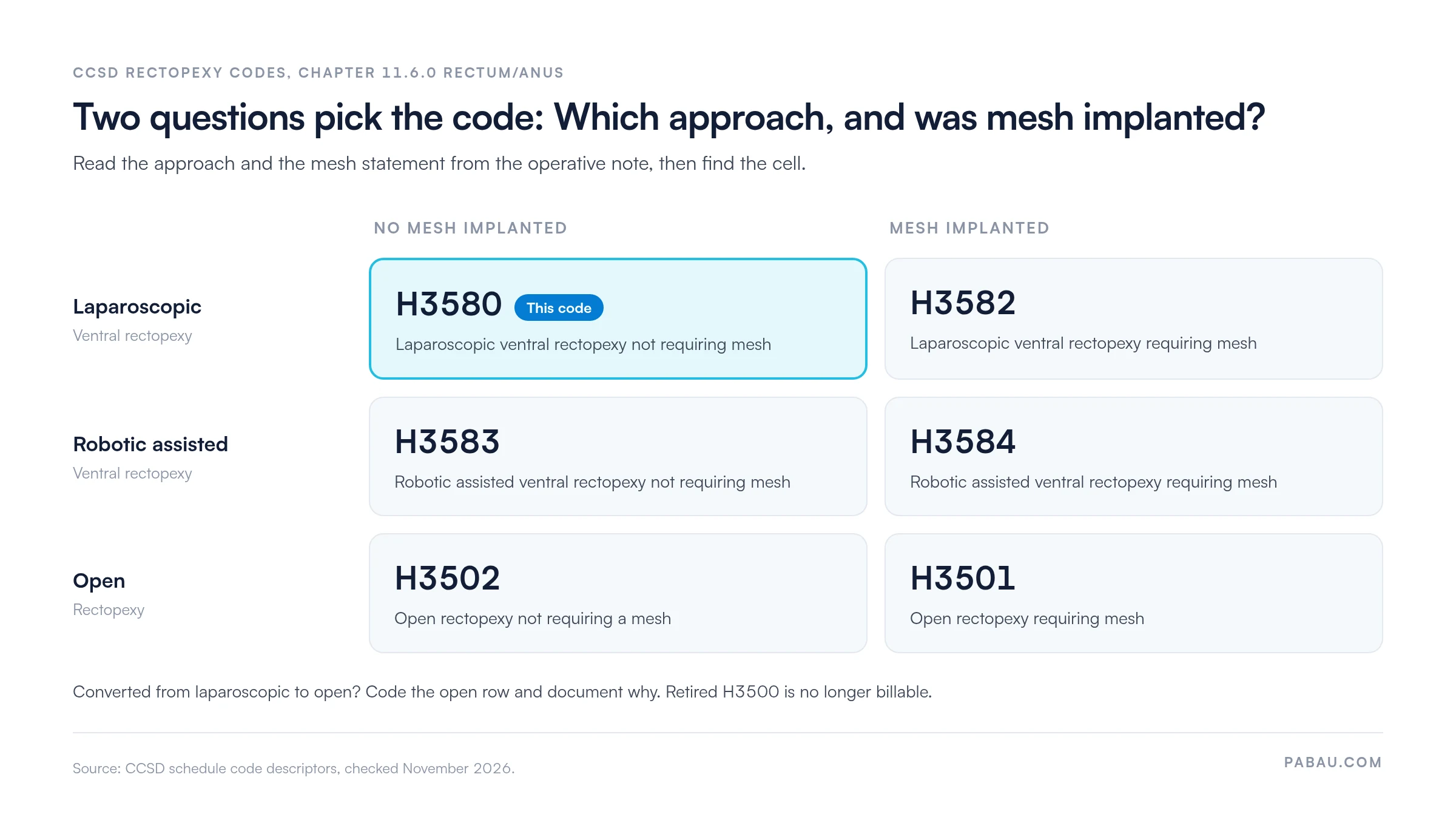
Verify against the current CCSD schedule before you submit, because code descriptors are updated periodically.
Every H3580 claim needs an ICD-10 diagnosis code that justifies the procedure. UK private insurers cross-check the procedure code against the submitted diagnosis to confirm medical necessity. The codes below are clinically valid pairings. Check them against the current ICD-10 edition and each insurer’s approved diagnosis list, because individual payers may restrict which codes they accept.
K62.3 is the most common primary diagnosis for CCSD code H3580 claims. Internal rectal prolapse is coded under K62.3 as well, not under K62.2. Confirm the ICD-10 code matches the clinical findings in the referral letter and pre-operative assessment. A mismatch between the diagnosis code and the clinical letters is a straightforward denial trigger.
All major UK private health insurers class laparoscopic ventral rectopexy as elective colorectal surgery. Pre-authorization (pre-auth) is required before the procedure takes place. A claim submitted without a valid pre-auth reference number is denied outright, however complete the documentation is. Check the Bupa CCSD code schedule and the equivalent guide for each insurer before you submit a pre-auth request.
If surgery goes ahead without pre-authorization, insurers typically decline the claim in full. Some policies allow retrospective authorization for emergency procedures, but laparoscopic rectopexy does not qualify as an emergency. Track pre-auth status for each patient episode, and confirm it before any elective operating date is booked.
Request pre-authorization at least 10 working days before the planned operating date for H3580 procedures. Most UK private insurers require clinical evidence alongside the CCSD code, and turnaround for elective colorectal cases can stretch to two weeks. Build this lead time into your pre-admission process, so authorization is confirmed before the theater list is set.
The operative note is the single most important document for an H3580 claim. Because the code descriptor specifies “not requiring mesh,” the note must state explicitly that no mesh was implanted. Insurers treat a note that describes the procedure correctly but never mentions mesh as ambiguous, and a query about H3582 often follows. A structured operative note template with a mandatory mesh/no-mesh field stops that query before it starts.
A complete H3580 operative note covers seven points.
H3580 claims go through smoothly when the pre-auth is in place and the operative note is complete. Denials cluster around a few recurring causes, each with a clear fix.
Several CCSD codes are often confused with H3580. Their procedure names overlap, or the clinical picture sits on the boundary between two codes. The table below covers the most common neighbors and the differentiator for each.
Older claims and templates may still carry H3500, the former rectopexy code that is no longer in the CCSD schedule. Replace it with the approach-and-mesh code that matches the operative note. Code descriptors and groupings are reviewed periodically by the CCSD group, so verify every code against the current schedule before submission.
Colorectal surgeons performing laparoscopic ventral rectopexy may legitimately bill other CCSD codes on the same episode. Insurers apply bundling rules that restrict what can be submitted alongside H3580, though. Unbundling means splitting a single procedure into several codes to raise the total claim value, and it is a billing compliance risk.
When in doubt, submit the primary code (H3580) and describe the additional procedure separately in the operative note. Explain why it was clinically necessary as a distinct step. Insurers are more likely to accept an extra code when the justification is explicit rather than inferred.
Private colorectal practices billing CCSD code H3580 juggle pre-authorization, coding, operative note capture and claim submission across several insurer portals. Each portal has its own rules and timelines, so every manual handoff is another chance for a query.
Pabau centralizes the admin steps that most often delay H3580 claims. Its claims management workflow lets billing teams attach pre-auth references to patient episodes and flag claims nearing an insurer’s submission deadline. Claim status sits in one view, so nobody has to switch between insurer portals to chase it.
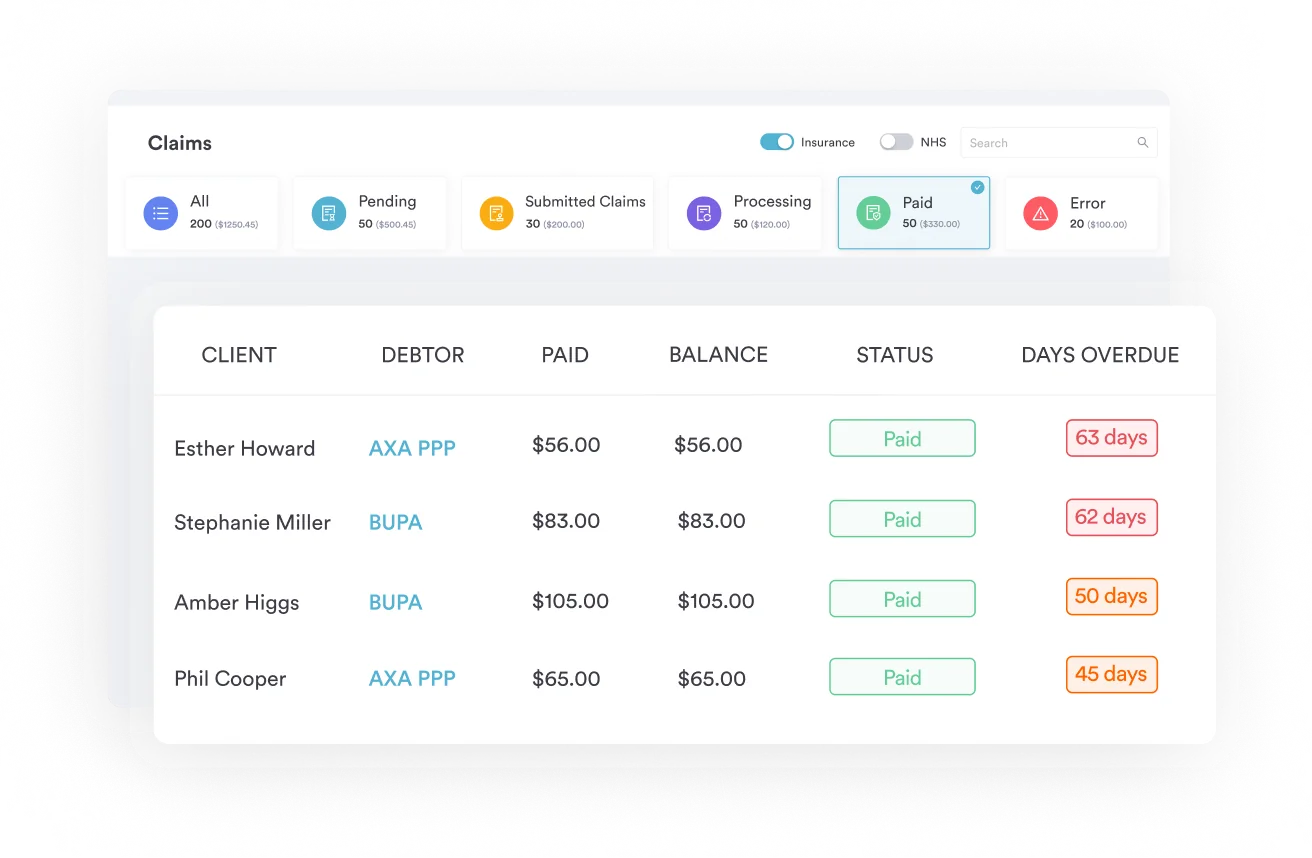

Pabau helps colorectal practice teams track pre-authorization status and code procedures against the CCSD schedule. Structured operative notes meet insurer documentation standards. Fewer queries, faster payment.

CCSD code H3580 stands or falls on a single documented fact: That the ventral rectopexy was performed without mesh. Get that statement into every operative note and the code holds up against insurer scrutiny. Leave it out and the claim gets queried against H3582, which adds weeks to payment.
The fix sits in your templates. Add a mandatory mesh field once and confirm pre-auth before the operating date, and two of the denial causes above stop reaching your queue.
Book a demo to see how Pabau carries an H3580 claim from pre-auth through to payment, with the mesh statement already in the note.

Still seeing H3500 on older rectopexy claims? CCSD code H3500 explains which current code replaces the retired rectopexy code.
Need a complete overview of Bupa’s CCSD billing requirements? Bupa CCSD codes guide covers how Bupa uses the CCSD schedule for procedure and diagnostic code submissions.
Looking up a neighboring procedure? CCSD codes collects Pabau’s CCSD procedure code guides in one place.
Want to reduce claim errors across your colorectal practice? Claims management for private practice outlines how structured billing workflows reduce CCSD code errors and claim delays.
CCSD code H3580 covers laparoscopic ventral rectopexy not requiring mesh. It is the UK private healthcare billing code for keyhole rectal fixation performed without a synthetic mesh implant. It does not cover open or robotic-assisted rectopexy, or any procedure in which mesh was used.
H3580 applies when the laparoscopic ventral rectopexy was completed with suture fixation and no mesh. H3582 applies when mesh was implanted during the same procedure. Both codes cover the laparoscopic ventral approach, so mesh use is the only coding differentiator. The operative note must state it explicitly.
The primary ICD-10 pairing is K62.3 (rectal prolapse). K59.8 (other specified functional intestinal disorders) may apply where obstructed defecation syndrome is the documented indication. N81.6 (rectocele) may be appropriate where posterior vaginal wall involvement is confirmed. Check the current ICD-10 edition and each insurer’s approved diagnosis list before submitting.
Yes. All major UK private health insurers, including Bupa, AXA Health, Aviva, Vitality and WPA, require pre-authorization before elective laparoscopic rectopexy. Claims submitted without a valid pre-auth reference are denied outright. Pre-auth must be confirmed before the operating date, not retrospectively.
Expect an insurer query asking whether H3580 or H3582 applies, because a note that is silent on mesh is treated as ambiguous. Amend the note with an explicit statement such as “no mesh was used,” then resubmit it with the appeal. Going forward, add a mandatory mesh/no-mesh field to every rectopexy operative note template.
Yes. The anesthetist bills their own CCSD general anesthetic code as a separate claim, and this does not count as unbundling on the surgeon’s H3580 submission. Assistant surgeon fees and additional procedure codes need checking against each insurer’s unbundling rules before they go on the same episode claim.