CCSD code H4430: Examination of rectum under anaesthetic
CCSD code H4430 pays for the examination alone CCSD code H4430 is the UK private...

Last Updated: Oct 20, 2026
H1300 is the CCSD code for bypass of colon, a major operation that reroutes the bowel around a blocked or diseased stretch of colon. Surgeons usually choose it when that segment can't be removed safely, so it stays in place.
The code sits in Chapter 11 of the CCSD schedule, under sub-chapter 11.5.0 Large intestine. UK private insurers such as Bupa, AXA Health, Aviva and Vitality use it for the surgeon's fee. CCSD flags several colon codes as unacceptable alongside H1300, including the main resections, and its list may be longer than the ones covered here. The operation note also has to show that the segment stayed in place.
Let Pabau's smart automation suggest the right codes, reduce claim denials, and keep your practice compliant—effortlessly.
Automate repetitive tasks and focus on what matters most—your patients.
Reduce coding errors and ensure compliance with the latest regulations.
Clean claims, fewer denials, and faster reimbursements.
Powerful insights and reporting to help your practice thrive.
HIPAA compliant SOC 2 certified GDPR-compliant Trusted by 4,000+ clinics worldwide

CCSD code H1300 is bypass of colon, a major large-intestine operation in Chapter 11, sub-chapter 11.5.0 of the schedule.
Use it when the surgeon reroutes bowel around a colon segment and leaves that segment in place.
CCSD flags several colon codes as unacceptable with H1300, including the main resections and H1200 lesion excision.
The operation note has to describe a bypass, not a resection, or the insurer is likely to query the code.
If the plan changes during surgery, update the pre-authorization to H1300 before you submit the invoice.
CCSD code H1300 is the schedule entry for bypass of colon. The surgeon joins healthy bowel above a problem segment to healthy bowel below it. Stool then travels around that segment, which stays in the abdomen.
Surgeons usually choose a bypass when removing the segment isn’t safe or possible. A typical case is an obstructing tumor fixed to nearby structures. The bypass relieves the blockage without a major resection.
That detail drives the coding. If the segment comes out, a resection code fits instead. If the surgeon brings the colon out as a stoma rather than rejoining it, look at the colostomy codes, such as H1590.
The CCSD (Clinical Coding and Schedule Development) Group maintains the code set. Aviva, AXA Health, Bupa and Vitality all use it, and many smaller UK insurers follow. The group sets codes and descriptors, not fees. For more entries, browse our CCSD codes library.
H1300 lives in Chapter 11, Abdomen (excluding urinary and reproductive organs). Within it, sub-chapter 11.5.0 covers the large intestine. Its neighbors describe other colon operations, so a quick comparison keeps you on the right line.
Complexity bands differ by insurer. Bupa’s February 2026 schedule places H1300 in its MAJOR 4 band, and Freedom Health Insurance lists it as Major. Our Bupa CCSD codes guide explains how those bands work, but always confirm the fee in your insurer’s own schedule.
CCSD flags a set of colon codes as unacceptable combinations with H1300, including the main resections and lesion excisions. Most describe surgery that already removes or rejoins the same bowel.
Billing both would usually count one operation twice, and the chart below shows the main pairings we’ve verified.
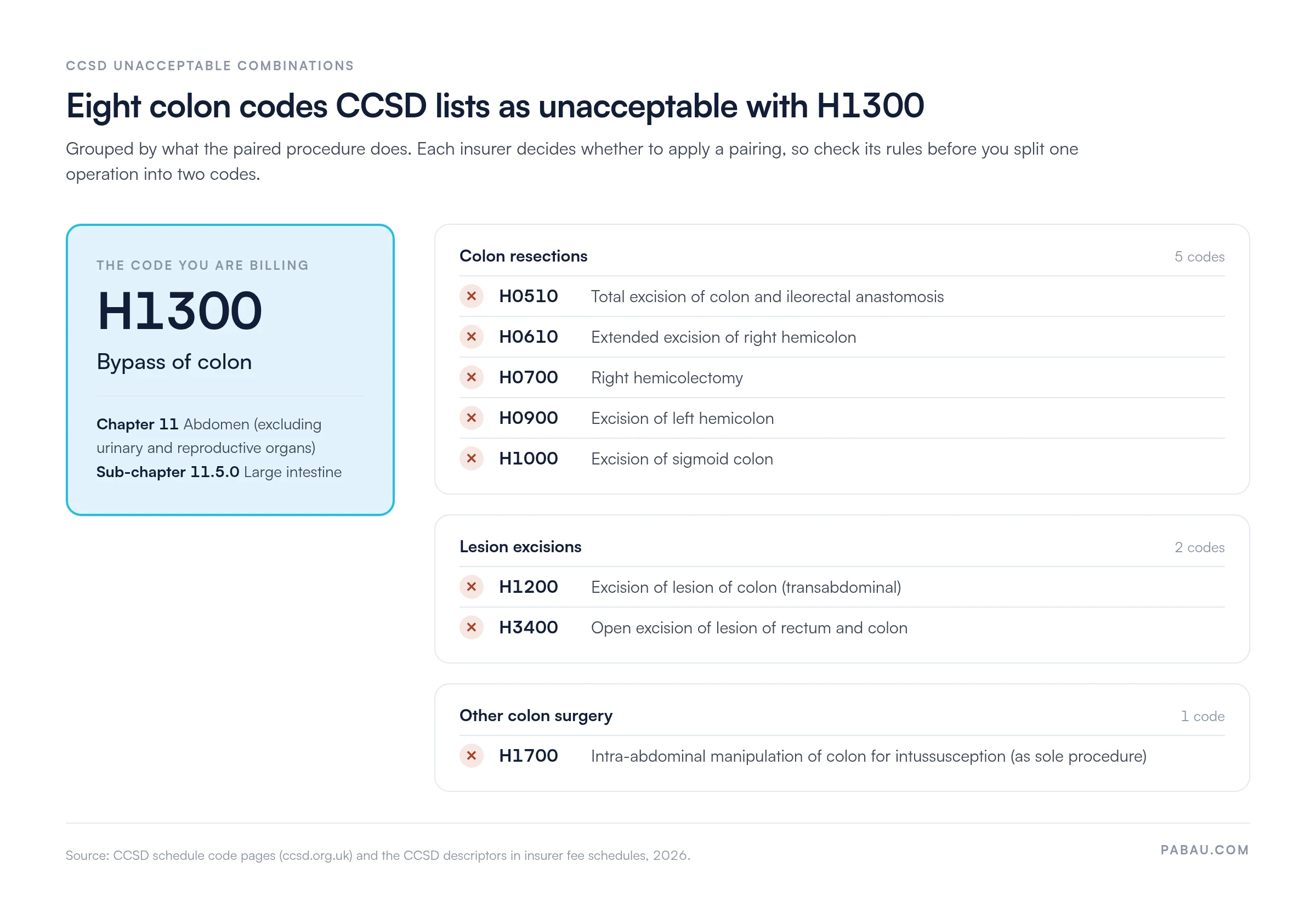
The list is guidance rather than law. CCSD calls its coding principles non-exhaustive, and each insurer decides which combinations to enforce. Its list for H1300 may also be longer than the chart, so check the current H1300 page on the CCSD site before you submit. Still, expect a query if one of these codes shares a claim with H1300.
Sometimes a surgeon does perform two separate procedures in one session. In that case, document why each was needed. Then call the insurer before you submit, and note the call reference in the patient file.
For major colon surgery, the insurer leans on the operation note first. It should leave no doubt that a bypass took place. Here’s what a clean note contains.
Keep the signed consent form, the pre-authorization reference and the discharge summary with the note. Together, they answer most insurer queries without a second letter from the surgeon.
Ask the surgeon to add one line explaining why the segment wasn’t resected. That sentence heads off the obvious question of why the claim carries no resection code.
Healthcode is the UK clearinghouse that most private insurers accept for electronic bills. Here’s how a typical H1300 claim travels from booking to payment.
The hospital and the anesthetist usually bill the insurer separately for the same episode. So the surgeon’s invoice covers the surgeon’s fee only.
Most H1300 queries trace back to a mismatch between the paperwork and the operation. The table pairs each common problem with its fix.
Run this check on every H1300 invoice. It takes a couple of minutes and catches the problems in the table above.
Most H1300 errors come from reading the word bypass too loosely. Three patterns are worth watching.
A right hemicolectomy rejoins the ileum to the transverse colon. In a hurried note, that join can look like a bypass. However, the segment was removed, so H0700 applies rather than H1300.
H1300 covers the colon only. A jejunal bypass belongs under CCSD code G6100, and an ileal bypass under CCSD code G7100.
A defunctioning colostomy diverts stool, but it doesn’t rejoin bowel inside the abdomen. For that operation, check the colostomy codes, such as H1590 or the laparoscopic H1581.
A surgeon plans a sigmoid colectomy, CCSD code H1000, for an obstructing tumor. During surgery, she finds the tumor fixed to the pelvic wall. Removal isn’t safe, so she joins bowel above the tumor to bowel below it.
The authorization still says H1000, yet the note describes a bypass. So the practice calls the insurer, updates the authorization to H1300 and bills H1300 alone.
Colon surgery claims pass through several hands. The surgeon writes the note, a secretary chases authorization, and someone else builds the invoice. Each handoff is a chance for the code and the paperwork to drift apart.
Pabau keeps those steps in one patient record. The authorization reference sits with the booking, and the operation note and consent live in the same file. When the invoice is ready, Pabau’s claims management software submits it to Healthcode without retyping membership details.
Claim status then flows back into the record, so your team sees a query the day it lands. Payments reconcile against the invoice, which keeps the surgeon’s ledger accurate.

Pabau keeps authorization references, operation notes and CCSD-coded invoices in one patient record, then submits claims through Healthcode. Fewer retyped details mean fewer queries on major surgery claims.

H1300 is a narrow code with a clear test. If the bowel was rerouted and the diseased segment stayed, bypass of colon is the right line. If the surgeon removed any colon, a resection or excision code will almost always fit better.
Most H1300 trouble starts when the plan changes during surgery. So update the authorization early, keep the note specific, and leave unacceptable pairs off the claim. Book a demo to see how Pabau keeps CCSD claims and their paperwork together for surgical practices.

Billing rectal surgery too? CCSD code H3320 covers abdominoperineal resection of rectum and anus, with its own documentation checks.
Need the upper-gut equivalent? CCSD code G5100 explains how bypass of duodenum is coded and billed.
Coding an abscess drainage after colon surgery? CCSD code H0310 covers drainage of an appendix or intra-abdominal abscess.
No. A colon bypass rejoins bowel inside the abdomen, so stool still passes normally. A colostomy brings the colon out to a stoma on the skin. CCSD codes colostomy formation separately, under H1590 for open surgery and H1581 for laparoscopic surgery.
Each insurer sets its own fee. The CCSD Group maintains codes and descriptors, but it doesn’t decide fees. For example, Bupa’s February 2026 schedule places H1300 in its MAJOR 4 band.
Not strictly. CCSD describes its coding principles as guidance, and each insurer chooses which combinations to apply. Even so, a listed pair on one claim often draws a query, so justify it in writing first.
Bill the procedure performed. Tell the insurer as soon as possible and ask it to update the authorization to H1300. Then keep the operation note that explains why the segment stayed in place.
Chapter 11 has a bypass code for most sections of the gut. G0500 covers the esophagus, G5100 the duodenum, G6100 the jejunum and G7100 the ileum. H1300 is the entry for the colon.