CCSD code H4430: Examination of rectum under anaesthetic
CCSD code H4430 pays for the examination alone CCSD code H4430 is the UK private...

Last Updated: Oct 20, 2026
H1200 is the CCSD code for excision of lesion of colon (transabdominal). The surgeon reaches the colon through the abdominal wall and removes a lesion from it, rather than snaring it through a colonoscope. UK private medical insurers use the code to pay the surgeon for that operation.
H1200 sits in sub-chapter 11.5.0 Large Intestine of the CCSD schedule, beside the hemicolectomy and sigmoid excision codes. CCSD lists those resections, and the snare excision codes H2003 and H2503, as unacceptable combinations. So the extent of the operation decides which single code goes on the claim.
Let Pabau's smart automation suggest the right codes, reduce claim denials, and keep your practice compliant—effortlessly.
Automate repetitive tasks and focus on what matters most—your patients.
Reduce coding errors and ensure compliance with the latest regulations.
Clean claims, fewer denials, and faster reimbursements.
Powerful insights and reporting to help your practice thrive.
HIPAA compliant SOC 2 certified GDPR-compliant Trusted by 4,000+ clinics worldwide

CCSD code H1200 is excision of lesion of colon (transabdominal), filed under sub-chapter 11.5.0 Large Intestine.
It fits when the surgeon removes a colon lesion through the abdomen, not with a snare through a colonoscope.
Colon resections, colon bypass and the snare excision codes H2003 and H2503 can’t share a claim with H1200.
AXA Health grades H1200 as Major in its published code list, but each insurer sets its own fee.
The operative note should record the approach, the lesion’s site and size, what was removed and the histology.
CCSD code H1200 covers excision of lesion of colon (transabdominal). The surgeon reaches the colon through the abdominal wall and cuts out a lesion. That sets it apart from a snare excision at colonoscopy, which goes on the claim as CCSD code H2003.
The code belongs to the schedule kept by the Clinical Coding and Schedule Development (CCSD) Group. UK private medical insurers use its codes to identify the procedure on a claim. Our guide to CCSD procedure codes explains how the wider schedule works.
H1200 sits in sub-chapter 11.5.0 Large Intestine. Its neighbors there include H0700 right hemicolectomy, H0900 excision of left hemicolon and CCSD code H1000, excision of sigmoid colon. Those codes take out a section of bowel. H1200 describes removing the lesion itself.
Fees are a separate matter. The CCSD Group writes the codes and their wording, while each insurer decides what it pays. AXA Health, for one, grades H1200 as Major in its published list.
H1200 describes one operation: reaching the colon through the abdomen and excising a lesion from it. Trouble starts when the operation becomes something else. Here is how the common scenarios code.
If the plan changes mid-operation, code what the surgeon did, not what was booked. Then tell the insurer, because its authorization was issued for H1200.
Most H1200 operations are booked ahead, which gives the practice time to get each step right. A typical private case follows this path.
Queries land at the last step, but their cause sits earlier. Two early slips are common culprits. One is an authorization issued for the wrong code, and the other is a scope code added to the claim.
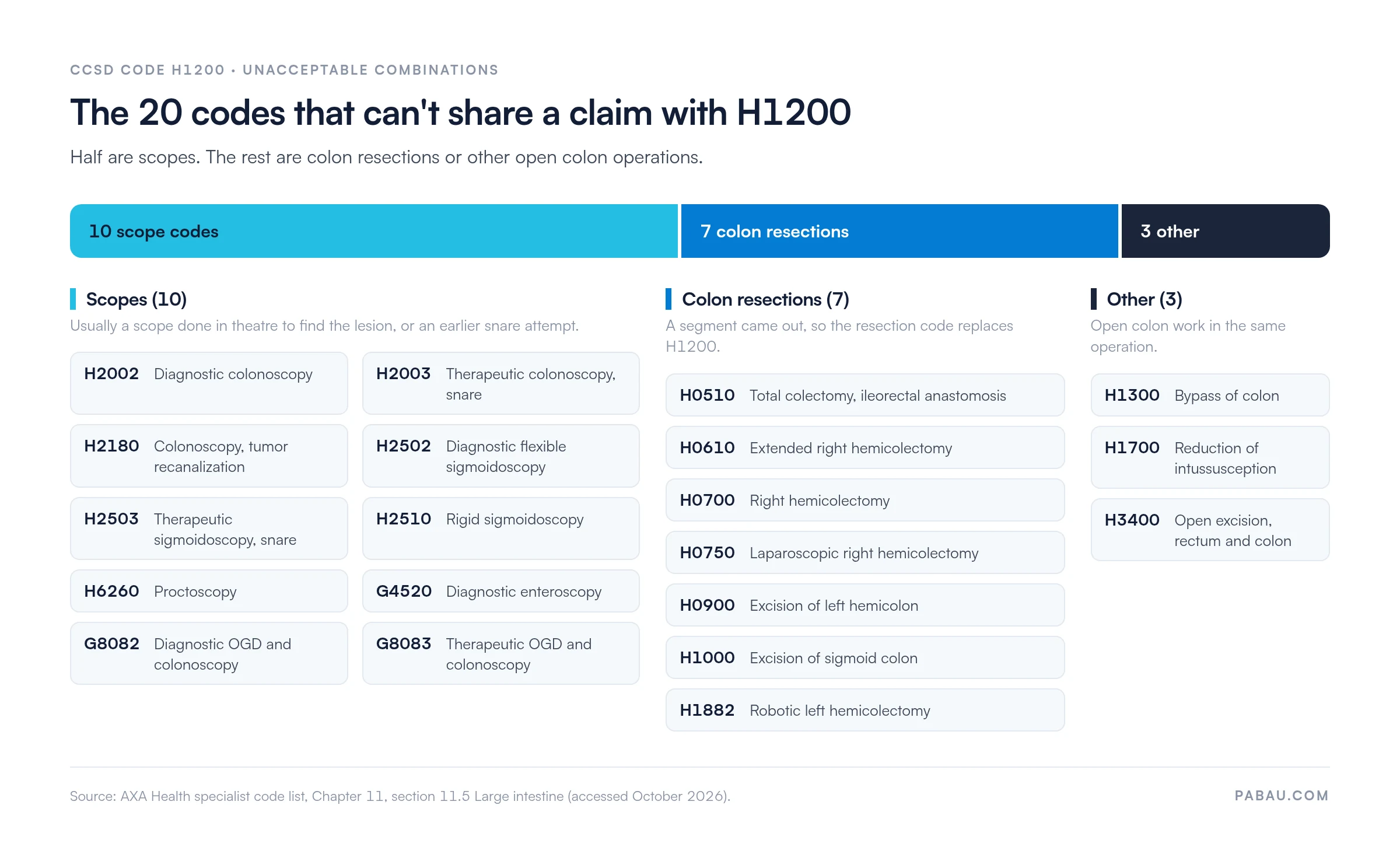
CCSD lists unacceptable combinations for each code. These are pairs an insurer won’t pay together, because one already covers the other. AXA Health’s published Chapter 11 code list reproduces the H1200 list, which runs to 20 codes.
These are the ones most likely to come up around a colon lesion.
The rest of the list covers proctoscopy, sigmoidoscopy, enteroscopy, combined OGD and colonoscopy, and other colon resections. Each insurer decides which pairs it enforces, so check its schedule before you add a second code.
The chart below sorts all 20 codes by the kind of operation they describe.
A 64-year-old man has a large polyp in the transverse colon. At colonoscopy, the endoscopist judges it unsafe to snare and takes biopsies instead. Six weeks later, a colorectal surgeon excises the lesion through the abdomen.
The surgical claim carries H1200. The earlier colonoscopy was a separate episode with its own claim, so it stands on its own. Had both happened in one theatre session, the colonoscopy code couldn’t ride alongside H1200.
Now say histology shows early cancer, and the surgeon later performs a right hemicolectomy. That is a new operation. It goes in as H0700, on its own date, with a fresh authorization.
Insurers rarely ask for the full record on a routine claim. When they query an H1200 claim, though, the operative note is the first document they want. A note that holds up usually records the following.
The fourth line does the heavy lifting. It answers the question an insurer is most likely to ask: was this a lesion excision or a resection?
Each clinician on the case sends their own invoice. The anesthetist bills separately from the surgeon, usually quoting the same procedure code with their own fee. The hospital bills for theatre time and the stay.
Histology may arrive as a separate pathology invoice. That one isn’t yours to send, but the patient may ask about it.
Surgical assistants are less predictable. Insurers treat assistant fees differently, and some won’t pay one at all. Check the insurer’s rules before an assistant invoices.
Finally, keep the paperwork aligned. Every invoice for the case should carry the same procedure code and date of surgery. A mismatch between the surgeon’s and anesthetist’s claims is an easy query to avoid.
Because most H1200 cases are elective, there’s time to authorize properly. Get the number before the date is fixed, and make sure the insurer issued it for H1200. Before you call, work through these points.
Bupa, for example, lists its procedure codes in its online code search. Our guide to Bupa CCSD codes explains how its schedule works.
Run through these points before the claim leaves the practice. Each one catches a reason insurers send H1200 claims back.
Rejected H1200 claims follow a familiar pattern. These are the usual causes, with the fix for each one.
Surgical practices often keep the operative note in one system and the claim in another. The authorization number and diagnosis then get retyped, which is where errors creep in. Pabau, the practice software our team builds, keeps the note, the invoice and the claim on one patient record.
The procedure code attached to the service carries through to the invoice. Before the claim goes, Pabau checks required fields such as the membership and authorization numbers.
From there, Pabau’s claims software for private surgeons submits the claim to UK insurers through Healthcode. Operative notes and histology reports stay in the patient’s record, ready if a query arrives.
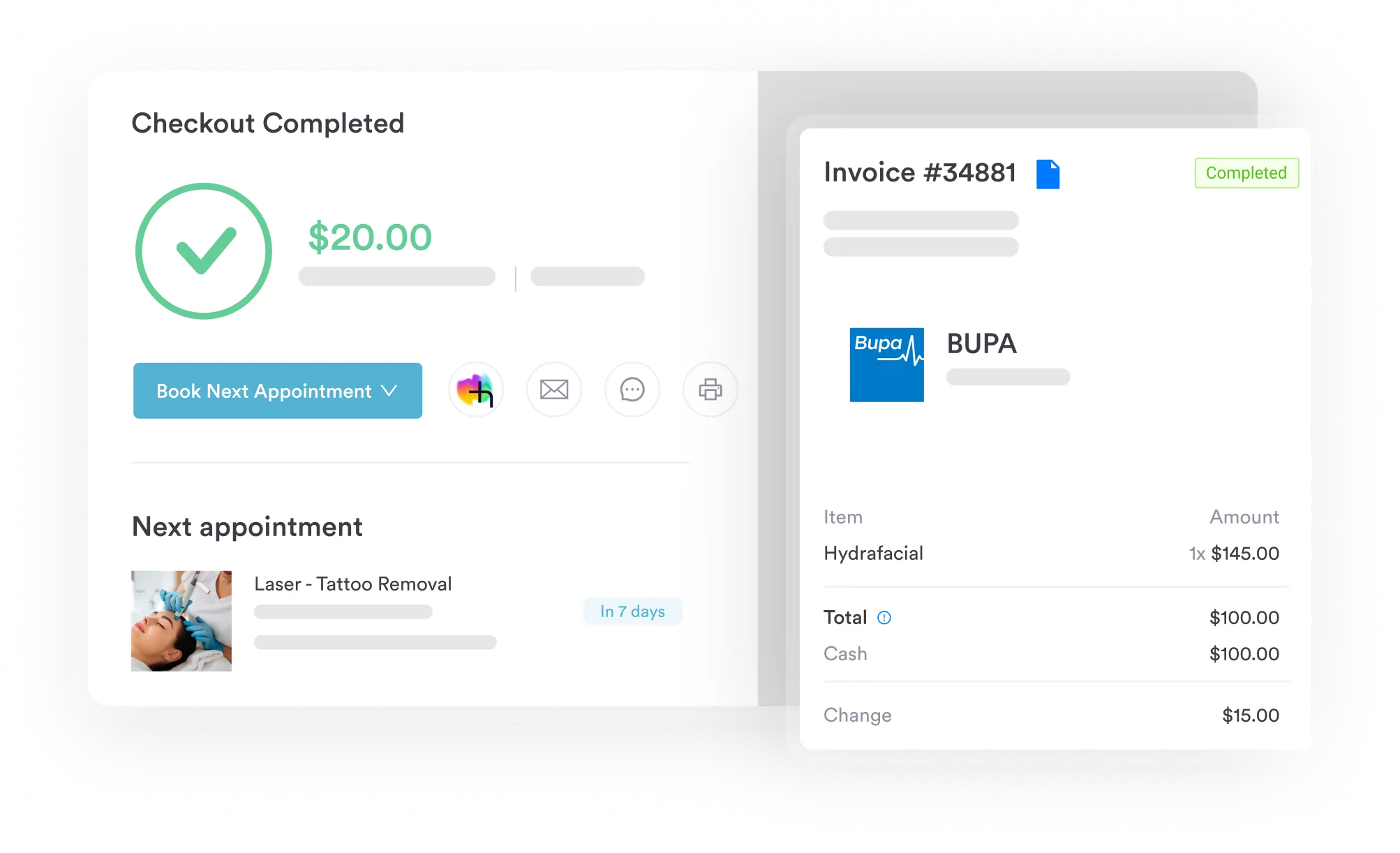

Pabau keeps operative notes, invoices and insurer claims on one patient record. Required fields are checked before submission, so fewer H1200 claims come back.

H1200 is a narrow code with clear borders. It pays for removing a colon lesion through the abdomen, and its neighbors cover the larger and smaller operations. Most rejected claims cross one of those borders, toward a scope code or a resection.
So let the operative note settle the question before the insurer asks it. State the approach, describe the lesion and confirm that no segment came out. Then match the authorization to the operation the surgeon performed.
Book a demo to see how Pabau keeps operative notes and colon surgery claims in step.

Was the lesion snared instead? CCSD code H2003 covers therapeutic colonoscopy with snare loop biopsy or excision of lesion.
Lesion lower in the bowel? CCSD code H2503 walks through therapeutic sigmoidoscopy billing.
Did the sigmoid come out too? CCSD code H1000 covers excision of sigmoid colon.
Billing more than one insurer? Bupa CCSD codes explains how Bupa uses the CCSD schedule and where to check its rules.
Coding another large intestine operation? CCSD code H0310 covers appendix abscess drainage, including drainage of an intra-abdominal abscess.
Each insurer sets its own fee. The CCSD Group only defines the code and its wording, so check the insurer’s schedule or your recognition agreement for the rate.
Use the diagnosis the histology supports. Benign tumors of the colon sit in category D12, while malignant tumors of the colon sit in C18. Update the code if the report changes the picture.
There is no official crosswalk between CCSD and CPT. The closest US code is usually CPT 44110, excision of one or more lesions of small or large intestine through a single enterotomy.
The CCSD website needs a login to search its schedule. Insurers publish their own lists, though, and AXA Health’s online code list shows H1200 with its grade and unacceptable combinations.