CCSD code G5100: Bypass of duodenum billing guide
CCSD code G5100 bills a bypass that leaves the duodenum in place CCSD code G5100...

Last Updated: Oct 16, 2026
G6100 is the CCSD code for bypass of jejunum. The surgeon joins healthy bowel above a blocked or diseased stretch of jejunum to bowel below it. Intestinal contents then flow around the segment, which stays in place.
That detail decides the claim. If the segment is removed, the operation is a resection and G6100 is the wrong code. The code sits in section 11.4.0 (jejunum/ileum) of the CCSD schedule, and seven other codes can't be billed with it. Insurers expect pre-authorization and an operation note that explains why the surgeon chose a bypass.
Let Pabau's smart automation suggest the right codes, reduce claim denials, and keep your practice compliant—effortlessly.
Automate repetitive tasks and focus on what matters most—your patients.
Reduce coding errors and ensure compliance with the latest regulations.
Clean claims, fewer denials, and faster reimbursements.
Powerful insights and reporting to help your practice thrive.
HIPAA compliant SOC 2 certified GDPR-compliant Trusted by 4,000+ clinics worldwide

CCSD code G6100 reports bypass of jejunum, where the surgeon routes bowel contents around a jejunal segment that stays in place.
If the diseased segment is removed, the operation is a resection and needs a resection code instead of G6100.
CCSD bars G6100 from pairing with seven codes, including G5810, G6000, G6080 and both gastro-jejunostomy codes.
The operation note must explain why the surgeon bypassed the segment rather than removing it.
Pabau pre-fills Healthcode claims from the patient record and checks each one for missing or invalid details, such as the authorization code, before you submit.
CCSD code G6100 is the private billing code for bypass of jejunum. The surgeon joins healthy bowel above a problem segment of jejunum to healthy bowel below it. Intestinal contents then flow around the segment, which stays in the abdomen.
The code belongs to the schedule kept by the Clinical Coding and Schedule Development (CCSD) Group. UK private medical insurers use that schedule to recognize procedures on consultant and hospital invoices. The NHS codes the same operation with OPCS-4, where category G61 carries the same title. Our guide to CCSD codes explains how the private schedule works.
The descriptor names no laparoscopic approach. Keyhole small bowel work has separate codes, such as G6080 for laparoscopic small bowel resection.
A jejunal bypass relieves a blockage without cutting out the diseased bowel. Surgeons usually take this route when resection would carry more risk than leaving the segment in place.
Typical reasons recorded in the indication include:
Jejunoileal bypass was once used for weight loss. Surgeons largely abandoned it because of its long-term complications, and modern weight-loss operations sit elsewhere in the schedule. So a G6100 claim with an obesity diagnosis will draw questions from the insurer.
Insurers read the operation note to confirm that the code matches the surgery. For G6100, the key question is simple. Did the surgeon bypass the segment, or remove it?
A note that supports a clean claim records:
If the note describes a removed specimen, the coder should stop and query the surgeon. A specimen sent to pathology suggests a resection, and a G6100 claim will not survive that report.
Each answer the note can give leads to a different code, and only one of them is G6100.
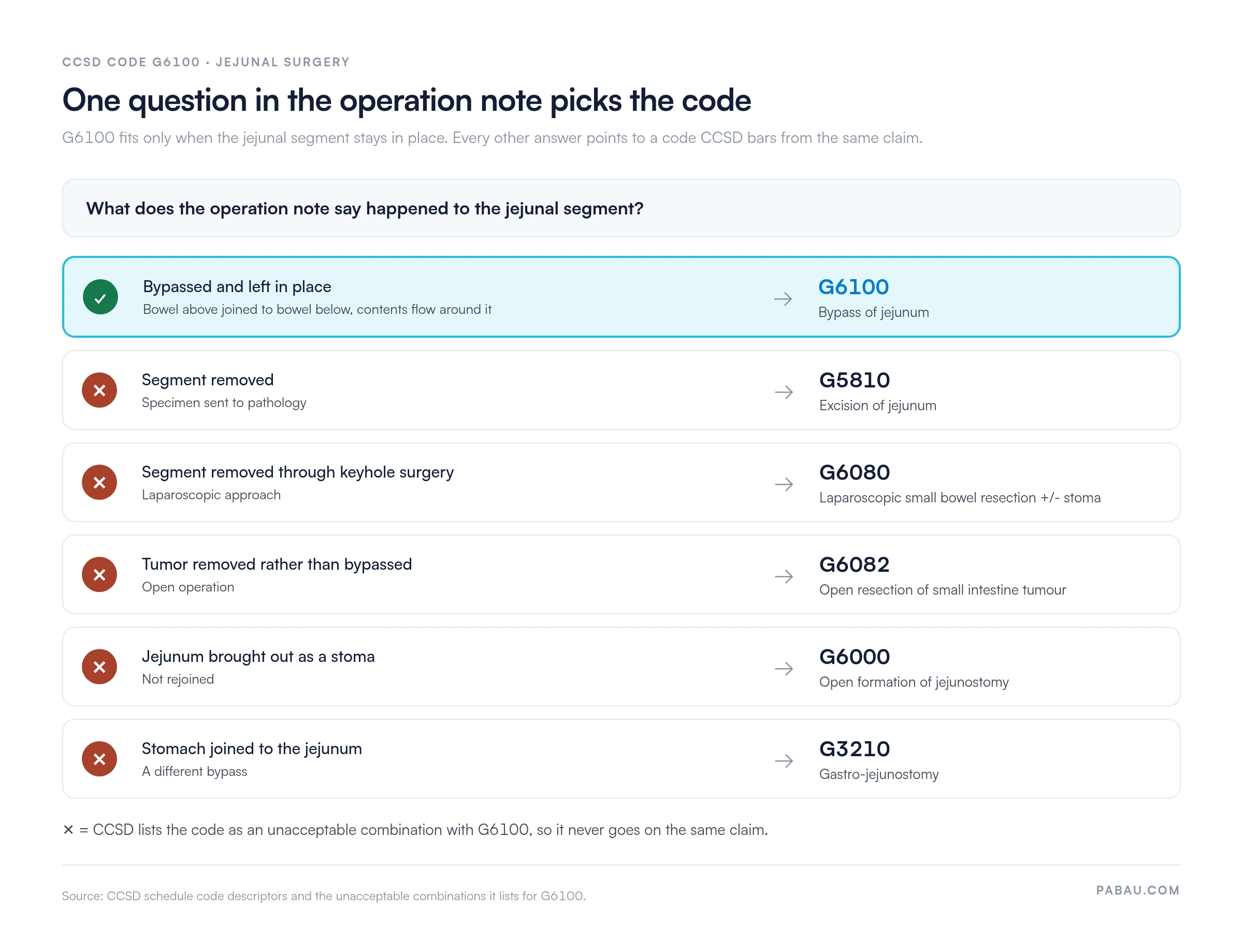
CCSD lists seven codes as unacceptable combinations with G6100. Each one either overlaps the bypass or describes a different operation on the same bowel.
Read the operation note before choosing between these codes. An open jejunostomy under G6000 or a gastro-jejunostomy revision under G3220 can look similar in a short summary. A bypass of the ileum takes its own code in the same section, so confirm which part of the small bowel was bypassed.
A G6100 admission produces several invoices for one operation. Each one quotes the same procedure code and the same pre-authorization number.
Mismatched details across these invoices are a common source of queries. A different procedure date or authorization number on one invoice can hold up every claim for the admission. Check the assistant rules first, because insurers decide case by case whether they pay one.
Insurers treat jejunal bypass as inpatient surgery, so the consultant should secure pre-authorization before booking theater time. The request normally names the proposed CCSD code, the diagnosis and the planned admission.
Emergency cases are the exception. When a patient needs surgery the same day, notify the insurer as soon as possible afterward. Then send the operation note with the claim. Rules differ by payer and policy year, so check each insurer’s current position. Our guide to Bupa CCSD codes covers one large insurer’s approach.
If the plan changes during surgery, contact the insurer. A pre-authorization for a resection does not cover a bypass, and one for a bypass does not cover a resection.
Every G6100 claim needs an ICD-10 diagnosis that explains why the bowel was bypassed. These diagnoses commonly fit the operation:
Code the diagnosis the operation note supports. A vague obstruction code on a planned tumor bypass invites a query.
Most rejected G6100 claims trace back to a handful of avoidable errors. Each one has a clear fix.
Surgical billing often means retyping details from the operation note into an insurer invoice. Each retyped field is a chance for a wrong date or a missing authorization code.
Pabau, the practice management platform we build for private practices, keeps the note, the patient record and the claim together. Its claims management software pre-fills each claim from the record. It also checks each claim for missing or invalid details, such as the authorization code, before you submit.
Through the Healthcode integration, your team submits CCSD claims and tracks their status without leaving Pabau.
Custom forms let surgeons complete a structured operation note, with fields for the reason for bypass and the intraoperative findings. Your billing team then works from a complete note instead of chasing the surgeon after the admission.

Pabau pre-fills CCSD claims from the patient record and checks required fields before sending them through Healthcode. Your team spends less time correcting rejected surgical invoices.

G6100 stands or falls on one fact in the operation note. The jejunal segment stayed in place. Get that sentence written, and the code choice, the pre-authorization and the non-combinable checks follow from it.
So read the note before the code, and query any mention of a specimen. Then match every invoice for the admission to the same date and authorization number. Book a demo to see how Pabau keeps private surgical claims accurate from the note to Healthcode.

Billing the keyhole alternative? CCSD code G6080 explains laparoscopic small bowel resection and what happens when a case converts to open surgery.
Was a stoma formed instead? CCSD code G6000 covers open formation of jejunostomy and how it differs from a bypass.
Working with Bupa patients? Bupa CCSD codes sets out how Bupa uses the CCSD schedule for surgical claims.
New to private surgical coding? CCSD codes explained walks through how the schedule is structured and maintained.
CCSD code G6100 covers bypass of jejunum. The surgeon joins bowel above a problem segment of jejunum to bowel below it. The bypassed segment stays in place.
G6100 reroutes bowel contents around the jejunal segment and leaves it in place. G5810 covers excision of jejunum, where the segment is removed. CCSD does not allow the two codes on the same claim.
CCSD lists G3210, G3220, G5810, G6000, G6080, G6082 and G6710 as unacceptable combinations with G6100. Remove any of them from the claim before submission.
Insurers treat jejunal bypass as inpatient surgery, so elective cases need pre-authorization before admission. In an emergency, notify the insurer as soon as possible afterward. Check each payer’s current rules.
They send separate invoices for the same admission. The hospital bills under its own insurer contract, and an assistant bills only where the insurer allows it. Each invoice should quote the same procedure date and authorization number.