CCSD code G6100: Bypass of jejunum billing guide
CCSD code G6100 covers a bypass, not a resection CCSD code G6100 is the private ...

Last Updated: Oct 16, 2026
G5100 is the CCSD code for bypass of duodenum. It covers an operation that routes bowel contents around a blocked or diseased duodenal segment and leaves that segment in place. Bupa bands it MAJOR 3, with a £575 surgeon fee on its February 2026 schedule.
Getting it right turns on one detail in the operative note. A bypass that starts at the stomach is G3210, and a jejunal bypass is G6100, both two bands higher. Scope, neighboring codes, fees, documentation and the claim steps follow, in the order a biller meets them.
Let Pabau's smart automation suggest the right codes, reduce claim denials, and keep your practice compliant—effortlessly.
Automate repetitive tasks and focus on what matters most—your patients.
Reduce coding errors and ensure compliance with the latest regulations.
Clean claims, fewer denials, and faster reimbursements.
Powerful insights and reporting to help your practice thrive.
HIPAA compliant SOC 2 certified GDPR-compliant Trusted by 4,000+ clinics worldwide

CCSD code G5100 is the UK private billing code for bypass of duodenum, listed in section 11.3 of the Abdomen chapter.
Bupa’s February 2026 schedule bands G5100 as MAJOR 3 with a £575 surgeon fee, the same as closure of a perforated duodenal ulcer.
A bypass that joins the stomach to the jejunum is a gastrojejunostomy, which takes G3210 rather than G5100.
The descriptor names no technique or approach, so the operative note has to state which segments were joined and why.
Pabau, our practice management software, links the CCSD and ICD-10 codes on one invoice and sends the claim to Healthcode.
CCSD code G5100 is the procedure code for bypass of duodenum in the CCSD Schedule. UK private medical insurers use that schedule to pay for procedures.
A duodenal bypass joins the bowel above an obstructed or diseased duodenal segment to the bowel beyond it, so contents flow around the problem. The bypassed segment stays in place, which is what separates this operation from an excision.
CCSD codes are used only for UK private medical insurance (PMI) billing. The NHS records the same operation under OPCS-4 category G51 (Bypass of duodenum) and sets tariffs through Healthcare Resource Group (HRG) codes.
G5100 sits in chapter 11 (Abdomen, excluding urinary and reproductive organs), section 11.3 (Duodenum). Our CCSD billing guides explain how the private schedule is structured.
The descriptor doesn’t name a technique or an approach. That leaves the operative note to show the payer which anastomosis was made. Payer queries about G5100 usually start there.
Surgeons bypass the duodenum when a segment is blocked or narrowed and leaving it in place is safer than removing it. The common scenarios behind a G5100 claim are:
Palliative bypass for malignant obstruction is often a gastrojejunostomy, which has its own code in the stomach section. Read the operative note before you code it, because the two operations pay differently.
Reading the scope correctly prevents both under-coding and over-coding. The table below separates the work G5100 covers from the work that takes another code or a separate claim.
The CCSD schedule entry for G5100 sets out its unacceptable combinations, and only registered users can view it. Check the entry on the CCSD website before a second duodenal code goes on the same claim. If both procedures took place, ask the payer how to code the episode.
Upper bowel surgery has several close neighbors, and they don’t pay the same. The table lists each one with its band and surgeon fee from Bupa’s February 2026 schedule. Our Bupa CCSD codes guide explains that schedule in full.
G3210 and G6100 both sit two bands above G5100 on Bupa’s schedule. A bypass coded against the wrong segment therefore moves the surgeon fee by £75. Payers check the operative note to see which segments were joined.
Here’s how that plays out on a single note. The surgeon writes “duodenojejunostomy for superior mesenteric artery syndrome”, so the anastomosis starts at the duodenum and G5100 applies. Had the note read “gastrojejunostomy”, the claim would move to G3210 at £650.
If the surgeon removed the lesion instead, the code becomes G5000 at £698. The chart below maps each description to its code and Bupa fee.
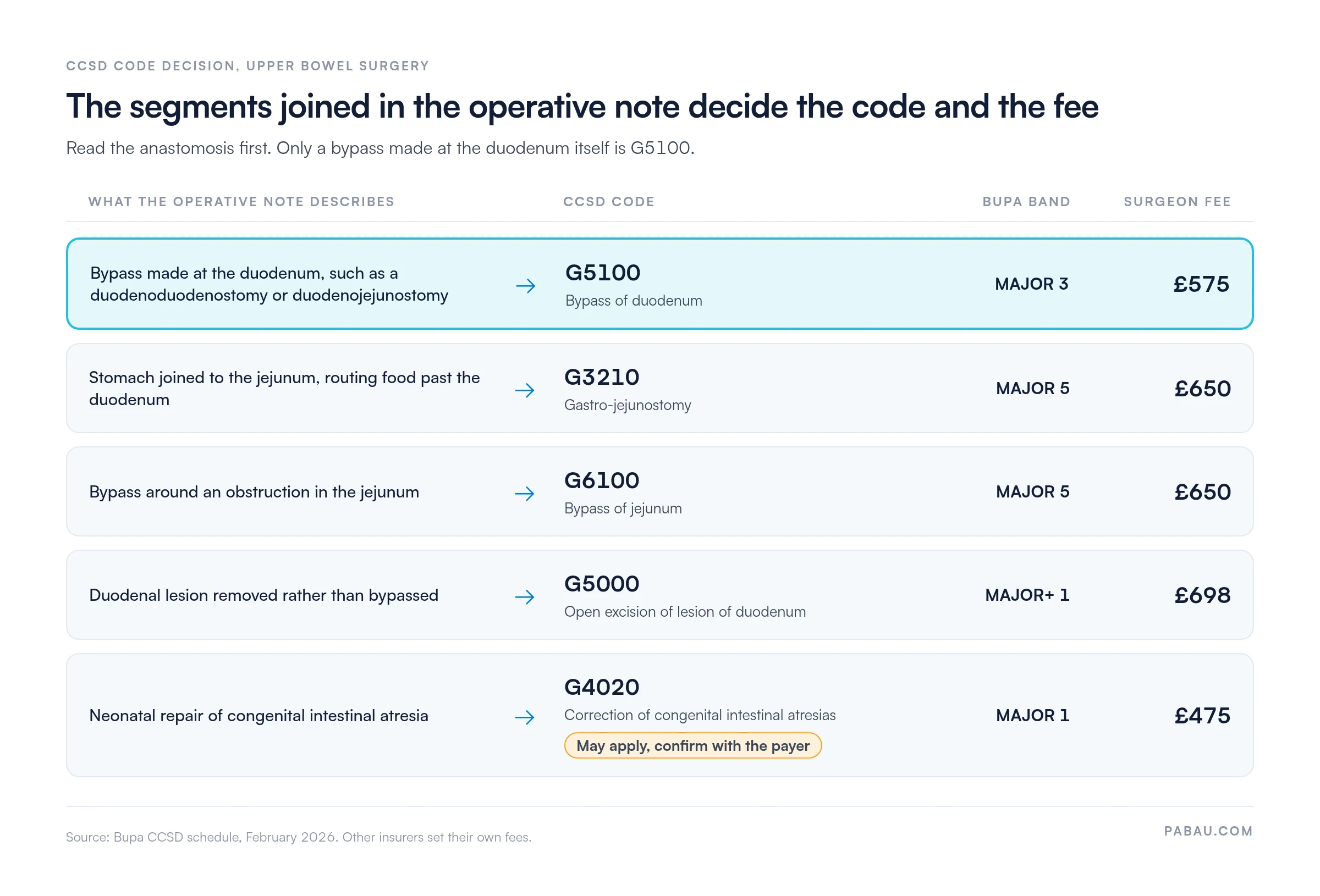
G3210 applies, not G5100. A gastrojejunostomy joins the stomach to the jejunum and sits in the stomach section of chapter 11, even though it routes food past the duodenum.
Some notes describe a gastrojejunostomy and a separate duodenal anastomosis in one operation. In that case, ask the payer how to code the episode before you submit. A later revision of that gastrojejunostomy has its own code, G3220.
Each insurer publishes its own fee for a CCSD code, so G5100 pays a different amount depending on the payer. Two published schedules show the spread.
Figures come from Pabau’s Bupa CCSD code reference (February 2026) and the Freedom Health Insurance chapter 11 fee schedule. Check the payer’s current schedule before invoicing, because insurers revise fees during the year.
The operative note is the main evidence behind a CCSD code G5100 claim. Because the descriptor is short, the note has to supply the detail the code leaves out.
Make sure the note records each of these points:
Structured digital operative forms help surgical teams capture each element before the note reaches billing. Any AI-assisted draft must be reviewed and signed by the operating consultant before the claim goes out.
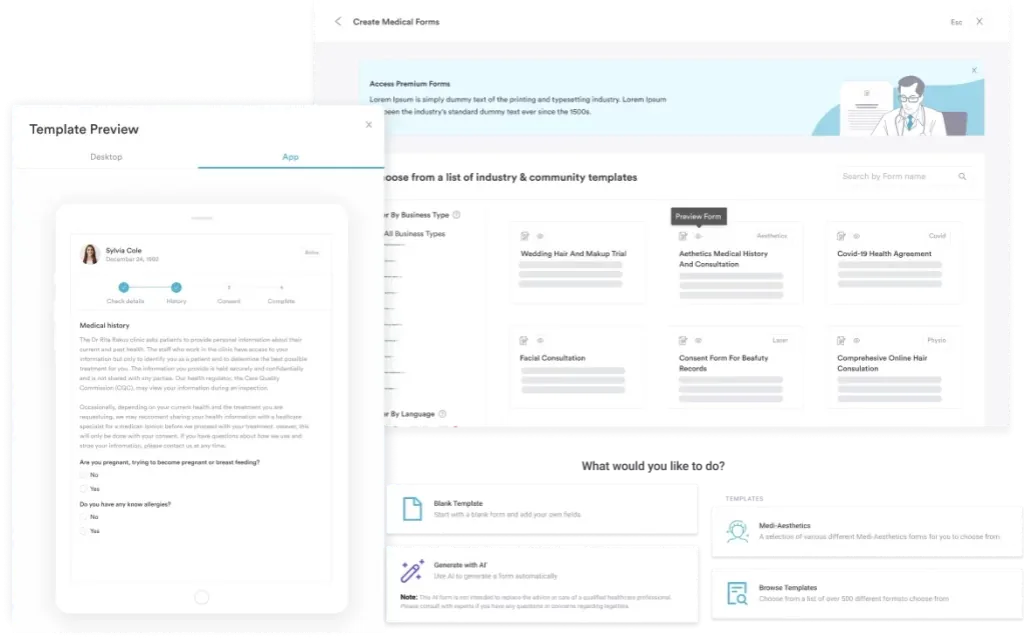
Add a required “anastomosis performed” field to your duodenal surgery note template. A note that names the segments joined tells the payer straight away whether G5100, G3210 or G6100 applies.
UK PMI payers treat elective duodenal bypass as major inpatient surgery, so pre-authorization is typically required before the procedure. Emergency admissions follow each insurer’s own notification rules.
The table shows where to check the code and fee for each payer. Requirements vary by policy year and plan, so confirm them with the payer before you schedule surgery.
Check the pre-authorization reference against the booked procedure code before each elective G5100 date. An authorization issued for a gastrojejunostomy won’t cover a duodenal bypass, and the mismatch surfaces only when the claim is rejected.
Any of these six causes can stop a G5100 claim, and each one has a specific fix.
Every G5100 claim needs a principal diagnosis that matches the indication in the note. UK insurers use the WHO version of ICD-10, and the codes below match the common indications.
Healthcode is the main electronic route for CCSD-coded claims to UK PMI payers. Most private hospitals and independent surgical practices follow the steps below, then check payer portals for any insurer-specific rules.
Go through this list once the claim is built and before you submit it. Each point lines up with one of the denial reasons above.
In many surgical practices, the operative note sits in one system and the pre-auth reference in an email. Someone then types the claim into the Healthcode portal, and each re-keyed field is another chance for the wrong bypass code.
Pabau replaces those hand-offs with claims management without re-keying. The insurer and policy sit on the patient record, and the CCSD and ICD-10 codes link on the invoice. When the invoice is ready, the claim goes to Healthcode without leaving Pabau.
Each claim then moves through clear stages, from submitted to paid or error, so your billing team spots a G5100 query the day it lands. The operative note sits on the same patient record, ready to send when a payer asks for it.

Pabau helps UK private surgical teams capture operative notes, code CCSD procedures, and send claims to Healthcode from one place.

G5100 is simple to bill once the operative note names the anastomosis and the obstruction behind it. The coding errors come when a stomach-side or jejunal bypass is filed as duodenal.
Before you submit, check the note against G3210 and G6100, and check the CCSD schedule entry for unacceptable combinations. For a newborn atresia repair, confirm with the payer whether G4020 applies instead. Fixing the code at that point costs far less than a resubmission.
Book a demo to see how Pabau links the operative record, the CCSD code and the Healthcode claim for your surgical billing team.

Removing a duodenal lesion instead? CCSD code G5000 covers open excision of a lesion of the duodenum.
Revising an earlier gastrojejunostomy? CCSD code G3220 covers revision of gastrojejunostomy.
Coding small bowel surgery? CCSD code G6080 covers laparoscopic small bowel resection with or without stoma.
Billing Bupa patients? Bupa CCSD codes explains fee categories, code lookup and submission rules.
MAJOR 3 is the complexity band Bupa assigns to G5100. Bupa groups procedures into bands, and each band carries a set surgeon fee. That’s why G5100 and G5320 both pay £575 on the February 2026 schedule.
A duodenojejunostomy joins the duodenum directly to the jejunum, so food passes around a blocked lower duodenum. Surgeons use it for superior mesenteric artery syndrome, and it codes to G5100 because the bypass starts at the duodenum.
No. A duodenal switch is a weight-loss operation that pairs a sleeve gastrectomy with a long intestinal bypass. It doesn’t treat a duodenal obstruction, so check the payer’s bariatric codes rather than billing G5100.
Yes. The G5100 descriptor doesn’t specify an open or laparoscopic approach. Record the approach in the operative note anyway, because payers may ask for it when they review the claim.
No. CCSD codes are used only for UK private medical insurance claims. NHS hospitals record a duodenal bypass under OPCS-4 category G51 and are paid through HRG tariffs.