CPT code 36600: Arterial puncture billing guide
CPT code 36600: definition and procedure overview CPT code 36600 is classified u...

Last Updated: Oct 15, 2026
H1000 is the CCSD code for excision of sigmoid colon, the removal of the S-shaped last section of the colon above the rectum. UK private medical insurers use it for sigmoid colectomy, most often for diverticular disease or sigmoid cancer.
The code sits in CCSD section 11.5.0, Large Intestine. Robotic-assisted excision bills as H1001, and Hartmann's procedure takes H3362 or H3366 instead.
Let Pabau's smart automation suggest the right codes, reduce claim denials, and keep your practice compliant—effortlessly.
Automate repetitive tasks and focus on what matters most—your patients.
Reduce coding errors and ensure compliance with the latest regulations.
Clean claims, fewer denials, and faster reimbursements.
Powerful insights and reporting to help your practice thrive.
HIPAA compliant SOC 2 certified GDPR-compliant Trusted by 4,000+ clinics worldwide

CCSD Code H1000 covers excision of the sigmoid colon with the bowel rejoined, billed to UK private medical insurers.
Diverticular disease and sigmoid cancer are the two most common indications for an H1000 claim.
Robotic-assisted sigmoid excision has its own code, H1001, so the operative note must record the approach.
Hartmann’s procedure bills as H3362 or H3366 instead of H1000, and a later reversal takes its own code.
Claims software such as Pabau checks authorization codes and membership numbers before an H1000 claim goes out.
CCSD Code H1000 describes excision of the sigmoid colon, the S-shaped final segment of the large bowel that joins the descending colon to the rectum. It sits in Chapter 11 of the CCSD schedule (Abdomen, excluding urinary and reproductive organs), under the Large Intestine category.
The Clinical Coding and Schedule Development group maintains the code, and every major UK private medical insurer expects it on a sigmoid colectomy claim.
H1000 is the code a colorectal surgeon’s billing team uses when sigmoid resection with a rejoined bowel is the main procedure.
Robotic-assisted cases, Hartmann’s procedures, and resections that run into the rectum or descending colon each take a different code. Neighboring abdominal procedures are listed in the CCSD code reference.
Coders who trained in the NHS will know OPCS-4, where sigmoid colectomy sits in category H10. The two systems look alike but are not interchangeable. UK private insurers recognize the CCSD codes, rules, and fee structures, not OPCS-4.
Sigmoid colectomy removes the sigmoid colon from its junction with the descending colon down to the rectosigmoid junction. A consultant colorectal surgeon performs it under general anesthesia, usually in four stages.
The operative note must state the approach: open, laparoscopic, or robotic-assisted. It decides between H1000 and H1001, and most UK private insurers check it at pre-authorization.
Private insurers expect a valid diagnosis on every H1000 claim. These are the main indications for sigmoid colectomy in UK private practice, with the ICD-10 code that belongs on the claim.
Check each diagnosis code against the NHS Classifications Browser before you submit, because insurer requirements vary.
Knowing the scope of H1000 prevents both under-coding and unbundling. The table shows what is bundled into the code and what takes a separate or different CCSD code.
Check bundling rules against the CCSD schedule in force on the date of surgery, as they can change between editions. If a rule is unclear, check the insurer’s provider portal before submitting. Payer-specific context for common operations is in our Bupa CCSD code guide.
Several colorectal codes sit close to H1000, and picking the wrong one is a common cause of denial on sigmoid colectomy claims.
The most frequent error is billing an anterior resection code when the resection did not reach the rectum. Insurers compare the histology report with the operative note.
If the specimen is described as sigmoid colon only, an anterior resection code will trigger a query or denial. The chart below sets out the five outcomes side by side.
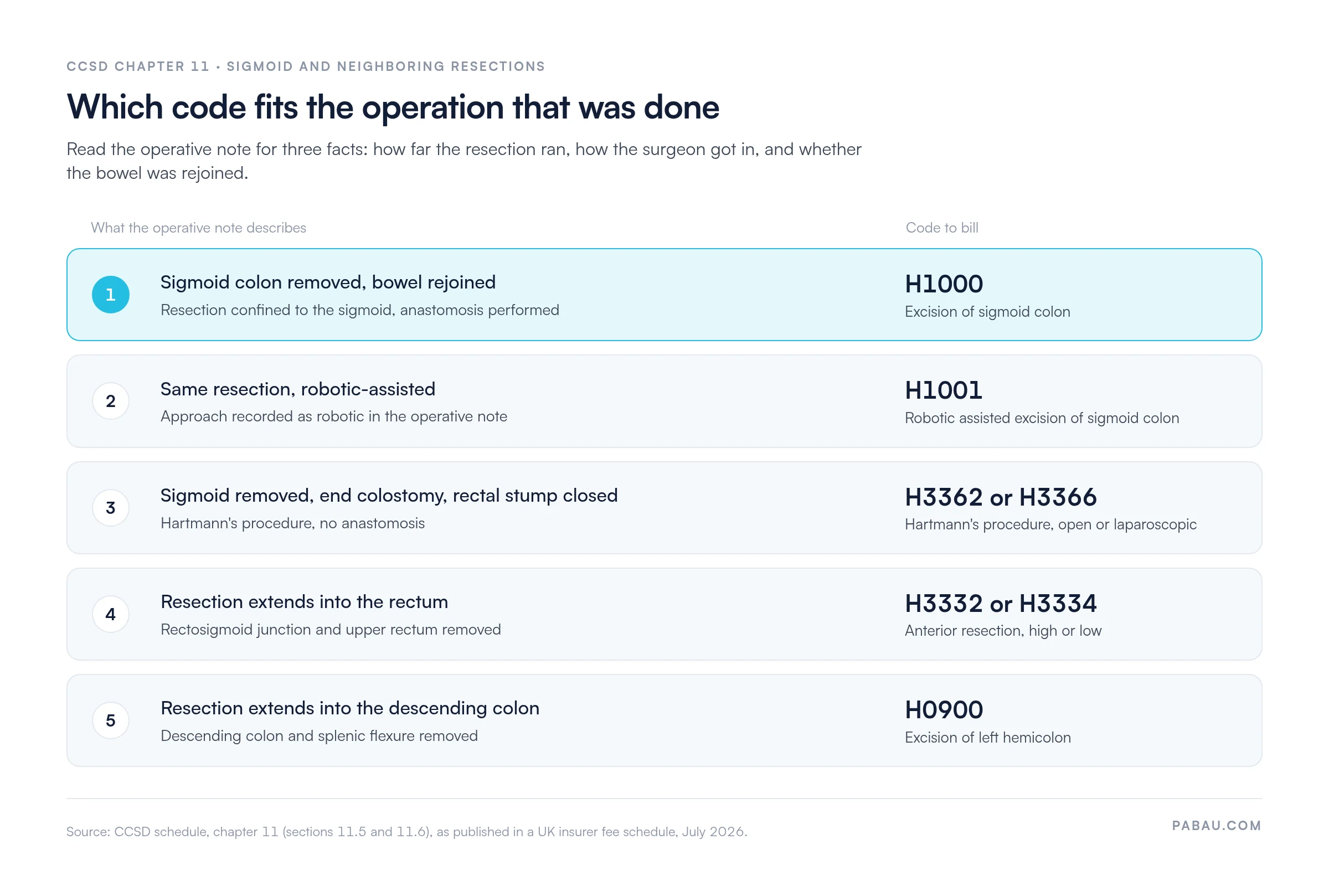
CCSD publishes a separate code for robotic-assisted surgery: H1001, robotic assisted excision of sigmoid colon. Bill H1001 instead of H1000 whenever the operative note records robotic assistance.
There is no separate laparoscopic version of H1000 in the schedule. A laparoscopically assisted left colon resection has its own code, H1880. Check the CCSD technical guide and the insurer’s guidance before choosing between H1000 and H1880 for a laparoscopic case.
Every UK private payer expects the operative note to state the approach clearly. Bupa, AXA Health, and Aviva all review operative notes and will query a claim where the approach is missing. The AXA Health specialist procedure codes portal lets you check a code against that insurer’s list before you bill.
Hartmann’s procedure removes the sigmoid colon, forms an end colostomy, and closes the rectal stump without rejoining the bowel. Surgeons choose it for emergency sigmoid surgery where an anastomosis is too risky, most often perforated diverticulitis with fecal peritonitis.
CCSD gives Hartmann’s procedure its own codes: H3362 for the open operation and H3366 for the laparoscopic one. Each covers the sigmoid resection and the colostomy together. Billing H1000 plus a colostomy formation code for the same operation is unbundling, and insurers will query it.
When an elective H1000 case becomes a Hartmann’s procedure in the operating room, the pre-authorization still names H1000. Tell the insurer about the change of code soon after surgery, so the claim and the authorization match.
UK private insurers assess an H1000 claim against the documents sent with it. Missing paperwork causes more preventable surgical denials than any coding error, so check these elements before you submit.
Pre-authorization timelines vary by insurer. For a planned sigmoid colectomy, secure it at least 48 hours before surgery, ideally when the operation is booked. The Aviva fee schedule and Healix fee schedule both publish procedure-specific documentation expectations worth reading early in any insurer relationship.
Sigmoid colectomy claims are high-value, so they get closer scrutiny than low-cost outpatient procedures. These triggers account for most rejected H1000 claims in UK private practice.
Some cases put H1000 on the same claim as another procedure code. Each combination has its own documentation needs and its own risk of an insurer query.
Each extra procedure on a multi-code claim needs its own clinical justification in the operative note. Payers using the Healix or Aviva fee schedule typically reduce the fee for secondary procedures by a percentage, so confirm the rules first. If you are unsure, call the insurer’s provider helpline before you submit, not after a denial.
Review the Healix unbundling guidelines and your insurer’s fee schedule before you submit a multi-code colorectal claim. Secondary-procedure reductions vary by payer, and so do the rules on what is separately billable.
Most practices still assemble a colorectal claim by hand. The pre-authorization sits in an email, the consultant’s GMC number in a spreadsheet, and the invoice in a separate billing tool. Each handover is a chance to send H1000 with the wrong authorization or a missing membership number.
Pabau, the practice management platform we build, keeps those pieces on one patient record. You store the patient’s insurer and policy once, and each invoice routes to that insurer automatically.
Before a claim leaves, Pabau checks that authorization codes and membership numbers are in place. You can then send it through Healthcode or by email.
Every claim then moves through five stages in one dashboard: pending, submitted, processing, paid, or error. Your billing team sees a rejected H1000 claim the day it fails, with faster claims management in place of chasing insurers by phone.

Pabau helps UK private practices attach procedure codes, consultant details, and pre-authorization references to claims before submission, so fewer claims come back from private insurers.

An H1000 claim succeeds or fails on the operative note. Before you pick the code, confirm three facts from it: where the resection stopped, how the surgeon got in, and whether the bowel was rejoined.
Get those right and most denials disappear. Robotic cases move to H1001, Hartmann’s procedures to H3362 or H3366, and rectal extensions to an anterior resection code. The trade-off is a few extra minutes of checking before submission, which costs far less than a resubmission weeks later.
Book a demo to see how Pabau links each colorectal claim to its pre-authorization and tracks it until the insurer pays.

Coding an endoscopic colorectal procedure? CCSD code H2503: therapeutic sigmoidoscopy covers billing for therapeutic work done through a sigmoidoscope.
Billing for a UK insurer with its own rules? Bupa CCSD codes explains how Bupa applies CCSD codes to surgical claims.
Working on other digestive tract resections? CCSD code G0220: intestinal interposition walks through coding a bowel segment used to replace part of the digestive tract.
Coding open upper GI surgery? CCSD code G3800: open stomach surgery sets out the documentation insurers expect for open gastric operations.
Excising a lesion higher in the bowel? CCSD code G5000: duodenal lesion excision covers open excision of a duodenal lesion and its claim requirements.
CCSD Code H1000 is the UK private healthcare code for excision of the sigmoid colon. Practices use it to claim for sigmoid colectomy from private medical insurers such as Bupa, AXA Health, and Aviva. It sits in Chapter 11 of the CCSD schedule, under the Large Intestine category.
H1000 covers resection of the sigmoid colon only, without extending into the rectum. Anterior resection includes the rectosigmoid junction and rectum, typically with total mesorectal excision, and is coded as H3332 or H3334. The operative note must confirm the distal resection margin to support the code you choose.
No. Hartmann’s procedure has its own CCSD codes: H3362 for the open operation and H3366 for the laparoscopic one. Those codes cover the sigmoid resection and the end colostomy together, so H1000 is not billed alongside them.
Not for a Hartmann’s procedure. A sigmoid resection with an end colostomy is billed as H3362 or H3366, not as H1000 plus a stoma code. For any other stoma formed in the same sitting, check the insurer’s bundling rules before adding a code.
Insurers typically need a valid pre-authorization reference and a confirmed diagnosis with its ICD-10 code. They also expect an operative note stating the approach and extent of resection. Add the histology request, the anesthetic record, and the consultant’s name and GMC number. Missing any of these is a common denial trigger.
The usual causes are missing or expired pre-authorization and an anterior resection code used for a sigmoid-only resection. A mismatched ICD-10 code, unbundled components, or an incomplete operative note also lead to denials. Billing H1000 for a robotic case that should carry H1001 is another frequent error.