

HCPCS Code L0472: Hyperextension TLSO billing guide
HCPCS code L0472: Official descriptor and device definition HCPCS code L0472 des...

Last Updated: Nov 5, 2026
H0750 is the CCSD code for laparoscopic right hemicolectomy +/- stoma. It covers removal of the right colon through keyhole ports, and a stoma formed in the same operative session is included in the code.
H0750 sits in CCSD sub-chapter 11.5.0 Large Intestine. A case converted to open surgery is billed as H0700, the right hemicolectomy code. UK insurers generally require pre-authorisation before surgery.
Let Pabau's smart automation suggest the right codes, reduce claim denials, and keep your practice compliant—effortlessly.
Automate repetitive tasks and focus on what matters most—your patients.
Reduce coding errors and ensure compliance with the latest regulations.
Clean claims, fewer denials, and faster reimbursements.
Powerful insights and reporting to help your practice thrive.
HIPAA compliant SOC 2 certified GDPR-compliant Trusted by 4,000+ clinics worldwide

CCSD code H0750 covers laparoscopic right hemicolectomy with or without stoma, so a stoma formed at the same sitting is billed within this single code.
H0750 and H0700, the open-surgery code, are mutually exclusive. A keyhole case converted to open is billed as H0700, with the conversion point recorded.
Major UK insurers generally require pre-auth before H0750 is performed, so confirm each payer’s rules and record the approval number before surgery.
Pabau, the practice management platform we build, helps UK billing teams track pre-auth numbers, attach surgeon’s note, and submit CCSD-coded claims through Healthcode.
CCSD code H0750 describes laparoscopic right hemicolectomy +/- stoma. The Clinical Coding and Schedule Development (CCSD) Group publishes it, and UK private healthcare uses its schedule to bill for consultants and specialists. However, the Group does not set fees. Instead, each payer publishes its own.
H0750 sits in sub-chapter 11.5.0 Large Intestine. Surgeons use it when they resect the right colon through a laparoscopic (keyhole) approach.
The “+/- stoma” element of the wording is a bundling qualifier. It means H0750 includes stoma formation at the same sitting, so no extra CCSD code applies. Coders who add an extra stoma code on top of H0750 over-code, and payers then reject the claim.
The code applies whatever the reason for surgery. For instance, the patient may have colorectal cancer, Crohn’s disease, or a non-resectable polyp. In each case, H0750 is correct provided the approach was keyhole and the surgeon resected the right colon.
A laparoscopic right hemicolectomy removes the right colon from the terminal ileum to the mid-transverse colon via keyhole ports. Understanding the steps helps billing teams confirm H0750 is the correct code and supports an accurate review of the surgeon’s note.
PMI claims reviewers check the surgeon’s note closely, so it must record all five stages, the approach used, and the reason for any deviation from standard technique.
In UK private practice, the most common reason for removing the right colon is colorectal malignancy in the caecum, ascending colon, or hepatic flexure. Cancer surgery on the right colon is mostly planned inpatient care, and payers generally require pre-auth for it.
For cancer cases, payers may request staging records (CT staging report, MDT outcome) as part of the prior authorisation package. Billing teams should therefore expect this request when the reason for surgery is cancer.
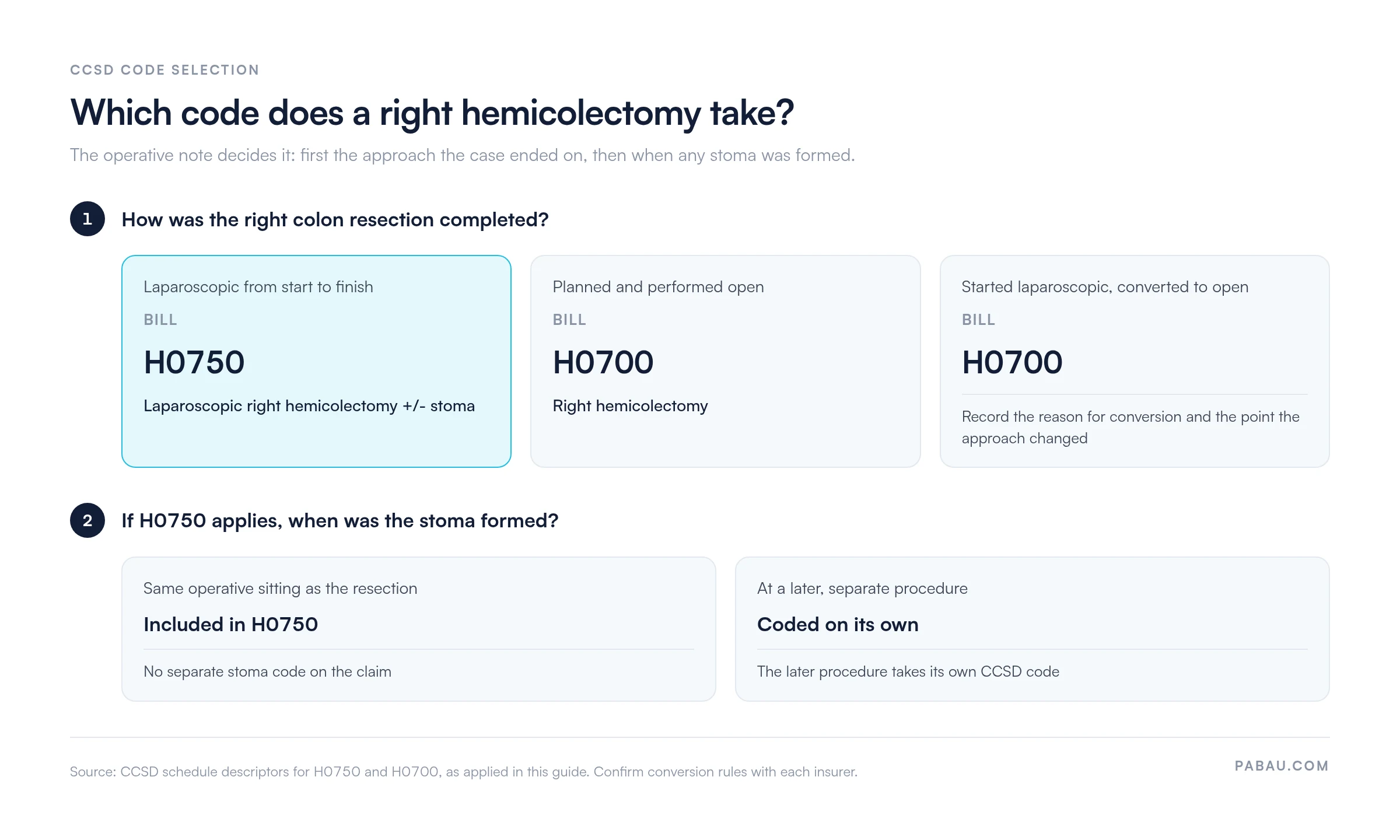
H0750 includes stoma formation performed at the same sitting. The “+/-” qualifier in the official CCSD wording means the code covers the case whether or not a stoma is created. Billers should not submit an extra CCSD stoma code on top of H0750 for the same episode.
Adding one anyway is a frequent coding error on H0750 claims. When a billing coordinator adds a lone ileostomy or colostomy code, the claim often fails payer unbundling edits, and the payer then rejects it as duplicate or excessive billing. Meanwhile, the surgeon’s note confirms that the stoma formed during the same anaesthetic, which tells the payer the stoma is bundled.
The bundling rule applies to every stoma type. For instance, a loop ileostomy, end ileostomy, or defunctioning colostomy all remain within H0750. The only condition is that the surgeon formed the stoma in the same session as the resection.
In contrast, a stoma that the surgeon creates at a separate later sitting attracts its own CCSD code. The deciding factor is the same anaesthetic episode.
H0750 and H0700 are the CCSD codes for a standard right hemicolectomy. H0750 is the keyhole code, while H0700 (the schedule’s plain right hemicolectomy) covers the open approach. Therefore, they are mutually exclusive.
When a surgeon converts a planned keyhole right hemicolectomy to open surgery partway through, the correct code changes to H0700. Do not submit H0750 for a case that finished through a laparotomy incision, however it started.
The surgeon’s note must document two points clearly. The first is the reason for conversion (bleeding, adhesions, failure to progress, cancer concern). The second is the point at which the approach changed. Payers reviewing a converted claim will look for both. For instance, a surgeon’s note that simply states “converted to open” without a stated reason is likely to trigger a query or rejection.
Filing H0750 after a documented open conversion misstates what the surgeon did, and payers treat that as a serious billing error. So always confirm the final operative approach from the surgeon’s note before you select a code. The decision chart below brings the approach and stoma rules together.
The CCSD codes for colon resection differ by segment and approach. Before selecting H0750, confirm the surgeon’s note doesn’t describe a nearby code instead, such as H1880 for a laparoscopically assisted left colon resection. The table below covers the codes that billers most often confuse with H0750.
Verify adjacent code wording against the current CCSD schedule, since the CCSD Group adds and retires codes over time. For a left-sided open resection, H0900 is the code to check. Likewise, for payer-specific confirmation, use the Bupa CCSD codes guide with the payer’s own code search tool.
Major UK insurers generally require pre-auth before the surgeon performs H0750, so confirm the rules with each payer before the surgery date. This is major planned inpatient surgery, and each payer sets its own thresholds and process. Without a valid pre-auth number, payers are likely to query or reject the claim.
Each payer’s pre-auth covers specific CCSD codes. Confirm that the pre-auth letter lists H0750 before you submit the claim. The payer may have approved the case under another code, for instance when the surgeon expected an open approach. In that case, contact the payer to amend the pre-auth before the surgery date.
In addition, billing teams working across several payers should log each pre-auth number from request to claim filing.
H0750 is a high-value surgical claim, so payers expect a full records package and will query or reject claims that lack key items. The surgeon’s note is the most critical document.
A laparoscopic right hemicolectomy usually takes two to four hours. UK PMI providers use time-based CCSD anaesthesia codes, so the anaesthetist’s fee scales with operative duration. The surgeon’s billing team does not submit the anaesthesia code, because the anaesthetist submits their own claim. Both claims should carry the same pre-auth number and episode.
Request the anaesthetist’s induction and extubation times before filing the surgical claim. If the anaesthetist’s time-based claim and the surgeon’s note show very different surgery times, the payer may hold both claims pending clarification.
Healthcode is the main EDI (electronic data interchange) portal for submitting CCSD-coded claims to UK PMI providers. Colorectal billing teams use Healthcode for most major payer filings. The steps below cover an H0750 filing.
Teams handling high volumes of surgical claims often use medical billing software that stores pre-auth numbers against patient records. That way, the software catches a claim that lacks its number before filing.
H0750 is a high-value claim, and payers apply detailed review criteria. For this reason, knowing the most common causes lets billing teams build a quality check into every filing.
Colorectal surgeons who operate in both NHS and private settings use different code systems for the same procedure. CCSD code H0750 is a private billing code, while NHS clinical coders use OPCS-4. Knowing the crosswalk prevents confusion when a surgeon reviews coding across both sectors. It also helps billing teams working for surgeons who are moving from the NHS to private practice.
The OPCS-4 crosswalk is indicative. NHS clinical coders apply their own coding rules and secondary code combinations that differ from CCSD practice. Therefore, never use the OPCS-4 code to inform a CCSD filing, or vice versa. The two systems are not interchangeable.
The rejection causes above share a pattern. The pre-auth number sits in an email, the surgeon’s note lives in the hospital system, and staff key the code into Healthcode by hand. As a result, each handover is a chance for one piece to go missing.
In Pabau, the pre-auth number, the CCSD code, and the surgery records sit on the patient’s record. The billing team submits the claim through Healthcode from that record, so the number and the code travel with it.
Before each H0750 filing, the team checks one record instead of three systems. Likewise, when a payer queries the claim, the answer is in the same place.

Pabau helps UK private practice billing teams track pre-auth numbers, record CCSD codes against the right patient, and submit claims through Healthcode. Fewer manual steps means fewer rejections.

Read the surgeon’s note before you pick the code. It settles the three facts H0750 depends on. Those are the segment resected, the approach the case ended on, and whether the surgeon formed a stoma in the same session.
Settle pre-auth first. Next, confirm the code with the payer before surgery and amend it if the plan changes. A code mismatch is far harder to fix once the payer rejects the claim.
Book a demo to see how Pabau keeps pre-auth numbers, CCSD codes, and surgeon’s note together for colorectal billing teams.

Setting up billing across UK PMI providers? Bupa CCSD procedure codes covers the full Bupa CCSD code schedule with fee and paperwork guidance.
Billing a rectal cancer resection? CCSD code H3322 explains laparoscopic abdominoperineal resection, another colorectal code with a bundled stoma.
Coding a resection of the upper rectum? CCSD code H3332 covers high anterior resection and how it differs from colon resection codes.
CCSD code H0750 covers laparoscopic right hemicolectomy with or without stoma formation. It applies when a surgeon removes the right colon through a keyhole approach. Stoma creation during the same session is bundled into the code.
Stoma formation sits within H0750 when performed at the same sitting. The +/- qualifier in the code wording means stoma creation is bundled. Adding an extra CCSD stoma code on top of H0750 is over-coding and will trigger an unbundling rejection.
H0750 covers laparoscopic right hemicolectomy, and H0700 covers right hemicolectomy by the open approach. The codes are mutually exclusive. If a keyhole case switches to open surgery, H0700 is billed, and the surgeon’s note must record the reason and the point of conversion.
No. When a keyhole right hemicolectomy switches to open surgery, H0700 (right hemicolectomy) is billed instead of H0750. Filing H0750 for a case completed via laparotomy is a billing inaccuracy. The surgeon’s note must record the conversion reason and the point at which the approach changed.



