HCPCS Code J1110: Dihydroergotamine mesylate injection billing guide
HCPCS Code J1110: Official descriptor and drug overview HCPCS Code J1110 is the ...

Last Updated: Oct 29, 2026
Billable Code Specific Code
H3332 is the CCSD code for a high anterior resection, where the colorectal anastomosis is formed above the peritoneal reflection. It covers the open operation, and UK private medical insurers such as Bupa and AXA Health pay against it.
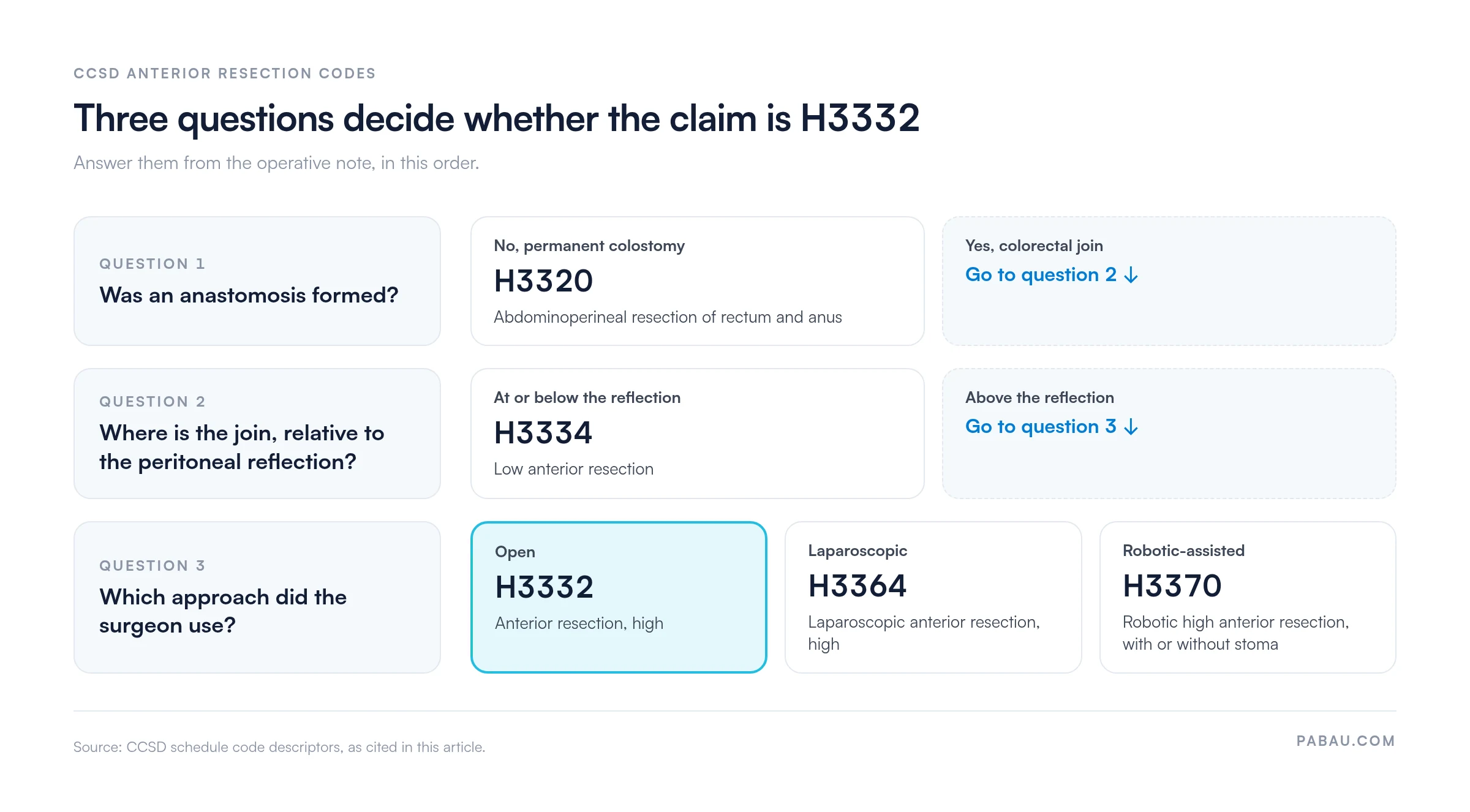
The anastomosis level decides the code. A join at or below the reflection is H3334, while laparoscopic and robotic-assisted high resections take H3364 and H3370.
Let Pabau's smart automation suggest the right codes, reduce claim denials, and keep your practice compliant—effortlessly.
Automate repetitive tasks and focus on what matters most—your patients.
Reduce coding errors and ensure compliance with the latest regulations.
Clean claims, fewer denials, and faster reimbursements.
Powerful insights and reporting to help your practice thrive.
HIPAA compliant SOC 2 certified GDPR-compliant Trusted by 4,000+ clinics worldwide

CCSD code H3332 covers an open anterior resection with the colorectal anastomosis above the peritoneal reflection. A join at or below it is H3334.
CCSD is the UK Clinical Coding and Schedule Development Group. Its codes are used to bill UK private medical insurers such as Bupa, AXA Health, Aviva and Vitality.
The operative note must state the anastomosis level relative to the peritoneal reflection. Without it, the insurer can query or reject the claim.
Approach changes the code. A laparoscopic high anterior resection is H3364, and a robotic-assisted one is H3370.
Pabau, the practice management platform we build, tracks H3332 pre-authorization, attaches the operative note and flags incomplete claims before submission.
CCSD code H3332 covers one defined procedure: An anterior resection of the sigmoid colon or upper rectum, joined above the peritoneal reflection. The official descriptor reads “Anterior resection – high (i.e. colorectal anastomosis above the peritoneal reflection)”. That anatomical qualifier is what makes H3332 a high anterior resection.
When the join sits at or below the reflection, the correct code is H3334, the low anterior resection.
CCSD is the Clinical Coding and Schedule Development Group, which maintains the procedure codes UK private medical insurers use. Bupa, AXA Health, Aviva and Vitality all pay claims against CCSD codes, and practices use them for self-pay invoices too.
Each insurer sets its own fee for H3332, so check the current schedule of the insurer covering the patient. Bupa publishes its rates, and our Bupa fee schedule guide shows where to find them.
In the CCSD schedule, H3332 sits in chapter 11.0.0, Abdomen (excl. urinary & reproductive organs), under category 11.6.0, Rectum/Anus. Its CCSD reference is Fk.081. The code exists because CCSD split the former H3330 “Anterior resection” into two codes by site. H3332 took the high resection, and H3334 took the low one.
To look up neighboring procedures, browse our CCSD code library. For the wider structure, our Bupa CCSD codes guide explains how the schedule is organized and how its chapters relate.
A high anterior resection removes a segment of sigmoid colon and/or upper rectum. It restores continuity by joining the remaining colon to the upper rectum above the peritoneal reflection. Knowing the steps helps the billing team confirm that the operative note supports H3332 rather than a neighboring code.
The approach decides the code. H3332 is the open operation, while laparoscopic and robotic-assisted cases take their own codes (see the approach section below).
The following diagnoses commonly lead to a high anterior resection and support H3332 billing. The primary diagnosis coded on the claim must correspond to the pathology confirmed in histology or operative findings.
High and low anterior resections differ in anatomical level, surgical complexity and risk profile. CCSD assigns them separate codes, and billing the wrong one is a known audit trigger. The peritoneal reflection is a documentable landmark, and insurer claims reviewers expect the operative note to reference it.
An operative note that says only “anterior resection”, with no level, leaves the claim open to downgrade or denial. Ask the surgeon for an addendum before submission rather than after a denial arrives.
CCSD gives each approach to a high anterior resection its own code. H3332 is the open operation.
A laparoscopic case is H3364, “Laparoscopic anterior resection – high”, and a robotic-assisted case is H3370, “Robotic assisted high anterior resection of rectum +/- stoma”. A minimally invasive case billed as H3332 is miscoded, even where the fee happens to match. Three questions about the operation lead to the right code, as the diagram below shows.
The operative note must state the approach used, because insurers can pay a different fee for each approach code. Three points apply to every case:
UK private medical insurers expect an ICD-10 diagnosis code alongside the CCSD procedure code. The WHO ICD-10 browser provides the authoritative international classification. The codes below are the diagnoses most often paired with H3332. The principal diagnosis must match the confirmed pathology, so never select a code without supporting histology, imaging or operative findings.
This list is guidance only. The correct ICD-10 code is always determined by the patient’s confirmed pathology. Insurers may ask for proof that the coded diagnosis justified the procedure.
A mismatch between diagnosis site and procedure site is common grounds for denial. UK claims use the WHO edition of ICD-10, so check code descriptions in the WHO browser rather than a US ICD-10-CM lookup.
H3332 includes the principal colorectal resection and anastomosis. Some procedures in the same operative session attract a separate CCSD code. Others are part of the H3332 work and must not be billed on top. Unbundling means billing separately for work already included in H3332, and it is an audit risk. The CCSD technical guide sets out the general unbundling principles.
Two other open-approach codes are easily confused with H3332. H3334 covers the low resection, with the join at or below the peritoneal reflection. H3320 covers an abdominoperineal resection of rectum and anus, where no anastomosis is formed and the patient leaves with a permanent colostomy.
Check every companion code against the current CCSD schedule before submission. Insurers also apply their own bundling rules, so confirm stoma codes with the insurer covering the patient.
UK private medical insurers expect pre-authorization before an elective high anterior resection. Bupa, AXA Health, Aviva and Vitality each run their own process and forms. Operating without authorization is one of the most preventable reasons an H3332 claim fails. Self-pay patients need no pre-authorization, but their invoice should still carry the CCSD code.
Good UK medical billing software records the authorization number against each admission. That stops a claim reaching submission without one.
The operative note is the primary evidence that an H3332 claim is valid. An insurer’s claims reviewer looks for one point above all others: Confirmation that the anastomosis was formed above the peritoneal reflection.
A note that does not state this leaves the claim open to challenge, even when the surgeon performed exactly the right procedure. A digital operative note template captures the same fields on every surgical case.
The operative note for an H3332 claim should contain all of the following elements:
A well-documented operative note does two jobs at once. It supports the H3332 claim, and it gives the pathologist what they need to correlate the specimen. Poor documentation is rarely deliberate. It usually comes from time pressure on a busy operating list. A standardized template that prompts the surgeon for these elements cuts the corrections billing staff have to chase.
H3332 claims are denied for a predictable set of reasons. Most are preventable before submission. The rest are recoverable on appeal with the right documentation.
This workflow covers the administrative cycle for an H3332 claim, from the day surgery is booked through to payment. Pabau, the practice software we build, tracks each step in its surgical claims management software and flags incomplete claims before submission.
Keeping the surgical record and the claim status in one system stops a claim stalling unnoticed at any stage.
Build a five-point check for every H3332 claim. Confirm the authorization number is on file and the operative note states the anastomosis level. Check the ICD-10 code matches the confirmed pathology. Verify companion codes against the current CCSD schedule, and confirm the approach is documented. That check prevents most H3332 denials.
An H3332 claim depends on a chain of steps: Pre-authorization, operative notes, pathology, code selection and claim tracking. Those steps pass between several staff members over several days. Pabau keeps that chain in one system for UK private surgical practices.
The authorization number sits against each admission, and the operative note attaches straight to the patient record before the claim is prepared. Outstanding insurer claims stay visible in the billing dashboard, so none of them ages without action.
A demo walks through the billing workflow for insurer and self-pay surgical claims.

Pabau helps UK private surgical practices track pre-authorization, attach operative documentation and follow up insurer claims in one platform. See how it handles H3332 and similar complex procedure claims.

H3332 fits one operation only: An open anterior resection with the join above the peritoneal reflection. Change the level and the claim needs H3334. Change the approach and it needs H3364 or H3370.
So make the operative note do the coding work. A note that names the level and the approach, with a matching WHO ICD-10 code and an authorization number, gives the insurer nothing to query.
Pabau keeps pre-authorization tracking, operative documentation and insurer claim follow-up in one place. Book a demo to see how it supports UK private surgical billing.

Coding a join at or below the peritoneal reflection? CCSD code H3334 covers the low anterior resection, its approach variants and the TME codes.
Need a guide to how CCSD codes are structured? Our Bupa CCSD codes guide explains how the schedule is organized and how Bupa applies it.
Checking what Bupa pays for colorectal codes? The Bupa procedure codes and fee schedule guide links each code to its published fee.
Choosing software to bill UK insurers? Our roundup of the best medical billing software in the UK compares tools for insurer claims, invoicing and payment tracking.
Want to reduce claim errors across your surgical practice? Surgical claims management covers how Pabau tracks procedure codes, pre-authorization and claim follow-up in one place.
CCSD code H3332 covers a high anterior resection. That is the open removal of the sigmoid colon and/or upper rectum, with a colorectal anastomosis above the peritoneal reflection. CCSD is the UK Clinical Coding and Schedule Development Group. UK private medical insurers such as Bupa, AXA Health, Aviva and Vitality use its codes alongside an ICD-10 diagnosis code.
H3332 applies when the anastomosis is formed above the peritoneal reflection. H3334, the low anterior resection code, applies when it is formed at or below the reflection. The operative note must state the level explicitly, because coding the wrong one is a known insurer audit trigger.
The peritoneal reflection is the fold where the peritoneum turns from covering the rectum anteriorly to lining the pelvis. It is the boundary between a high anterior resection (above) and a low anterior resection (at or below). Insurer claims reviewers look for this landmark in the operative note when assessing H3332 claims.
No. CCSD gives each approach its own code. A laparoscopic high anterior resection is H3364, and a robotic-assisted one is H3370. H3332 fits the open operation, so a minimally invasive case billed as H3332 is miscoded.
The most frequent reasons are missing pre-authorization and an operative note that does not state the anastomosis level. Others include the wrong code for the level or approach, a diagnosis-procedure mismatch, and unbundling of work already included in H3332. A pre-submission checklist prevents most of them.
Often, yes. A defunctioning loop ileostomy formed in the same operation can take a chapter 11 ileostomy code, such as G7402 for open formation. Some insurers treat the stoma as part of the resection fee, so confirm with the insurer before billing.
Common pairings include C18.7 (sigmoid colon cancer), C19 (rectosigmoid junction cancer) and C20 (rectal cancer). K57.3 (diverticular disease without perforation or abscess) and D12.5 (benign sigmoid polyp) also apply. UK claims use the WHO edition of ICD-10. The correct code always follows the confirmed pathology, so treat this list as guidance.