

HCPCS Code Q4175: Billing, coverage, and documentation guide
HCPCS Code Q4175: Code Description and Product Identity HCPCS Code Q4175 is the ...

Last Updated: Nov 20, 2026
T4300 is the CCSD code for laparoscopic adhesiolysis (including biopsy), the keyhole operation that divides adhesions inside the abdomen. It sits in Chapter 11 of the CCSD schedule, under sub-chapter 11.10 Peritoneum. UK private medical insurers such as Bupa, AXA Health, Aviva and Vitality use it to pay the surgeon.
Any biopsy taken during the operation is already part of the code, so it never goes on the claim as a second line. Each insurer sets its own fee for T4300, and the insurer authorises the operation before surgery.
Let Pabau's smart automation suggest the right codes, reduce claim denials, and keep your practice compliant—effortlessly.
Automate repetitive tasks and focus on what matters most—your patients.
Reduce coding errors and ensure compliance with the latest regulations.
Clean claims, fewer denials, and faster reimbursements.
Powerful insights and reporting to help your practice thrive.
HIPAA compliant SOC 2 certified GDPR-compliant Trusted by 4,000+ clinics worldwide

CCSD code T4300 covers laparoscopic adhesiolysis, and any biopsy taken in the same operation is part of the code, so it is never billed separately.
K66.0 (peritoneal adhesions) and N73.6 (female pelvic peritoneal adhesions) are the usual WHO ICD-10 pairings for a T4300 claim.
There is no national price list. Each UK insurer sets its own fee, and Allianz Care pays £350 to the surgeon and £200 to the anaesthetist.
Diagnostic laparoscopy (J0900) and open adhesiolysis (T4302) are unacceptable combinations with T4300, so neither belongs on the same claim.
Pabau’s claims management software checks the membership and authorisation numbers before the claim goes to the insurer through Healthcode.
CCSD code T4300 means laparoscopic adhesiolysis, the keyhole release of adhesions inside the abdomen. It is listed under that name in The Exeter’s published schedule, one of the insurer fee lists built on CCSD codes. UK private medical insurers use these codes to identify the procedure on a claim.
The code belongs to the schedule kept by the Clinical Coding and Schedule Development (CCSD) Group. Bupa, AXA Health, Aviva and Vitality all sit in that group.
The official descriptor reads: Laparoscopic adhesiolysis (including biopsy). That parenthetical matters. A biopsy taken during the operation is already paid for within T4300, so a separate biopsy code on the same claim will be rejected.
T4300 sits in Chapter 11 of the schedule, Abdomen (excluding urinary and reproductive organs), under sub-chapter 11.10 Peritoneum. The same sub-chapter holds code T3600, for wedge excision or removal of the omentum as a sole procedure. The CCSD Group sets codes and their descriptions, but it does not set fees. Each insurer decides what it pays for T4300. Other operations have their own guides under Bupa CCSD codes.
Laparoscopic adhesiolysis is the division of fibrous adhesive bands using laparoscopic instruments, through small abdominal port sites under general anaesthesia. Adhesions form between abdominal or pelvic organs after prior surgery, infection, endometriosis or pelvic inflammatory disease. Left untreated, they can cause chronic pain, infertility and bowel obstruction.
The operation note for a T4300 claim should reflect these steps:
Every step performed belongs in the operation note. When an insurer queries a claim, it reads the note against the codes billed. A step that is billed but not recorded is hard to defend.
T4300 is appropriate when the planned operation is laparoscopic division of adhesions and the indication is recorded before surgery. The insurer will look for that indication when it authorises the procedure.
Accepted indications include:
UK insurers code diagnoses with the WHO ICD-10 classification, not the US ICD-10-CM. Every T4300 claim needs a diagnosis code that explains why the adhesions were divided. The table lists the WHO codes that most often fit.
Pick the code from the findings, not the referral letter. If the note confirms adhesions, K66.0, N73.6 or N99.4 is more precise than R10.2. If both adhesions and endometriosis are present, list both codes with the main indication first.
Several codes sit close to T4300, and the approach or the specialty usually decides between them. Choosing the wrong one and correcting it after a query adds weeks to payment. Descriptors below are taken from The Exeter’s published fee schedule. For a code outside this shortlist, you can look up any CCSD code in our library.
The decision rule is simple. If the note records division of adhesions by keyhole surgery, and no broader procedure code covers it, T4300 is the code. If the surgeon only inspected the abdomen, Q3900 or J0900 may fit instead. The chart below runs the same rule as three questions, in the order the note answers them.
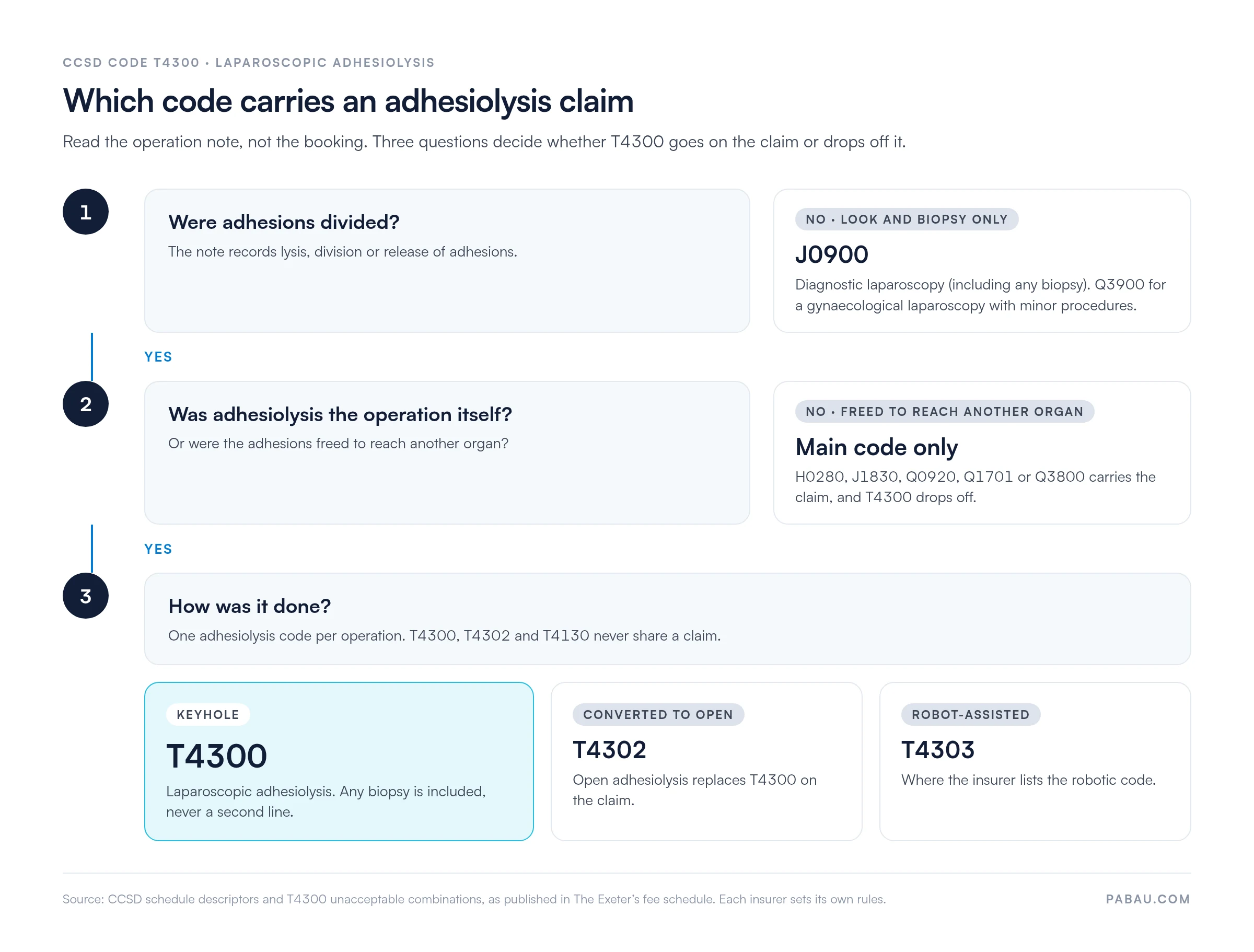
Before selecting T4300, search the operation note for the words lysis, division or release of adhesions. If they appear in the findings or technique, T4300 may apply. If the note records only inspection and biopsy, look at J0900 instead.
CCSD lists unacceptable combinations for each code: pairs an insurer will not pay together, because one already includes the other. The Exeter’s schedule reproduces the T4300 list, which runs to more than 100 codes. The ones most likely to come up are below.
The pattern is consistent. When adhesions are divided to reach the organ being operated on, the main procedure code carries the claim and T4300 drops off.
Our guides to H0280 and J1830 show the same rule from the appendicectomy and gallbladder sides. Each insurer decides which combinations it enforces, so check its own schedule before adding a second code.
Included in T4300:
Billed by others, not on the surgeon’s T4300 invoice:
Insurers rarely ask for the full record on a routine claim. When they query one, the operation note is the first document they want. A note that holds up answers six questions.
Structured digital forms built around these six points make the note complete every time. Patient records that keep the assessment, operation note and histology on one timeline let billing staff check the claim before it leaves.
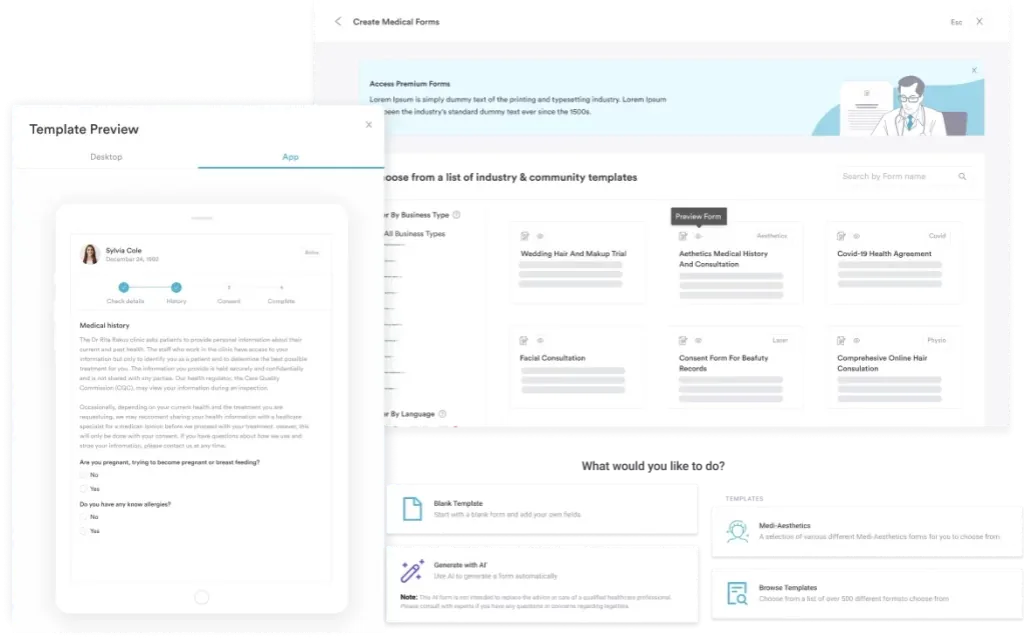
Pre-authorisation for T4300 comes from the patient’s private medical insurer, before the operation. Without an authorisation number, the claim is likely to be rejected however good the clinical case.
When the patient or the practice calls the insurer, have these ready:
Recognition matters too. The surgeon must be registered with the General Medical Council and recognised by the insurer before it pays the surgeon’s fee. Bupa, for example, lists its procedure codes in its online code search. Rules vary by insurer and policy, so confirm them for each patient.
If the operation turns out to be urgent, record the urgency clearly in the notes. Then contact the insurer as soon as possible about a retrospective authorisation, since policies differ on whether they allow one.
Each UK insurer sets its own fee for T4300, and there is no national reference price list. The published figures below show how far the surgeon’s fee varies between insurers.
Three invoices usually follow one T4300 operation:
A surgeon who charges above the insurer’s fee may leave the patient with a shortfall to pay. Tell the patient about it before surgery, in writing.
CCSD codes carry no US-style modifiers. Second procedures are handled through the unacceptable combinations list, and each insurer sets its own rules on top.
Before an assistant surgeon joins a T4300 case, confirm that the insurer pays for one. Also check that the assistant is GMC registered and recognised by that insurer.
Rejected T4300 claims follow a familiar pattern. Here are the usual causes, with the fix for each one.
Surgical practices often keep the operation note in one system and the claim in another. The authorisation number and diagnosis then get retyped, and errors creep in. Pabau, a practice management platform, keeps the note, the invoice and the claim on one patient record.
The procedure code attached to the service carries through to the invoice. Before the claim can be sent, Pabau checks required fields such as the membership and authorisation numbers. The claims management software then submits it to UK insurers through Healthcode.
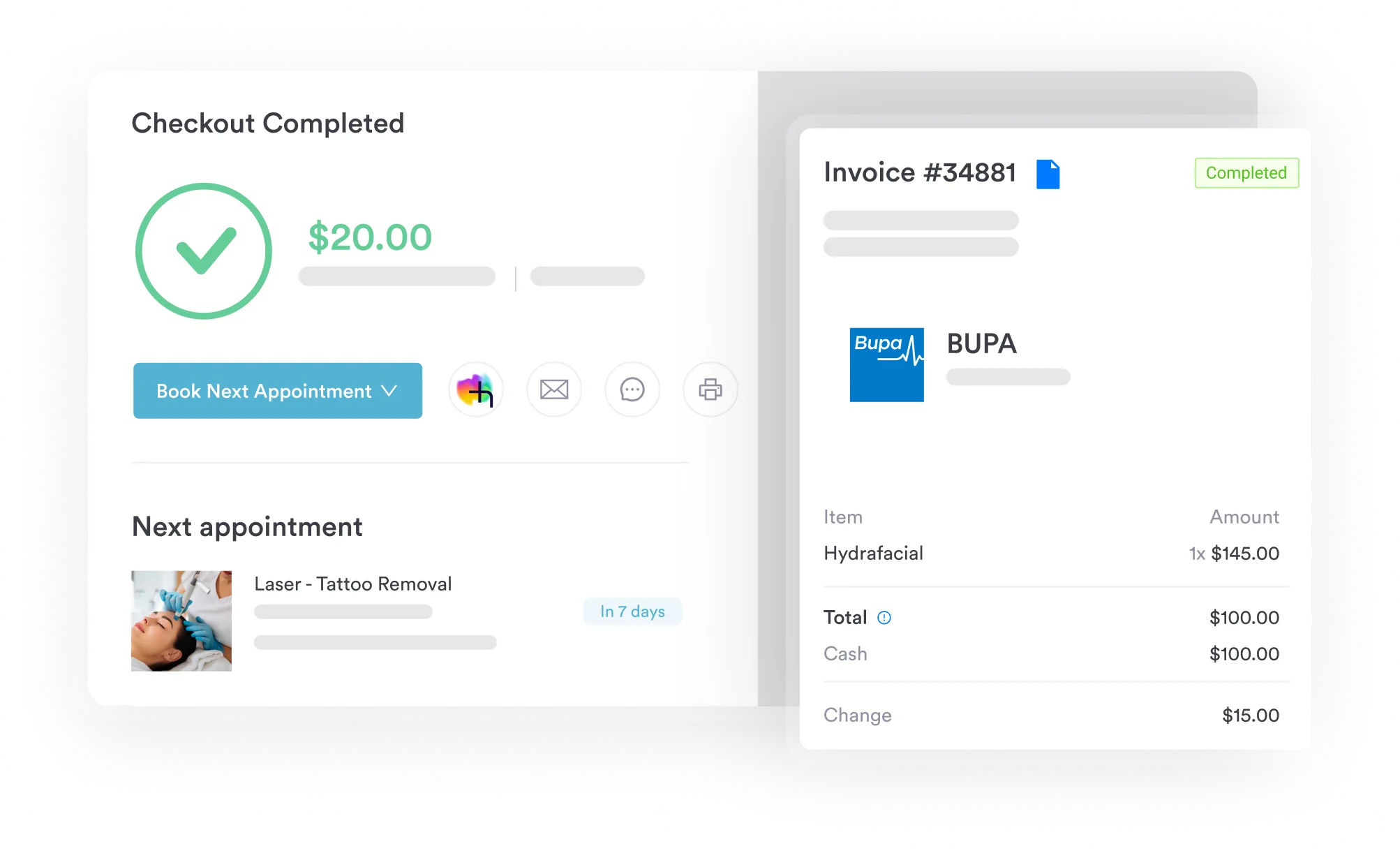
Operation notes and histology reports stay in the patient’s record, ready if the insurer sends a query. For gynaecology practices, the same record holds the pre-operative assessment that justified the authorisation.

Pabau keeps operation notes, authorisation numbers and insurer claims on one patient record, then submits claims to UK insurers through Healthcode.

T4300 is often the code that drops off the claim, not the one that carries it. When adhesions are freed to reach an appendix, a fibroid or endometriosis, the main operation code already pays for that work. T4300 earns its place when adhesiolysis is the operation itself.
So decide the code from the note, not the booking. Confirm that adhesiolysis was the main procedure, match the WHO ICD-10 code to the findings, and get the insurer’s authorisation for T4300 before surgery. Book a demo to see how Pabau keeps surgical notes and insurer claims in step.

Need a broader CCSD billing reference? Bupa CCSD codes and fee schedule covers the full CCSD structure, chapter organisation and UK insurer billing context.
CCSD code T4300 covers laparoscopic adhesiolysis, the keyhole division of abdominal or pelvic adhesions. Any biopsy taken in the same operation is included in the code. So a biopsy is never billed as a separate line on the same claim.
The biopsy is included in T4300, as the descriptor says: laparoscopic adhesiolysis (including biopsy). Billing a separate biopsy or diagnostic laparoscopy code alongside it will be rejected. The histology itself is invoiced by the pathology provider, not the surgeon.
UK insurers use WHO ICD-10, and the usual pairings are K66.0 (peritoneal adhesions) and N73.6 (female pelvic peritoneal adhesions). N99.4 covers postprocedural pelvic adhesions, and K56.5 covers adhesions with obstruction. Choose the code that matches the findings in the operation note.
Yes. UK private medical insurers such as Bupa, AXA Health, Aviva and Vitality expect an authorisation number before a planned T4300 operation. Give the insurer the code, the WHO ICD-10 diagnosis and the clinical reasons. The surgeon must also be GMC registered and recognised by that insurer.
No. J0900, diagnostic laparoscopy (including any biopsy), is an unacceptable combination with T4300. The look around the abdomen is part of the adhesiolysis. Bill T4300 alone when adhesions are divided.
The usual causes are a missing authorisation number and a thin operation note. Others are a diagnosis code that does not match the findings, or a second code from the unacceptable combinations list. Each one can be caught with a short check before the claim is sent.





