HCPCS code G0257: Unscheduled or emergency dialysis billing guide
HCPCS code G0257: Official descriptor and code overview HCPCS code G0257 is defi...

Last Updated: Oct 27, 2026
H3322 is the CCSD code for laparoscopic abdominoperineal resection +/- stoma, used in UK private medical insurance billing. The surgeon removes the rectum and anus through keyhole ports and a perineal incision, and the procedure ends with a permanent end colostomy.
H3322 sits in CCSD chapter 11.6.0 Rectum/Anus. The code turns on the abdominal approach: Open resection is H3320, and robotic-assisted resection is H3324.
Let Pabau's smart automation suggest the right codes, reduce claim denials, and keep your practice compliant—effortlessly.
Automate repetitive tasks and focus on what matters most—your patients.
Reduce coding errors and ensure compliance with the latest regulations.
Clean claims, fewer denials, and faster reimbursements.
Powerful insights and reporting to help your practice thrive.
HIPAA compliant SOC 2 certified GDPR-compliant Trusted by 4,000+ clinics worldwide

CCSD code H3322 covers the laparoscopic approach only. Open abdominoperineal resection is coded H3320, and the robotic-assisted version is H3324.
Abdominoperineal resection always ends with a permanent end colostomy, because the rectum and anus are both removed.
UK private insurers including Bupa, AXA Health, and Aviva require pre-authorization before this procedure, so check each insurer’s current provider handbook.
Pabau, the practice management platform we build, tracks pre-authorization references and submits CCSD-coded claims for UK private practices.
CCSD code H3322 is the private healthcare billing code for laparoscopic abdominoperineal resection of the rectum and anus. Its official descriptor is “Laparoscopic abdominoperineal resection +/- stoma”, and it sits in CCSD chapter 11.6.0 Rectum/Anus.
The code applies only where the surgeon completes the procedure using laparoscopic (keyhole) techniques. Where the same operation is performed through an open incision, the correct code is H3320. A robotic-assisted resection takes its own code, H3324. Choosing between these approach codes is where most errors in this procedure family start.
Verify the current descriptor and any fee updates against the CCSD schedule maintained by the Clinical Coding and Schedule Development Group. Codes and fees are reviewed annually. For neighboring procedures, browse our full library of CCSD codes.
Laparoscopic abdominoperineal resection (also called laparoscopic APR or Miles’ procedure) removes both the rectum and the anus. The surgeon combines abdominal dissection through keyhole ports with a perineal dissection. Because both structures are excised, bowel continuity cannot be restored, and the procedure always ends with a permanent end colostomy.
Where the sphincter can be preserved, the surgeon usually performs a low anterior resection instead, which is coded H3334.
Clinical coders need to understand the operative steps to audit the operative note correctly. The key stages are:
The operative note must confirm the laparoscopic approach and describe each of these phases. A note that records only the abdominal component is insufficient to support an H3322 claim. It also needs the perineal dissection and the stoma formation.
H3322 is indicated when a patient requires complete removal of the rectum and anus and sphincter preservation is not oncologically or anatomically feasible. The primary indications, with their accompanying ICD-10 diagnosis codes, are:
The diagnosis code must reflect the pathology confirmed in the histopathology report and the MDT decision to proceed to abdominoperineal resection. When that pathology is rectal cancer, the claim pairs with C20. ICD-10 codes are maintained by NHS Digital. Verify the current edition for the billing year via the NHS Classifications Browser.
H3322 covers the laparoscopic approach, and H3320 covers open abdominoperineal resection. The procedural steps are identical in both. The sole distinguishing factor is the surgical approach used to complete the abdominal phase, so coders must confirm it from the operative note before choosing.
A third approach code completes the set, and the decision below maps each operative-note finding to its code.
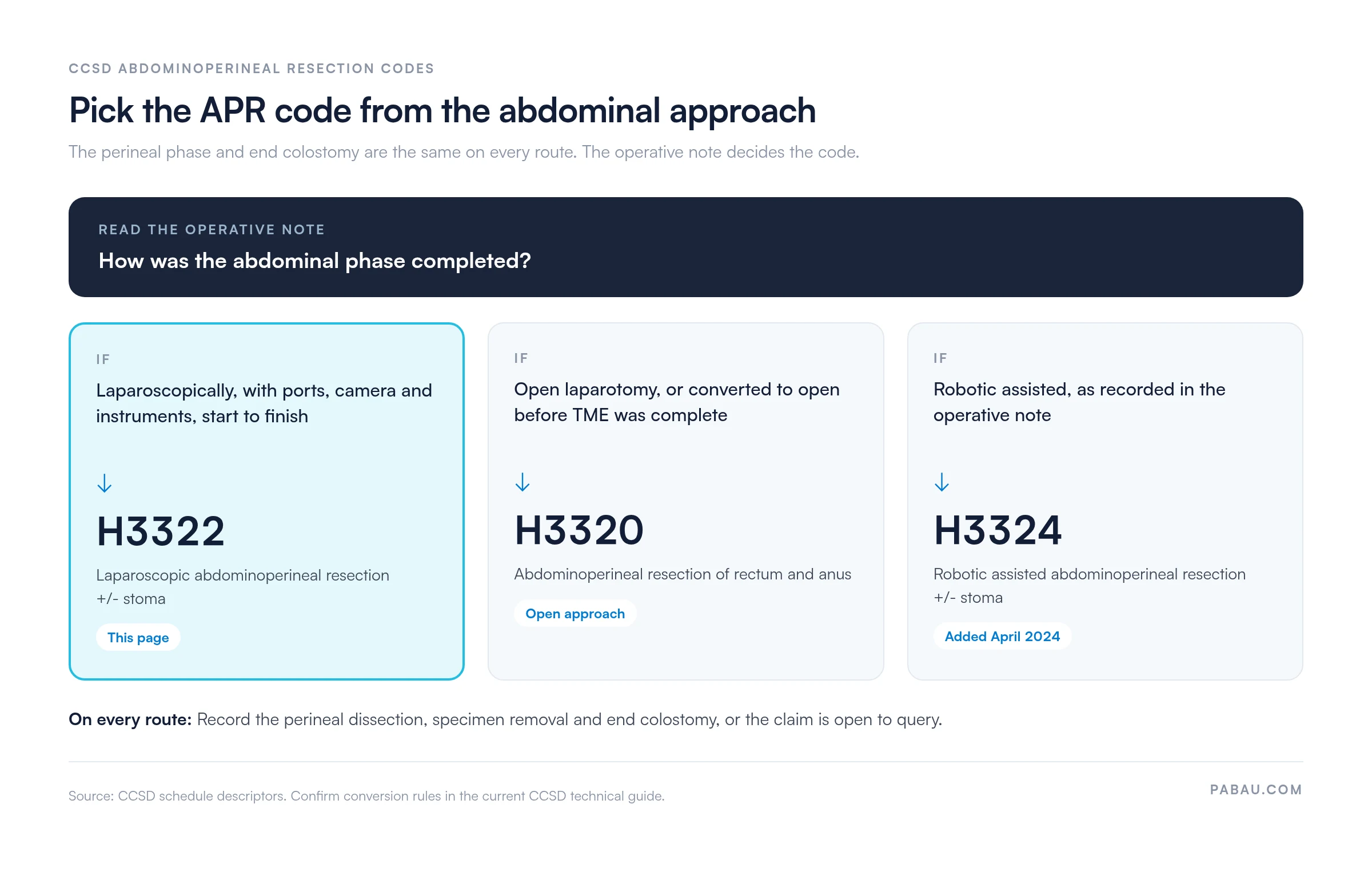
When a laparoscopic APR is converted to open during the operation, the general CCSD coding principle is to code the procedure as completed. If the abdominal phase was converted before TME was complete, the appropriate code is H3320, because the procedure was ultimately performed open. Confirm the specific conversion rule against the current CCSD technical guide, as payer-specific guidance may apply.
The operative note must clearly record the point of conversion, the reason for it, and how the rest of the case was conducted. Ambiguous conversion documentation is a common source of claim queries from insurers.
CCSD code H3322 sits within a short series of abdominoperineal resection codes. Knowing the adjacent codes prevents miscoding and supports accurate cross-referencing when a claim query arrives.
Use the Bupa code search tool to confirm descriptors and current fee rates for H33-series codes when preparing Bupa claims. For the full CCSD code structure and bundling rules, refer to the official CCSD schedule.
A valid H3322 claim requires an operative note that confirms the laparoscopic approach and all three procedural components. Those are abdominal dissection, perineal excision and stoma formation. Missing documentation on any component gives the insurer grounds to query or deny the claim.
The operative note should record:
UK private practice documentation standards go beyond NHS requirements, because each insurer applies its own audit criteria. Store the operative note, anesthetic record and histopathology request together in the patient record at the time of claim submission.
H3322 is never submitted alone. A complete H3322 claim requires the following accompanying codes and supporting documentation.
The permanent colostomy is an integral, inseparable component of abdominoperineal resection. The procedure cannot be completed without it, so stoma formation is generally considered inclusive within H3322. Billing a separate stoma formation code alongside H3322 risks a bundling denial.
Drain insertion and wound closure are similarly routine components of the operation and are not separately billable. The CCSD schedule defines what is and is not separately claimable. Confirm its bundling rules for H3322 before claim submission.
Every major UK private medical insurer (PMI) requires pre-authorization before an abdominoperineal resection proceeds. Without a valid pre-auth reference number, the claim will be denied even when H3322 is coded correctly.
Pre-authorization requirements and evidence thresholds change, so always verify against the current provider handbook. Bupa’s code lookup and pre-auth guidance sit in the same Bupa code search portal linked above. AXA Health maintains its procedure codes and fee chapters on the AXA Health specialist forms portal. Aviva publishes pre-auth and fee details on the Aviva provider fee schedule.
For practices managing multiple PMI relationships, our guide to Bupa CCSD codes gives a procedure-level view of Bupa’s coding expectations.
H3322 claim denials almost always fall into one of five categories. Identifying the denial pattern early reduces the time to resolution.
Flag H3322 claims for a documentation audit before submission. Confirm three things. The operative note records laparoscopic port placement, the perineal phase and colostomy formation are documented, and the pre-auth reference matches the CCSD code being submitted. Catching these on the way out prevents a denial cycle and delays payment.
A single H3322 case creates several linked billing tasks for a UK private colorectal practice. Staff track the pre-auth, submit the claim and match the operative note to the insurer record. Each payer runs its own portal and timeline, so errors compound when those tasks live in separate systems.
Pabau’s claims management software handles CCSD-coded claim submission and pre-authorization tracking inside one patient record. Billing staff store the pre-auth reference alongside the patient episode and link the clinical note to the claim. Insurer responses are tracked in the same place, so nobody switches between portals to chase an APR claim.
The result is a repeatable sequence for complex surgical cases. The pre-auth reference, CCSD code and operative note stay auditable in one record. When an insurer queries the claim, billing staff have the full answer to hand.

Pabau helps UK private practices track pre-auth references, submit CCSD-coded claims, and keep patient records linked to each authorization. Book a demo to see how it handles complex surgical billing.

Treat the operative note as the deciding document for every APR claim. Before anyone picks between H3322, H3320 and H3324, the note has to name the abdominal approach and any conversion point. It also has to record the perineal phase and the colostomy.
Practices that audit the note and the pre-auth reference before submission spend less time on resubmissions. The trade-off is a few minutes of checking per case, set against rounds of insurer correspondence. Book a demo to see how Pabau keeps the pre-auth, the code and the operative note together for each surgical claim.

Need the open-approach code? CCSD code H3320 covers open abdominoperineal resection and the documentation that separates it from H3322.
Was the sphincter preserved? CCSD code H3334 explains how low anterior resection is coded and documented.
Coding the diagnosis side of the claim? ICD-10 code C20 sets out the rectal cancer diagnosis code that most APR claims pair with.
Managing Bupa claims for multiple CCSD codes? Bupa CCSD codes and billing guide covers Bupa’s coding requirements and fee schedule navigation for UK private practice.
Want to reduce claim admin time for surgical cases? Pabau claims management software tracks pre-authorizations, CCSD codes, and insurer responses in one place.
CCSD code H3322 covers laparoscopic abdominoperineal resection, the removal of the rectum and anus using keyhole techniques. The procedure ends in a permanent end colostomy. UK private billing uses it when the abdominal phase is completed laparoscopically, as distinct from the open approach under H3320.
H3320 covers open abdominoperineal resection, and H3322 covers the laparoscopic equivalent. The oncological scope, perineal phase, and permanent colostomy are identical in both. The only distinguishing factor is the abdominal approach: Open laparotomy for H3320, laparoscopic ports and instruments for H3322. Coders must confirm the approach from the operative note before choosing.
Yes, permanent colostomy formation is an integral component of abdominoperineal resection and is generally considered inclusive within H3322. Billing a separate stoma formation code alongside H3322 is likely to trigger a bundling denial. Confirm the current bundling rules against the CCSD schedule before submission, as rules are reviewed periodically.
The general CCSD principle is to code the procedure as it was completed. If the case was converted from laparoscopic to open before the TME was completed, code H3320. The operative note must record the point and reason for conversion clearly. Confirm the specific conversion rule against the current CCSD technical guide, as insurer-specific guidance may apply.
Yes. Bupa requires pre-authorization for abdominoperineal resection before the procedure takes place. The pre-authorization reference number must appear on the claim. Bupa typically requires a confirmed diagnosis, the MDT outcome, and the intended CCSD code as part of the request. Verify current requirements via the Bupa provider portal, as pre-auth thresholds are updated regularly.
H3322 is a CCSD code used only in UK private medical insurance (PMI) billing. NHS procedures are billed through the NHS tariff and HRG (Healthcare Resource Group) coding, not CCSD codes. Coders in private hospitals and independent sector treatment centers submit H3322 to insurers such as Bupa, AXA Health, and Aviva. NHS providers do not use this code.