CCSD code H0410: Panproctocolectomy and ileostomy
CCSD code H0410: What it covers and when to use it CCSD code H0410 sits within t...

Last Updated: Nov 23, 2026
H0610 is the CCSD code for extended excision of right hemicolon.
Let Pabau's smart automation suggest the right codes, reduce claim denials, and keep your practice compliant—effortlessly.
Automate repetitive tasks and focus on what matters most—your patients.
Reduce coding errors and ensure compliance with the latest regulations.
Clean claims, fewer denials, and faster reimbursements.
Powerful insights and reporting to help your practice thrive.
HIPAA compliant SOC 2 certified GDPR-compliant Trusted by 4,000+ clinics worldwide

CCSD Code H0610 describes an extended excision of right hemicolon, removing more colon than a standard right hemicolectomy (H0600).
The most common indications are right-sided colorectal malignancy (C18.0, C18.2) and Crohn’s disease affecting the terminal ileum or right colon (K50.1).
Prior authorisation from the medical aid is required before surgery; the operative note must document the specific anatomical segments removed and the anastomosis type.
Pabau’s claims management and digital documentation tools help colorectal surgery practices submit H0610 claims with the correct ICD-10 pairings and complete operative records.
CCSD Code H0610 is the designated code for an extended excision of right hemicolon under the Coding Conventions for South African Doctors (CCSD), the tariff and procedure coding framework used across the private healthcare sector in South Africa. The adjacent code H0600 covers a standard right hemicolectomy; H0610 applies specifically when the resection is extended beyond the standard boundaries, typically including a greater length of transverse colon and, depending on the clinical situation, structures approaching the mid-transverse colon or beyond.
The distinction between H0600 and H0610 is surgical extent, not approach. Both codes may apply to open and laparoscopic procedures; what determines which code is correct is how much colon is removed, documented in the operative note.
An extended right hemicolectomy removes the cecum, the full ascending colon, the hepatic flexure, and a substantial portion of the transverse colon beyond what a standard right hemicolectomy would include. In oncological cases, this additional resection is driven by lymphovascular territory: When a tumour sits at or near the hepatic flexure, the draining lymphatic field extends toward the middle colic vessels, requiring wider excision to achieve adequate nodal clearance.
The terminal ileum is resected proximally, and an ileocolic anastomosis restores bowel continuity. Standard steps include:
The histopathology specimen is a mandatory component of the surgical episode. Its submission is both a clinical requirement for staging and a documentation anchor that payers may check during audit to confirm the procedure described in the operative note actually occurred.
Right-sided colorectal malignancy is the most common indication. When the tumour is located at the hepatic flexure or the proximal transverse colon, an extended resection is required to achieve adequate oncological margins and mesenteric lymph node clearance. The table below maps the principal indications to their corresponding ICD-10 codes:
Always verify ICD-10 codes against the specific edition in use in South Africa and confirm that the documented diagnosis matches the submitted code exactly. Mismatches between the clinical record and the billing code are a primary trigger for medical aid audit requests.
CCSD H0610 covers the procedure regardless of surgical approach. The same code applies to both open (laparotomy) and laparoscopic (minimally invasive) extended right hemicolectomy, including robotic-assisted cases. The code describes the extent of resection, not the access method. Where a payer requests differentiation between approaches, this is typically handled via a modifier or a motivating letter attached to the claim, rather than a separate procedure code.
Coders should note that if a laparoscopic procedure is converted to open intraoperatively, the operative note must document the conversion. Bill H0610 for the completed procedure (open), and include the conversion note to prevent queries from the medical aid about approach-related tariff differentials.
The H06xx block covers major colonic resections. Selecting the wrong code from this group is the most common H610 mis-coding error, because the clinical distinctions are subtle and the code descriptors are similar in structure. The table below shows the key H-series neighbours:
Common mis-coding error: Billing H0600 when the operative note clearly states that more than the standard extent of transverse colon was removed. This under-codes the procedure and results in underpayment. The reverse error, billing H0610 for a standard hemicolectomy, risks payer audit and potential recovery action. The operative note is the arbiter.
Always read the operative note before selecting between H0600 and H0610. Look for two specific phrases: (1) the named anatomical endpoint of the distal transverse resection margin (e.g. ‘transverse colon at the junction of the right and middle thirds’), and (2) explicit reference to middle colic vessel ligation, which signals that an extended resection was performed.
The operative note is the single most important document for an H0610 claim. Medical aids audit this code partly because extended hemicolectomies carry a higher tariff than standard procedures; a note that does not explicitly justify the “extended” designation will trigger a downcode request or outright rejection. Use digital surgical documentation to ensure operative records are structured, timestamped, and immediately available for submission with the claim.
The operative note must contain:
Absent or vague operative notes are the most cited reason for H0610 claim audits. A note that reads “right hemicolectomy performed, bowel anastomosed” does not support H0610. It supports H0600 at best, and may not support either if it fails to describe the extent of resection.
All major South African medical aids require prior authorisation for major colorectal surgery, including procedures billed under CCSD Code H0610. Authorisation must be obtained before the procedure takes place, except in documented emergencies. Retrospective authorisation is possible in emergency cases but requires additional clinical motivation and is subject to scheme discretion under the Medical Schemes Act 131 of 1998, which governs scheme obligations regarding claims adjudication.
Standard prior authorisation requirements across Discovery Health, Bonitas, Medscheme/Fedhealth, and Momentum Health typically include:
Always verify current requirements directly with the specific scheme before submission. Authorisation requirements change with annual scheme rule updates and are not standardised across payers. An authorisation obtained from one scheme’s clinical team cannot be assumed to reflect another scheme’s current criteria.

Pabau helps South African colorectal surgery practices structure operative documentation, attach ICD-10 codes to procedures, and manage prior authorisation workflows, so claims go out complete and come back paid.

CCSD Code H0610 claims attract scrutiny because the tariff is higher than H0600 and the clinical threshold between the two codes is not always obvious from an administrative file. The table below maps the most frequent denial reasons to their corrective actions:
CCSD bundling conventions incorporate the ileocolic anastomosis into the H0610 tariff. Billing a separate anastomosis code on the same claim constitutes unbundling and is a common trigger for denial or recovery action. The following are considered bundled into H0610 and cannot be billed separately:
The following may be billable as separate codes when they represent genuinely distinct, separately documented procedures. Coders should verify these against the current CCSD tariff book and the specific medical aid’s scheme rules before submitting, as payer interpretation varies and unbundling carries significant compliance risk under South African medical scheme regulations:
When uncertain, the safer position is to contact the scheme’s coding desk before submission rather than bill and dispute after the fact. The Board of Healthcare Funders (BHF) publishes coding guidance that informs how member schemes interpret bundling conventions; this guidance is worth consulting for complex colorectal claims.
If a stoma was formed at the same sitting as H0610, check whether the scheme authorised both the colonic resection and the stoma formation separately. Schemes that authorise H0610 as an oncological admission may not automatically cover a stoma if it was not explicitly listed in the pre-authorisation request.
Accurate CCSD H0610 billing depends on two things: The right code being selected and the supporting documentation being available at the moment of claim submission. Practice management software built for the South African private healthcare environment can address both. Pabau’s claims management tools allow colorectal surgery practices to attach procedure codes and ICD-10 diagnosis codes to patient episodes, flag missing documentation before a claim is submitted, and maintain a structured audit trail.
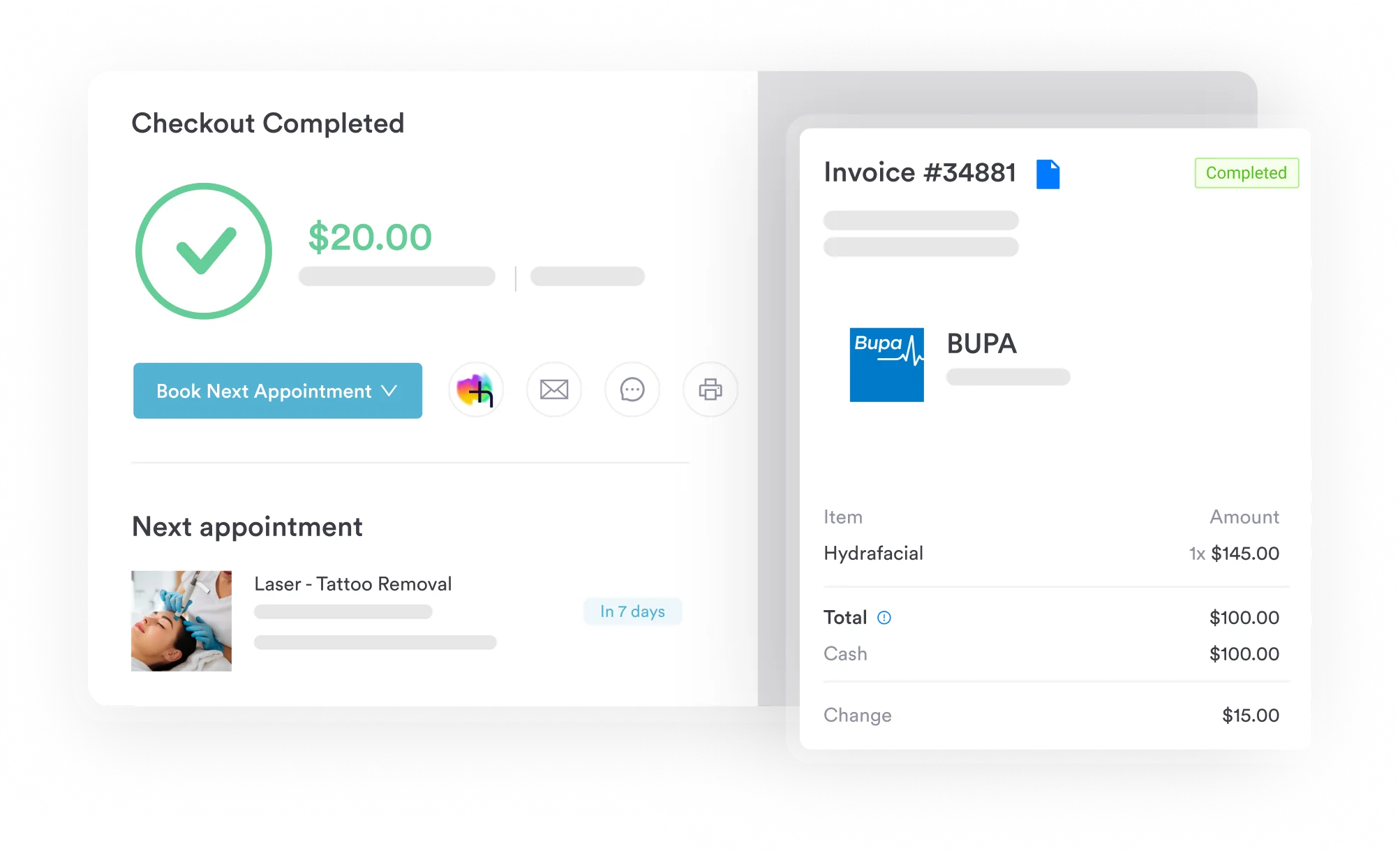
For surgical practices billing H0610 regularly, the highest-value workflow changes are upstream of the claim itself. Structured operative note templates, pre-authorisation tracking, and automatic attachment of histopathology results to the billing record prevent the documentation gaps that generate most H0610 denials. Pabau’s clinic software for South Africa is configured for the private sector, supporting CCSD code workflows alongside patient records and billing in a single system.
Practices managing high volumes of colorectal surgery claims should also consider how their billing software handles billing software comparisons for South African practices when evaluating platforms. The key requirements for H0610 workflows are: CCSD code library integration, ICD-10 pairing at the procedure level, prior authorisation status tracking, and the ability to attach operative notes and histopathology reports directly to the claim record.
CCSD Code H0610 claims succeed or fail on documentation specificity. The extended designation must be supported by the operative note, the ICD-10 code must match the histopathology, and the prior authorisation must name H0610 rather than the adjacent standard code H0600. These three elements, together with correct bundling (anastomosis in, stoma out when separately authorised), represent the complete H0610 billing pathway.
Pabau helps South African surgical practices structure their documentation and claims workflows so that H0610 submissions go out complete on first attempt. To see how the platform handles CCSD coding and medical aid claim tracking, book a demo.

Need a broader CCSD billing reference for private practice? Bupa CCSD procedure codes covers how CCSD codes are structured, submitted, and adjudicated across major private health insurers.
Looking for South African clinic software that handles medical aid billing? Clinic software for South Africa reviews the platforms most used in the private healthcare sector and what to look for in a CCSD-compatible system.
Want to understand what a clean claim looks like before submission? Claims management tools outlines how structured billing workflows reduce denial rates across surgical practices.
CCSD Code H0610 is the South African private-sector procedure code for an extended excision of right hemicolon, covering a colonic resection that removes the cecum, full ascending colon, hepatic flexure, and a larger portion of transverse colon than a standard right hemicolectomy (H0600). The code applies to both open and laparoscopic approaches and includes the ileocolic anastomosis as a bundled component.
H0600 covers a standard right hemicolectomy with resection to the mid-transverse colon; H0610 applies when the resection is extended further into the transverse colon, typically with wider mesenteric clearance. The distinction is based on what the operative note documents as the distal resection margin, not on approach or anastomosis technique.
Bill H0610 for a laparoscopic extended right hemicolectomy using the same code as for an open procedure; CCSD H0610 covers both approaches. If the scheme requires differentiation, attach a motivation letter specifying the laparoscopic approach. If the procedure was converted to open, document the conversion in the operative note and bill H0610 for the completed open procedure.
The most common pairings are C18.0 (malignant neoplasm of cecum), C18.2 (malignant neoplasm of ascending colon), C18.3 (malignant neoplasm of hepatic flexure), K50.1 (Crohn’s disease of large intestine), and K56.2 (cecal volvulus). Always use the most specific code available and confirm it matches the histopathology report. Verify codes against the edition of ICD-10 currently in use in South Africa with guidance from the WHO ICD-10 browser.
No. Under CCSD bundling conventions, the ileocolic anastomosis is included in the H0610 tariff and cannot be billed as a separate code on the same claim. Billing an anastomosis code alongside H0610 constitutes unbundling and is a common cause of claim denial and potential compliance action.
The most frequent denial reasons are: A prior authorisation issued for H0600 rather than H0610, an operative note that does not document the extended resection extent, an ICD-10 mismatch between the clinical record and the submitted code, and unbundling of the anastomosis as a separate item. Missing or retrospective authorisation on elective cases is also a common trigger.