CPT Code 62284: Injection procedure for myelography
CPT Code 62284: official descriptor and procedure overview The American Medical ...

Last Updated: Oct 19, 2026
E5480 is the CCSD code for lung resection with resection of chest wall. It covers removing part of a lung with the adjacent chest wall, typically one or more ribs and intercostal muscle, as one en bloc specimen.
The code sits in sub-chapter 8.5.0 Bronchi/Lungs/Pleura. Pancoast tumors are the classic indication. It applies only when the operative note documents both components, and it is billed instead of separate lung and chest wall codes.
Let Pabau's smart automation suggest the right codes, reduce claim denials, and keep your practice compliant—effortlessly.
Automate repetitive tasks and focus on what matters most—your patients.
Reduce coding errors and ensure compliance with the latest regulations.
Clean claims, fewer denials, and faster reimbursements.
Powerful insights and reporting to help your practice thrive.
HIPAA compliant SOC 2 certified GDPR-compliant Trusted by 4,000+ clinics worldwide

CCSD code E5480 covers lung resection combined with chest wall resection, not a simple lobectomy or pneumonectomy alone.
Both the pulmonary and chest wall components must be explicitly documented in the operative note for the code to be supported.
Major UK private insurers generally require prior authorization before E5480 surgery, so confirm each insurer’s current rules first.
Submitting separate lung and chest wall codes instead of the single E5480 code is an unbundling error that insurers reject.
E5480 sits in CCSD sub-chapter 8.5.0 Bronchi/Lungs/Pleura, within chapter 8.0.0 Thorax & Intra-Thoracic Organs.
CCSD code E5480 is the procedure code for lung resection with resection of the chest wall. It belongs to the CCSD (Clinical Coding and Schedule Development Group) procedure schedule, which UK private healthcare uses to bill this combined thoracic operation. E5480 applies only when lung tissue and adjacent chest wall structures are removed in the same operative episode.
CCSD codes are the coding standard UK private insurers use for procedure billing, including Bupa, AXA Health, Vitality, Aviva, WPA and Cigna. Codes are assigned per operative procedure, and the code you select decides what the insurer reimburses.
Billing a simpler lung resection code when chest wall structures were also removed is a miscoding error. It typically leads to underpayment or, if an audit finds it, a request to recover funds.
CCSD organizes its codes by anatomical chapter. E5480 sits in sub-chapter 8.5.0 Bronchi/Lungs/Pleura, inside chapter 8.0.0 Thorax & Intra-Thoracic Organs. It does not apply when a surgeon performs a lobectomy and separately documents a minor pleural procedure. The chest wall resection must be a documented part of the same surgical episode.
Lung resection with chest wall resection is a major thoracic operation. The surgeon removes part of the lung together with an adjacent section of the chest wall.
That section typically includes one or more ribs and the intercostal muscles, and sometimes the overlying periosteum or pleura. The hallmark is en bloc resection. The lung and chest wall come out as one specimen, with the tumor still attached to the tissue it invaded.
Surgeons most often use a posterolateral thoracotomy, which gives direct access to the posterior and lateral chest wall. Some use video-assisted thoracoscopic surgery (VATS) techniques in selected cases. Even so, the technical demands of en bloc chest wall resection keep open thoracotomy the main approach.
A standard lobectomy removes a lobe of the lung and leaves the chest wall intact. E5480 procedures add the operative steps below, and each one adds time, anesthetic risk and rehabilitation burden.
E5480 is used when a thoracic cancer or other disease has spread into the chest wall far enough to need en bloc resection. That resection achieves oncological clearance or a satisfactory surgical margin. The indications fall into four groups.
Pancoast tumors are the classic indication. These apical lung cancers grow at the thoracic inlet. They often involve the first or second rib, the subclavian vessels, the brachial plexus roots or the vertebral body.
En bloc resection of lung and chest wall is the standard surgical approach for a resectable Pancoast tumor. Thoracic oncology literature and Society for Cardiothoracic Surgery in Great Britain and Ireland (SCTS) guidance both reflect this.
The decision to proceed rests on pre-operative staging (CT, PET and MRI), multidisciplinary team (MDT) agreement and findings during surgery. The code does not apply when the surgeon simply excises a pleural adhesion or takes a superficial pleural biopsy next to a lobectomy.
Picking the right code in the thoracic chapter means knowing what each code includes and excludes. E5480 miscoding usually goes one of two ways. Coders either downcode to a simpler lung resection code, or unbundle the procedure into separate lung and chest wall codes.
Both create claim problems, and the three questions below settle most cases before you reach the scenario table.
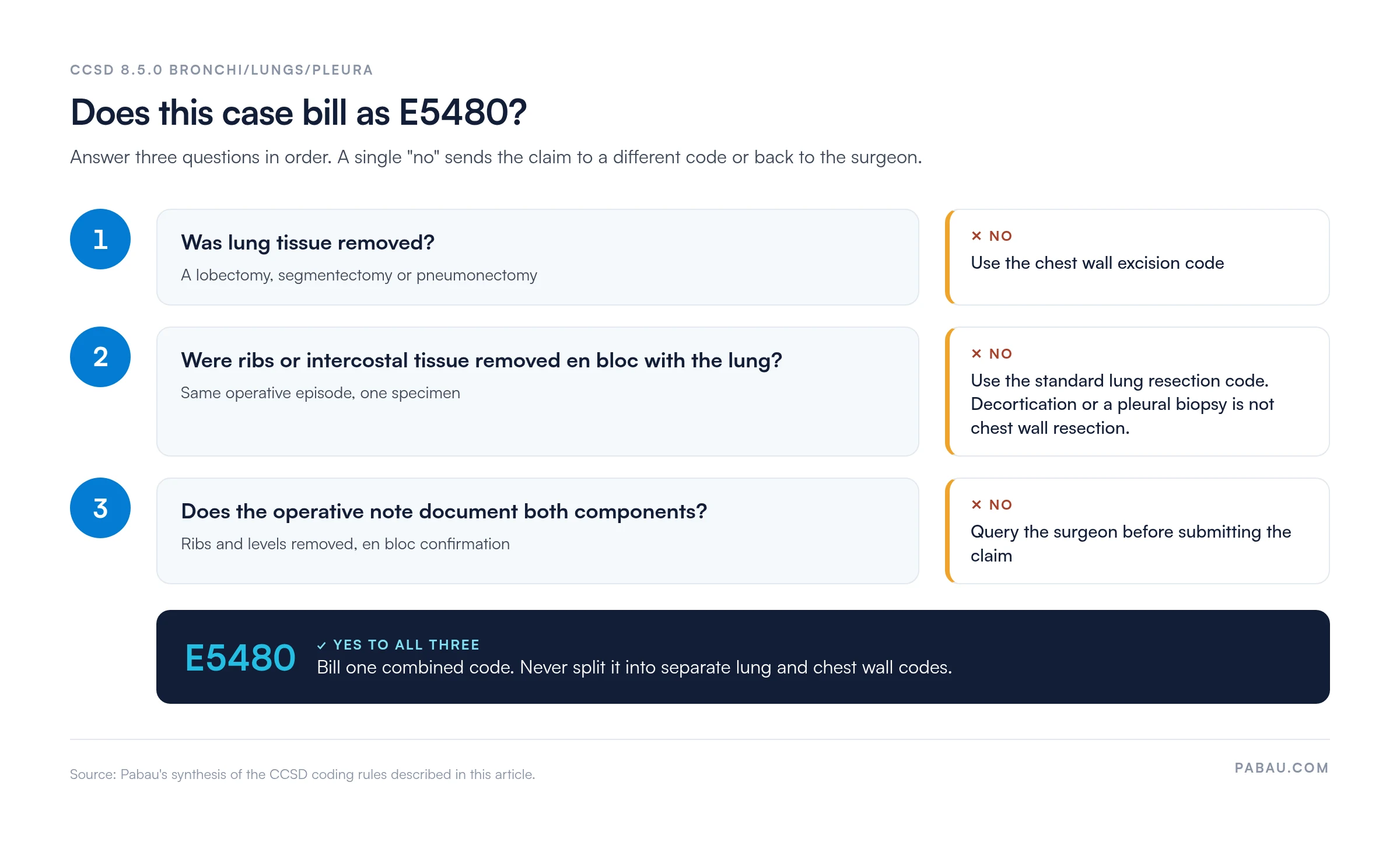
Unbundling E5480 into a lung resection code plus a chest wall excision code breaks standard CCSD coding principles. When both procedures happen in one operative episode, the combined code applies. Two separate codes will typically see one denied as a duplicate or bundled component. A thoracoscopic wedge resection that leaves the chest wall intact bills under E5442 instead.
Coders who work across private and NHS settings, or bill mixed-payer cases, need to cross-reference E5480 against OPCS-4. OPCS-4 (Office of Population Censuses and Surveys Classification of Interventions and Procedures) is the NHS standard for coding surgical procedures. Its alphanumeric structure differs from the CCSD system.
In OPCS-4, lung resections sit mainly in Chapter E, which covers the respiratory tract.
A combined lung and chest wall resection typically takes an E-range primary code for the lung, plus a subsidiary code for the chest wall. The NHS Classifications Browser is the authoritative lookup for current OPCS-4 codes. Check the exact sub-code against the current OPCS-4 release rather than a historical mapping, since sub-codes change between releases.
The general mapping works like this. CCSD E5480 corresponds to an OPCS-4 primary E-range code for the lung component, meaning the specific lobectomy, segmentectomy or pneumonectomy. A T-range or E-range subsidiary code then covers the chest wall excision.
OPCS-4 pairs a primary code with a subsidiary code instead of using one bundled code. Coders moving between the systems should never treat the OPCS-4 primary code alone as the CCSD equivalent.
When cross-referencing CCSD E5480 to OPCS-4, always check the NHS Classifications Browser for the current coding year. OPCS-4 sub-codes for combined thoracic resections change between releases. A superseded code in a mixed-payer case can trigger a claim query. Document both the primary pulmonary code and the subsidiary chest wall code in your operative record.
The operative note is the primary document behind an E5480 claim. Because the code covers a combined procedure, the note must describe both components explicitly.
A clinical coder reading it should be able to confirm the lung resection, the chest wall resection and en bloc removal. A note that describes a lobectomy without chest wall involvement will not support E5480, whatever happened in the operating room.
Private insurers typically review the operative note during claims processing or audit. Thin documentation of the chest wall component is one of the most common reasons E5480 claims get queried or denied. An operative note template that prompts for rib levels and en bloc confirmation catches the omission before the claim goes out.
The histopathology report confirming en bloc resection and margin status is a key supporting document. Insurers may also ask for the pre-operative MDT outcome letter and the radiology report showing chest wall invasion. Some request the anesthetic record too. Together, these documents establish medical necessity for the combined procedure. That matters most when prior authorization was not obtained before surgery.
Major UK private insurers generally require prior authorization for elective major thoracic resections, including E5480 procedures, so confirm each insurer’s current rules. Get authorization before the operation. Insurers assess retrospective applications differently and do not guarantee them. The clinical team and billing staff share responsibility for confirming authorization is in place.
Deadlines, evidence requirements and authorization processes vary by insurer and change over time. Check current requirements on the relevant provider portal before proceeding. The Bupa CCSD billing guide covers Bupa-specific coding and authorization in more detail.
E5480 denials typically fall into a few recurring categories. Knowing them lets billing teams build pre-submission checks that catch problems before a claim reaches the insurer.
Linking the operative note to the billed code at submission, rather than after a denial, cuts E5480 rejections. Practices using claims management software that holds the note and the claim in one record can make that check routine.
Some companion codes can be billed alongside E5480 when those procedures were separately performed and documented. Add-on codes must represent distinct operative steps, not components the E5480 descriptor already includes.
The Healix fee schedule sets out detailed unbundling rules for UK private healthcare procedures. It shows which codes count as integral to a procedure and which are separately billable. Individual insurer portals carry similar guidance. Always check companion code eligibility against the specific insurer’s bundling policy rather than assuming universal acceptance.
When submitting companion codes alongside E5480, include a brief clinical justification on the claim form or in the covering letter. This lowers the chance of an automated bundling edit triggering a query before a human reviewer sees the claim. A diagnostic bronchoscopy done before the resection, for example, bills under E5180 with its own indication.
Many private thoracic teams still build an E5480 claim by hand. Someone reads the dictated operative note, picks the code, then keys it into an insurer portal. Each handoff is another chance for the chest wall component to drop out of the claim.
Pabau, the practice management platform we build, keeps the operative note, the patient’s insurance details and the claim on one patient record. UK practices send private medical insurance claims through Healthcode to insurers including Bupa, AXA Health, Vitality, WPA and Aviva. Your team can also check a patient’s Bupa cover before surgery is booked.
The result is fewer E5480 claims coming back for a missing chest wall detail or authorization number. Claims come with every Pabau subscription, so there’s no add-on to buy.

Pabau helps UK private practices handle procedure coding, documentation, and claims workflows in one place. See how it works for thoracic and surgical teams.

An E5480 claim stands or falls on the operative note. A note that names the ribs, their levels and the en bloc specimen supports the combined code. One that just says “lobectomy” leaves the practice billing a simpler code for a bigger operation.
So build one short check into every thoracic case before it is billed. Confirm the code against the three questions above, then check the note for both components and the form for the authorization number. It costs a few minutes of admin per case, set against a denial or a funds-recovery request months later.
Book a demo to see how Pabau keeps operative notes, authorizations and CCSD claims together for UK private surgical teams.

Need a full overview of Bupa billing requirements? Bupa CCSD codes guide covers Bupa’s procedure code schedule, fee structure, and submission requirements for UK private practice teams.
Managing CCSD claims across a private surgical practice? Pabau’s claims management software helps UK private practices track procedure codes, documentation, and insurer submissions in one place.
Coding a thoracoscopic lung resection instead? CCSD code E5442 covers VATS wedge resection of lung, with its documentation rules and neighboring codes.
Billing an open lung biopsy? CCSD code E5532 explains thoracotomy and lung biopsy coding for UK private claims.
CCSD code E5480 covers lung resection with resection of the chest wall. That means removing part of the lung with the adjacent chest wall, typically one or more ribs and intercostal tissue, as one en bloc specimen. It does not cover a standard lobectomy or pneumonectomy without chest wall involvement.
Standard lung resection codes cover removal of lung tissue alone, whether a lobe, a segment or a whole lung, with the chest wall left intact. E5480 applies when the resection extends to adjacent chest wall structures. That adds operative complexity and requires explicit documentation of both components in the operative note.
Yes. Rib resection is a core part of the chest wall element in E5480 procedures. The operative note should state how many ribs were removed and at which levels, so the code holds up on submission.
Yes. Pancoast tumors, also called superior sulcus tumors, are one of the main indications for E5480. These apical lung cancers often need en bloc resection of the lung and adjacent chest wall, including ribs and intercostal structures, to achieve oncological clearance.
CCSD E5480 maps to an OPCS-4 primary E-range code for the lung resection, plus a subsidiary code for the chest wall component. Verify the exact sub-codes against the current OPCS-4 release in the NHS Classifications Browser, since sub-codes change between releases.
Four problems cause most denials. The first is an operative note that describes only a lobectomy, without explicitly documenting the chest wall resection. The others are missing prior authorization, separate lung and chest wall codes instead of the combined E5480 code, and an incomplete claim form. Fixing documentation when the operative note is dictated prevents most of these issues.
Generally, yes. Major UK private insurers, including Bupa, AXA Health, Vitality, Aviva and WPA, typically require prior authorization for elective major thoracic resections. Get it before the procedure, because retrospective applications are not guaranteed. Confirm each insurer’s current rules on its provider portal.