

HCPCS Code Q4175: Billing, coverage, and documentation guide
HCPCS Code Q4175: Code Description and Product Identity HCPCS Code Q4175 is the ...

Last Updated: Nov 20, 2026
T0133 is the CCSD (Clinical Coding and Schedule Development) code for excision of chest wall tumour – without chest wall reconstruction. Surgeons use it to bill UK private medical insurers for removing a tumour of the ribs, sternum or chest wall soft tissue. The wound is closed without rebuilding the wall. Bupa’s schedule lists it in band MAJOR 2.
If mesh, a prosthetic rib or a flap is used to reconstruct the defect, the code is T0132 instead.
Let Pabau's smart automation suggest the right codes, reduce claim denials, and keep your practice compliant—effortlessly.
Automate repetitive tasks and focus on what matters most—your patients.
Reduce coding errors and ensure compliance with the latest regulations.
Clean claims, fewer denials, and faster reimbursements.
Powerful insights and reporting to help your practice thrive.
HIPAA compliant SOC 2 certified GDPR-compliant Trusted by 4,000+ clinics worldwide

CCSD code T0133 covers excision of a chest wall tumour with no chest wall reconstruction. If the defect is reconstructed, the code is T0132.
Bupa lists T0133 in band MAJOR 2 with a fee of £533, and T0132 in MAJOR+2 at £725. Other UK insurers publish their own fees.
Pair T0133 with a WHO ICD-10 code taken from the histology report, such as C41.3, C49.3, C79.8, D16.7 or D21.3.
Most UK private medical insurers expect pre-authorisation, and the operative note must say plainly that no reconstruction was done.
Pabau, the practice software we build, keeps the operative note, authorisation reference and claim together, and submits CCSD-coded claims through Healthcode.
CCSD code T0133 is the UK private healthcare code for excision of chest wall tumour – without chest wall reconstruction. CCSD stands for Clinical Coding and Schedule Development, the code set for private healthcare in the UK. The CCSD Group, made up of Aviva, AXA Health, Bupa and VitalityHealth, maintains the schedule.
T0133 sits in chapter 8 of the schedule, Thorax and intra-thoracic organs, under the Chest Wall category. Billing teams can find the neighbouring thorax procedures among our CCSD codes for specialists. Plication of a paralysed diaphragm, filed under the same Chest Wall category, is CCSD Code T1620.
Specialists and their billing teams use it to invoice UK private medical insurers such as Bupa, AXA Health, Aviva, Vitality and WPA. Each insurer then decides the claim against its own policy terms and fee schedule. Our guide to Bupa CCSD codes explains how the schedule is structured.
The chest wall takes in the sternum, ribs, costal cartilages, intercostal muscles and the overlying soft tissue. T0133 applies to a tumour arising from or invading any of these, when the surgeon closes the wound without rebuilding the wall. That covers primary bone tumours, soft tissue sarcomas, secondary deposits and benign lesions. Away from the chest wall, the old benign soft tissue tumour code T7790 is retired, so check its replacement before you quote.
The operative steps for a T0133 excision generally follow this sequence:
The words “without chest wall reconstruction” decide the code. Reconstruction means any technique that restores the wall’s structure after resection, such as synthetic mesh, a prosthetic rib or a myocutaneous flap.
When the surgeon reconstructs in the same operation, the correct code is T0132, excision of chest wall tumour with chest wall reconstruction.
T0132 already includes the excision, so T0133 and T0132 are not billed together for the same tumour. The two codes form the whole Chest Wall pair, and the chart below shows how differently Bupa pays them.
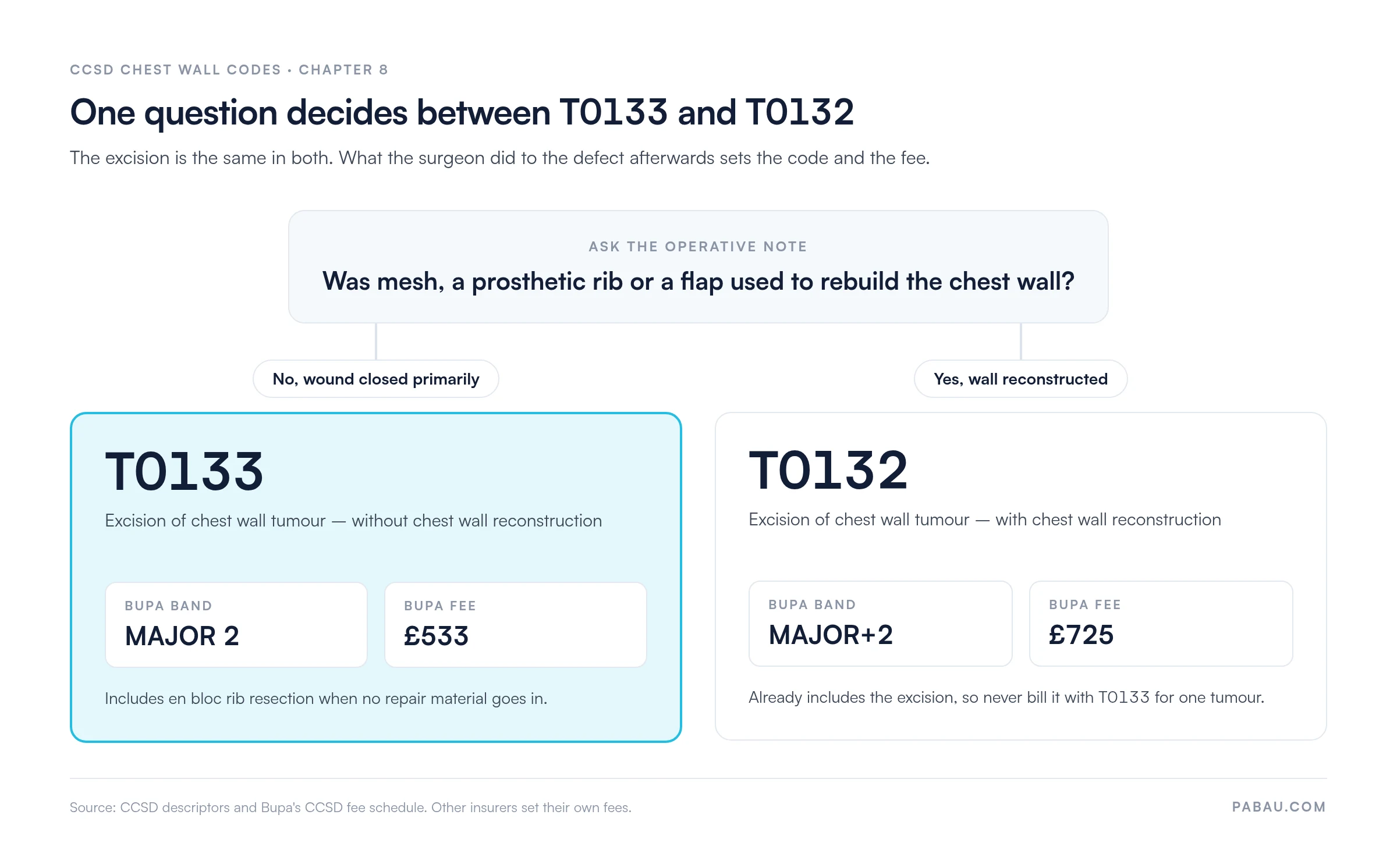
CCSD sets the codes, and each insurer sets its own fees against them. Bupa’s schedule places T0133 in band MAJOR 2, with a fee of £533. AXA Health, Aviva, Vitality and WPA publish their own schedules and benefit maximums, so the same code can pay differently.
A surgeon who charges more than the insurer pays leaves the patient with a shortfall. Tell the patient about it in writing before the operation. When comparing UK medical billing software, check that it holds each insurer’s fee against the CCSD code.
Check the T0133 fee in each insurer’s schedule whenever it is republished. Bupa’s £533 is not another insurer’s figure, so record the shortfall conversation before you charge above an insurer’s rate.
UK private medical insurers expect pre-authorisation before a major procedure such as T0133. Requirements differ between insurers, policies and hospitals, so confirm them for each patient before you book theatre.
When you request authorisation, have the following ready:
Record the authorisation reference in the patient’s file and quote it on the invoice. If the operation changes to include reconstruction, ask the insurer to update the authorisation to T0132 before you invoice.
UK private medical insurers code diagnoses with WHO ICD-10, not the US ICD-10-CM. Every T0133 claim needs a diagnosis code that justifies the operation, at the highest specificity the record supports. The WHO ICD-10 browser holds the official definitions.
Code the diagnosis from the histopathology report, not the imaging impression, wherever both exist. A confirmed diagnosis is easier to defend at audit than a provisional “uncertain behaviour” code.
An insurer that queries a T0133 claim will ask for the operative note. Make sure it records each of these before the invoice goes out:
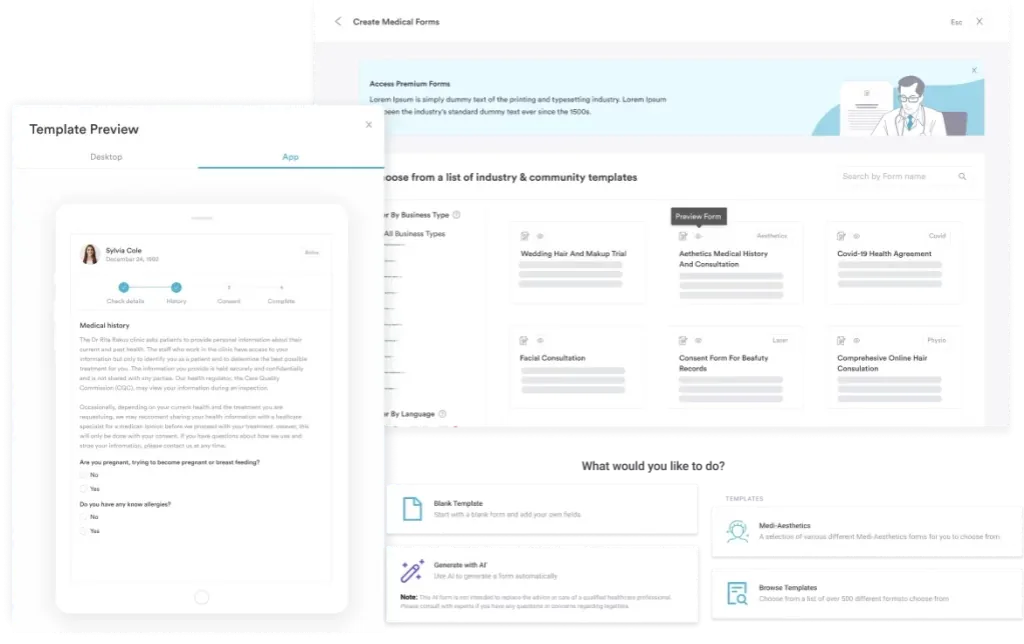
Structured digital forms make these fields mandatory, so a note cannot reach billing with the reconstruction status missing.
The anaesthetist invoices separately, against the same CCSD procedure code and the anaesthetist fee in each insurer’s schedule. Both invoices should carry the same date, patient details and authorisation reference, so the insurer can match them.
When T0133 is one of several procedures in the same operation, each insurer applies its own multiple-procedure rules. The CCSD technical guide sets out how codes are built and which combinations are unacceptable. Check the insurer’s own policy before you add a second code.
Sound medical billing compliance habits, such as a short pre-submission check, catch most of these before the insurer does.
Private thoracic and surgical practices billing T0133 need the note, the authorisation and the invoice to agree. Pabau keeps all three in one patient record.
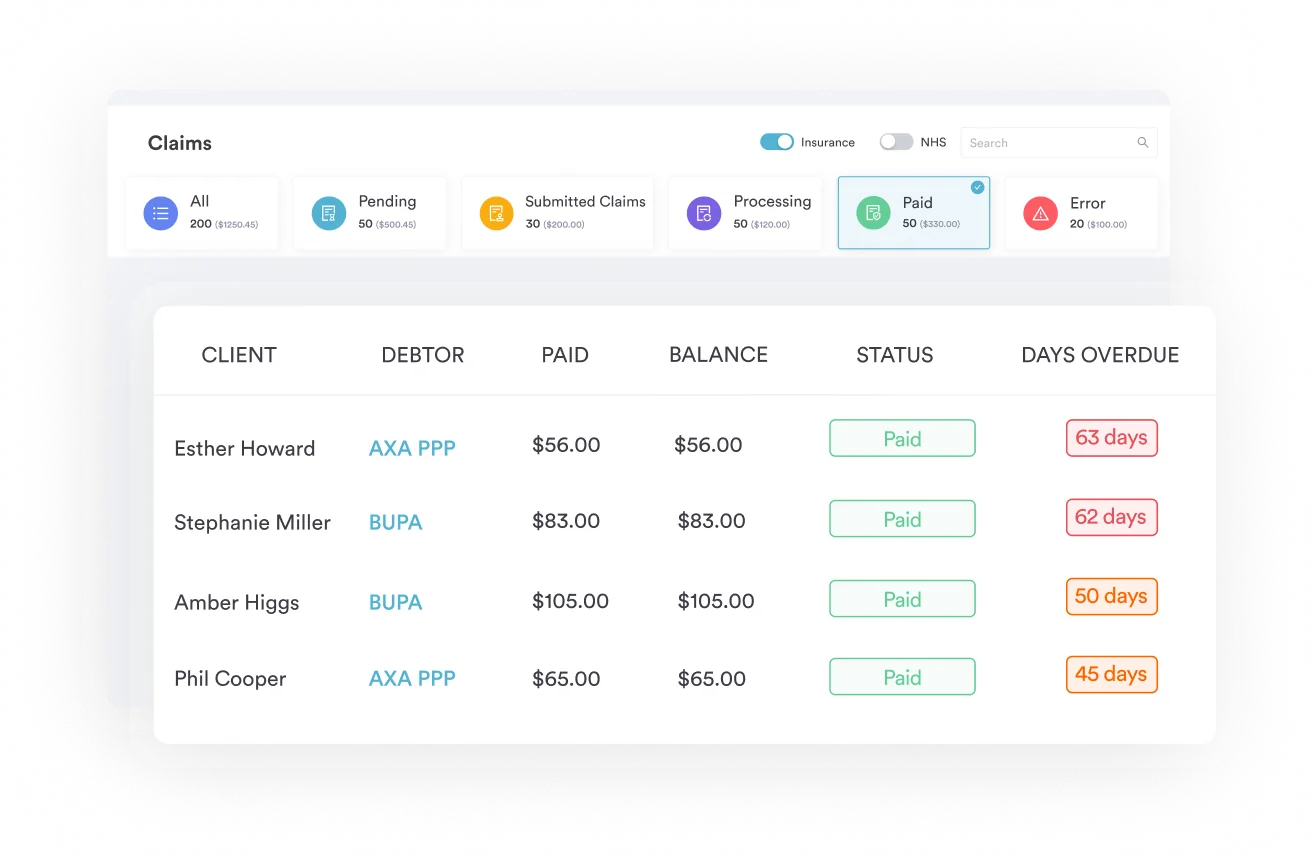
With Pabau’s claims management software, your team submits CCSD-coded claims through Healthcode and tracks each one to payment. Automated workflows remind the team when surgery is near and no authorisation reference is recorded.

Pabau helps UK private practices keep operative notes, authorisation references and ICD-10 codes together, then submits CCSD-coded claims through Healthcode.

T0133 pays for removing a chest wall tumour and closing the wound, and nothing more. The moment mesh, a prosthetic rib or a flap goes in, the code is T0132.
So the whole claim rests on one line in the operative note: whether the wall was reconstructed. Write it plainly, match the authorisation to it, and check the insurer’s own fee. Book a demo to see how Pabau sends CCSD claims through Healthcode with the note beside each one.

Choosing billing software for a UK practice? The best medical billing software in the UK compares the options for insurer claims.
CCSD code T0133 covers excision of a chest wall tumour without chest wall reconstruction. It is part of the UK private healthcare coding schedule maintained by the CCSD Group. It applies when the wound is closed without mesh, a prosthetic rib or a flap.
T0133 is excision only. T0132 is excision of a chest wall tumour with chest wall reconstruction in the same operation. T0132 already includes the excision, so the two are not billed together for the same tumour.
Bupa’s schedule places T0133 in band MAJOR 2 with a fee of £533. T0132 sits in MAJOR+2 at £725. Other insurers, such as AXA Health, Aviva and Vitality, publish their own fees.
UK insurers use WHO ICD-10. Common pairings are C41.3 for a malignant tumour of the ribs or sternum and C49.3 for a thoracic soft tissue sarcoma. A secondary deposit takes C79.8. Benign tumours take D16.7 or D21.3. Code from the histology report where it exists.
Most UK private medical insurers, including Bupa, AXA Health, Aviva and Vitality, expect pre-authorisation before chest wall surgery. Confirm the rules for each patient’s policy, and record the reference before the operation.
Common reasons are missing pre-authorisation, a note that describes reconstruction, or both chest wall codes on one invoice. A diagnosis code that does not match the notes is another. Checking these before submission prevents most rejections.
The anaesthetist invoices separately, using the same CCSD procedure code and the insurer’s anaesthetist fee. Both invoices should carry the same date, patient details and authorisation reference.





