

HCPCS Code Q4185: Cellesta flowable amnion billing guide
HCPCS Code Q4185: definition and official descriptor HCPCS Code Q4185 is the Lev...

Last Updated: Nov 20, 2026
T0132 is the CCSD code for excision of chest wall tumour – with chest wall reconstruction. It covers en bloc removal of a chest wall tumour, often with one or more ribs. The defect is then repaired in the same operation.
The code sits in Chapter 8, under Chest Wall, in the CCSD schedule used by UK private medical insurers. Bupa rates it Major+ 2. When the defect is closed without mesh, implant or flap repair, T0133 applies instead.
Let Pabau's smart automation suggest the right codes, reduce claim denials, and keep your practice compliant—effortlessly.
Automate repetitive tasks and focus on what matters most—your patients.
Reduce coding errors and ensure compliance with the latest regulations.
Clean claims, fewer denials, and faster reimbursements.
Powerful insights and reporting to help your practice thrive.
HIPAA compliant SOC 2 certified GDPR-compliant Trusted by 4,000+ clinics worldwide

CCSD code T0132 covers excision of a chest wall tumour with chest wall reconstruction at the same operation, not excision alone.
It is a UK private medical insurance code. Bupa rates it Major+ 2, with a surgeon benefit limit of £725 in its February 2026 schedule.
When the defect is closed without mesh, prosthesis or flap repair, T0133 applies instead. Billing T0133 plus a separate repair code for one operation is unbundling.
Pair T0132 with a WHO ICD-10 diagnosis, usually C41.3, C49.3 or C79.5, and get the insurer’s authorisation number before surgery.
CCSD code T0132 is the UK private medical insurance code for “excision of chest wall tumour – with chest wall reconstruction”. It appears in Bupa’s schedule of procedures under Chapter 8, Chest Wall, at complexity Major+ 2. Consultants quote it on pre-authorisation requests and invoices to UK insurers.
The key word in the descriptor is “with”. T0132 is a combined code, so it applies only when the surgeon removes the tumour and repairs the defect at the same operation. If the wound is closed without a formal repair, the sister code T0133 applies. Our guide to Bupa CCSD codes explains how the wider schedule is organised.
CCSD stands for Clinical Coding and Schedule Development. The CCSD Group maintains the CCSD codes used across UK private healthcare, and its members include Bupa, AXA Health, Aviva and Vitality. WPA and other UK insurers use the same codes.
The codes are shared, but the fees are not. Each insurer sets its own complexity rating and benefit limit for every code. That is why one CCSD code can carry a different maximum fee at Bupa, AXA Health or Aviva.
T0132 sits in Chapter 8, Thorax and intra-thoracic organs, under the Chest Wall heading. That heading also holds thoracoplasty, pectus surgery and resection of rib for pleural drainage. Plication of a paralysed diaphragm, T1620, also sits under that heading. Bupa grades T0132 as Major+ 2, one band above the Major 2 rating it gives T0133.
Chest wall tumour excision with reconstruction is one of the more demanding operations in thoracic surgery. The sequence below is broadly the same whatever the tumour type.
Most T0132 cases fall into three groups. These are primary malignant tumours of bone or soft tissue, metastases to the chest wall, and selected benign or locally aggressive tumours. A benign soft tissue tumour outside the chest wall used to take code T7790, which the major insurers have since dropped. UK insurers code diagnoses in WHO ICD-10, not the US ICD-10-CM.
Check each code in the WHO ICD-10 browser before submission. A lung cancer invading the chest wall, removed with a lung resection, is not a T0132 case. That combined operation has its own code, E5480.
Choosing between the chest wall codes turns on two questions. Was the defect formally reconstructed, and was lung or pleura treated in the same operation? Two neighbours involve no tumour at all. A rib resected to drain an empyema is T0810, and a chest opened without any resection is T0320.
Ratings and fees are from Bupa’s February 2026 schedule of procedures. Bupa updates the schedule monthly, so confirm the figures on its code search for the date of treatment.
Before submitting a T0132 claim, run a three-point check on the operative note. Does it confirm reconstruction happened under the same anaesthetic? Does it name the mesh, implant or flap used? Does it record the number and level of ribs resected? If the note misses any one of them, the insurer has grounds to query the claim.
CCSD codes were built on OPCS-4, the NHS classification of interventions and procedures. Hospital records often hold the OPCS-4 codes, so the two need to describe the same operation. The nearest OPCS-4.10 codes are listed below.
The consultant’s invoice still carries the single CCSD code, T0132. The OPCS-4 codes are a cross-check that the hospital record and the claim tell the same story.
Thin operative notes are the most common reason insurers query complex surgical codes like T0132. The report must let a claims reviewer confirm that excision and reconstruction both happened in one operation. These elements belong in every T0132 note.
Structured clinical forms make it harder for one of these items to go missing. A short post-operative checklist, completed before the claim is raised, confirms each one is on the record.
UK private medical insurers expect pre-authorisation for major elective surgery such as T0132. The patient or the practice contacts the insurer with the CCSD code and receives an authorisation number. Without it, the insurer can decline the claim, however clear the clinical case.
Insurers handle urgent and emergency admissions differently, so check the policy terms and call the insurer as soon as possible. Authorisation confirms cover is in place, but the claim is still checked against the operative note and the policy.
In Bupa’s February 2026 schedule, T0132 carries complexity Major+ 2 and a surgeon benefit limit of £725. The anaesthetist’s fee is a separate benefit limit, and so are the hospital charges.
Against the neighbouring chest wall codes, T0132 sits mid-table. Its limit is well above T0133 and T0810, and well below E5480.
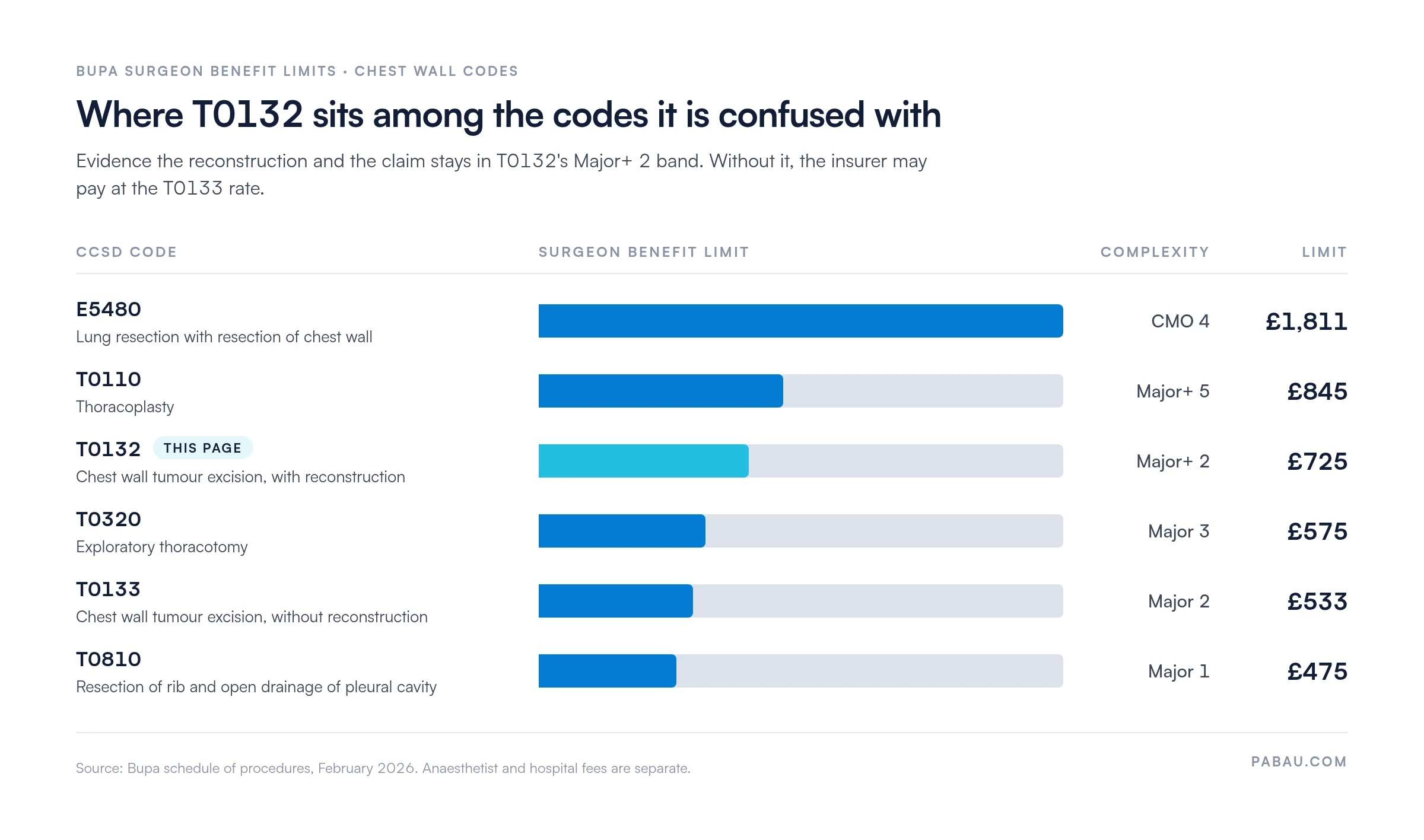
T0132 claims draw close scrutiny because the operation is complex and the code sits a band above T0133. Most queries and rejections trace back to a handful of preventable errors.
Run a monthly T0132 denial review. List every T0132 claim from the past 90 days and group each query or rejection by reason. If one reason accounts for a large share, fix the billing workflow before the next claim goes out.
Many private thoracic teams still build a T0132 claim by hand. Someone reads the dictated operative note, picks the code, then keys it into an insurer portal. Each handoff is another chance for the reconstruction detail or the authorisation number to drop out.
Pabau, the practice management software we build, keeps the operative note, the patient’s insurance details and the claim on one patient record. UK practices send private medical insurance claims through Healthcode to insurers including Bupa, AXA Health, Aviva, Vitality and WPA. Your team can also check a patient’s Bupa cover before surgery is booked.
With claims management and medical records in one system, the code on the claim comes from the note that supports it. The reconstruction detail and the authorisation number travel with the claim instead of being re-keyed.

Pabau keeps operative notes, insurer authorisations and CCSD claims on one patient record, and sends claims through Healthcode to UK private insurers. See how it works for thoracic surgical teams.

A T0132 claim rests on one detail: proof that the chest wall was reconstructed in the same operation. A note that names the ribs, the defect and the mesh or flap supports the combined code. A note that only says “chest wall tumour excised” invites the insurer to pay at the T0133 rate.
So settle the code before theatre, not after. Put the planned reconstruction on the authorisation request, then check the note against it before the invoice goes out. That costs a few minutes per case, set against a query or a recovery request months later.
Book a demo to see how Pabau keeps operative notes, authorisations and CCSD claims together for UK private surgical teams.

Reporting a large flap outside chest wall surgery? CCSD code S1740 covers a large myocutaneous flap of 9 cm² or more, including closure of the donor site.
Comparing T0132 with other Bupa benefit limits? Bupa’s procedure codes and fee schedule explains how each code maps to a maximum reimbursable amount, and what triggers a shortfall.
Billing other open thoracic procedures? CCSD code E5532 covers thoracotomy with lung biopsy, from documentation to insurer pre-authorisation.
Choosing software for UK insurer claims? The best medical billing software in the UK compares tools that handle CCSD coding and insurer submissions.
CCSD code T0132 covers excision of a chest wall tumour with chest wall reconstruction at the same operation. It includes en bloc removal of the tumour, usually with involved ribs and soft tissue. It also includes repair of the defect with mesh, a prosthetic implant or a myocutaneous flap.
Both codes cover excision of a chest wall tumour. T0132 applies when the defect is formally reconstructed in the same operation. T0133 applies when it is closed without reconstruction. Bupa rates T0132 as Major+ 2 and T0133 as Major 2.
UK insurers use WHO ICD-10. Common pairings are C41.3 for a primary bone tumour of the ribs or sternum, and C49.3 for a soft tissue sarcoma of the thorax. C79.5 covers a metastasis to bone, with the primary site coded as well.
Yes. UK private medical insurers expect pre-authorisation for major elective surgery such as T0132. The request usually includes histology, imaging, the MDT outcome and the planned reconstruction. Quote the authorisation number on the invoice.
In Bupa’s February 2026 schedule, T0132 carries complexity Major+ 2 and a surgeon benefit limit of £725. Anaesthetist and hospital fees are separate. Bupa updates its schedule monthly, so check its code search for the date of treatment.
The usual reasons are a missing authorisation number, a note that does not evidence the reconstruction, and unbundling. A WHO ICD-10 code that does not support the operation also causes queries. A pre-submission check of the note and the authorisation prevents most of them.





